CategoriesBlog

Buying a House in Brampton: Your Complete 2026 Guide

The prospect of buying a house in Brampton is an exciting milestone, yet it often comes with a formidable set of challenges. In the fast-paced Greater Toronto Area market, it’s easy to feel overwhelmed by critical decisions: Which neighbourhood truly fits your family’s needs and budget? What are the total costs beyond the list price? How do you find an expert agent you can trust implicitly? These questions can create uncertainty at a time when you need absolute confidence.

This is where strategic preparation meets expert guidance. Our complete 2026 guide is engineered to be your definitive roadmap, transforming complexity into clarity. We will walk you through every stage of the process-from performing a detailed market analysis and securing financing to identifying the perfect community and negotiating with precision. Prepare to navigate the Brampton real estate market not with apprehension, but with the assurance that you are making a sound, successful, and strategic investment in your future.

Key Takeaways

  • Understand the current Brampton real estate market trends and key metrics to position yourself for a successful and strategic purchase in 2025.
  • Our guide simplifies the complex journey of buying a house in Brampton into a clear, 7-step action plan, from financial preparation to closing day.
  • Discover insights into Brampton’s most desirable neighbourhoods to identify the community that best aligns with your lifestyle and investment objectives.
  • Look beyond the purchase price with a comprehensive breakdown of all associated costs, including land transfer tax and legal fees, to budget with complete accuracy.

Why Buy a House in Brampton? A City of Opportunity

As one of the fastest-growing and most dynamic cities in the Greater Toronto Area, Brampton presents a strategic opportunity for first-time homebuyers. The decision of buying a house in Brampton is an investment in a community defined by its unique blend of cultural diversity, robust economic growth, and a family-oriented lifestyle. It offers a compelling alternative to the higher costs of downtown Toronto, providing more space and value without sacrificing access to urban amenities. To learn more about the city of Brampton and its foundational history, this resource provides excellent context for your homebuying journey.

Economic Landscape and Job Market

Brampton boasts a powerful and diverse economic engine, anchored by key industries such as advanced manufacturing, logistics, information technology, and food and beverage processing. It is home to the corporate headquarters of major national companies, providing a stable and expanding local job market. Furthermore, its prime location makes it an ideal hub for professionals commuting across the GTA, ensuring career opportunities are always within reach.

Lifestyle and Community

Beyond its economic advantages, Brampton delivers an exceptional quality of life. The city is rich with green spaces and recreational facilities, from the historic charm of Gage Park to the expansive natural landscapes of Heart Lake Conservation Area. Residents enjoy a vibrant arts scene, a world-class culinary landscape reflecting its multicultural population, and a strong sense of community found within its distinct and welcoming neighbourhoods.

Connectivity is a cornerstone of Brampton’s value proposition. With seamless access to major arteries like Highways 410, 407, and 401, as well as extensive GO Transit services, the entire region is easily accessible. This unparalleled connectivity, combined with a more attainable real estate market, makes buying a house in Brampton an intelligent investment in both your financial portfolio and your future lifestyle.

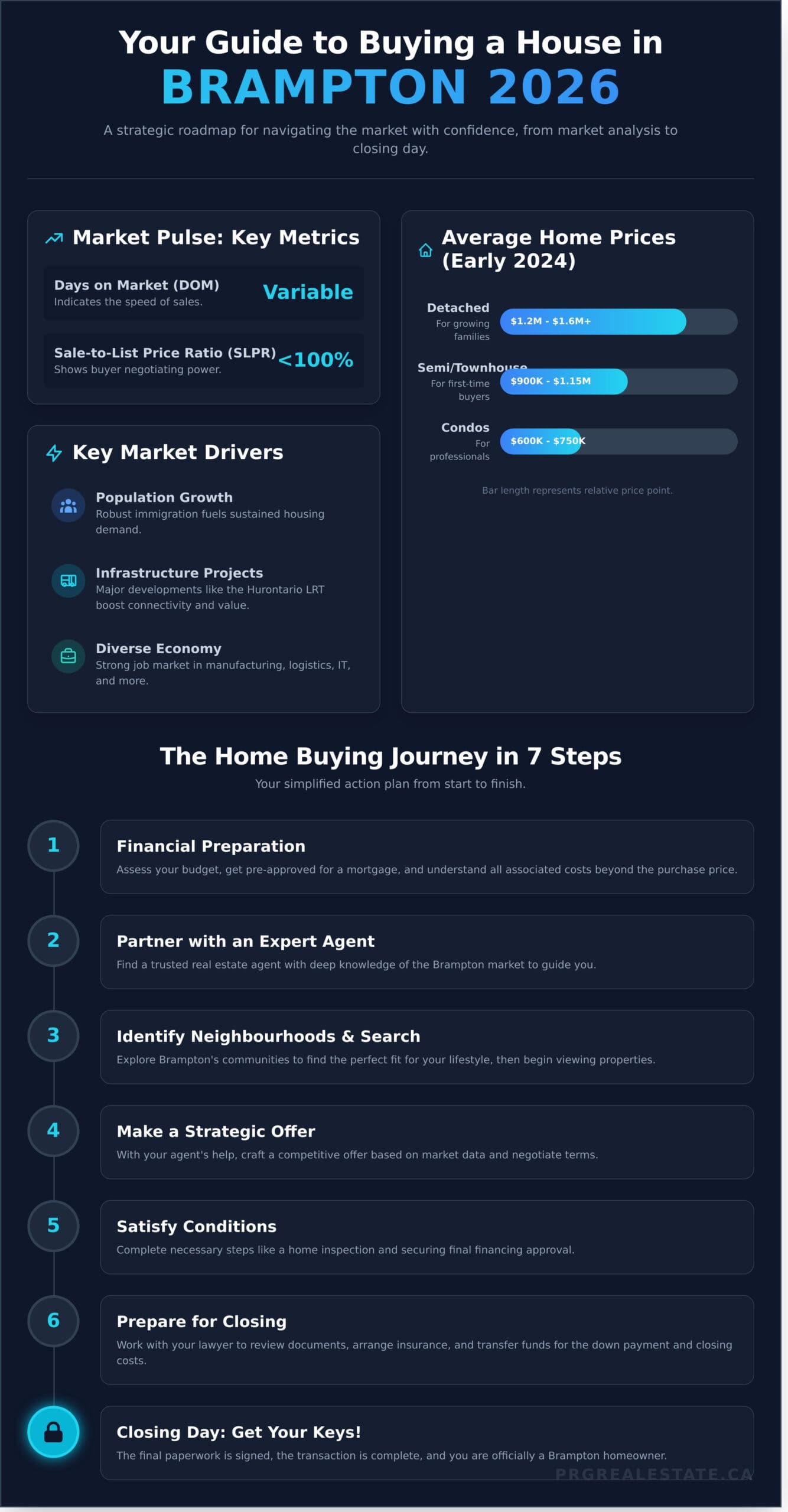
Successfully buying a house in Brampton requires a strategic understanding of its dynamic market. Currently, the market is navigating a period of adjustment, influenced by broader economic factors. Key metrics provide a clear picture: the average Days on Market (DOM) indicates the speed of sales, while the Sale-to-List Price Ratio (SLPR) reveals how close homes are selling to their asking price. A high SLPR often signals a competitive seller’s market, whereas a ratio below 100% can indicate more negotiating power for buyers. Analyzing these trends is the first step to positioning yourself for success.

Average Home Prices by Property Type

Brampton offers a diverse range of housing options, each with distinct price points. Understanding these categories is essential for aligning your budget with your goals. Below is a snapshot of typical price ranges as of early 2024.

.price-table {
width: 100%;
border-collapse: collapse;
margin: 1em 0;
}
.price-table th, .price-table td {
border: 1px solid #ddd;
padding: 8px;
text-align: left;
}
.price-table th {
background-color: #f2f2f2;
font-weight: bold;
}

Property Type Average Price Range (CAD) Ideal For
Detached Homes C$1,200,000 – C$1,600,000+ Growing families seeking space and privacy.
Semi-Detached & Townhouses C$900,000 – C$1,150,000 First-time buyers and families wanting a balance of space and value.
Condominiums C$600,000 – C$750,000 Young professionals and downsizers prioritizing lifestyle and amenities.

Key Market Drivers in Brampton

Several powerful forces shape property values in Brampton. The city’s continuous population growth, largely fueled by robust immigration, creates sustained housing demand. You can explore Brampton’s latest population and housing data to see these demographic trends firsthand. Furthermore, major infrastructure projects like the Hurontario LRT extension are enhancing connectivity and boosting property values along its corridor. Finally, the national interest rate environment directly impacts mortgage affordability, influencing buyer purchasing power and overall market activity.

Navigating Bidding Wars and Offers

In high-demand neighbourhoods, you may encounter multiple-offer situations, or “bidding wars.” This is where strategic execution becomes critical. A competitive offer is not just about the highest price; it involves strong financing, a significant deposit, and favourable conditions, such as a flexible closing date. Overpaying is a significant risk when emotions run high. This is where the expertise of an elite real estate agent is invaluable. A top agent provides data-driven pricing advice, expertly structures your offer, and navigates negotiations to secure the property on optimal terms. When you are serious about buying a house in Brampton, professional representation is non-negotiable. Get a professional market analysis from our experts.

The Home Buying Journey in Brampton: A 7-Step Process

Navigating the path to homeownership requires a strategic, step-by-step approach. To ensure a successful transaction, our experts have outlined the critical framework every first-time homebuyer should follow. This proven process demystifies the journey and positions you for a seamless and confident purchase.

Step 1-3: Financial Preparation and Finding an Agent

Your journey begins with financial diligence. First, secure a mortgage pre-approval from a lender to define your exact purchasing power. Next, calculate your down payment (a minimum of 5% for homes under C$500,000 in Canada) and budget for closing costs, which typically range from 1.5% to 4% of the purchase price to cover legal fees and the Land Transfer Tax. Finally, partner with a top Brampton real estate agent whose market expertise is indispensable for navigating local complexities.

Step 4-5: The Property Search and Making an Offer

With your finances in order, the search begins. Define your criteria, from property type to neighbourhood amenities. Consider long-term value by researching proximity to transit and understanding Brampton’s key economic sectors, which drive local employment and property demand. Once you identify a property, your agent will help you submit a strategic offer using an Agreement of Purchase and Sale (APS). This legally binding document outlines the price, closing date, and any conditions of your offer.

Step 6-7: Closing the Deal

After your offer is accepted, you must fulfill the conditions. This typically involves securing final mortgage approval and conducting a professional home inspection to assess the property’s structural integrity. Your real estate lawyer then manages the final stage, conducting a title search and preparing all legal documents. On closing day, your lawyer finalizes the transfer of funds and ownership. Once the transaction is registered, you will receive the keys to your new home. Following this structured process is fundamental to successfully buying a house in Brampton and securing a valuable asset for your future.

Exploring Brampton’s Best Neighbourhoods for Homebuyers

A critical component of any successful real estate strategy is location. Brampton offers a diverse portfolio of neighbourhoods, each with a unique character and investment profile. Making an informed choice is fundamental when buying a house in Brampton, ensuring your property aligns perfectly with your lifestyle and long-term financial goals. Our expert analysis simplifies this complex decision by segmenting the city into key residential archetypes.

For Growing Families: Heart Lake & Springdale

These northern communities are premier destinations for growing families seeking a blend of nature and suburban convenience. They offer unparalleled access to green spaces like the Heart Lake Conservation Area and White Spruce Park, alongside state-of-the-art facilities such as the Cassie Campbell Community Centre. The housing stock is dominated by spacious detached and semi-detached homes on family-friendly streets, supported by a network of highly-rated public and Catholic schools.

For Young Professionals & Commuters: Downtown & Bramalea

Engineered for connectivity and a dynamic lifestyle, these central hubs are ideal for professionals and commuters. With streamlined access to the GTA via the Brampton and Bramalea GO Stations, the location provides a significant strategic advantage. These neighbourhoods offer a mix of modern condos and townhouses, with key amenities often just steps away:

  • Vibrant entertainment at the Rose Theatre and Garden Square.
  • Major shopping hubs like Bramalea City Centre.
  • Excellent transit links including GO Transit and Züm bus rapid transit.

This combination of walkability and convenience makes it a top choice for those with an active, urban-centric focus.

For Luxury & Prestige: Castlemore & Credit Valley

For discerning buyers seeking luxury and prestige, Castlemore in the east and Credit Valley in the west represent the pinnacle of Brampton real estate. These exclusive enclaves are defined by their large, executive-style homes on expansive, manicured lots. Residents enjoy proximity to premium amenities, including prestigious golf courses like Lionhead Golf & Conference Centre and upscale retail. While commanding a higher price point, properties here represent a powerful and strategic investment in the city’s most sought-after postal codes.

Financing Your Purchase: Understanding the Full Cost

The listed price of a home is merely the starting point of your investment. A strategic financial plan accounts for every associated expense, ensuring a smooth and successful transaction. When you are buying a house in Brampton, understanding the complete financial picture is the most critical step toward making a confident and sound decision. This transparency builds the foundation for a successful purchase.

The Upfront Costs: Before You Own the Home

These are the initial cash outlays required to secure your property. Key expenses include:

  • Down Payment: The minimum is 5% on the first C$500,000 of the purchase price, and 10% on the portion from C$500,000 to C$999,999. A down payment under 20% requires CMHC mortgage default insurance.
  • Home Inspection Fee: An essential due diligence step. Expect to pay between C$400 and C$600 for a professional inspector to identify any potential issues with the property before you commit.
  • Deposit: Submitted with your offer, this payment (typically 5% of the purchase price) demonstrates your commitment and becomes part of your down payment at closing.

Closing Costs: The Final Financial Step

Paid on the closing day, these costs typically range from 1.5% to 4% of the home’s final price.

  • Land Transfer Tax (LTT): A mandatory provincial tax. Fortunately, Brampton does not have an additional municipal LTT, offering a significant saving compared to Toronto. You can calculate your estimated LTT using this online tool.
  • Legal Fees and Disbursements: Your lawyer manages the title transfer and legal paperwork. Budget approximately C$1,500 to C$2,500 for these essential services.
  • Title Insurance: A one-time premium of around C$250 to C$400 that protects you against title fraud and other ownership challenges.

Ongoing Costs of Homeownership

Your financial responsibilities continue after you take possession. A comprehensive budget for owning a home in Brampton must include:

  • Brampton Property Taxes: Calculated annually based on your home’s MPAC assessed value and the city’s tax rate.
  • Home Insurance: A mandatory requirement for any mortgaged property, protecting your investment from fire, theft, and other potential damages.
  • Utilities and Maintenance: Factor in monthly costs for hydro, gas, water, and internet. Prudent homeowners also budget 1-2% of the home’s value each year for routine maintenance and unexpected repairs.

Navigating these financial details requires expert guidance. The top realtors at PRG Real Estate Brokerage ensure our clients are fully prepared for every step of the home-buying journey.

Why Partner with PRG Real Estate for Your Brampton Home Purchase

The preceding tips provide a strong foundation for your journey, but turning knowledge into a successful purchase in a competitive market requires a strategic partner. At PRG Real Estate, we don’t just facilitate transactions; we architect successful outcomes for our clients. Our commitment is to ensure the process of buying a house in Brampton is both a sound investment and a seamless experience from start to finish.

Unmatched Local Expertise and Data

Our advantage is rooted in a granular understanding of Brampton’s diverse micro-neighbourhoods, from the family-friendly streets of Heart Lake to the growing communities in Mount Pleasant. We provide access to exclusive opportunities, including off-market properties and upcoming listings, giving you a critical edge. Every piece of advice is backed by robust market data, empowering you to make a competitive offer with confidence.

A Seamless, Professional Experience

We manage the complexities so you can focus on the excitement of finding your home. Our team brings expert negotiation skills to the table, securing the best possible price and terms on your behalf. You will be supported by a dedicated team and our curated network of trusted professionals, including:

  • Top-tier real estate lawyers
  • Thorough and reliable home inspectors
  • Strategic mortgage lenders and brokers

This integrated approach ensures every detail is handled with precision and professionalism.

Proven Results and Client Commitment

Our track record is built on a foundation of unwavering integrity and a commitment to client excellence. We measure our achievements not by sales figures, but by the long-term relationships we build-the core of our “clients for life” philosophy. We are dedicated to ensuring your first home purchase is a rewarding milestone that sets the stage for future prosperity. The journey to buying a house in Brampton is significant; ensure it’s guided by unparalleled expertise. Partner with Brampton’s top real estate experts today.

Secure Your Brampton Home with Confidence

As we’ve detailed, Brampton presents a remarkable opportunity for homebuyers, from its diverse neighbourhoods to its dynamic economic growth. Successfully navigating the market requires a strategic approach, a clear understanding of the buying process, and deep local knowledge. The journey of buying a house in Brampton is a significant investment in your future, and the right partner can make all the difference in achieving an exceptional outcome.

To ensure your purchase is both seamless and successful, align yourself with proven industry leaders. PRG Real Estate, led by top-performing realtor Harsh Pabla, brings a reputation built on trust, integrity, and exceptional results. Our team’s comprehensive expertise across both residential and commercial real estate ensures you receive strategic advice tailored to your goals. Let our commitment to excellence guide you home.

Start your Brampton home search with an expert by your side. Contact PRG Real Estate today.

Frequently Asked Questions About Buying a Home in Brampton

Is Brampton a good place to invest in real estate?

Brampton represents a strategic real estate investment due to its significant growth, diverse economy, and excellent connectivity to the Greater Toronto Area. Its continuous development in infrastructure, including transit and community amenities, positions it for strong long-term appreciation. For both families seeking a community and investors looking for robust returns, Brampton’s market offers compelling opportunities. Partnering with an expert realtor is key to capitalizing on this potential and securing a valuable asset for your portfolio.

What is the average down payment needed for a house in Brampton?

In Canada, the minimum down payment is tiered. For a home priced up to C$500,000, you need 5%. For the portion of the price between C$500,000 and C$999,999, you need 10%. For example, on a C$900,000 home, the minimum down payment would be C$65,000 (5% of C$500k + 10% of C$400k). Homes priced at C$1 million or more require a minimum 20% down payment. Our team provides strategic financial guidance to navigate these requirements effectively.

How much is the Land Transfer Tax in Brampton for a first-time homebuyer?

First-time homebuyers in Brampton are only subject to the Ontario Land Transfer Tax (LTT), as Brampton does not have a municipal LTT. Eligible first-time buyers can receive a provincial rebate of up to C$4,000, which can significantly reduce or even eliminate this closing cost. This rebate effectively makes properties valued up to C$368,333 tax-free. Calculating this tax is a critical step in budgeting, and our experts ensure you maximize all available credits and rebates.

What are the best school districts in Brampton for families?

Brampton offers excellent educational opportunities through the Peel District School Board and Dufferin-Peel Catholic District School Board. Neighbourhoods such as Castlemore, Springdale, and Heart Lake are highly sought-after for their top-rated schools, including Turner Fenton Secondary School and St. Roch Catholic Secondary School. We provide clients with detailed analyses of school rankings and catchment areas to ensure their new home meets their family’s academic priorities, a key factor in any strategic real estate decision.

How long does the home buying process typically take in Brampton?

The timeline for buying a house in Brampton typically ranges from 30 to 90 days, from the initial search to the closing date. After securing mortgage pre-approval, the property search can vary. Once an offer is accepted, the conditional period for financing and inspection is usually 5-10 business days. The standard closing period is then 30 to 60 days. An experienced realtor can streamline this process, ensuring all deadlines are met efficiently for a seamless transaction.

What should I look for during a home inspection?

A professional home inspection is a critical risk-management step. The inspector should provide a detailed assessment of the home’s core systems: the roof, foundation, electrical, plumbing, and HVAC. Pay close attention to any signs of water damage, the age of major components like the furnace and roof, and the condition of windows and insulation. This expert evaluation identifies potentially costly deficiencies, providing you with the leverage to negotiate or the confidence to proceed with your investment.

Can I buy a house in Brampton if I am new to Canada?

Absolutely. Newcomers to Canada, including Permanent Residents and individuals on specific work permits, are eligible for buying a house in Brampton. Lenders have specialized programs for new Canadians, though requirements may include a larger down payment and verification of foreign credit history and employment. It is crucial to work with a realtor and mortgage broker who are experienced with newcomer programs to ensure a smooth and successful purchase process, navigating all federal and provincial regulations with confidence.

CategoriesBlog

Industrial Property for Lease in Vaughan: A Tenant’s Guide

Securing the right location is a critical strategic decision for any successful enterprise. Yet, navigating Vaughan’s dynamic and competitive commercial landscape can be a formidable challenge. The search for the ideal industrial property for lease in Vaughan is often complicated by opaque market rates, confusing lease terminology like TMI, and the immense difficulty of matching specific operational needs-from ceiling heights to loading dock configurations-with available inventory. The wrong choice can lead to costly inefficiencies and directly impact your company’s growth trajectory.

This is where professional insight and strategic planning become indispensable. Our comprehensive tenant’s guide is engineered to provide you with the clarity and confidence required to master the leasing process. We will break down everything you need to know, from evaluating Vaughan’s distinct industrial zones to negotiating favorable lease terms that protect your interests. Our objective is to empower you to find a property that optimizes your operations, secure a successful agreement, and ensure a seamless transition, positioning your business for sustained success in this thriving economic hub.

Key Takeaways

  • Leverage Vaughan’s strategic location and superior access to major GTA transportation corridors to optimize your logistics and supply chain.
  • Successfully identify the right industrial property for lease in Vaughan by understanding the key differences between warehousing, manufacturing, and flex spaces.
  • Confidently navigate the leasing process by understanding essential financial terms and critical legal clauses that protect your business interests.
  • Gain a significant competitive advantage by partnering with an expert commercial realtor who provides strategic advice and advocates for your best interests.

Why Vaughan is a Premier Hub for Industrial Businesses

Vaughan’s position as a dominant force in the Greater Toronto Area’s industrial sector is no accident. It is the result of strategic planning, exceptional infrastructure, and a pro-business environment. For companies seeking a competitive edge, the City of Vaughan offers a powerful combination of location and resources, making it a top-tier destination for logistics, manufacturing, and distribution operations.

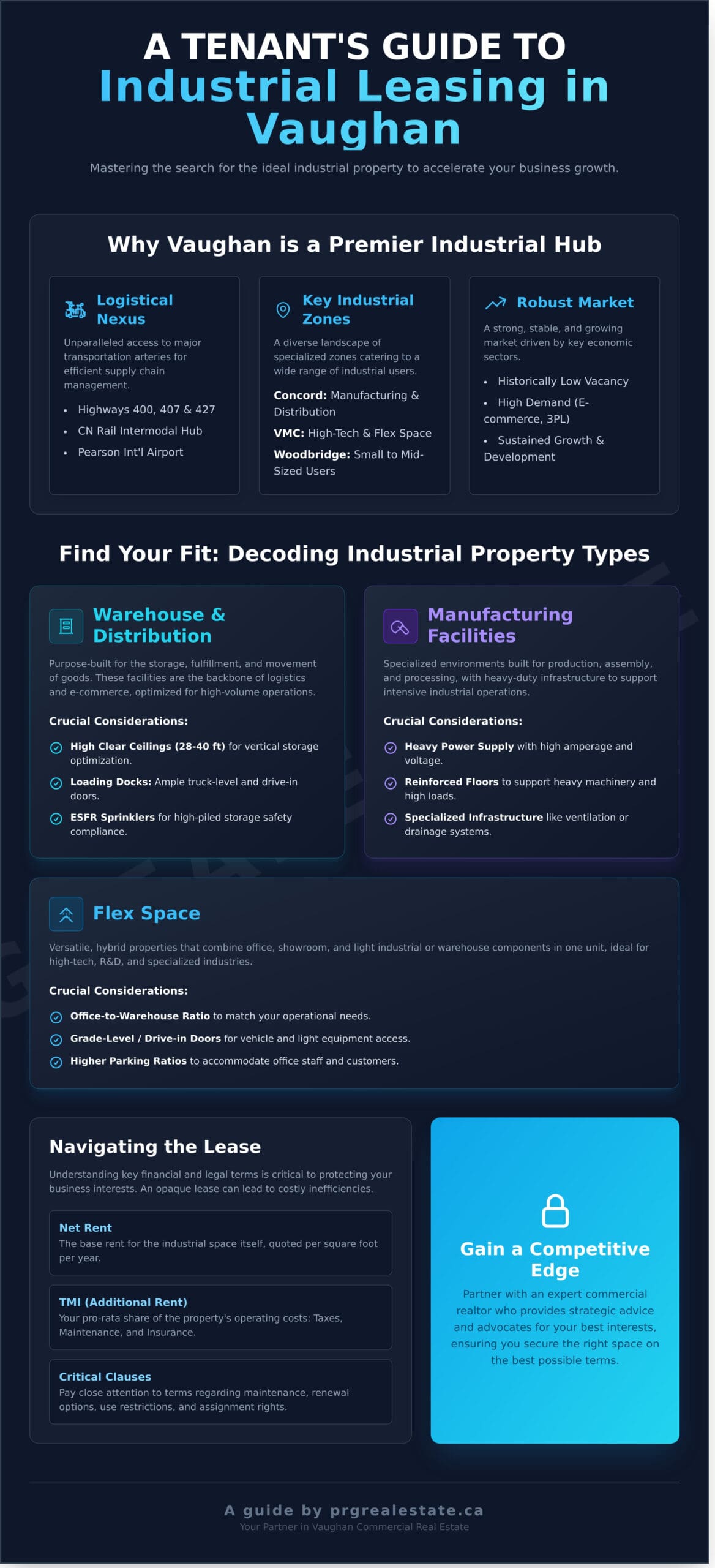
The city’s primary advantage lies in its unparalleled logistical connectivity. Businesses located here benefit from direct access to major transportation arteries that are critical for efficient supply chain management. This strategic network includes:

  • Major Highways: Immediate access to Highways 400, 407, and 427, providing seamless travel across the GTA and into major North American markets.
  • Rail and Air Access: Proximity to the CN Rail Yard in Vaughan and Pearson International Airport, Canada’s largest cargo hub, facilitates national and international distribution.

This superior infrastructure is complemented by a robust and skilled labour force, supporting a diverse range of industries. Vaughan’s thriving business community and stable economic foundation provide the security and confidence that businesses need to invest and grow, making the search for an industrial property for lease Vaughan a strategic move for long-term success. For expert guidance in navigating this premier market, PRG Real Estate Brokerage stands ready to assist your business.

Key Industrial Parks and Zones in Vaughan

Vaughan’s industrial landscape is organized into several key zones, each offering unique advantages. Concord remains the city’s largest and most established industrial hub, ideal for manufacturing and large-scale distribution. The emerging Vaughan Metropolitan Centre (VMC) offers modern flex spaces suitable for high-tech and specialized industries. Meanwhile, Woodbridge provides a diverse mix of property types, catering to a wide range of small to mid-sized industrial users with its established community and amenities.

Current Market Trends for Vaughan Industrial Real Estate

The market for industrial properties in Vaughan remains exceptionally strong, characterized by historically low vacancy rates and consistent absorption. This high demand is driven by the explosive growth of e-commerce, third-party logistics (3PL), and advanced manufacturing sectors. Consequently, average net rental rates per square foot reflect the area’s premium status. The future outlook is positive, with new developments underway to meet sustained demand for high-quality industrial space.

Decoding Types of Industrial Properties for Lease in Vaughan

Selecting the right type of industrial property for lease in Vaughan is a critical strategic decision that directly impacts your operational efficiency and potential for growth. The city’s robust industrial landscape offers a diverse range of facilities, each designed for specific business functions. Understanding these classifications is the first step toward securing a space that not only meets your current needs but also supports your future ambitions. Aligning the property type with your business model ensures you invest in functionality, not just square footage.

Warehouse and Distribution Centers

These facilities are the backbone of logistics and e-commerce, purpose-built for the storage and movement of goods. They are characterized by vast, open floor plates, significant vertical space, and seamless access for transport. Businesses focused on supply chain management, fulfillment, and bulk inventory will find these properties optimal for their operations.

  • Key Features: High clear ceilings (often 28-40 feet), multiple truck-level and drive-in loading docks, and large shipping aprons for easy truck maneuverability.
  • Crucial Considerations: Look for modern ESFR (Early Suppression, Fast Response) sprinkler systems for high-piled storage, ample trailer parking, and strategic proximity to major transportation routes like Highways 400, 407, and 427.

Manufacturing Facilities

Designed for production, assembly, and processing, manufacturing facilities are specialized environments built to handle demanding operational requirements. These properties provide the heavy-duty infrastructure necessary for intensive industrial processes, from metal fabrication to food production. Verifying that a facility’s infrastructure can support your specific machinery and output is paramount.

  • Key Features: Heavy power supply (high amperage and voltage), reinforced concrete floors to support heavy machinery, and specialized ventilation or drainage systems.
  • Crucial Considerations: Confirm the exact power capacity (Amps/Volts), ensure zoning bylaws permit your specific use by consulting resources like the Vaughan Economic Development office, and assess the adequacy of all utility services.

Flex and R&D Spaces

Flex spaces offer a versatile hybrid of professional office or showroom areas combined with light industrial or warehouse components. This model is ideal for businesses that require a polished, client-facing presence alongside research, development, light assembly, or local distribution. Finding an industrial property for lease in Vaughan with this blend allows you to consolidate operations under one roof.

  • Key Features: A significant office-to-warehouse ratio (e.g., 40% office, 60% warehouse), modern architectural aesthetics, and ample parking for both employees and visitors.
  • Crucial Considerations: Evaluate the layout to ensure it supports both your administrative and operational workflows, check for high-speed data connectivity, and consider the property’s accessibility and visibility for clients.

The Industrial Leasing Process: A Step-by-Step Guide for Tenants

Navigating the commercial leasing market can be a complex undertaking for any business. At PRG Real Estate Brokerage, we simplify this journey with a structured, professional approach that covers every stage, from initial planning to signing the final lease agreement. This meticulous process ensures no critical details are overlooked, empowering your business to secure a property that aligns perfectly with your operational and strategic goals.

Step 1: Defining Your Space and Operational Requirements

The foundation of a successful property search is a clear understanding of your needs. Before viewing any listings, it is critical to define your core parameters:

  • Square Footage & Layout: Calculate the total space required for inventory, equipment, and office areas.
  • Technical Specifications: Determine non-negotiable features like ceiling height, power capacity (amps/volts), and the number and type of loading doors (drive-in vs. truck-level).
  • Budget: Establish a realistic budget that includes base rent plus Total Maintenance and Insurance (TMI), which covers property taxes, maintenance, and building insurance.
  • Location: Define your ideal geographic search area within Vaughan based on proximity to major highways (400, 407, 427), suppliers, and your client base.

Step 2: The Property Search, Tours, and Shortlisting

With your requirements defined, the search for an industrial property for lease Vaughan begins. We leverage our extensive network to present you with both publicly listed and exclusive off-market opportunities. During site tours, we guide you on what to inspect and which questions to ask, from power capacity to truck access. By comparing potential sites against a standardized checklist, we help you strategically narrow the options down to a shortlist of the top two or three properties that best fit your business.

Step 3: Offer to Lease, Negotiation, and Due Diligence

Once you’ve selected a property, we structure a compelling Offer to Lease (OTL) designed to protect your interests. Key negotiation points often include the net rental rate, term length, rent-free periods, and the landlord’s contribution to tenant improvements. This is followed by a critical due diligence phase where we verify zoning compliance and assess the property’s condition. Finally, we ensure the formal lease agreement is thoroughly reviewed by legal counsel before you sign.

This step-by-step process transforms a potentially overwhelming task into a manageable and successful business decision. Don’t navigate the complexities of the industrial real estate market alone. Let our experts guide you through every step. Contact PRG Real Estate Brokerage today.

Securing an industrial property for lease in Vaughan involves more than just agreeing on a location and price. The commercial lease is a complex legal document where a single clause can have significant financial implications for your business. Understanding the key financial components is essential for accurate budgeting, while a thorough review of legal terms protects your operational interests. Familiarizing yourself with these details before entering negotiations is a critical step toward a successful tenancy.

Understanding Net Leases and TMI

In Vaughan’s industrial market, most leases are structured as ‘net’ leases. Unlike a ‘gross’ lease where one price covers everything, a net lease requires the tenant to pay a base rent plus a proportionate share of the property’s operating costs. This additional rent is commonly known as TMI (Taxes, Maintenance, and Insurance). These variable costs are estimated annually and reconciled at year-end. To forecast your total occupancy costs accurately, always request historical TMI data from the landlord for the past 2-3 years.

Critical Clauses to Review

Your lease agreement contains numerous clauses that define the landlord-tenant relationship. Paying close attention to the following is non-negotiable:

  • Use Clause: This clause strictly defines the business activities permitted on the premises. Ensure it is broad enough to cover all current and potential future operations.
  • Term and Renewal Options: This outlines the length of your lease and your right to renew. Securing renewal options protects your business from displacement and provides long-term stability.
  • Indemnity and Insurance: Understand your liability and the specific insurance coverage (e.g., Commercial General Liability) you are required to maintain throughout the term.
  • Workplace Safety and Compliance: Tenants are responsible for meeting provincial WSIB regulations, which includes ensuring staff are properly trained for emergencies. Securing certification through a recognized provider like Aspire First Aid Guide Training Corp is a critical step in preparing any industrial facility for safe operation.
  • Assignment and Subletting: This clause dictates your rights to transfer your lease or sublet the space if your business needs change, providing a crucial exit strategy.

Tenant Improvement (TI) Allowance Explained

A Tenant Improvement (TI) allowance is a sum of money provided by the landlord to help you customize the space for your specific needs. This allowance is a key point of negotiation and is typically quoted on a per-square-foot basis (e.g., C$15.00 per sq. ft.). It can be used for things like building offices, installing specific electrical systems, or adding a lunchroom. Clearly defining the “Landlord’s Work” (base building condition) versus the “Tenant’s Work” (your custom fit-up) is essential. Navigating these critical details with an expert ensures you secure the best possible terms for your investment. For professional guidance on your next lease, contact our team of experts.

While online listing sites provide a starting point, they only show what’s available-not what’s possible. Securing the right industrial property for lease Vaughan requires more than a simple search; it demands strategic insight, market intelligence, and expert advocacy. A dedicated commercial realtor acts as your partner, working exclusively to protect your interests and achieve the best possible outcome for your business.

A common misconception is that hiring a tenant representative is an added expense. In the Canadian commercial real estate market, the landlord typically pays the commission for both their agent and the tenant’s agent. This means you gain professional representation and expert guidance at no direct cost, making it one of the most strategic business decisions you can make.

Access to Off-Market Properties and Market Intelligence

An expert realtor provides access to exclusive opportunities, including properties that are not yet listed on the public market. We leverage real-time data on comparable lease transactions in Vaughan, giving you a critical advantage. This intelligence ensures you understand fair market value and can make decisions based on current, accurate information, not just advertised asking rates.

Expert Negotiation on Your Behalf

A skilled realtor is your professional buffer and advocate during negotiations. We have extensive experience securing favourable terms on your behalf, including:

  • Base rental rates and annual escalations
  • Tenant Improvement Allowances (TIs) to fund your build-out
  • Lease clauses regarding renewals, termination, and subletting

Our expertise helps you avoid common lease traps and hidden clauses that can negatively impact your business’s flexibility and bottom line.

Streamlining a Complex Process

The search for a new industrial facility is a time-consuming endeavour. A commercial real estate professional manages the entire process, allowing you to focus on running your business. We handle every detail, from coordinating site tours and managing communications to assisting with extensive paperwork and due diligence. Let an expert navigate the market and secure your company’s next location with precision and professionalism. Partner with Vaughan’s leading commercial real estate experts.

Secure Your Strategic Advantage in Vaughan’s Industrial Market

Securing the right industrial space in Vaughan is a critical step toward achieving your business objectives. As we’ve explored, understanding the strategic advantages of Vaughan’s location, navigating the complexities of the leasing process, and decoding critical financial terms are foundational to success. This knowledge empowers you to make informed decisions that align with your operational needs and long-term growth strategy.

However, navigating this competitive market requires more than just knowledge-it demands expert guidance. To secure the most favourable terms for an industrial property for lease Vaughan, partnering with a proven leader is essential. The top-ranked commercial real estate professionals at PRG offer unmatched expertise in the Vaughan and GTA markets. We leverage our deep industry insight and strategic negotiation skills to ensure your next lease is not just a transaction, but a competitive advantage.

Take the definitive step towards securing your company’s future in one of Canada’s most dynamic industrial hubs. Find Your Next Industrial Property in Vaughan with PRG’s Expert Team. Let our commitment to excellence drive your success.

Frequently Asked Questions

How much does it cost to lease industrial space in Vaughan per square foot?

In Vaughan, the net asking rental rate for industrial space typically ranges from C$18.00 to C$25.00 per square foot, per year. This rate is influenced by factors such as the property’s location, size, clear height, and shipping door configuration. It is important to note that this is the base rent; additional costs, known as TMI, will also apply. Our expert advisors can provide a detailed cost analysis for properties that match your specific operational needs.

Who pays the commercial realtor’s commission when a tenant leases a property?

In a standard commercial lease transaction in Ontario, the landlord is responsible for paying the commission to both their listing brokerage and the tenant’s representative brokerage. This industry-standard practice allows tenants to benefit from expert, professional representation to secure favourable terms and navigate the complexities of the leasing process at no direct cost to them. It is a strategic advantage for any business seeking to lease a property.

What is a typical lease term for an industrial property in the GTA?

The typical lease term for an industrial property in the Greater Toronto Area, including Vaughan, is between five and ten years. Landlords prefer longer terms as they provide financial stability and reduce turnover costs. While shorter terms of three to five years may be negotiable, they often come with fewer landlord incentives, such as a Tenant Improvement Allowance. The ideal term depends on your business’s long-term strategic goals, which we can help you evaluate.

What is TMI and how much should I budget for it on top of my base rent?

TMI stands for Taxes, Maintenance, and Insurance. It is an additional rent amount that covers the property’s annual operating costs, which are passed through to the tenant. When budgeting for an industrial property for lease Vaughan, you should plan for TMI to be between C$5.00 and C$8.00 per square foot annually. This figure can fluctuate based on property taxes and maintenance expenses, so it is essential to verify the current rate for any property you consider.

Can I negotiate a Tenant Improvement Allowance to customize my space?

Yes, negotiating a Tenant Improvement Allowance (TIA) is a standard and crucial part of the commercial leasing process. A TIA is a financial contribution from the landlord used to customize the space for your specific business needs, such as building offices or installing specialized equipment. The amount of the TIA is highly negotiable and is often tied to the strength of your covenant and the length of the lease term you are willing to commit to.

What is the difference between industrial zoning (E, EM) in Vaughan?

Understanding zoning is critical when selecting an industrial property for lease Vaughan. Generally, E (Employment) zones permit a wide range of industrial uses, including manufacturing, warehousing, and processing. In contrast, EM (Prestige Employment) zones are often found in newer business parks and have higher aesthetic standards for architecture and landscaping. EM zones may also restrict more intensive uses, such as outdoor storage, to maintain a more professional and corporate environment.