

The document in front of you is more than just paper-it’s the foundation of your business’s future. Yet, for many entrepreneurs, it’s a daunting labyrinth of legal jargon and hidden liabilities. Signing an Ontario commercial lease agreement without expert guidance can lock you into unfavorable terms that hinder growth and profitability for years to come. The fear of making a costly mistake can be paralyzing, leaving you unsure of your rights and what terms are even open for discussion.
This is where ambiguity ends and strategic clarity begins. Our comprehensive 2026 Tenant’s Guide is engineered to move you from a position of uncertainty to one of absolute control. We will dissect every critical clause, from rent structures and repair obligations to renewal options and exit strategies, providing the expert insights needed to negotiate with confidence. By the end of this guide, you will have the knowledge to secure a fair agreement that protects your investment and fuels your business’s success.
Key Takeaways
- Uncover the true cost of your lease by mastering the difference between Base Rent and Additional Rent (TMI) to prevent unexpected financial burdens.
- Identify critical clauses within your commercial lease agreement that can either restrict or enable your business’s future growth and operational flexibility.
- Navigate the complex leasing process in the Ontario market with a clear, step-by-step roadmap designed for tenant success.
- Understand how leveraging an expert commercial realtor transforms lease negotiations from a liability into a strategic advantage for your business.
What is a Commercial Lease Agreement? The Foundation of Your Business Space
A commercial lease agreement is the cornerstone of your business’s physical presence-a legally binding contract that grants a tenant the right to use a property for business purposes in exchange for rent. Its primary function is to meticulously outline the rights and responsibilities of both the landlord (lessor) and the tenant (lessee), creating a clear framework for the professional relationship. Understanding the fundamentals of what is a lease is a critical first step for any entrepreneur.
Unlike a standard residential lease, a commercial lease is characterized by greater complexity, longer terms-often spanning five to ten years or more-and significant room for negotiation. In Ontario, these agreements are governed by the Commercial Tenancies Act (CTA), which provides a legal structure but offers less tenant protection than its residential counterpart. This distinction underscores the importance of strategic negotiation and expert legal review before signing.
Key Components of Every Commercial Lease
Every well-drafted commercial lease agreement should precisely define several critical elements to prevent future disputes. These non-negotiable components form the core of the contract:
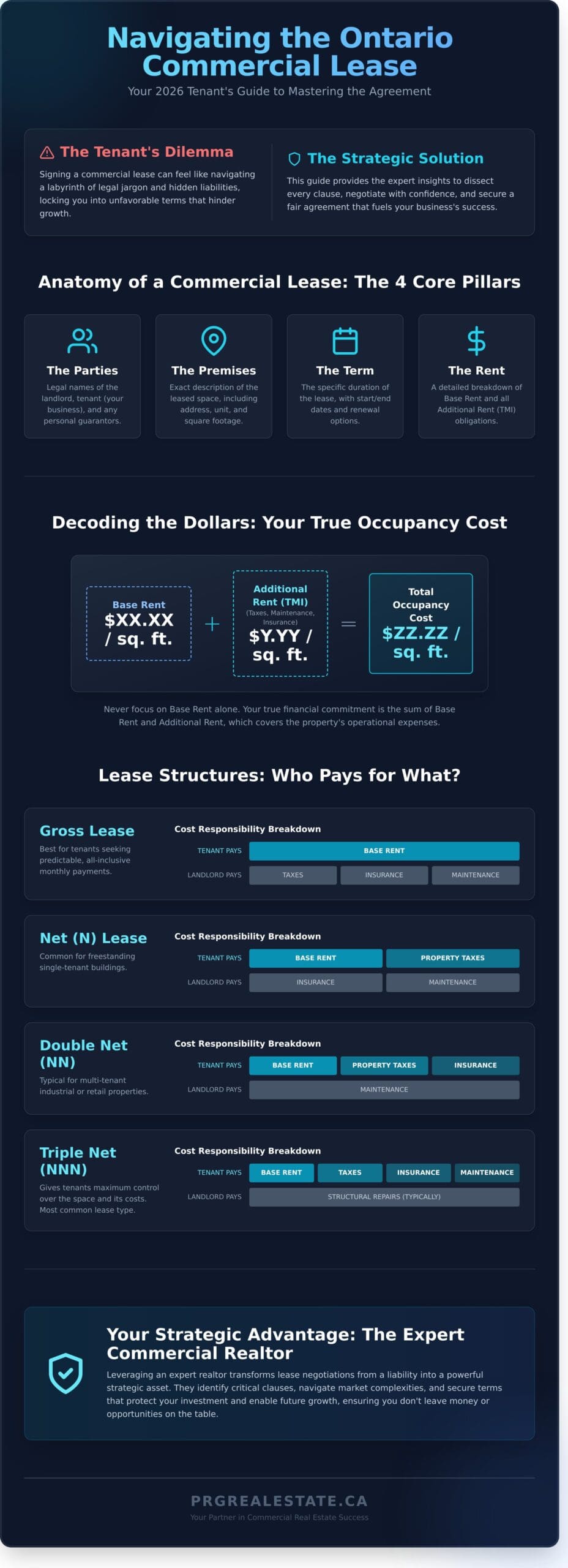
- The Parties: Clear identification of the legal names of the landlord, the tenant (your business entity), and any personal guarantors who will be financially responsible.
- The Premises: An exact description of the leased space, including the municipal address, unit number, and verified square footage, often with a floor plan attached.
- The Term: The specific duration of the lease, detailing the official start (commencement) and end (expiration) dates, along with any options to renew and the required notice periods.
- The Rent: A detailed breakdown of all financial obligations, including the Base Rent (the primary lease cost) and Additional Rent (covering property taxes, maintenance, and insurance), as well as the payment schedule.
Common Types of Commercial Properties for Lease
The type of property you lease will be dictated by your business operations. The most common categories include:
- Office Space: Designed for professional services, corporate headquarters, and administrative tasks. Leases often cover individual suites or entire floors in multi-tenant buildings.
- Retail Space: Includes storefronts, units in shopping malls, and standalone buildings intended for selling goods and services directly to consumers.
- Industrial Space: Encompasses properties used for manufacturing, warehousing, storage, and distribution. These leases often involve large, specialized facilities.
Decoding the Dollars: Key Financial Clauses That Impact Your Bottom Line
A strategic approach to a commercial lease agreement demands a focus beyond the advertised base rent. Your true total occupancy cost is a combination of this base figure and ‘Additional Rent’-a critical component covering the property’s operational expenses, often referred to as TMI (Taxes, Maintenance, and Insurance). Understanding this distinction is the first step to protecting your bottom line and ensuring your investment is sound.
Gross Lease vs. Net Leases: Who Pays for What?
The structure of your lease dictates who is responsible for operational costs. This allocation is one of the most significant financial factors in any commercial real estate transaction. While variations exist, most leases fall into one of the following categories, each suiting different business needs and risk tolerances.
| Lease Type | Tenant’s Responsibility | Best For |
|---|---|---|
| Gross Lease | Base Rent only. Landlord pays all operating costs. | Tenants seeking predictable, all-inclusive monthly payments. |
| Net (N) Lease | Base Rent + Property Taxes. | Freestanding single-tenant buildings. |
| Double Net (NN) Lease | Base Rent + Property Taxes & Insurance. | Multi-tenant industrial or retail properties. |
| Triple Net (NNN) Lease | Base Rent + Taxes, Insurance & Maintenance (TMI/CAM). | Tenants who want maximum control over their space and its costs. |
Understanding Common Area Maintenance (CAM) Charges
In multi-tenant properties, Common Area Maintenance (CAM) charges cover the costs of managing and maintaining shared spaces like lobbies, parking lots, elevators, and landscaping. These charges are calculated based on your business’s proportionate share of the total leasable area. Our expert advice is to always demand a detailed breakdown of CAM expenses and negotiate a cap on annual increases to prevent unpredictable and potentially crippling costs.
Other Critical Financial Terms to Negotiate
A comprehensive commercial lease agreement contains several other financial clauses that require expert negotiation. Securing favourable terms on these items is a hallmark of a successful deal.
- Rent Escalation Clauses: Landlords build in rent increases over the lease term. These can be fixed annual percentages (e.g., 2% per year) or tied to the Consumer Price Index (CPI). We help clients analyze which structure offers greater long-term stability.
- Security Deposit: In Ontario, security deposits for commercial leases are not regulated to the same extent as residential ones. The amount (typically one to two months’ gross rent) and conditions for its return are governed by the lease itself, not directly by Ontario’s Commercial Tenancies Act, making this a critical point of negotiation.
- Tenant Improvement Allowance (TIA): This is a sum of money provided by the landlord to help you customize the space for your business needs (a “fit-out”). Negotiating a substantial TIA can significantly reduce your upfront capital expenditure.
Beyond Rent: Critical Operational Clauses and Common Tenant Pitfalls
While rent and term length often dominate initial negotiations, the true operational viability of your business is dictated by the finer print of a commercial lease agreement. These operational clauses govern how you can use, modify, and ultimately exit your space. Overlooking this “boilerplate” language is a significant pitfall that can restrict your company’s flexibility and future growth. A strategic approach focuses on securing terms that protect your business for the long term.
Use and Exclusivity Clauses
The ‘Use’ clause defines precisely what business activities are permitted on the premises. A narrow clause, such as “for the sale of coffee and pastries,” can prevent future pivots like adding a catering service or selling merchandise. We advocate for negotiating the broadest possible use to ensure your business can evolve. Conversely, an ‘Exclusivity’ clause is a strategic asset, preventing the landlord from leasing space in the same complex to a direct competitor, thereby protecting your market share.
Repairs, Maintenance, and Alterations
Ambiguity in this section leads to costly disputes. Your lease must explicitly define who is responsible for major capital systems, including:
- Heating, Ventilation, and Air Conditioning (HVAC)
- Roof and structural components
- Plumbing and electrical systems
Similarly, the process for making alterations to the space should be clear. The ‘Surrender’ clause, which dictates the condition of the property upon your departure, can hide expensive obligations to remove all improvements and restore the space to its original shell. Understanding these maintenance responsibilities is one of the most critical tips for your commercial lease, as an unexpected C$20,000 HVAC replacement can severely impact cash flow.
Subleasing, Assignment, and Renewal Options
Your business needs are not static, and your commercial lease agreement must provide for potential changes. An ‘Assignment’ clause allows you to transfer the lease to another party, which is crucial if you sell your business. A ‘Subletting’ clause permits you to lease a portion of your space to another tenant. For both, it is imperative that the lease states the landlord’s consent “cannot be unreasonably withheld.” Finally, negotiating an ‘Option to Renew’ provides long-term security, giving you the right to extend your tenancy and protect the location you have invested in.
The Commercial Leasing Process in Ontario: A Step-by-Step Guide
Securing the right commercial space in a competitive market like Brampton and the GTA requires a strategic, systematic approach. This proven three-phase process ensures your business interests are protected at every stage, transforming a complex challenge into a successful outcome. Following this roadmap mitigates risk and positions your enterprise for long-term success.
Phase 1: Preparation and Property Search
The foundation of a successful lease is built on meticulous preparation. This initial phase is about defining your objectives and leveraging expert resources to find the ideal property.
- Step 1: Define Your Needs. Precisely determine your operational requirements, including square footage, necessary zoning, and a comprehensive budget that accounts for base rent and TMI (Taxes, Maintenance, and Insurance).
- Step 2: Engage a Commercial Realtor. Partnering with a top commercial realtor provides access to exclusive listings and critical market data. We leverage our network to identify opportunities that align perfectly with your strategic goals.
- Step 3: Tour and Shortlist Properties. We facilitate targeted property tours, allowing you to assess functionality, accessibility, and overall suitability, culminating in a shortlist of top contenders.
Phase 2: Negotiation and Documentation
Once a target property is identified, the focus shifts to securing favourable terms and formalizing the arrangement. This is where expert negotiation creates significant value.
- Step 4: Submit a Letter of Intent (LOI). We draft and submit a compelling LOI or Offer to Lease. This document outlines the core business terms-rent, term length, renewal options, and permitted use-that will form the basis of the final commercial lease agreement.
- Step 5: Negotiate Key Business Terms. Our expertise is your advantage. We advocate fiercely on your behalf to secure optimal terms on rent, tenant inducements, and other critical financial and operational clauses.
- Step 6: Receive the Formal Lease. After business terms are agreed upon, the landlord’s legal counsel will draft the comprehensive lease for review.
Phase 3: Due Diligence and Execution
The final phase is dedicated to legal scrutiny and execution. Diligence here is paramount to protecting your business from future liabilities.
- Step 7: Conduct a Professional Legal Review. A commercial real estate lawyer is essential. They will scrutinize the lease for onerous clauses, ensure compliance with Ontario’s Commercial Tenancies Act, and safeguard your legal interests.
- Step 8: Finalize and Execute the Lease. Your lawyer will negotiate final legal points with the landlord’s counsel. Upon full agreement, all parties execute the binding contract.
- Step 9: Fulfill Pre-Occupancy Conditions. Before taking possession, you must satisfy all conditions, such as providing proof of insurance and paying the required security deposit and first month’s rent.
Navigating this process with an expert team ensures a seamless transaction and a lease that empowers your business to thrive. For strategic guidance in the Brampton and GTA market, contact PRG Real Estate Brokerage.
Why You Need an Expert: The Value of a Commercial Realtor in Lease Negotiations
In a complex market, many business owners consider handling their own lease negotiations to save on costs. However, the intricacies of a commercial lease agreement-from understanding Common Area Maintenance (CAM) costs to negotiating tenant-friendly clauses-demand specialized expertise. Attempting to navigate this landscape alone can lead to costly oversights and unfavorable terms that impact your business for years. A professional commercial realtor is not a salesperson; they are a strategic advisor dedicated to protecting your interests and maximizing your investment.
Market Knowledge and Access to Off-Market Deals
An expert commercial realtor provides a decisive advantage through unparalleled market intelligence. They have access to comprehensive listing data, proprietary databases, and a network of contacts that reveal off-market opportunities you would never find on your own. This insider knowledge, including crucial insight into comparable rents and recent deals in markets like Brampton, provides the essential leverage needed to negotiate from a position of strength.
Strategic Negotiation on Your Behalf
Your realtor acts as your dedicated advocate, handling the often-contentious negotiations with landlords and their agents. They are fluent in the language of commercial real estate and understand the industry standards for critical concessions you may not know to ask for. This includes securing:
- Tenant Improvement Allowances (TIA): Funds from the landlord to help you build out the space.
- Rent-Free Periods: Months of free rent, typically at the beginning of the lease, to ease the financial burden of moving and setup.
- Favorable Clauses: Options to renew, rights of first refusal, or limits on operating expense pass-throughs.
Their expertise ensures every facet of the commercial lease agreement is optimized to benefit your business.
Partnering with PRG for Your Next Commercial Lease
At PRG Real Estate Brokerage, our team of top commercial realtors specializes in the dynamic Brampton and GTA markets. We offer unwavering integrity and a commitment to excellence, guiding you through every step of the leasing process-from initial site selection and financial analysis to the final lease signing. Our objective is to secure a lease that is not merely a liability, but a strategic asset for your business’s future success. Let our expertise ensure your next move is your best move.
Contact our commercial real estate experts to discuss your leasing needs.
Secure Your Business’s Future with a Strategic Lease
Navigating the complexities of commercial real estate in Ontario requires more than just finding a location; it demands a strategic approach. As this guide has detailed, understanding the critical financial and operational clauses within your commercial lease agreement is paramount to protecting your bottom line. The leasing process is multifaceted, and overlooking a single detail can pose significant long-term risks. This is where professional expertise transforms from a cost into your most valuable asset.
Don’t leave your company’s future to chance. As specialists in the Brampton & GTA Commercial Market, the team at PRG Real Estate provides the expert negotiation to protect your interests. We leverage our deep market knowledge and provide access to exclusive on and off-market listings to find the perfect space for your objectives. Let our commitment to excellence guide your next successful move.
Secure the right space for your business. Partner with Brampton’s top commercial realtors. The ideal location to grow your enterprise is within reach.
Frequently Asked Questions About Commercial Lease Agreements
What is the difference between a Letter of Intent (LOI) and a lease agreement?
A Letter of Intent (LOI) is a preliminary, non-binding document that outlines the proposed key terms of a deal, such as rent, term length, and permitted use. It signals serious intent and forms the basis for negotiation. The formal lease agreement, however, is the comprehensive, legally binding contract detailing every obligation and condition. It is the final, enforceable document that governs the tenancy. Securing expert guidance at both stages is critical for a successful transaction.
Can a landlord terminate a commercial lease early in Ontario?
In Ontario, a landlord’s ability to terminate a commercial lease early is strictly limited. It is typically only possible if the tenant has breached a fundamental term of the agreement, such as failing to pay rent. Some leases may also contain specific clauses allowing for early termination under certain conditions, like a demolition or redevelopment clause. Without such provisions, a landlord cannot unilaterally end the lease before its term expires, providing tenants with significant security.
How much does it cost to have a lawyer review a commercial lease?
The cost for a lawyer to review a commercial lease in Canada varies based on its complexity and length. Legal fees can range from a flat rate of approximately C$1,000 to C$2,500 for a standard review, or an hourly rate if extensive negotiations are required. This strategic investment is essential to identify potential risks, clarify obligations, and ensure the terms align with your business objectives, safeguarding your interests over the long term.
Are commercial tenants in Ontario responsible for property taxes?
Yes, in the majority of Ontario commercial leases, tenants are responsible for paying a proportionate share of property taxes. This is a standard component of “Additional Rent” in net and triple-net (TMI) leases, which are prevalent in the market. The specific terms outlined in your commercial lease agreement will dictate the exact calculation and payment structure. It is crucial to understand this financial obligation before signing, as it significantly impacts your total occupancy cost.
What happens if my business fails and I need to break the lease?
Breaking a commercial lease due to business failure presents a significant financial challenge, as your company remains liable for rent until the term expires. Strategic options include negotiating a buyout with the landlord or finding a suitable new tenant to assign the lease to or sublet the space from you, subject to the landlord’s approval. If a personal guarantee was signed, your personal assets could also be at risk to cover the outstanding obligations.
How long are typical commercial lease terms in the Greater Toronto Area?
In the dynamic Greater Toronto Area (GTA) commercial real estate market, standard lease terms typically range from five to ten years. Landlords prefer longer commitments to ensure stable occupancy and return on investment, especially after providing tenant improvement allowances. These longer terms are often structured with options to renew, providing established businesses with long-term security while allowing for future flexibility. This structure reflects the strategic planning required for success in a competitive market.
Is it possible to negotiate a shorter lease term, like one or two years?
While longer terms are standard, negotiating a shorter lease of one to two years is achievable, particularly for smaller spaces or in a tenant-favourable market. However, landlords may be less willing to offer incentives like tenant improvement allowances and may request a higher rental rate to compensate for the increased turnover risk. A skilled commercial realtor can effectively position your business to secure the flexibility you need while mitigating these potential trade-offs.
What is a personal guarantee, and should I sign one?
A personal guarantee is a provision where you, as the business owner, become personally liable for the lease obligations if your corporation defaults on its payments. This means the landlord can pursue your personal assets, such as your home or savings, to cover the debt. Signing one is a significant risk and is often required for new businesses or those with limited credit history. It is imperative to seek expert legal and real estate advice to understand the full implications before committing.