

Commercial Real Estate Agent Brampton: Strategic Guidance for 2026 Investors
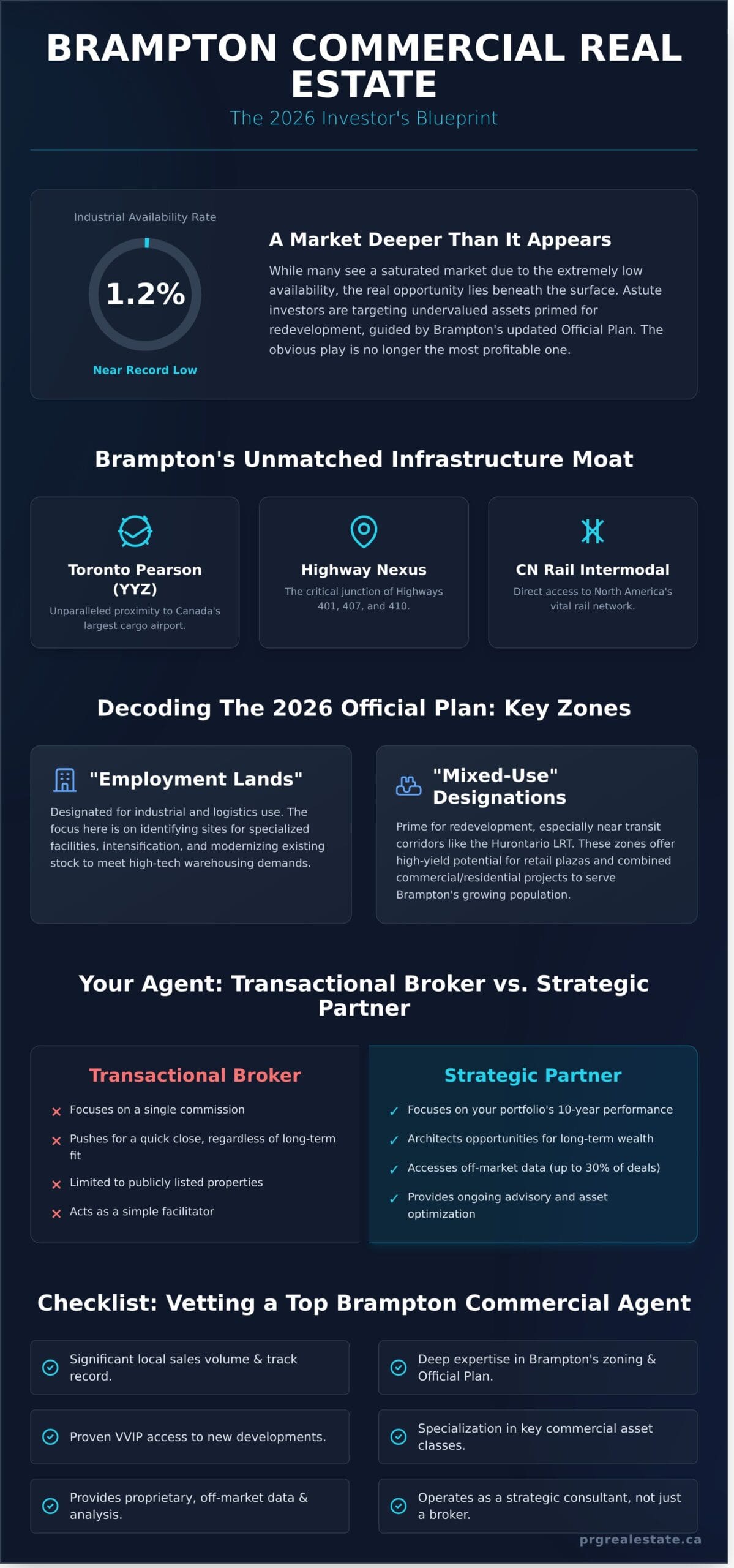
Most investors will miss Brampton’s most profitable commercial real estate opportunities by 2026. While many fixate on the city’s near-record-low 1.2% industrial availability rate and see only saturation, a select few are identifying undervalued assets primed for redevelopment under Brampton’s updated Official Plan. It’s a market where the obvious play is no longer the most strategic one.
It’s understandable to feel hesitant. The combination of fluctuating interest rates, which have compressed cap rates over the last 18 months, and complex municipal zoning changes can make the market feel impenetrable without elite guidance. Finding the right commercial real estate agent Brampton isn’t just an advantage; it’s a necessity. This guide promises to deliver the strategic clarity you need to move with confidence. We will reveal the proven methodologies our top-rated brokerage uses to uncover exclusive off-market properties, secure favourable zoning for high-yield projects, and lock in long-term, high-credit tenants for maximum ROI. Prepare to learn the key submarkets to watch and the tactics required to build a resilient commercial portfolio in Brampton for years to come.
Key Takeaways
- Learn to identify high-potential investment zones by understanding the strategic differences between “Employment Lands” and “Mixed-Use” designations in Brampton’s 2026 Official Plan.
- Discover which commercial asset classes, from specialized industrial facilities to high-growth retail plazas, are positioned for maximum returns in Brampton’s evolving market.
- Develop a checklist to vet a top commercial real estate agent Brampton, focusing on critical metrics like significant sales volume and VVIP access to new developments.
- Understand how the role of a modern commercial realtor has shifted from a transaction facilitator to a strategic consultant essential for navigating 2026 market complexities.
The Role of a Commercial Real Estate Agent in Brampton’s 2026 Market
In the evolving landscape of 2026, the function of a commercial real estate agent has fundamentally shifted. Gone are the days of simple transaction facilitation. Today, a top-tier commercial real estate agent is a strategic asset manager, architecting opportunities for business growth and long-term wealth creation. This is especially true in a dynamic city like Brampton, where market intelligence and foresight are paramount to securing high-performance assets.
Despite global economic recalibrations, Brampton’s position as the “Logistic Capital of Canada” remains secure. Its unmatched proximity to Toronto Pearson International Airport (YYZ), the nexus of the 401, 407, and 410 highways, and the critical CN Rail Intermodal Terminal creates an infrastructure moat that insulates its industrial sector. For 2026 investors, this means that while other markets may face volatility, Brampton’s core logistics and warehousing demand provides a stable and compelling foundation for investment.
Understanding this market requires a specialist. Unlike residential real estate, which focuses on emotional appeal and neighbourhood amenities, commercial transactions are driven by pure financial metrics: capitalization rates, net operating income, and zoning regulations. The complexity of a Commercial property overview, from M2-zoned industrial properties to C4-zoned retail plazas, demands a dedicated professional who navigates these nuances daily. A residential agent, however skilled, simply doesn’t possess the specialized financial modelling and legal expertise required for a C$10 million warehouse acquisition or a multi-unit plaza lease negotiation.
Why Local Brampton Expertise Matters Now
Hyper-local knowledge is the definitive competitive advantage. An expert commercial real estate agent Brampton understands the city isn’t a monolith but a collection of distinct micro-markets. The industrial corridors along Steeles Avenue West, valued for their 400-series highway access, present entirely different opportunities than the Queen Street corridor, which is undergoing a significant transformation. The Hurontario LRT, with its projected 2024 completion, is already driving up valuations for properties within an 800-meter radius of its new stations, creating prime opportunities for mixed-use and retail redevelopment. A local specialist also provides access to programs like the Downtown Brampton BIA’s façade improvement grants, which can directly impact an investor’s bottom line.
Strategic vs. Transactional Brokerage
A transactional broker focuses on a single commission. A strategic partner focuses on your portfolio’s 10-year performance. This distinction is critical. Transactional agents often miss the long game, pushing for a quick close that may not align with future appreciation or redevelopment potential. The PRG approach is built on an unwavering commitment to becoming “Clients for Life.” We don’t just find you a property in 2026; we provide the advisory to optimize its performance through 2036. This philosophy is powered by access to proprietary, off-market data. In a market as tight as Brampton, upwards of 30% of the most desirable assets trade hands before ever being publicly listed. This is the data that matters, and it’s only available through deep local relationships and a reputation for excellence.
Asset Class Specialization: Finding Value in Every Sector
Success in Brampton’s 2026 commercial real estate market won’t come from a one-size-fits-all approach. It demands a granular understanding of each asset class and its unique drivers. A top-tier commercial real estate agent Brampton doesn’t just find properties; they identify strategic opportunities by dissecting market trends sector by sector. From the logistics corridors humming with activity to the new retail formats serving a booming population, discerning investors know that value is found in the details.
Industrial & Logistics Dominance
Brampton remains the undisputed heart of the GTA’s industrial market, a status cemented by its strategic location. Proximity to Toronto Pearson International Airport and the convergence of Highways 410, 407, and 401 create an unparalleled logistics network. This keeps industrial demand exceptionally high, with vacancy rates consistently hovering below 2%. For 2026, the opportunity lies beyond standard warehousing. Investors should target specialized facilities like third-party logistics (3PL) hubs, cold storage for the grocery sector, and food-grade production buildings. Analyzing the current roster of industrial buildings for sale reveals a clear distinction: small-bay units (under 20,000 sq. ft.) cater to local businesses and command high lease rates per square foot, while large-bay facilities (over 100,000 sq. ft.) attract national distributors on long-term leases, offering stable returns.
Retail and Mixed-Use Opportunities
With a population that grew by 10.6% between the 2016 and 2021 censuses, Brampton’s consumer base is expanding rapidly. This growth fuels a dynamic retail sector. Forward-thinking investors are looking at mixed-use developments that integrate retail with residential, such as the “Storefront Home” model in new master-planned communities. When evaluating a commercial unit for sale in Brampton for retail viability, a rigorous analysis is crucial. Key metrics include daily foot traffic counts, neighbourhood demographics, and the strength of co-tenants. For plaza investors, a detailed credit-tenant analysis is non-negotiable, focusing on the financial stability of anchor tenants like major banks or national grocery chains to secure long-term income.
While the traditional office market adapts to hybrid work models, specialized sectors are thriving. The demand for professional medical buildings, particularly near Brampton Civic Hospital, remains incredibly strong due to an aging population and non-discretionary healthcare spending. These assets offer exceptional stability with long-term tenants. Another growing niche is smaller, move-in-ready office suites equipped with modern tech infrastructure and flexible layouts, designed to attract startups and professional service firms that have downsized their physical footprint but still require a premium corporate address.
For investors with a long-term vision, development land presents the highest potential for appreciation. The most promising opportunities are parcels located along major transit corridors, such as the Hurontario Main Street LRT and the expanded Bramalea GO Station. Identifying land already zoned for high-density residential or mixed-use development is key to mitigating risk. Navigating municipal zoning bylaws and the City of Brampton’s Official Plan requires an expert partner whose professional standing is in good order with the Real Estate Council of Ontario (RECO). This ensures your investment strategy is built on a foundation of regulatory compliance and expert insight. Understanding which asset class aligns with your portfolio is the first step; connect with our advisory team to perform a strategic analysis of your 2026 investment options.
Navigating Brampton’s Zoning and Development Landscape
Successful commercial real estate investment in Brampton isn’t just about location; it’s about understanding the city’s strategic vision. The City of Brampton’s Official Plan is the blueprint for future growth, and by 2026, its policies will have profoundly shaped property values and development potential. Investors who fail to grasp the nuances of this plan risk acquiring assets with limited upside or unforeseen restrictions.
A critical distinction lies in land designations. “Employment Lands” are specifically zoned for industrial, warehousing, and office uses, forming the backbone of Brampton’s economic engine. In contrast, “Mixed-Use” corridors, particularly along major arterials, are designated for higher-density projects combining retail, commercial, and residential components. For ambitious projects, land assembly—the strategic acquisition of multiple adjacent properties—is often required. This is a complex, high-stakes process involving discreet negotiations and a deep understanding of individual landowner motivations. An expert commercial real estate agent Brampton is indispensable in mitigating these risks, liaising directly with city planners to verify development feasibility and de-risk your purchase before you commit significant capital.
Transit-Oriented Development (TOD)
Brampton’s commitment to public transit is creating concentrated pockets of high-value opportunity. The Hurontario LRT, slated for completion in 2024, and the corresponding “Main Street North” redevelopment plan are set to transform key corridors. Real estate studies consistently show that commercial properties within a 500-meter radius of major transit hubs can command a 15-20% value premium. Strategic acquisition near future GO Transit expansion points, like those along the upgraded Kitchener line, offers a direct path to long-term appreciation.
Zoning Bylaws and Permitted Uses
Zoning details can make or break an investment. A common pitfall is purchasing a “warehouse for sale” only to discover its zoning prohibits your specific logistics or manufacturing operation due to noise or emission bylaws. Navigating these rules may require a minor variance application for small adjustments or a full rezoning for a change of use—a costly and lengthy process. Furthermore, for most commercial and industrial sites in Brampton, a Phase I & II Environmental Site Assessment is not just recommended; it’s essential due diligence to uncover potential soil or groundwater contamination liabilities.
Understanding this intricate regulatory environment is fundamental. It requires a partner who can interpret municipal code, anticipate planning hurdles, and align your investment goals with the city’s approved vision for growth. This proactive guidance ensures your 2026 investment strategy is built on a solid foundation of compliance and strategic foresight.
How to Vet a Commercial Real Estate Agent: A 2026 Checklist
Selecting your representative in Brampton’s competitive commercial market is the single most critical decision you’ll make. The right agent is more than a facilitator; they are a strategic partner whose expertise directly impacts your ROI. For 2026 and beyond, your vetting process must be rigorous, focusing on four non-negotiable pillars: a verifiable track record, an exclusive network, elite data access, and uncompromising integrity.
A proven track record is measured in closed deals, not just years of experience. Demand to see a portfolio of significant sales volume specifically within Brampton’s commercial sector, such as industrial properties near the CN Rail Yard or retail plazas along Queen Street. An elite commercial real estate agent Brampton leverages more than the public MLS. They subscribe to and analyze data from premium platforms like CoStar and Altus Group’s REALNET, which provide granular insights on vacancy rates, absorption trends, and comparable sales down to the square foot. Even more valuable are their proprietary off-market lists, which contain opportunities that never face public competition.
The VVIP Access Advantage
Top-performing agents cultivate deep relationships with developers, granting them VVIP access to new commercial condo units or land acquisition opportunities before they are ever marketed. This network is a powerful asset, particularly for investors seeking to secure premier locations in projects like the Brampton Business Centre. At PRG, our connections mean we are often the first to be consulted on confidential “business for sale in Brampton” opportunities, giving our clients a decisive first-mover advantage.
Finally, integrity is the foundation of a successful long-term partnership. A slogan like “unwavering commitment to excellence” must be backed by transparent practices and a fiduciary-first mindset. It’s the difference between an agent who pushes a quick deal and a strategist who advises you to walk away from a transaction that doesn’t align with your five-year goals. This philosophy is central to our goal of building relationships with “clients for life,” ensuring our advice is always aligned with your best interests, not our commission.
Evaluating Agent Transparency
An agent’s transparency is a direct reflection of their integrity. You must ask direct questions about commission structures and their policy on dual agency. Verify their performance claims through third-party validation. For example, the prestigious Royal LePage® Red Diamond™ Award is given to only the top 2% of its agents across Canada, offering objective proof of elite performance. True expert advice is data-driven and objective; a sales pitch is transactional and emotional. Choose the expert.
Your 2026 investment strategy deserves a partner who meets these stringent criteria. Don’t settle for average representation when market-leading expertise is available. To ensure your next commercial acquisition is guided by proven success and unparalleled market intelligence, connect with PRG Real Estate’s top commercial team today.
Why PRG is the Strategic Choice for Brampton Commercial Real Estate
Selecting the right advisory team is the single most critical decision an investor will make ahead of 2026. In a market as dynamic as Brampton’s, your success depends not just on the property you acquire, but on the strategic intelligence guiding that acquisition. Pabla Realtor Group (PRG) isn’t simply a brokerage; we are a results-driven team of specialists engineered to maximize your portfolio’s potential and deliver measurable returns.
Our firm is led by Broker of Record, Harsh Pabla, an award-winning professional whose reputation is built on a foundation of unwavering integrity and a track record of success. His consistent achievement of the Royal LePage® Red Diamond™ Award, placing him in the top 2% of agents nationwide, is a testament to the high-caliber results he delivers. This leadership instills a culture of excellence throughout our team, ensuring every client benefits from elite-level expertise and a commitment to achieving their financial objectives.
This commitment is codified in our “Clients for Life” philosophy. Where other firms focus on closing a single deal, we focus on opening a long-term strategic partnership. We manage the relationship, not just the transaction. This means providing ongoing advisory services, portfolio performance reviews, and proactive identification of future acquisition or disposition opportunities that align with your evolving goals. We don’t just find you a property; we help you build a legacy.
At PRG, our promise extends beyond individual transactions to the community itself. We are dedicated to facilitating innovative, sustainable, and forward-thinking developments that contribute to a thriving Brampton. When you partner with us, you’re investing in a team that is shaping the future of the city’s commercial landscape for the better.
Our Multi-Disciplinary Approach
Our integrated structure gives our clients a decisive market advantage. The seamless collaboration between our residential and commercial teams provides unparalleled insight into mixed-use development projects, ensuring commercial viability is supported by real-time residential demand data. From initial site acquisition and zoning analysis to project completion, our comprehensive development services offer a single, expert point of contact. For a deeper analysis of market trends, explore our Brampton Commercial Real Estate Guide.
Getting Started with PRG
Your 2026 investment strategy begins with a conversation. We invite you to book a confidential consultation to outline your objectives with a top commercial real estate agent Brampton investors rely on. Our process involves creating a customized property search meticulously calibrated to your specific ROI requirements, whether it’s targeting assets with a 6% cap rate or identifying value-add opportunities with clear upside potential. Let’s build your future success together. Partner with Brampton’s top commercial realtors today.
Secure Your 2026 Brampton Investment Advantage
As we look toward 2026, Brampton’s commercial landscape presents immense opportunities for prepared investors. Your success will hinge on navigating the city’s complex zoning regulations and identifying true value across all asset classes. This isn’t a market for guesswork; it’s a market that demands a strategic partner with a proven record of excellence. Choosing the right commercial real estate agent Brampton provides isn’t just a transaction, it’s a decisive competitive edge.
At PRG Real Estate, our performance is quantified by results. As recipients of the Royal LePage® Red Diamond™ Award, our team ranks in the top 2% of agents across Canada. We leverage specialized expertise in Brampton’s development sector to deliver our clients unparalleled guidance and access to high-potential opportunities. Our commitment is to transform your investment goals into tangible, high-value assets.
The time to build your 2026 strategy is now. Secure Your Strategic Advantage with PRG Real Estate and partner with a team dedicated to your long-term success.
Frequently Asked Questions
What is the current state of the Brampton commercial real estate market in 2026?
The Brampton commercial real estate market in 2026 is characterized by robust industrial demand and evolving retail needs. Industrial vacancy rates remain exceptionally low, hovering around 1.5%, driven by the city’s logistics and advanced manufacturing sectors. Meanwhile, retail is shifting towards mixed-use developments, particularly along key transit corridors like the Hurontario LRT. Office space is stabilizing with a focus on high-quality, flexible workspaces to accommodate hybrid models.
How do commercial real estate commissions work in Ontario?
Commercial real estate commissions in Ontario are negotiable and typically paid by the seller or landlord. The total commission, often ranging from 3% to 6% of the sale price or lease value, is split between the brokerages representing the seller/landlord and the buyer/tenant. For example, a common structure on a C$10 million sale might be 3% on the first C$1 million and 1.5% on the balance, divided between the two parties.
What is the difference between a real estate agent and a commercial broker?
A commercial broker possesses specialized expertise and licensing focused exclusively on investment and business properties, whereas a real estate agent often handles residential transactions. Brokers undergo more extensive training to manage complex issues like commercial zoning, property valuation, environmental assessments, and intricate lease negotiations. This focused knowledge is critical for navigating the financial and legal nuances inherent in commercial real estate acquisitions and dispositions.
Can a residential realtor help me buy a warehouse in Brampton?
It’s highly inadvisable to use a residential realtor for a commercial purchase like a warehouse. They lack the critical expertise in industrial zoning laws, loading dock specifications, ceiling height requirements, and Phase I Environmental Assessments. A successful industrial investment requires a specialist who understands the logistics sector’s unique demands. Engaging a dedicated commercial professional ensures your asset meets both operational needs and long-term investment criteria.
How does the Hurontario LRT affect commercial property taxes in Brampton?
The Hurontario LRT is projected to increase commercial property values along its route, which will lead to higher property tax assessments by MPAC. Properties located within a 500-meter radius of an LRT station are expected to see assessment values climb by 10-20% over the five years following the line’s full operational launch. Investors should proactively factor this phased tax increase into their financial models to accurately forecast net operating income.
What are the most profitable commercial asset classes in the GTA right now?
Industrial properties and multi-family residential buildings are the top-performing commercial asset classes in the Greater Toronto Area for 2026. The industrial sector, especially logistics and cold storage facilities in Brampton and Mississauga, is experiencing rental growth above 7% year-over-year due to e-commerce demand. Multi-family assets provide stable returns, with vacancy rates below 2% across the GTA, ensuring consistent cash flow and strong appreciation.
How do I find off-market commercial properties in Brampton?
Finding off-market properties requires leveraging the network of a deeply connected commercial real estate agent in Brampton. These exclusive opportunities aren’t publicly listed and are sourced through established relationships with property owners, developers, and financial institutions. Our team at PRG Real Estate utilizes a proprietary database and decades of market presence to provide our clients with VVIP access to these strategic investment opportunities before they become common knowledge.
What environmental checks are required for commercial property in Ontario?
A Phase I Environmental Site Assessment (ESA) is the standard due diligence requirement for commercial property transactions in Ontario. This assessment investigates the property’s historical use to identify any potential for contamination. If the Phase I ESA flags potential risks, a Phase II ESA is then mandated. The Phase II assessment involves collecting and analyzing soil and groundwater samples to confirm the presence and extent of any contaminants.