

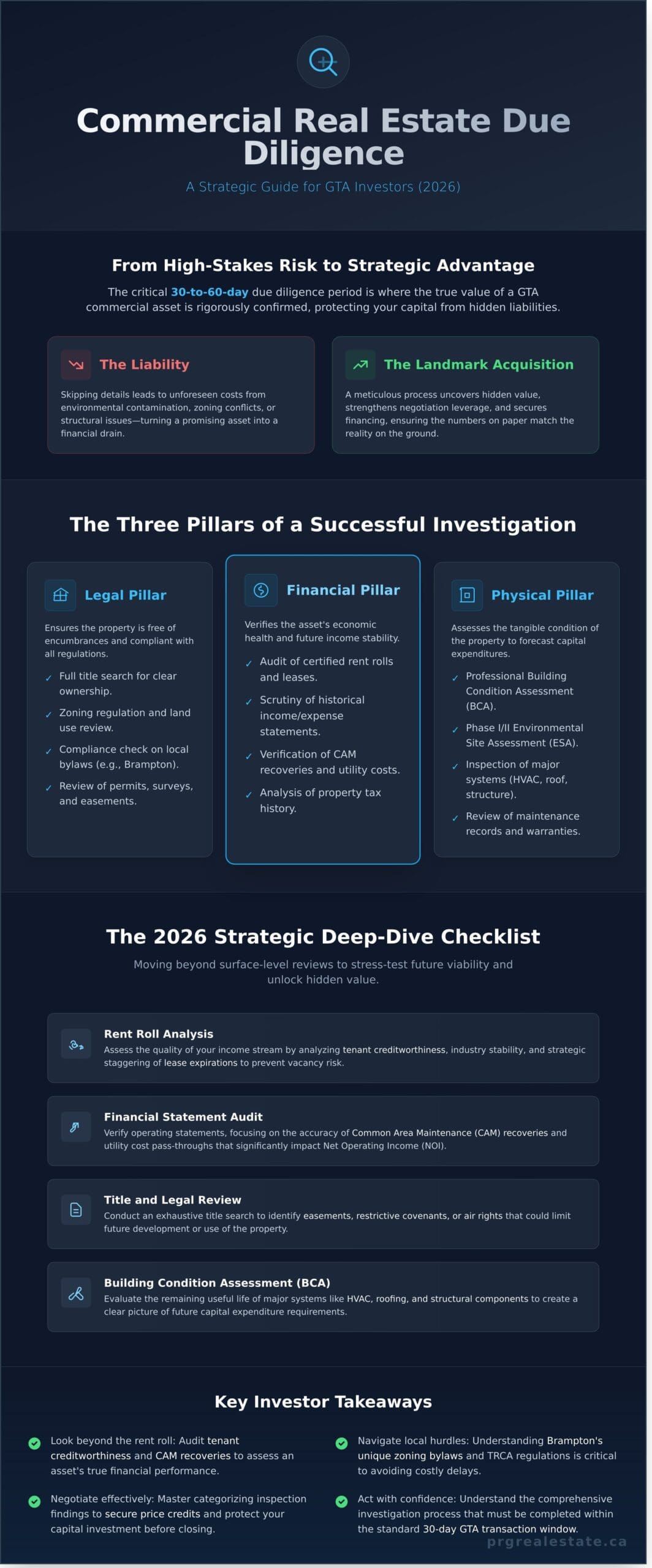
In the high-stakes Greater Toronto Area commercial market, the difference between a landmark acquisition and a multi-million-dollar liability is often buried in the details. The pro-forma looks perfect and the location is prime, but a nagging question remains: what hidden risks-from environmental contamination to complex Ontario zoning bylaws or unstable tenancy-lie just beneath the surface? This is precisely where a meticulous commercial real estate due diligence process transforms investor anxiety into strategic advantage. It’s the critical 30-to-60-day period where assumptions are challenged and the true value of a C$ asset is rigorously confirmed.
This definitive 2026 guide is engineered for savvy investors seeking to master this complex phase. We provide the actionable roadmap to navigate every inspection, document, and financial review. By the end, you will have the strategic clarity to protect your capital, uncover hidden liabilities, and confidently secure high-performing GTA assets, ensuring the numbers on paper match the reality on the ground.
Key Takeaways
- Learn to look beyond the rent roll by auditing tenant creditworthiness and CAM recoveries to accurately assess an asset’s true financial performance.
- Discover why navigating Brampton’s unique zoning bylaws and TRCA regulations is a critical step in your commercial real estate due diligence to avoid costly delays.
- Master the art of categorizing inspection findings to effectively negotiate price credits and protect your capital investment before closing.
- Understand the comprehensive investigation process-from financial audits to legal reviews-that must be completed within the standard 30-day GTA transaction window.
What is Commercial Real Estate Due Diligence in 2026?
In the high-stakes arena of the Greater Toronto Area’s property market, commercial real estate due diligence is the strategic, comprehensive investigation that separates a landmark investment from a financial liability. It is the process of verifying a property’s financial, physical, and legal health to ensure all facts presented are accurate and to uncover any potential risks before a transaction becomes binding. For most GTA transactions, the industry benchmark is a standard 30-day due diligence window, a period where the buyer has the conditional right to scrutinize every detail of the asset.
Looking ahead to 2026, this process is evolving. The modern approach now integrates AI-driven platforms for rapid document auditing and places a greater emphasis on environmental sustainability standards and ESG (Environmental, Social, and Governance) compliance. This process is typically two-phased: preliminary due diligence conducted before submitting an offer to assess initial viability, and formal due diligence, the deep-dive investigation that occurs after an offer is accepted.
The High Stakes of Skipping the Details
Overlooking details during due diligence is a costly error. In Ontario, the principle of Caveat Emptor, or “Buyer Beware,” places the onus squarely on the purchaser to uncover any defects. A “hidden” liability, such as an unregistered lien, significant structural fatigue, or environmental contamination, can translate into unexpected costs reaching tens or even hundreds of thousands of Canadian dollars. Furthermore, a thorough due diligence report is non-negotiable for securing financing, as Canadian lenders require this verification to mitigate their own risk and confirm the asset’s value.
The Three Pillars: Legal, Financial, and Physical
A successful investigation is built on three foundational pillars, each providing a critical layer of insight. The process of due diligence in commercial real estate requires a meticulous review of documents and physical conditions across these core areas to protect your investment.
- Legal Pillar: This involves a full title search to confirm clear ownership, a review of zoning regulations to ensure the property’s intended use is permitted, and a compliance check against local Brampton bylaws and provincial regulations.
- Financial Pillar: Here, we analyze the asset’s economic performance. This includes auditing certified rent rolls, scrutinizing historical operating expenses and income statements, and reviewing property tax history to project future financial stability.
- Physical Pillar: This pillar assesses the tangible state of the property. It is typically executed through a professional Building Condition Assessment (BCA) to identify structural issues and an Environmental Site Assessment (ESA) to uncover any potential soil or groundwater contamination.
The 2026 Commercial Due Diligence Checklist: A Strategic Deep-Dive
In today’s competitive market, a surface-level review of a commercial asset is insufficient. Achieving superior returns requires a forward-looking, strategic approach to commercial real estate due diligence. This deep-dive moves beyond verifying current income to stress-testing a property’s future viability and profitability. A truly comprehensive commercial real estate due diligence process involves scrutinizing every operational, legal, and physical facet of the investment to mitigate risk and unlock hidden value.
Our 2026 checklist prioritizes four critical pillars of investigation:
- Rent Roll Analysis: Moving beyond the numbers to assess the quality of your income stream. This involves a rigorous analysis of tenant creditworthiness, industry stability, and the strategic staggering of lease expirations to prevent catastrophic vacancy risk.
- Financial Statement Audit: A meticulous verification of operating statements is essential. We focus on confirming the accuracy of Common Area Maintenance (CAM) recoveries and utility cost pass-throughs, as discrepancies here can significantly impact your Net Operating Income (NOI).
- Title and Legal Review: We conduct an exhaustive title search to identify any easements, restrictive covenants, or air rights that could limit future development or use of the property. Uncovering these encumbrances early is critical to understanding an asset’s true potential.
- Building Condition Assessment (BCA): A professional BCA provides a clear picture of capital expenditure requirements. We evaluate the remaining useful life of major systems like HVAC, roofing, and structural components to accurately forecast future costs.
Tenant and Lease Analysis
The stability of your investment is directly tied to your tenants. We demand Estoppel Certificates from every tenant to ensure their understanding of lease terms aligns with the landlord’s records-a non-negotiable step. Furthermore, our analysis identifies restrictive “Exclusive Use” clauses that could hinder future leasing to a broader tenant mix and flags any “Termination Rights” that could expose the property to sudden vacancy in a shifting economic climate.
Environmental and Structural Integrity
A Phase I Environmental Site Assessment (ESA) is standard. However, if it reveals potential contamination, a more invasive Phase II ESA becomes necessary to quantify the risk and remediation cost. Looking ahead to 2026, we assess the property’s “Carbon Footprint” and energy efficiency to ensure compliance with emerging sustainability standards. For assets in Ontario, we also conduct a thorough evaluation of Accessibility for Ontarians with Disabilities Act (AODA) compliance, a critical factor for long-term value and operational legality.
Navigating Local Hurdles: Due Diligence in Brampton and the GTA
A generic checklist is insufficient for a dynamic and complex market like the Greater Toronto Area. The success of your commercial real estate due diligence hinges on granular, local knowledge that can identify both hidden risks and strategic opportunities. In Brampton and the surrounding Peel Region, navigating municipal-specific regulations is a critical component of any sound investment strategy. Partnering with top commercial realtors in Brampton ensures you have the expert guidance needed to master these local intricacies.
For investors eyeing development land, engagement with Conservation Authorities like the TRCA (Toronto and Region Conservation Authority) is non-negotiable. Their regulations can significantly impact site plans and development potential. Similarly, a forward-looking analysis of Municipal Property Tax Assessments is essential. We go beyond current MPAC values, examining Peel Region’s budgets and infrastructure plans-like upcoming Brampton transit projects-to forecast future tax hikes and value appreciation that directly affect your long-term returns.
Zoning and Land Use in Brampton
Brampton’s zoning bylaws present unique challenges that demand a specialist’s eye. It is critical to investigate a property’s “Legal Non-Conforming” status, as these rights can be lost upon redevelopment, potentially derailing your plans. Furthermore, verifying specific requirements, such as parking ratios for retail versus industrial units, can prevent costly compliance issues. An expert analysis of the “Brampton 2040 Vision” is also key to understanding how specific commercial corridors are slated for growth, ensuring your investment aligns with the city’s strategic direction. For a comprehensive overview of permitted uses, amendment processes, and designation checks, our detailed guide to Brampton zoning bylaws for property owners and investors is an essential resource.
Ontario-Specific Legal Requirements
A comprehensive approach to due diligence in commercial real estate must include a deep dive into the property’s legal and regulatory history. This process involves more than a simple title search; it requires proactive investigation into municipal records, often through freedom of information requests, to uncover a property’s complete file. Key Ontario-specific legal verifications include:
- Work Orders & Building Permits: Reviewing the complete municipal history for any outstanding work orders, open permits, or past infractions that could become your liability.
- Boundary Verification: Engaging an Ontario Land Surveyor (OLS) is essential to confirm precise property boundaries, identify any encroachments, and ensure the legal description is accurate.
- Heritage Designations: Investigating if the property is subject to the Ontario Heritage Act, which can impose significant restrictions on alterations, demolition, and future development.
Identifying Deal-Breakers and Negotiating Post-Discovery
The commercial real estate due diligence period is where your investment thesis is tested against reality. The findings from your inspections and reports are not just data; they are powerful negotiation tools. A successful outcome requires strategically categorizing these findings to determine your next move: renegotiate, proceed with adjustments, or walk away from a deal that no longer meets your financial objectives.
Expert investors sort discoveries into three tiers: minor maintenance (cosmetic fixes, routine upkeep), major capital repairs (a C$75,000 HVAC system replacement), and absolute deal-breakers-issues that fundamentally threaten the asset’s viability or your projected ROI.
Common Deal-Breakers in the GTA Market
In the competitive Greater Toronto Area, certain issues consistently emerge as non-negotiable roadblocks for savvy investors:
- Severe Soil Contamination: A failed Phase II Environmental Site Assessment (ESA) near a former industrial site in Mississauga or Scarborough can reveal contamination requiring remediation costs that run into the hundreds of thousands of dollars, making the deal financially untenable.
- Major Structural Deficiencies: When a Building Condition Assessment (BCA) uncovers foundational or structural repair costs exceeding 10% of the property’s purchase price, the immediate capital outlay often destroys the investment case.
- Irreconcilable Zoning Conflicts: Discovering that municipal bylaws in Toronto or Brampton permanently prohibit your intended business use is a definitive deal-breaker that no amount of negotiation can overcome.
Negotiation Tactics After the Inspection
Armed with a detailed BCA report, you gain significant leverage. The art is in converting these data points into tangible financial advantages.
- Price Reductions vs. Seller Repairs: A price reduction (or “credit at closing”) is almost always superior for your cash flow. It gives you direct control over the quality and timing of repairs, whereas seller-managed repairs can be rushed or completed to a minimum standard.
- Extending the Due Diligence Period: If a major issue requires a specialist’s quote, professionally request an extension. Frame it as a necessary step to keep the deal on track, demonstrating your commitment to a fair resolution.
Your entire negotiation position can be summarized in one data-driven sentence: “The BCA has identified C$120,000 in immediate and unforeseen capital expenditures required to bring this property to an operational standard.” This shifts the conversation from opinion to fact. Furthermore, presenting these findings to lenders can demonstrate your meticulous risk management, potentially securing more favourable financing terms. For expert guidance on navigating these complex negotiations, connect with the specialists at PRG Real Estate.
How PRG Real Estate Streamlines Your Acquisition Strategy
Navigating the complexities of commercial real estate due diligence requires more than a checklist; it demands a seasoned conductor to orchestrate the entire process. At PRG Real Estate Brokerage, we serve as your “Acquisition General,” seamlessly coordinating the critical efforts of lawyers, engineers, accountants, and environmental assessors. We manage the timelines, synthesize the data, and ensure every detail is meticulously examined so you can make decisions with absolute confidence.
Our advisory is guided by a core “Clients for Life” philosophy. We are focused on your long-term return on investment, not a short-term commission. This commitment means we actively seek to identify and mitigate risk. Leveraging the market-leading expertise of Harsh Pabla, one of the top commercial realtors in Brampton, we spot potential red flags-from zoning inconsistencies to structural flaws-long before they become costly liabilities. Furthermore, our clients gain exclusive access to VVIP listings and off-market opportunities that have already undergone our rigorous preliminary vetting, saving you invaluable time and resources.
The PRG Advantage: Local Expertise Meets Strategic Vision
Our deep roots in the Brampton and Peel Region business communities provide an unparalleled advantage. We uncover the “soft” data-local sentiment, upcoming infrastructure projects, and a property’s true reputation-that official reports often miss. During this high-stakes phase of the transaction, our unwavering integrity ensures your interests are protected. Recently, we advised a client against a C$6 million industrial acquisition after our local intelligence revealed future logistical hurdles not yet public, safeguarding their capital from a high-risk investment.
Ready to Secure Your Next Investment?
Your journey toward a successful acquisition begins with a strategic consultation to define your investment criteria and financial goals. In the hyper-competitive Greater Toronto Area market, partnering with an elite brokerage is essential for navigating challenges and seizing premier opportunities. Partner with Brampton’s top commercial realtors for your next acquisition to ensure your due diligence is as strategic as your investment.
Transform Due Diligence from a Hurdle to a Strategic Advantage
As we’ve explored, successful commercial real estate investing in 2026 hinges on a meticulous and forward-thinking approach. The key takeaways are clear: due diligence is not merely a procedural checklist but a strategic deep-dive into a property’s true potential, and navigating the unique regulatory landscape of markets like Brampton and the GTA is non-negotiable for mitigating risk. A comprehensive commercial real estate due diligence process empowers you to identify deal-breakers, negotiate from a position of strength, and secure assets that align with your long-term financial goals.
This level of scrutiny demands specialized expertise. The team at PRG Real Estate brings a proven track record in high-value commercial and development transactions, backed by our position as top realtors in the Brampton and GTA markets. As recipients of the Royal LePage Red Diamond Award, placing us in the top 2% of agents nationwide, we offer an unparalleled level of strategic guidance to protect and grow your capital.
Don’t leave your next acquisition to chance. Book a Strategic Consultation with PRG Real Estate today and let our award-winning expertise transform your investment strategy. Your next successful commercial venture is within reach.
Frequently Asked Questions
How long does commercial real estate due diligence typically take in Ontario?
In Ontario, the due diligence period for a commercial property typically ranges from 30 to 90 days. The exact timeline is negotiable and depends on the asset’s complexity, the scope of necessary inspections, and any financing conditions. For instance, a simple retail unit may require less time than a large industrial site with potential environmental concerns. A strategic approach ensures this period is used efficiently to mitigate risk and confirm the investment’s value.
What is the difference between a Phase I and Phase II Environmental Site Assessment?
A Phase I Environmental Site Assessment (ESA) is a non-intrusive investigation to identify potential contamination by reviewing historical records and conducting a site visit. If this assessment reveals a recognized environmental condition, a Phase II ESA is then performed. Phase II is an intrusive process involving physical sampling of soil, air, or groundwater to confirm the presence and extent of contamination. This two-phased approach is critical for managing liability and risk.
Who pays for the due diligence reports, the buyer or the seller?
In almost all commercial real estate transactions, the buyer is responsible for commissioning and paying for all due diligence reports. These costs, including environmental assessments, building condition reports, and surveys, are considered the buyer’s investment in verifying the property’s condition and value. While this is standard practice, specific terms can occasionally be negotiated within the Agreement of Purchase and Sale, though it is rare for a seller to cover these expenses.
Can I back out of a commercial real estate deal during the due diligence period?
Yes, provided your Agreement of Purchase and Sale includes a well-defined due diligence clause. This condition grants you the right to terminate the agreement if your investigation uncovers findings that are unsatisfactory, at your sole discretion. When you withdraw from the deal within the specified timeframe as per the agreement’s terms, your deposit is typically returned in full. This contractual safeguard is fundamental to protecting your capital and ensuring you proceed with confidence.
What are the most common zoning issues found in Brampton commercial properties?
In Brampton, common zoning issues include legal non-conforming uses, where a property’s current use was permitted previously but fails to meet new zoning bylaws. Other frequent challenges are inadequate parking based on current standards, proposed uses that are prohibited within the specific zone, and structural encroachments that violate setback requirements. A comprehensive zoning review is essential to ensure your intended use for the property is fully compliant and to avoid future legal complications. Understanding the full scope of Brampton zoning bylaws can help investors proactively identify and address these issues before they become costly obstacles.
Why do I need a Building Condition Assessment if the property looks new?
A Building Condition Assessment (BCA) is a strategic necessity, even for properties that appear to be in excellent condition. This expert report uncovers latent defects in construction, assesses the lifespan of critical systems like HVAC and roofing, and provides a forecast for future capital expenditures. It moves beyond superficial appearances to deliver a precise understanding of the building’s structural and mechanical integrity, which is vital for accurate financial modeling and long-term asset management.
How does due diligence differ for a business purchase versus a property purchase?
While both require rigorous investigation, their focus differs significantly. Due diligence for a property purchase centres on the physical asset: the land, building, title, and environmental status. In contrast, due diligence for a business purchase is far broader, encompassing a deep analysis of financial statements, customer contracts, employee agreements, intellectual property, and goodwill. When acquiring an operating business with its real estate, both types of investigation must be conducted concurrently.
What specific documents should I request from the seller immediately after an accepted offer?
Immediately upon acceptance of an offer, your priority is to request a comprehensive document package from the seller. This should include the current certified rent roll, all tenant leases and related correspondence, and at least three years of financial operating statements. You should also request copies of all service and maintenance contracts, existing surveys, prior environmental or building condition reports, and recent property tax bills to begin your thorough commercial real estate due diligence process.