Commercial Real Estate Agent Brampton: Strategic Guidance for 2026 Investors
CategoriesBlog

Commercial Real Estate Agent Brampton: Strategic Guidance for 2026 Investors

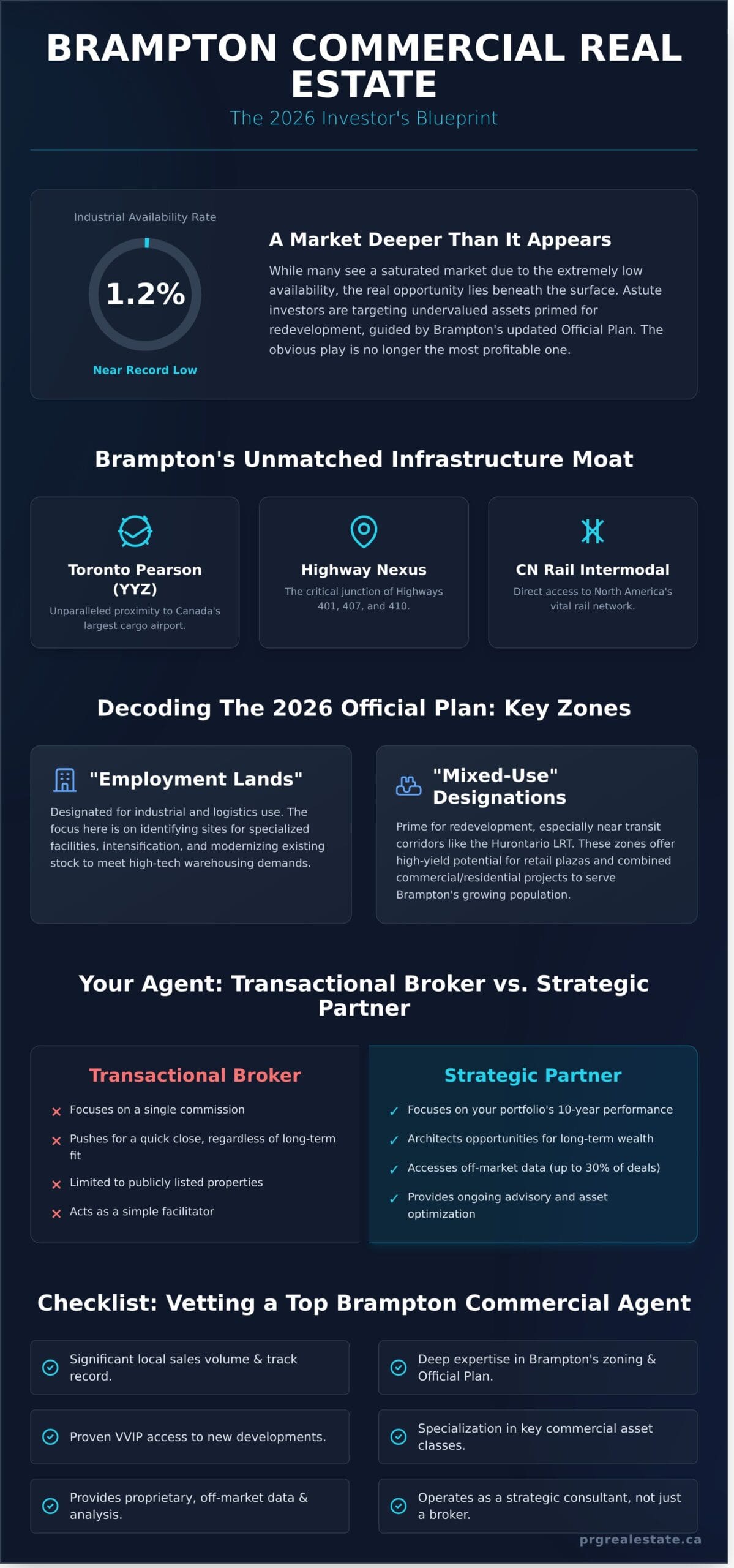
Most investors will miss Brampton’s most profitable commercial real estate opportunities by 2026. While many fixate on the city’s near-record-low 1.2% industrial availability rate and see only saturation, a select few are identifying undervalued assets primed for redevelopment under Brampton’s updated Official Plan. It’s a market where the obvious play is no longer the most strategic one.

It’s understandable to feel hesitant. The combination of fluctuating interest rates, which have compressed cap rates over the last 18 months, and complex municipal zoning changes can make the market feel impenetrable without elite guidance. Finding the right commercial real estate agent Brampton isn’t just an advantage; it’s a necessity. This guide promises to deliver the strategic clarity you need to move with confidence. We will reveal the proven methodologies our top-rated brokerage uses to uncover exclusive off-market properties, secure favourable zoning for high-yield projects, and lock in long-term, high-credit tenants for maximum ROI. Prepare to learn the key submarkets to watch and the tactics required to build a resilient commercial portfolio in Brampton for years to come.

Key Takeaways

  • Learn to identify high-potential investment zones by understanding the strategic differences between “Employment Lands” and “Mixed-Use” designations in Brampton’s 2026 Official Plan.
  • Discover which commercial asset classes, from specialized industrial facilities to high-growth retail plazas, are positioned for maximum returns in Brampton’s evolving market.
  • Develop a checklist to vet a top commercial real estate agent Brampton, focusing on critical metrics like significant sales volume and VVIP access to new developments.
  • Understand how the role of a modern commercial realtor has shifted from a transaction facilitator to a strategic consultant essential for navigating 2026 market complexities.

The Role of a Commercial Real Estate Agent in Brampton’s 2026 Market

In the evolving landscape of 2026, the function of a commercial real estate agent has fundamentally shifted. Gone are the days of simple transaction facilitation. Today, a top-tier commercial real estate agent is a strategic asset manager, architecting opportunities for business growth and long-term wealth creation. This is especially true in a dynamic city like Brampton, where market intelligence and foresight are paramount to securing high-performance assets.

Despite global economic recalibrations, Brampton’s position as the “Logistic Capital of Canada” remains secure. Its unmatched proximity to Toronto Pearson International Airport (YYZ), the nexus of the 401, 407, and 410 highways, and the critical CN Rail Intermodal Terminal creates an infrastructure moat that insulates its industrial sector. For 2026 investors, this means that while other markets may face volatility, Brampton’s core logistics and warehousing demand provides a stable and compelling foundation for investment.

Understanding this market requires a specialist. Unlike residential real estate, which focuses on emotional appeal and neighbourhood amenities, commercial transactions are driven by pure financial metrics: capitalization rates, net operating income, and zoning regulations. The complexity of a Commercial property overview, from M2-zoned industrial properties to C4-zoned retail plazas, demands a dedicated professional who navigates these nuances daily. A residential agent, however skilled, simply doesn’t possess the specialized financial modelling and legal expertise required for a C$10 million warehouse acquisition or a multi-unit plaza lease negotiation.

Why Local Brampton Expertise Matters Now

Hyper-local knowledge is the definitive competitive advantage. An expert commercial real estate agent Brampton understands the city isn’t a monolith but a collection of distinct micro-markets. The industrial corridors along Steeles Avenue West, valued for their 400-series highway access, present entirely different opportunities than the Queen Street corridor, which is undergoing a significant transformation. The Hurontario LRT, with its projected 2024 completion, is already driving up valuations for properties within an 800-meter radius of its new stations, creating prime opportunities for mixed-use and retail redevelopment. A local specialist also provides access to programs like the Downtown Brampton BIA’s façade improvement grants, which can directly impact an investor’s bottom line.

Strategic vs. Transactional Brokerage

A transactional broker focuses on a single commission. A strategic partner focuses on your portfolio’s 10-year performance. This distinction is critical. Transactional agents often miss the long game, pushing for a quick close that may not align with future appreciation or redevelopment potential. The PRG approach is built on an unwavering commitment to becoming “Clients for Life.” We don’t just find you a property in 2026; we provide the advisory to optimize its performance through 2036. This philosophy is powered by access to proprietary, off-market data. In a market as tight as Brampton, upwards of 30% of the most desirable assets trade hands before ever being publicly listed. This is the data that matters, and it’s only available through deep local relationships and a reputation for excellence.

Asset Class Specialization: Finding Value in Every Sector

Success in Brampton’s 2026 commercial real estate market won’t come from a one-size-fits-all approach. It demands a granular understanding of each asset class and its unique drivers. A top-tier commercial real estate agent Brampton doesn’t just find properties; they identify strategic opportunities by dissecting market trends sector by sector. From the logistics corridors humming with activity to the new retail formats serving a booming population, discerning investors know that value is found in the details.

Industrial & Logistics Dominance

Brampton remains the undisputed heart of the GTA’s industrial market, a status cemented by its strategic location. Proximity to Toronto Pearson International Airport and the convergence of Highways 410, 407, and 401 create an unparalleled logistics network. This keeps industrial demand exceptionally high, with vacancy rates consistently hovering below 2%. For 2026, the opportunity lies beyond standard warehousing. Investors should target specialized facilities like third-party logistics (3PL) hubs, cold storage for the grocery sector, and food-grade production buildings. Analyzing the current roster of industrial buildings for sale reveals a clear distinction: small-bay units (under 20,000 sq. ft.) cater to local businesses and command high lease rates per square foot, while large-bay facilities (over 100,000 sq. ft.) attract national distributors on long-term leases, offering stable returns.

Retail and Mixed-Use Opportunities

With a population that grew by 10.6% between the 2016 and 2021 censuses, Brampton’s consumer base is expanding rapidly. This growth fuels a dynamic retail sector. Forward-thinking investors are looking at mixed-use developments that integrate retail with residential, such as the “Storefront Home” model in new master-planned communities. When evaluating a commercial unit for sale in Brampton for retail viability, a rigorous analysis is crucial. Key metrics include daily foot traffic counts, neighbourhood demographics, and the strength of co-tenants. For plaza investors, a detailed credit-tenant analysis is non-negotiable, focusing on the financial stability of anchor tenants like major banks or national grocery chains to secure long-term income.

While the traditional office market adapts to hybrid work models, specialized sectors are thriving. The demand for professional medical buildings, particularly near Brampton Civic Hospital, remains incredibly strong due to an aging population and non-discretionary healthcare spending. These assets offer exceptional stability with long-term tenants. Another growing niche is smaller, move-in-ready office suites equipped with modern tech infrastructure and flexible layouts, designed to attract startups and professional service firms that have downsized their physical footprint but still require a premium corporate address.

For investors with a long-term vision, development land presents the highest potential for appreciation. The most promising opportunities are parcels located along major transit corridors, such as the Hurontario Main Street LRT and the expanded Bramalea GO Station. Identifying land already zoned for high-density residential or mixed-use development is key to mitigating risk. Navigating municipal zoning bylaws and the City of Brampton’s Official Plan requires an expert partner whose professional standing is in good order with the Real Estate Council of Ontario (RECO). This ensures your investment strategy is built on a foundation of regulatory compliance and expert insight. Understanding which asset class aligns with your portfolio is the first step; connect with our advisory team to perform a strategic analysis of your 2026 investment options.

Successful commercial real estate investment in Brampton isn’t just about location; it’s about understanding the city’s strategic vision. The City of Brampton’s Official Plan is the blueprint for future growth, and by 2026, its policies will have profoundly shaped property values and development potential. Investors who fail to grasp the nuances of this plan risk acquiring assets with limited upside or unforeseen restrictions.

A critical distinction lies in land designations. “Employment Lands” are specifically zoned for industrial, warehousing, and office uses, forming the backbone of Brampton’s economic engine. In contrast, “Mixed-Use” corridors, particularly along major arterials, are designated for higher-density projects combining retail, commercial, and residential components. For ambitious projects, land assembly—the strategic acquisition of multiple adjacent properties—is often required. This is a complex, high-stakes process involving discreet negotiations and a deep understanding of individual landowner motivations. An expert commercial real estate agent Brampton is indispensable in mitigating these risks, liaising directly with city planners to verify development feasibility and de-risk your purchase before you commit significant capital.

Transit-Oriented Development (TOD)

Brampton’s commitment to public transit is creating concentrated pockets of high-value opportunity. The Hurontario LRT, slated for completion in 2024, and the corresponding “Main Street North” redevelopment plan are set to transform key corridors. Real estate studies consistently show that commercial properties within a 500-meter radius of major transit hubs can command a 15-20% value premium. Strategic acquisition near future GO Transit expansion points, like those along the upgraded Kitchener line, offers a direct path to long-term appreciation.

Zoning Bylaws and Permitted Uses

Zoning details can make or break an investment. A common pitfall is purchasing a “warehouse for sale” only to discover its zoning prohibits your specific logistics or manufacturing operation due to noise or emission bylaws. Navigating these rules may require a minor variance application for small adjustments or a full rezoning for a change of use—a costly and lengthy process. Furthermore, for most commercial and industrial sites in Brampton, a Phase I & II Environmental Site Assessment is not just recommended; it’s essential due diligence to uncover potential soil or groundwater contamination liabilities.

Understanding this intricate regulatory environment is fundamental. It requires a partner who can interpret municipal code, anticipate planning hurdles, and align your investment goals with the city’s approved vision for growth. This proactive guidance ensures your 2026 investment strategy is built on a solid foundation of compliance and strategic foresight.
Commercial Real Estate Agent Brampton: Strategic Guidance for 2026 Investors

How to Vet a Commercial Real Estate Agent: A 2026 Checklist

Selecting your representative in Brampton’s competitive commercial market is the single most critical decision you’ll make. The right agent is more than a facilitator; they are a strategic partner whose expertise directly impacts your ROI. For 2026 and beyond, your vetting process must be rigorous, focusing on four non-negotiable pillars: a verifiable track record, an exclusive network, elite data access, and uncompromising integrity.

A proven track record is measured in closed deals, not just years of experience. Demand to see a portfolio of significant sales volume specifically within Brampton’s commercial sector, such as industrial properties near the CN Rail Yard or retail plazas along Queen Street. An elite commercial real estate agent Brampton leverages more than the public MLS. They subscribe to and analyze data from premium platforms like CoStar and Altus Group’s REALNET, which provide granular insights on vacancy rates, absorption trends, and comparable sales down to the square foot. Even more valuable are their proprietary off-market lists, which contain opportunities that never face public competition.

The VVIP Access Advantage

Top-performing agents cultivate deep relationships with developers, granting them VVIP access to new commercial condo units or land acquisition opportunities before they are ever marketed. This network is a powerful asset, particularly for investors seeking to secure premier locations in projects like the Brampton Business Centre. At PRG, our connections mean we are often the first to be consulted on confidential “business for sale in Brampton” opportunities, giving our clients a decisive first-mover advantage.

Finally, integrity is the foundation of a successful long-term partnership. A slogan like “unwavering commitment to excellence” must be backed by transparent practices and a fiduciary-first mindset. It’s the difference between an agent who pushes a quick deal and a strategist who advises you to walk away from a transaction that doesn’t align with your five-year goals. This philosophy is central to our goal of building relationships with “clients for life,” ensuring our advice is always aligned with your best interests, not our commission.

Evaluating Agent Transparency

An agent’s transparency is a direct reflection of their integrity. You must ask direct questions about commission structures and their policy on dual agency. Verify their performance claims through third-party validation. For example, the prestigious Royal LePage® Red Diamond™ Award is given to only the top 2% of its agents across Canada, offering objective proof of elite performance. True expert advice is data-driven and objective; a sales pitch is transactional and emotional. Choose the expert.

Your 2026 investment strategy deserves a partner who meets these stringent criteria. Don’t settle for average representation when market-leading expertise is available. To ensure your next commercial acquisition is guided by proven success and unparalleled market intelligence, connect with PRG Real Estate’s top commercial team today.

Why PRG is the Strategic Choice for Brampton Commercial Real Estate

Selecting the right advisory team is the single most critical decision an investor will make ahead of 2026. In a market as dynamic as Brampton’s, your success depends not just on the property you acquire, but on the strategic intelligence guiding that acquisition. Pabla Realtor Group (PRG) isn’t simply a brokerage; we are a results-driven team of specialists engineered to maximize your portfolio’s potential and deliver measurable returns.

Our firm is led by Broker of Record, Harsh Pabla, an award-winning professional whose reputation is built on a foundation of unwavering integrity and a track record of success. His consistent achievement of the Royal LePage® Red Diamond™ Award, placing him in the top 2% of agents nationwide, is a testament to the high-caliber results he delivers. This leadership instills a culture of excellence throughout our team, ensuring every client benefits from elite-level expertise and a commitment to achieving their financial objectives.

This commitment is codified in our “Clients for Life” philosophy. Where other firms focus on closing a single deal, we focus on opening a long-term strategic partnership. We manage the relationship, not just the transaction. This means providing ongoing advisory services, portfolio performance reviews, and proactive identification of future acquisition or disposition opportunities that align with your evolving goals. We don’t just find you a property; we help you build a legacy.

At PRG, our promise extends beyond individual transactions to the community itself. We are dedicated to facilitating innovative, sustainable, and forward-thinking developments that contribute to a thriving Brampton. When you partner with us, you’re investing in a team that is shaping the future of the city’s commercial landscape for the better.

Our Multi-Disciplinary Approach

Our integrated structure gives our clients a decisive market advantage. The seamless collaboration between our residential and commercial teams provides unparalleled insight into mixed-use development projects, ensuring commercial viability is supported by real-time residential demand data. From initial site acquisition and zoning analysis to project completion, our comprehensive development services offer a single, expert point of contact. For a deeper analysis of market trends, explore our Brampton Commercial Real Estate Guide.

Getting Started with PRG

Your 2026 investment strategy begins with a conversation. We invite you to book a confidential consultation to outline your objectives with a top commercial real estate agent Brampton investors rely on. Our process involves creating a customized property search meticulously calibrated to your specific ROI requirements, whether it’s targeting assets with a 6% cap rate or identifying value-add opportunities with clear upside potential. Let’s build your future success together. Partner with Brampton’s top commercial realtors today.

Secure Your 2026 Brampton Investment Advantage

As we look toward 2026, Brampton’s commercial landscape presents immense opportunities for prepared investors. Your success will hinge on navigating the city’s complex zoning regulations and identifying true value across all asset classes. This isn’t a market for guesswork; it’s a market that demands a strategic partner with a proven record of excellence. Choosing the right commercial real estate agent Brampton provides isn’t just a transaction, it’s a decisive competitive edge.

At PRG Real Estate, our performance is quantified by results. As recipients of the Royal LePage® Red Diamond™ Award, our team ranks in the top 2% of agents across Canada. We leverage specialized expertise in Brampton’s development sector to deliver our clients unparalleled guidance and access to high-potential opportunities. Our commitment is to transform your investment goals into tangible, high-value assets.

The time to build your 2026 strategy is now. Secure Your Strategic Advantage with PRG Real Estate and partner with a team dedicated to your long-term success.

Frequently Asked Questions

What is the current state of the Brampton commercial real estate market in 2026?

The Brampton commercial real estate market in 2026 is characterized by robust industrial demand and evolving retail needs. Industrial vacancy rates remain exceptionally low, hovering around 1.5%, driven by the city’s logistics and advanced manufacturing sectors. Meanwhile, retail is shifting towards mixed-use developments, particularly along key transit corridors like the Hurontario LRT. Office space is stabilizing with a focus on high-quality, flexible workspaces to accommodate hybrid models.

How do commercial real estate commissions work in Ontario?

Commercial real estate commissions in Ontario are negotiable and typically paid by the seller or landlord. The total commission, often ranging from 3% to 6% of the sale price or lease value, is split between the brokerages representing the seller/landlord and the buyer/tenant. For example, a common structure on a C$10 million sale might be 3% on the first C$1 million and 1.5% on the balance, divided between the two parties.

What is the difference between a real estate agent and a commercial broker?

A commercial broker possesses specialized expertise and licensing focused exclusively on investment and business properties, whereas a real estate agent often handles residential transactions. Brokers undergo more extensive training to manage complex issues like commercial zoning, property valuation, environmental assessments, and intricate lease negotiations. This focused knowledge is critical for navigating the financial and legal nuances inherent in commercial real estate acquisitions and dispositions.

Can a residential realtor help me buy a warehouse in Brampton?

It’s highly inadvisable to use a residential realtor for a commercial purchase like a warehouse. They lack the critical expertise in industrial zoning laws, loading dock specifications, ceiling height requirements, and Phase I Environmental Assessments. A successful industrial investment requires a specialist who understands the logistics sector’s unique demands. Engaging a dedicated commercial professional ensures your asset meets both operational needs and long-term investment criteria.

How does the Hurontario LRT affect commercial property taxes in Brampton?

The Hurontario LRT is projected to increase commercial property values along its route, which will lead to higher property tax assessments by MPAC. Properties located within a 500-meter radius of an LRT station are expected to see assessment values climb by 10-20% over the five years following the line’s full operational launch. Investors should proactively factor this phased tax increase into their financial models to accurately forecast net operating income.

What are the most profitable commercial asset classes in the GTA right now?

Industrial properties and multi-family residential buildings are the top-performing commercial asset classes in the Greater Toronto Area for 2026. The industrial sector, especially logistics and cold storage facilities in Brampton and Mississauga, is experiencing rental growth above 7% year-over-year due to e-commerce demand. Multi-family assets provide stable returns, with vacancy rates below 2% across the GTA, ensuring consistent cash flow and strong appreciation.

How do I find off-market commercial properties in Brampton?

Finding off-market properties requires leveraging the network of a deeply connected commercial real estate agent in Brampton. These exclusive opportunities aren’t publicly listed and are sourced through established relationships with property owners, developers, and financial institutions. Our team at PRG Real Estate utilizes a proprietary database and decades of market presence to provide our clients with VVIP access to these strategic investment opportunities before they become common knowledge.

What environmental checks are required for commercial property in Ontario?

A Phase I Environmental Site Assessment (ESA) is the standard due diligence requirement for commercial property transactions in Ontario. This assessment investigates the property’s historical use to identify any potential for contamination. If the Phase I ESA flags potential risks, a Phase II ESA is then mandated. The Phase II assessment involves collecting and analyzing soil and groundwater samples to confirm the presence and extent of any contaminants.

Commercial Real Estate Due Diligence: The Ultimate 2026 Investor’s Guide
CategoriesBlog

Commercial Real Estate Due Diligence: The Ultimate 2026 Investor’s Guide

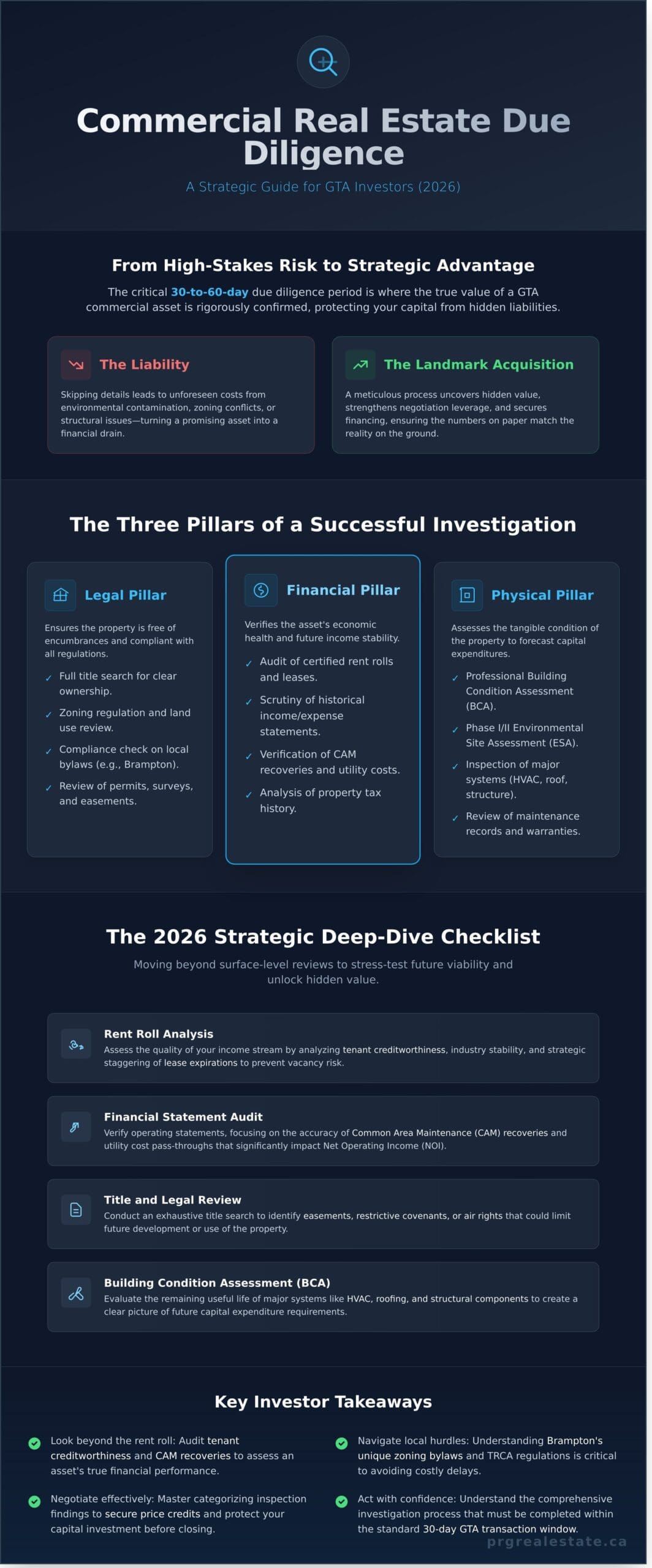
In the high-stakes Greater Toronto Area commercial market, the difference between a landmark acquisition and a multi-million-dollar liability is often buried in the details. The pro-forma looks perfect and the location is prime, but a nagging question remains: what hidden risks-from environmental contamination to complex Ontario zoning bylaws or unstable tenancy-lie just beneath the surface? This is precisely where a meticulous commercial real estate due diligence process transforms investor anxiety into strategic advantage. It’s the critical 30-to-60-day period where assumptions are challenged and the true value of a C$ asset is rigorously confirmed.

This definitive 2026 guide is engineered for savvy investors seeking to master this complex phase. We provide the actionable roadmap to navigate every inspection, document, and financial review. By the end, you will have the strategic clarity to protect your capital, uncover hidden liabilities, and confidently secure high-performing GTA assets, ensuring the numbers on paper match the reality on the ground.

Key Takeaways

  • Learn to look beyond the rent roll by auditing tenant creditworthiness and CAM recoveries to accurately assess an asset’s true financial performance.
  • Discover why navigating Brampton’s unique zoning bylaws and TRCA regulations is a critical step in your commercial real estate due diligence to avoid costly delays.
  • Master the art of categorizing inspection findings to effectively negotiate price credits and protect your capital investment before closing.
  • Understand the comprehensive investigation process-from financial audits to legal reviews-that must be completed within the standard 30-day GTA transaction window.

What is Commercial Real Estate Due Diligence in 2026?

In the high-stakes arena of the Greater Toronto Area’s property market, commercial real estate due diligence is the strategic, comprehensive investigation that separates a landmark investment from a financial liability. It is the process of verifying a property’s financial, physical, and legal health to ensure all facts presented are accurate and to uncover any potential risks before a transaction becomes binding. For most GTA transactions, the industry benchmark is a standard 30-day due diligence window, a period where the buyer has the conditional right to scrutinize every detail of the asset.

Looking ahead to 2026, this process is evolving. The modern approach now integrates AI-driven platforms for rapid document auditing and places a greater emphasis on environmental sustainability standards and ESG (Environmental, Social, and Governance) compliance. This process is typically two-phased: preliminary due diligence conducted before submitting an offer to assess initial viability, and formal due diligence, the deep-dive investigation that occurs after an offer is accepted.

The High Stakes of Skipping the Details

Overlooking details during due diligence is a costly error. In Ontario, the principle of Caveat Emptor, or “Buyer Beware,” places the onus squarely on the purchaser to uncover any defects. A “hidden” liability, such as an unregistered lien, significant structural fatigue, or environmental contamination, can translate into unexpected costs reaching tens or even hundreds of thousands of Canadian dollars. Furthermore, a thorough due diligence report is non-negotiable for securing financing, as Canadian lenders require this verification to mitigate their own risk and confirm the asset’s value.

The Three Pillars: Legal, Financial, and Physical

A successful investigation is built on three foundational pillars, each providing a critical layer of insight. The process of due diligence in commercial real estate requires a meticulous review of documents and physical conditions across these core areas to protect your investment.

  • Legal Pillar: This involves a full title search to confirm clear ownership, a review of zoning regulations to ensure the property’s intended use is permitted, and a compliance check against local Brampton bylaws and provincial regulations.
  • Financial Pillar: Here, we analyze the asset’s economic performance. This includes auditing certified rent rolls, scrutinizing historical operating expenses and income statements, and reviewing property tax history to project future financial stability.
  • Physical Pillar: This pillar assesses the tangible state of the property. It is typically executed through a professional Building Condition Assessment (BCA) to identify structural issues and an Environmental Site Assessment (ESA) to uncover any potential soil or groundwater contamination.

The 2026 Commercial Due Diligence Checklist: A Strategic Deep-Dive

In today’s competitive market, a surface-level review of a commercial asset is insufficient. Achieving superior returns requires a forward-looking, strategic approach to commercial real estate due diligence. This deep-dive moves beyond verifying current income to stress-testing a property’s future viability and profitability. A truly comprehensive commercial real estate due diligence process involves scrutinizing every operational, legal, and physical facet of the investment to mitigate risk and unlock hidden value.

Our 2026 checklist prioritizes four critical pillars of investigation:

  • Rent Roll Analysis: Moving beyond the numbers to assess the quality of your income stream. This involves a rigorous analysis of tenant creditworthiness, industry stability, and the strategic staggering of lease expirations to prevent catastrophic vacancy risk.
  • Financial Statement Audit: A meticulous verification of operating statements is essential. We focus on confirming the accuracy of Common Area Maintenance (CAM) recoveries and utility cost pass-throughs, as discrepancies here can significantly impact your Net Operating Income (NOI).
  • Title and Legal Review: We conduct an exhaustive title search to identify any easements, restrictive covenants, or air rights that could limit future development or use of the property. Uncovering these encumbrances early is critical to understanding an asset’s true potential.
  • Building Condition Assessment (BCA): A professional BCA provides a clear picture of capital expenditure requirements. We evaluate the remaining useful life of major systems like HVAC, roofing, and structural components to accurately forecast future costs.

Tenant and Lease Analysis

The stability of your investment is directly tied to your tenants. We demand Estoppel Certificates from every tenant to ensure their understanding of lease terms aligns with the landlord’s records-a non-negotiable step. Furthermore, our analysis identifies restrictive “Exclusive Use” clauses that could hinder future leasing to a broader tenant mix and flags any “Termination Rights” that could expose the property to sudden vacancy in a shifting economic climate.

Environmental and Structural Integrity

A Phase I Environmental Site Assessment (ESA) is standard. However, if it reveals potential contamination, a more invasive Phase II ESA becomes necessary to quantify the risk and remediation cost. Looking ahead to 2026, we assess the property’s “Carbon Footprint” and energy efficiency to ensure compliance with emerging sustainability standards. For assets in Ontario, we also conduct a thorough evaluation of Accessibility for Ontarians with Disabilities Act (AODA) compliance, a critical factor for long-term value and operational legality.

A generic checklist is insufficient for a dynamic and complex market like the Greater Toronto Area. The success of your commercial real estate due diligence hinges on granular, local knowledge that can identify both hidden risks and strategic opportunities. In Brampton and the surrounding Peel Region, navigating municipal-specific regulations is a critical component of any sound investment strategy. Partnering with top commercial realtors in Brampton ensures you have the expert guidance needed to master these local intricacies.

For investors eyeing development land, engagement with Conservation Authorities like the TRCA (Toronto and Region Conservation Authority) is non-negotiable. Their regulations can significantly impact site plans and development potential. Similarly, a forward-looking analysis of Municipal Property Tax Assessments is essential. We go beyond current MPAC values, examining Peel Region’s budgets and infrastructure plans-like upcoming Brampton transit projects-to forecast future tax hikes and value appreciation that directly affect your long-term returns.

Zoning and Land Use in Brampton

Brampton’s zoning bylaws present unique challenges that demand a specialist’s eye. It is critical to investigate a property’s “Legal Non-Conforming” status, as these rights can be lost upon redevelopment, potentially derailing your plans. Furthermore, verifying specific requirements, such as parking ratios for retail versus industrial units, can prevent costly compliance issues. An expert analysis of the “Brampton 2040 Vision” is also key to understanding how specific commercial corridors are slated for growth, ensuring your investment aligns with the city’s strategic direction. For a comprehensive overview of permitted uses, amendment processes, and designation checks, our detailed guide to Brampton zoning bylaws for property owners and investors is an essential resource.

Ontario-Specific Legal Requirements

A comprehensive approach to due diligence in commercial real estate must include a deep dive into the property’s legal and regulatory history. This process involves more than a simple title search; it requires proactive investigation into municipal records, often through freedom of information requests, to uncover a property’s complete file. Key Ontario-specific legal verifications include:

  • Work Orders & Building Permits: Reviewing the complete municipal history for any outstanding work orders, open permits, or past infractions that could become your liability.
  • Boundary Verification: Engaging an Ontario Land Surveyor (OLS) is essential to confirm precise property boundaries, identify any encroachments, and ensure the legal description is accurate.
  • Heritage Designations: Investigating if the property is subject to the Ontario Heritage Act, which can impose significant restrictions on alterations, demolition, and future development.

Commercial Real Estate Due Diligence: The Ultimate 2026 Investor’s Guide

Identifying Deal-Breakers and Negotiating Post-Discovery

The commercial real estate due diligence period is where your investment thesis is tested against reality. The findings from your inspections and reports are not just data; they are powerful negotiation tools. A successful outcome requires strategically categorizing these findings to determine your next move: renegotiate, proceed with adjustments, or walk away from a deal that no longer meets your financial objectives.

Expert investors sort discoveries into three tiers: minor maintenance (cosmetic fixes, routine upkeep), major capital repairs (a C$75,000 HVAC system replacement), and absolute deal-breakers-issues that fundamentally threaten the asset’s viability or your projected ROI.

Common Deal-Breakers in the GTA Market

In the competitive Greater Toronto Area, certain issues consistently emerge as non-negotiable roadblocks for savvy investors:

  • Severe Soil Contamination: A failed Phase II Environmental Site Assessment (ESA) near a former industrial site in Mississauga or Scarborough can reveal contamination requiring remediation costs that run into the hundreds of thousands of dollars, making the deal financially untenable.
  • Major Structural Deficiencies: When a Building Condition Assessment (BCA) uncovers foundational or structural repair costs exceeding 10% of the property’s purchase price, the immediate capital outlay often destroys the investment case.
  • Irreconcilable Zoning Conflicts: Discovering that municipal bylaws in Toronto or Brampton permanently prohibit your intended business use is a definitive deal-breaker that no amount of negotiation can overcome.

Negotiation Tactics After the Inspection

Armed with a detailed BCA report, you gain significant leverage. The art is in converting these data points into tangible financial advantages.

  • Price Reductions vs. Seller Repairs: A price reduction (or “credit at closing”) is almost always superior for your cash flow. It gives you direct control over the quality and timing of repairs, whereas seller-managed repairs can be rushed or completed to a minimum standard.
  • Extending the Due Diligence Period: If a major issue requires a specialist’s quote, professionally request an extension. Frame it as a necessary step to keep the deal on track, demonstrating your commitment to a fair resolution.

Your entire negotiation position can be summarized in one data-driven sentence: “The BCA has identified C$120,000 in immediate and unforeseen capital expenditures required to bring this property to an operational standard.” This shifts the conversation from opinion to fact. Furthermore, presenting these findings to lenders can demonstrate your meticulous risk management, potentially securing more favourable financing terms. For expert guidance on navigating these complex negotiations, connect with the specialists at PRG Real Estate.

How PRG Real Estate Streamlines Your Acquisition Strategy

Navigating the complexities of commercial real estate due diligence requires more than a checklist; it demands a seasoned conductor to orchestrate the entire process. At PRG Real Estate Brokerage, we serve as your “Acquisition General,” seamlessly coordinating the critical efforts of lawyers, engineers, accountants, and environmental assessors. We manage the timelines, synthesize the data, and ensure every detail is meticulously examined so you can make decisions with absolute confidence.

Our advisory is guided by a core “Clients for Life” philosophy. We are focused on your long-term return on investment, not a short-term commission. This commitment means we actively seek to identify and mitigate risk. Leveraging the market-leading expertise of Harsh Pabla, one of the top commercial realtors in Brampton, we spot potential red flags-from zoning inconsistencies to structural flaws-long before they become costly liabilities. Furthermore, our clients gain exclusive access to VVIP listings and off-market opportunities that have already undergone our rigorous preliminary vetting, saving you invaluable time and resources.

The PRG Advantage: Local Expertise Meets Strategic Vision

Our deep roots in the Brampton and Peel Region business communities provide an unparalleled advantage. We uncover the “soft” data-local sentiment, upcoming infrastructure projects, and a property’s true reputation-that official reports often miss. During this high-stakes phase of the transaction, our unwavering integrity ensures your interests are protected. Recently, we advised a client against a C$6 million industrial acquisition after our local intelligence revealed future logistical hurdles not yet public, safeguarding their capital from a high-risk investment.

Ready to Secure Your Next Investment?

Your journey toward a successful acquisition begins with a strategic consultation to define your investment criteria and financial goals. In the hyper-competitive Greater Toronto Area market, partnering with an elite brokerage is essential for navigating challenges and seizing premier opportunities. Partner with Brampton’s top commercial realtors for your next acquisition to ensure your due diligence is as strategic as your investment.

Transform Due Diligence from a Hurdle to a Strategic Advantage

As we’ve explored, successful commercial real estate investing in 2026 hinges on a meticulous and forward-thinking approach. The key takeaways are clear: due diligence is not merely a procedural checklist but a strategic deep-dive into a property’s true potential, and navigating the unique regulatory landscape of markets like Brampton and the GTA is non-negotiable for mitigating risk. A comprehensive commercial real estate due diligence process empowers you to identify deal-breakers, negotiate from a position of strength, and secure assets that align with your long-term financial goals.

This level of scrutiny demands specialized expertise. The team at PRG Real Estate brings a proven track record in high-value commercial and development transactions, backed by our position as top realtors in the Brampton and GTA markets. As recipients of the Royal LePage Red Diamond Award, placing us in the top 2% of agents nationwide, we offer an unparalleled level of strategic guidance to protect and grow your capital.

Don’t leave your next acquisition to chance. Book a Strategic Consultation with PRG Real Estate today and let our award-winning expertise transform your investment strategy. Your next successful commercial venture is within reach.

Frequently Asked Questions

How long does commercial real estate due diligence typically take in Ontario?

In Ontario, the due diligence period for a commercial property typically ranges from 30 to 90 days. The exact timeline is negotiable and depends on the asset’s complexity, the scope of necessary inspections, and any financing conditions. For instance, a simple retail unit may require less time than a large industrial site with potential environmental concerns. A strategic approach ensures this period is used efficiently to mitigate risk and confirm the investment’s value.

What is the difference between a Phase I and Phase II Environmental Site Assessment?

A Phase I Environmental Site Assessment (ESA) is a non-intrusive investigation to identify potential contamination by reviewing historical records and conducting a site visit. If this assessment reveals a recognized environmental condition, a Phase II ESA is then performed. Phase II is an intrusive process involving physical sampling of soil, air, or groundwater to confirm the presence and extent of contamination. This two-phased approach is critical for managing liability and risk.

Who pays for the due diligence reports, the buyer or the seller?

In almost all commercial real estate transactions, the buyer is responsible for commissioning and paying for all due diligence reports. These costs, including environmental assessments, building condition reports, and surveys, are considered the buyer’s investment in verifying the property’s condition and value. While this is standard practice, specific terms can occasionally be negotiated within the Agreement of Purchase and Sale, though it is rare for a seller to cover these expenses.

Can I back out of a commercial real estate deal during the due diligence period?

Yes, provided your Agreement of Purchase and Sale includes a well-defined due diligence clause. This condition grants you the right to terminate the agreement if your investigation uncovers findings that are unsatisfactory, at your sole discretion. When you withdraw from the deal within the specified timeframe as per the agreement’s terms, your deposit is typically returned in full. This contractual safeguard is fundamental to protecting your capital and ensuring you proceed with confidence.

What are the most common zoning issues found in Brampton commercial properties?

In Brampton, common zoning issues include legal non-conforming uses, where a property’s current use was permitted previously but fails to meet new zoning bylaws. Other frequent challenges are inadequate parking based on current standards, proposed uses that are prohibited within the specific zone, and structural encroachments that violate setback requirements. A comprehensive zoning review is essential to ensure your intended use for the property is fully compliant and to avoid future legal complications. Understanding the full scope of Brampton zoning bylaws can help investors proactively identify and address these issues before they become costly obstacles.

Why do I need a Building Condition Assessment if the property looks new?

A Building Condition Assessment (BCA) is a strategic necessity, even for properties that appear to be in excellent condition. This expert report uncovers latent defects in construction, assesses the lifespan of critical systems like HVAC and roofing, and provides a forecast for future capital expenditures. It moves beyond superficial appearances to deliver a precise understanding of the building’s structural and mechanical integrity, which is vital for accurate financial modeling and long-term asset management.

How does due diligence differ for a business purchase versus a property purchase?

While both require rigorous investigation, their focus differs significantly. Due diligence for a property purchase centres on the physical asset: the land, building, title, and environmental status. In contrast, due diligence for a business purchase is far broader, encompassing a deep analysis of financial statements, customer contracts, employee agreements, intellectual property, and goodwill. When acquiring an operating business with its real estate, both types of investigation must be conducted concurrently.

What specific documents should I request from the seller immediately after an accepted offer?

Immediately upon acceptance of an offer, your priority is to request a comprehensive document package from the seller. This should include the current certified rent roll, all tenant leases and related correspondence, and at least three years of financial operating statements. You should also request copies of all service and maintenance contracts, existing surveys, prior environmental or building condition reports, and recent property tax bills to begin your thorough commercial real estate due diligence process.

Commercial Property ROI in 2026: A Strategic Guide to Calculation & Maximization
CategoriesBlog

Commercial Property ROI in 2026: A Strategic Guide to Calculation & Maximization

In the dynamic Canadian real estate market, a surface-level understanding of an investment’s potential is a significant liability. Many sophisticated investors find themselves wrestling with complex spreadsheets, uncertain which metrics truly define a property’s value and fearful that a single miscalculation could derail their portfolio. This uncertainty often transforms the critical ‘go/no-go’ decision into a high-stakes gamble. The key to mitigating this risk and achieving superior outcomes lies in a strategic, forward-looking approach to calculating commercial property roi.

This 2026 strategic guide is engineered to move you beyond basic formulas. We will equip you with the advanced analytical tools and expert insights necessary to not only accurately project the financial performance of a potential asset but to truly maximize it. You will learn to identify the key levers that drive value, interpret complex data with confidence, and make decisive, data-driven investment decisions that build lasting wealth in the Canadian market. Prepare to transform your approach to commercial real estate investment for the years ahead.

Key Takeaways

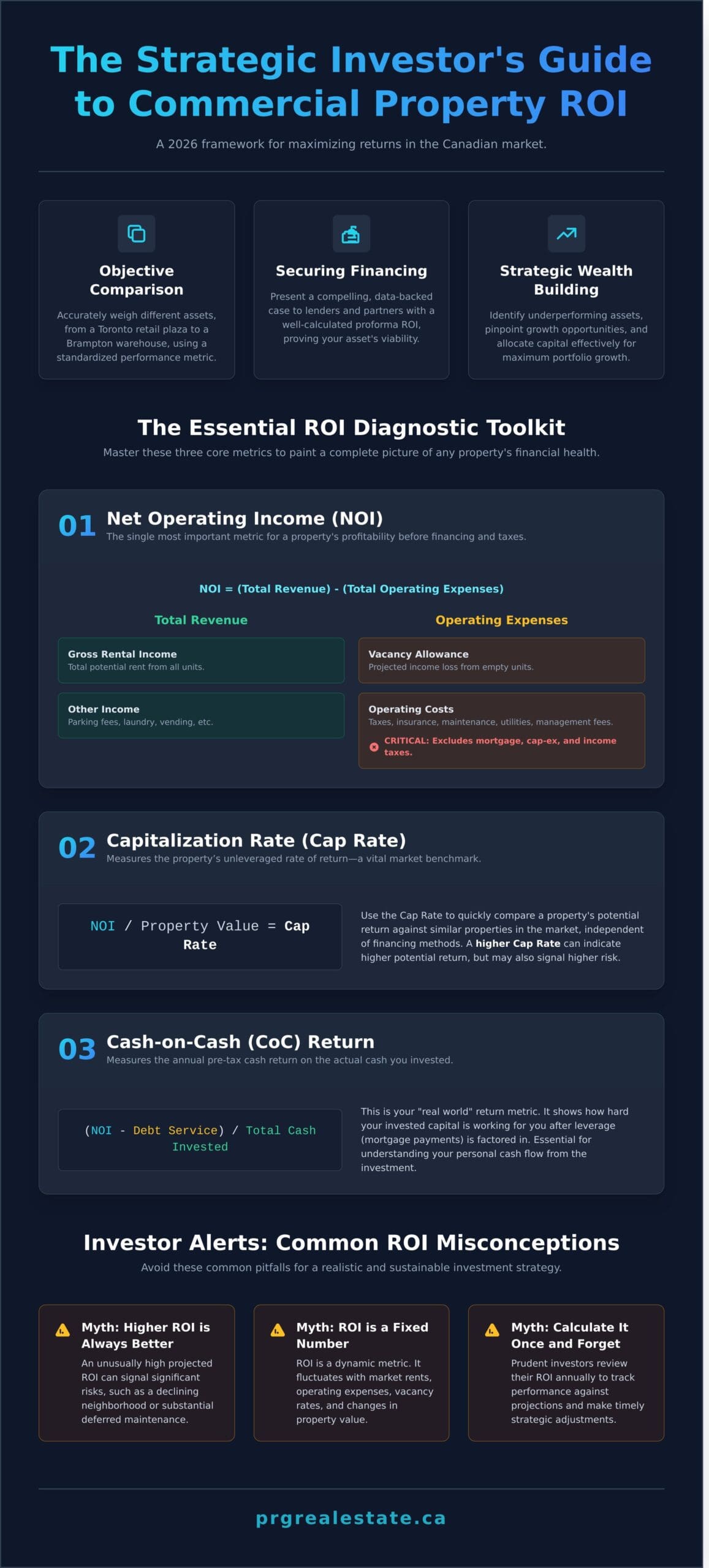
  • Move beyond purchase price to master the essential metrics, including Cap Rate and Cash-on-Cash Return, that reveal an investment’s true performance.
  • Uncover the critical factors beyond the initial calculation that significantly impact your real-world commercial property roi, from market fluctuations to unforeseen capital expenditures.
  • Learn four proven, value-add strategies to actively boost your property’s profitability, transforming a good investment into a high-performing asset.
  • Understand how leveraging expert local market knowledge is the definitive advantage in identifying and securing high-return commercial properties in Brampton.

Understanding Commercial Property ROI: The Ultimate Metric for Investors

In the strategic world of Canadian commercial real estate, success is not measured by the purchase price or gross rental income alone. The ultimate metric that separates savvy investors from speculators is the commercial property roi. At its core, Return on investment (ROI) is the definitive measure of an investment’s profitability and efficiency, expressing your net profit as a percentage of your initial capital. For example, a C$50,000 annual net profit on a C$1,000,000 property is far more telling than the gross rent figures.

It’s crucial to distinguish between an anticipated ROI, based on proforma projections before purchase, and your actual ROI, calculated from historical performance data. Mastering this calculation is the first and most critical step toward building a high-performing property portfolio.

Why ROI is Critical in Commercial Real Estate

A precise understanding of ROI is fundamental to any successful investment strategy. It moves beyond surface-level figures to provide a clear, standardized benchmark of performance, empowering you to make strategic decisions with confidence.

  • Objective Comparison: ROI allows for a direct, apples-to-apples comparison between vastly different assets. You can accurately weigh the potential of a 7% ROI on a retail plaza in Toronto against a 6% ROI on an industrial warehouse in Brampton.
  • Securing Financing: Lenders and financial partners demand proof of viability. A well-calculated proforma ROI demonstrates the asset’s potential to generate profit, making your financing application significantly more compelling.
  • Strategic Wealth Building: Your ROI figures form the foundation of your long-term goals. They help you identify underperforming assets, pinpoint opportunities for improvement, and strategically allocate capital for maximum growth.

Common Misconceptions About ROI

To leverage ROI effectively, investors must also recognize common pitfalls and myths that can lead to poor decision-making. Navigating these misconceptions is key to a realistic and sustainable investment approach.

  • Myth: A higher ROI is always better. While attractive, an unusually high ROI can signal higher risk, such as a property in a declining neighbourhood or one requiring substantial, unforeseen capital expenditures.
  • Myth: ROI is a fixed number. Your commercial property roi is a dynamic metric. It fluctuates with market rents, operating expenses, vacancy rates, and changes in the property’s market value over time.
  • Myth: You only need to calculate it once. Prudent investors review their property’s ROI annually. This regular analysis allows you to track performance against projections and make timely adjustments to your management strategy.

The Essential ROI Formulas: A Practical Calculation Guide

To make strategic investment decisions, you must move beyond speculation and into quantitative analysis. The true measure of a commercial property ROI is revealed through a core set of financial metrics. Think of these formulas not as isolated calculations, but as a diagnostic toolkit. While there are many different ways to calculate the ROI, mastering the following three will provide the foundational clarity needed to evaluate any deal. Each metric tells a different part of the story; together, they paint a complete picture of a property’s financial health and potential.

Calculating Net Operating Income (NOI)

NOI is the single most important metric for determining a property’s profitability before accounting for financing. It represents all the revenue the property generates, minus all reasonably necessary operating expenses.

Formula: Gross Rental Income + Other Income – Vacancy – Operating Expenses = NOI

Operating expenses include property taxes, insurance, maintenance, utilities, and property management fees. Crucially, they do not include mortgage payments (principal and interest), capital expenditures, or income taxes.

Example: A Small Brampton Commercial Unit

  • Annual Gross Rent: C$42,000
  • Vacancy Allowance (5%): -C$2,100
  • Annual Operating Expenses (Taxes, Insurance, Maint.): -C$9,900
  • Annual NOI: C$30,000

Determining Cap Rate (Capitalization Rate)

The Cap Rate measures the property’s unleveraged rate of return. It is a vital market benchmark used to compare the performance of similar properties, independent of any specific financing structure. It answers the question: “What return would I get if I bought this property with all cash?”

Formula: NOI / Current Market Value = Cap Rate

Using our Brampton example, if the property’s market value is C$550,000, the Cap Rate is C$30,000 / C$550,000 = 5.45%. In the current Greater Toronto Area market, commercial cap rates typically range from 4% to 6%, varying significantly by asset class and location. A higher cap rate often implies higher risk or a lower-quality asset, while a lower cap rate suggests lower risk and higher investor demand.

Calculating Cash-on-Cash Return

For investors using financing, the Cash-on-Cash Return is paramount. This metric calculates the return on the actual cash you’ve invested-your down payment, closing costs, and renovation expenses. It provides the clearest picture of the performance of your invested capital.

Formula: Annual Pre-Tax Cash Flow / Total Cash Invested = Cash-on-Cash Return

Continuing our example, assume a C$550,000 purchase with a C$200,000 total cash investment. If the annual mortgage payment (debt service) is C$26,400, your pre-tax cash flow is C$30,000 (NOI) – C$26,400 = C$3,600. Your Cash-on-Cash Return would be C$3,600 / C$200,000 = 1.8%. This demonstrates how leverage and financing terms directly impact your personal return and is a critical factor in assessing any deal’s viability.

Beyond the Numbers: Key Factors That Drive Real-World ROI

A spreadsheet can show a promising return, but seasoned investors know that financial formulas are only as reliable as the data fed into them. The most common pitfall for new investors is underestimating the qualitative factors that can drastically alter a property’s performance. Achieving a strategic and successful commercial property roi requires rigorous due diligence that goes far beyond the initial calculations. This is where professional expertise ensures your on-paper projections align with real-world outcomes.

Location and Market Dynamics

A property’s value is intrinsically tied to its location. A comprehensive analysis must include local economic indicators, such as job growth and major infrastructure projects, like those transforming areas of Brampton. Visibility and accessibility for customers, clients, and suppliers are critical. It’s also vital to assess the submarket’s health; high vacancy rates in the surrounding area can exert downward pressure on your rental income projections. Understanding the nuances of the broader post-pandemic commercial real estate market provides essential context for these local trends.

Tenant Quality and Lease Structure

Your tenants are the engine of your investment’s cash flow. A building occupied by creditworthy tenants on long-term leases represents a stable, low-risk asset. The structure of these leases is equally important. A Triple Net (NNN) lease, where the tenant covers property taxes, insurance, and maintenance, creates a predictable income stream for the landlord. Conversely, a Gross lease places these expense burdens on you, introducing more variability. A thorough review of existing lease agreements for details like rental escalations and renewal options is non-negotiable.

Property Condition and Capital Expenditures

Hidden costs can quickly erode your returns. Deferred maintenance is a liability that will eventually come due, often at a premium. Before any acquisition, you must account for the lifespan and potential replacement cost of major systems. These capital expenditures (CapEx) include:

  • Roofing systems
  • HVAC units
  • Parking lot and paving
  • Structural components

Commissioning a professional property condition assessment is a critical step to quantify these future costs, protecting your cash flow and the long-term viability of your investment. For a detailed guide on this process, review our comprehensive article: Evaluating Commercial Buildings for Sale: A Checklist.

Commercial Property ROI in 2026: A Strategic Guide to Calculation & Maximization

From Good to Great: 4 Proven Strategies to Increase Your Commercial ROI

Calculating your initial return on investment is merely the baseline. Elite investors understand that the true potential of an asset is unlocked through strategic management and proactive optimization. A disciplined approach to asset management is what separates average returns from exceptional ones. The following proven strategies are designed to actively enhance your commercial property roi, transforming your investment into a high-performing asset that delivers sustained value.

Strategy 1: Optimize and Increase Revenue Streams

Maximizing gross potential income is the most direct path to a higher ROI. This involves more than just collecting rent; it requires a strategic analysis of all potential revenue sources to ensure no opportunity is overlooked.

  • Align Rents with Market Value: Upon lease renewal, strategically adjust below-market rents to reflect current rates in your local Canadian market, instantly boosting your net operating income.
  • Introduce Ancillary Income: Monetize underutilized assets. Consider charging for reserved parking spots, leasing rooftop space for signage or telecom equipment, or offering secure storage units for a monthly fee.
  • Implement RUBS: Where permitted by provincial regulations, a Ratio Utility Billing System (RUBS) can be used to pass on a portion of utility costs to tenants, significantly reducing your operating expenditures.

Strategy 2: Systematically Reduce Operating Expenses

Every dollar saved in expenses flows directly to your bottom line and increases the property’s valuation. A disciplined approach to cost management is a critical component of maximizing investment performance and is essential for a healthy commercial property roi.

  • Conduct Regular Expense Audits: Routinely review all service contracts and operating costs to identify inefficiencies, eliminate waste, and renegotiate for more favourable terms.
  • Invest in Efficiency: Capital upgrades like LED lighting, smart thermostats, and low-flow water fixtures can generate substantial long-term savings on utilities, often with the support of government rebate programs.
  • Appeal Property Taxes: In Canada, property assessments are not always accurate. A successful tax appeal, managed by an expert, can result in significant and recurring annual savings.

Strategy 3: Execute Strategic Value-Add Improvements

Targeted capital expenditures can dramatically increase your property’s value and rental appeal, allowing you to command higher rents and attract more stable, long-term tenants. The key is to focus on improvements that offer the highest return.

  • Enhance Curb Appeal: Modernizing the facade, upgrading landscaping, and improving common areas can justify higher lease rates and reduce vacancy periods.
  • Repurpose Underutilized Space: Convert an oversized storage room into a small co-working space, a vacant basement into rentable storage lockers, or an unused office into a tenant lounge.
  • Add In-Demand Amenities: Depending on the asset class and location, adding features like EV charging stations, upgraded security systems, or modern end-of-trip facilities can be a powerful differentiator.

Executing these strategies with precision requires deep market expertise. To ensure your investment is positioned for maximum growth, partner with a top commercial real estate team that understands how to unlock true asset value.

Maximizing Your ROI in Brampton: The PRG Advantage

Understanding the formulas to calculate your return on investment is the first step. Translating those calculations into a profitable reality requires market-specific expertise and strategic execution. In Brampton’s dynamic and competitive landscape, the difference between an average return and a market-leading one is your choice of representation. This is where PRG Real Estate Brokerage provides a decisive advantage, ensuring your investment journey is built on a foundation of data, access, and expert guidance.

Expert Property Sourcing and Analysis

A superior commercial property roi begins with sourcing the right asset. Our team leverages unparalleled, on-the-ground knowledge of Brampton’s commercial corridors to identify undervalued properties with significant growth potential. We provide the accurate, verified data you need for your calculations-from current market rents in specific industrial parks to realistic operating expenses. Furthermore, our extensive network grants you VVIP access to off-market opportunities, positioning you to acquire high-return assets before they ever reach the public market.

Strategic Negotiation and Due Diligence

Securing a property on the right terms is critical to protecting your initial capital and maximizing future returns. The PRG Real Estate Brokerage team are master negotiators, adept at structuring deals that favour your financial objectives. We then guide you meticulously through the due diligence process, transforming assumptions into certainties. Our role extends to connecting you with our trusted network of professionals, including:

  • Top-tier commercial property inspectors
  • Experienced real estate lawyers in the Peel Region
  • Reliable contractors and property managers

A Partnership for Long-Term Growth

Our commitment to your success extends far beyond a single transaction. At PRG Real Estate Brokerage, we build relationships to become ‘clients for life,’ acting as your long-term strategic advisors. We provide ongoing insights into Brampton’s market trends, helping you identify the optimal moments to refinance, reposition, or sell your asset to secure maximum profit. Your success is our ultimate metric. Let our expertise in the local market elevate your investment strategy and deliver the exceptional commercial property roi you deserve.

Partner with Brampton’s top commercial realtors to secure your next high-return investment.

Transforming ROI from a Metric to a Milestone

As we look towards 2026, it is evident that achieving exceptional returns in commercial real estate demands more than a surface-level understanding. Success is built on a foundation of accurate calculation, a strategic awareness of the factors that influence value, and the proactive implementation of strategies to enhance asset performance. Ultimately, mastering your commercial property roi is the definitive measure of a successful and resilient investment portfolio.

Navigating this complex landscape requires a partner with proven expertise and a track record of excellence. As the Top Commercial Realtors in Brampton and Royal LePage® Red Diamond™ Award Winners, PRG Real Estate offers the strategic insight necessary to turn potential into profit. Our commitment is to ensure your investments are not just sound, but positioned for optimal growth in the Canadian market.

The opportunity for superior returns is within reach. Secure your strategic commercial investment. Contact PRG Real Estate today.

Frequently Asked Questions About Commercial Property ROI

What is a good ROI for commercial property in Canada?

In Canada, a good return on investment for commercial property typically ranges from 6% to 12% annually. However, this benchmark varies significantly based on asset class, location, and market conditions. Prime industrial properties in major hubs like the GTA may yield different returns than retail spaces in smaller cities. A strategic investment, backed by expert analysis, focuses on securing assets that align with your specific financial goals and risk tolerance for a superior commercial property roi.

Is commercial real estate more profitable than residential?

Commercial real estate can offer higher profitability than residential properties, primarily through stronger cash flow from long-term leases and built-in rent escalations. While residential assets may offer more stable appreciation, commercial investments provide opportunities for greater economies of scale. The choice depends on an investor’s capital, risk appetite, and management capabilities. A comprehensive analysis is essential to determine which strategy best aligns with your portfolio objectives.

How long does it take to see a return on a commercial property investment?

Investors can see returns from cash flow almost immediately after a property is tenanted, typically collected on a monthly basis. However, a return from capital appreciation-the increase in the property’s value-is a long-term prospect, often realized over a 5 to 10-year holding period. The timeline is heavily influenced by the investment strategy, whether it’s a stable, income-producing asset or a value-add project requiring significant repositioning and capital.

What is the difference between ROI and Cap Rate?

Capitalization Rate (Cap Rate) and Return on Investment (ROI) are both key performance metrics, but they measure different things. Cap Rate measures a property’s unleveraged annual return relative to its market value, providing a snapshot of potential profitability. In contrast, ROI provides a more comprehensive picture by calculating the total return, including financing, relative to the actual cash invested. A thorough analysis of commercial property roi requires understanding both metrics for a complete financial assessment.

Can you calculate ROI on a vacant commercial property?

You cannot calculate the actual ROI on a vacant property because there is no income to measure. However, you can and should calculate a *projected* ROI. This involves creating a pro-forma analysis using market-rate rental income, estimated operating expenses, leasing costs, and tenant improvement allowances. This forecast is a critical step in due diligence, allowing you to assess the investment’s potential and viability before acquisition, ensuring a strategic and informed decision.

What are the biggest risks that can negatively impact my ROI?

Several key risks can negatively impact your ROI. The most significant include tenant vacancies, which eliminate rental income, and unexpected capital expenditures, such as major structural or HVAC repairs. Economic downturns can also reduce tenant demand and rental rates. Furthermore, rising interest rates can increase financing costs and erode cash flow. Proactive property management and diligent financial planning are essential to mitigate these risks and protect your investment returns.

How do property taxes in Brampton affect my overall ROI?

Property taxes in Brampton, as in any municipality, are a significant operating expense that directly reduces a property’s Net Operating Income (NOI). Because ROI calculations are based on net profit, higher property taxes will lower your overall return. It is critical to factor in current and projected tax rates during your initial due diligence. A successful investment strategy requires accounting for these non-negotiable costs to ensure your financial projections are accurate and achievable.

Free Commercial Property Valuation: Accurately Determine Your Property's Worth
CategoriesBlog

Free Commercial Property Valuation: Accurately Determine Your Property’s Worth

Navigating the complexities of the Canadian commercial real estate market can be a significant challenge. You know your property is a valuable asset, but generic online calculators offer vague estimates, and the jargon of formal appraisals-from cap rates to Net Operating Income-can feel overwhelming. You need a clear, accurate picture of your property’s worth without committing to a costly formal appraisal. This is precisely why we’ve created this definitive guide, offering you a professional and free commercial property valuation to empower your investment strategy.

In the following sections, we will demystify the core valuation methods used by industry leaders and break down the key factors that influence your property’s value in today’s market. Our goal is to equip you with the clarity and confidence needed to make strategic decisions. Discover the true potential of your asset and receive a complimentary, data-backed assessment from PRG Real Estate, Brampton’s top commercial realtors, to help you determine your next move.

Key Takeaways

  • Understand why standard online valuation tools are inaccurate for commercial assets, which are primarily valued on their income-generating potential, not just comparable sales.
  • Discover the three core valuation methodologies-the Income, Sales Comparison, and Cost Approaches-that top brokers and appraisers use to determine a property’s true market worth.
  • Identify the key local market factors in Brampton and the GTA, from zoning regulations to economic trends, that directly impact your commercial property’s current and future value.
  • Learn how to leverage a Broker Opinion of Value (BOV) as a strategic tool for decision-making and receive your expert, no-obligation free commercial property valuation.

Why Online Valuation Tools Can’t Price Your Commercial Property

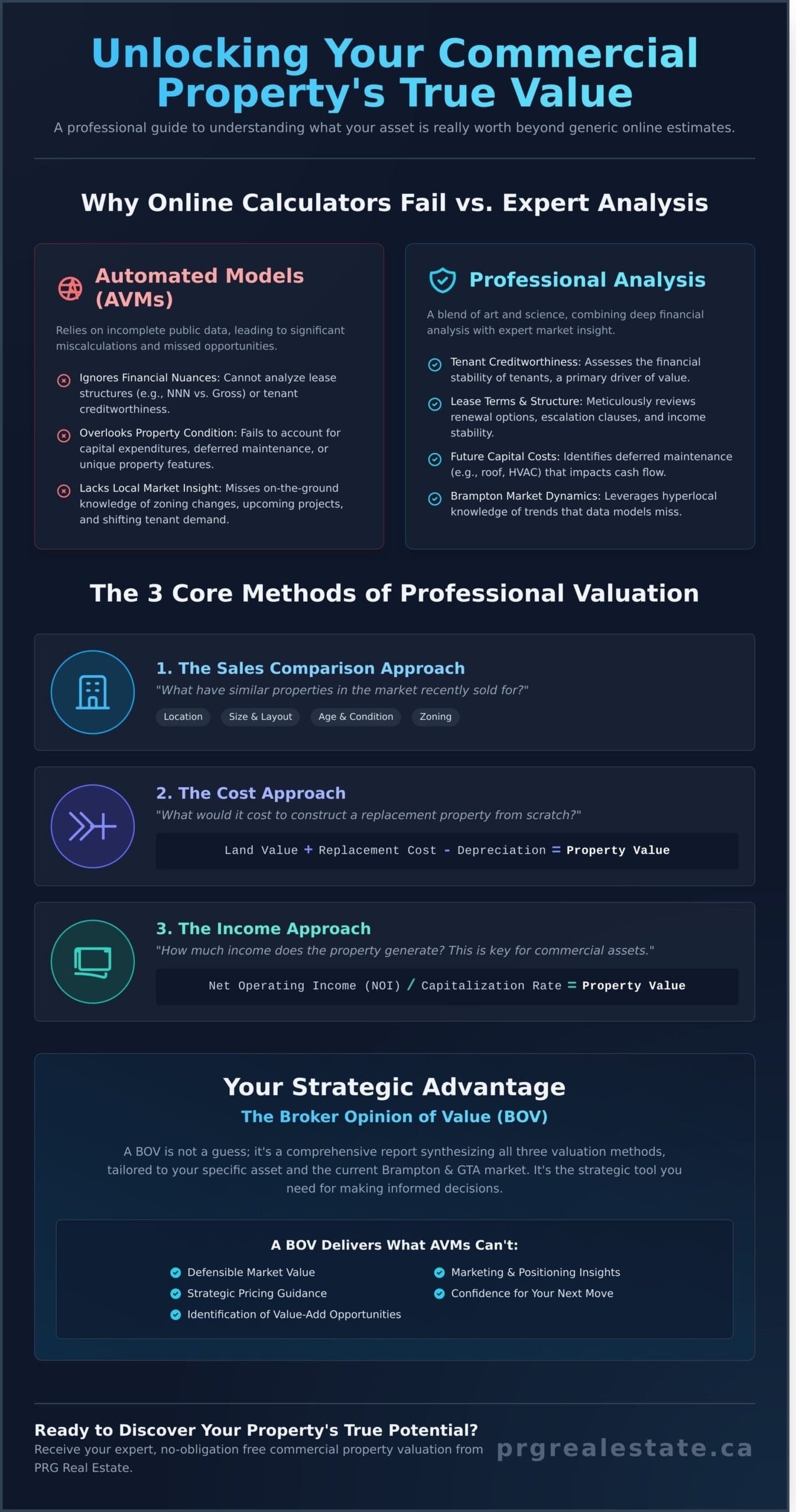
In today’s digital world, many investors search for a “Zillow for commercial properties”-a simple tool for an instant valuation. However, this concept is fundamentally flawed. Unlike residential homes, commercial assets are valued primarily as income-generating businesses, not just on square footage and recent sales. An automated estimate cannot grasp the complex financial and operational details that determine a commercial property’s true market worth, leading to significant miscalculations and missed opportunities.

The Problem with Automated Valuation Models (AVMs)

Automated Valuation Models (AVMs) are built on publicly available data, which is often incomplete or confidential for commercial transactions in Canada. These algorithms excel at comparing standardized residential properties but fail when faced with the unique nature of commercial real estate. An AVM cannot analyze the intricate details of a lease agreement, differentiate between a Triple Net (NNN) and a Gross lease, or understand how specific features like zoning restrictions, loading dock capacity, or ceiling clear height impact a property’s utility and value.

Key Data Points That Require Human Analysis

A strategic and accurate valuation requires an expert’s ability to interpret critical data points that algorithms overlook. Our approach to providing a free commercial property valuation is rooted in a comprehensive analysis that considers the complete financial picture of your asset. This includes a deep dive into factors that require professional judgment, such as:

  • Tenant Creditworthiness: The financial stability of your tenants is paramount. A long-term lease with a national, credit-rated corporation holds significantly more value than one with a new, unproven business.
  • Lease Terms & Structure: We meticulously review lease lengths, renewal options, and rent escalation clauses. The structure of the lease directly impacts your net operating income and, therefore, the property’s value.
  • Capital Expenditures: An expert assessment identifies deferred maintenance and potential future costs-like a roof replacement or HVAC system upgrade-that will affect the property’s cash flow and marketability.
  • Local Brampton Market Dynamics: As the top commercial realtors in Brampton, our team possesses on-the-ground knowledge of upcoming developments, infrastructure projects, and shifting tenant demand that generic data models will always miss.

Ultimately, a precise valuation is a blend of art and science, combining financial analysis with deep market insight. It requires an understanding of the established methods of professional commercial property valuation and the expertise to apply them to the unique context of your property and the local market. This level of detail is essential for making informed investment decisions.

The 3 Core Methods of Professional Commercial Property Valuation

Determining the true market value of a commercial asset is not guesswork; it is a strategic discipline built on established, industry-standard methodologies. At PRG, our experts don’t rely on a single data point. Instead, we synthesize insights from three core valuation approaches to provide a comprehensive and defensible assessment. Understanding these methods is the first step in appreciating the expert analysis that underpins a truly accurate, free commercial property valuation.

The Sales Comparison Approach (Market Approach)

Think of this as valuing your asset by examining what similar properties in the Canadian market have recently sold for. It’s a direct reflection of what buyers are currently willing to pay. Our experts perform a detailed analysis, comparing your property against others based on critical factors:

  • Location: Proximity to key arteries, transit, and amenities.
  • Size & Layout: Gross leasable area and functional design.
  • Age & Condition: The physical state and need for capital improvements.
  • Zoning: Permitted use and future development potential.

While highly effective, this method’s precision is contingent on the availability of recent, truly comparable sales, which can be scarce for unique assets.

The Cost Approach

This method answers a fundamental question: what would it cost to construct a replacement property from scratch today? The calculation is direct: Land Value + Replacement Construction Cost – Accumulated Depreciation = Property Value. Depreciation accounts for physical wear, functional inefficiencies, and external economic factors. This approach is most valuable for new constructions or special-purpose properties, such as a community centre or a custom-built industrial facility, where sales and income data are limited.

The Income Capitalization Approach

For an investor, a commercial property is an income-generating machine. This approach values the asset based on its capacity to produce cash flow. We first determine the Net Operating Income (NOI)-the property’s annual income after all operating expenses are paid. This NOI is then divided by a Capitalization (Cap) Rate, which reflects the prevailing rate of return for similar properties in the market. As the premier method for office buildings, retail plazas, and multi-family apartments, it directly links a property’s value to its financial performance, providing the insight you need from a free commercial property valuation.

Free Commercial Property Valuation: Accurately Determine Your Property's Worth

Key Factors That Directly Impact Your Property’s Value in Brampton

While valuation methods provide a framework, the true market value of your commercial property is determined by a strategic analysis of tangible, on-the-ground factors. An expert appraisal moves beyond theory to scrutinize the specific variables that buyers and investors prioritize. Understanding these elements allows you to see your asset through the eyes of the market, identifying both its strengths and areas for potential improvement.

Property-Specific Financials

The financial performance of your property is the bedrock of its value, directly feeding into the Income Approach calculation. A strong and stable cash flow is paramount for attracting premium offers.

  • Rent Roll Analysis: We assess the quality and diversity of your tenants. A property with long-term leases to national, credit-worthy tenants is inherently more valuable than one with short-term leases to small, independent businesses.
  • Lease Terms: Favourable terms, such as built-in annual rent escalations and limited landlord responsibilities (as in a triple net lease), create predictable revenue growth and reduce risk for a new owner.
  • Operating Expenses: A history of well-managed expenses, including property taxes, insurance, and maintenance, demonstrates efficiency and maximizes the Net Operating Income (NOI)-a critical driver of value.

Physical and Locational Attributes

A property’s physical characteristics and its strategic position within Brampton are fundamental to its desirability and long-term potential. Location isn’t just a mantra; in the GTA, it’s a primary value multiplier.

  • Location and Accessibility: Proximity to major transportation arteries like Highways 410, 407, and 401 is a significant advantage, particularly for industrial and logistics properties. High visibility and easy access for retail and office spaces also command higher values.
  • Building Condition: The age, construction quality, and recent capital expenditures (e.g., new roof, updated HVAC) are closely examined. A well-maintained building with minimal deferred maintenance is valued more highly.
  • Zoning and Development Potential: Current zoning regulations dictate the property’s use. However, its potential for future development, intensification, or rezoning can unlock substantial hidden value that a standard analysis might miss.

Brampton Market Dynamics

No property exists in a vacuum. Its value is directly influenced by the real-time conditions of the local Brampton and wider GTA market. This is where our deep market intelligence provides a decisive edge.

  • Supply and Demand: We analyze the current inventory for your specific asset class. Brampton’s tight industrial market, for example, has driven significant value appreciation due to high demand and limited supply.
  • Vacancy Rates and Market Rents: Low local vacancy rates indicate a healthy market, allowing landlords to command higher average rental rates per square foot, which in turn boosts potential income.
  • Prevailing Cap Rates: The capitalization rate is a direct reflection of investor sentiment and perceived risk for similar properties in the area. We track these rates meticulously to ensure your valuation is aligned with current market expectations.

These intricate factors and their interplay are precisely what our team at PRG Real Estate evaluates. A comprehensive understanding is essential for an accurate appraisal. To see how these elements apply to your asset, we invite you to request a free commercial property valuation from our experts. Our detailed analysis ensures you have the strategic insights needed to make informed decisions. Learn more about our approach at prgrealestate.ca.

How to Get Your Free, Professional Broker Opinion of Value (BOV)

Making a strategic decision about your commercial asset starts with a precise understanding of its current market value. A Broker Opinion of Value (BOV) from PRG Real Estate is a powerful tool designed to provide you with the clarity and confidence needed to optimize your investment strategy. We have streamlined our process to deliver expert insights efficiently and professionally.

What is a Broker Opinion of Value?

A BOV, often called a Comparative Market Analysis (CMA), is an expert assessment of your property’s market value conducted by an active commercial realtor with on-the-ground experience. It differs significantly from a formal appraisal, which is a legally binding document typically required by lenders for financing. A BOV is a strategic report that leverages real-time sales data and deep market intelligence, making it the ideal instrument for owners considering a sale, exploring refinancing options, or conducting a strategic portfolio review.

The PRG Valuation Process: What to Expect

Our commitment to excellence is reflected in our efficient and thorough valuation process. We respect your time and provide a clear, confidential path to the insights you need for your free commercial property valuation.

  • Step 1: Initial Consultation. We begin with a confidential discussion to understand your specific property, your long-term objectives, and any unique factors influencing your asset.
  • Step 2: Submission of Key Documents. To ensure maximum accuracy, we request essential documents such as the current rent roll and recent profit and loss (P&L) statements.
  • Step 3: In-Depth Market Analysis. Our team of top commercial realtors conducts a rigorous analysis, evaluating your property against comparable sales, active listings, and prevailing economic conditions in the Brampton market.
  • Step 4: Report Delivery and Discussion. We deliver a comprehensive valuation report and schedule a follow-up meeting to discuss the findings, answer your questions, and outline potential strategies to maximize your return.

Your Complimentary Valuation Report Includes:

Your final report is more than just a number; it is a detailed market intelligence document designed to empower your next move. The insights provided by the experts at PRG Real Estate will give you a decisive advantage.

  • A clear, estimated value range for your property in the current market.
  • A detailed analysis of comparable recent sales and active listings in your area.
  • Expert commentary on current Brampton and GTA market trends affecting your property’s value.

Ready to unlock the true potential of your commercial asset? Take the first step toward a more strategic and profitable future.

Request Your Confidential Valuation from Our Experts.

Secure Your Investment with a Professional Property Valuation

Determining the true worth of your commercial property is a critical strategic decision that generic online estimators simply cannot support. As we’ve covered, a credible valuation moves beyond simple algorithms, requiring an expert analysis of the three core valuation methods and the specific market factors impacting property values right here in Brampton.

Your asset deserves a precise and professional assessment. Let our team of top commercial real estate specialists provide you with a complimentary and confidential free commercial property valuation. This in-depth Broker Opinion of Value is grounded in real-time, local market data and is tailored to the unique characteristics of your property, providing the clarity you need to act with confidence.

Unlock the true potential of your investment. Request Your Free, No-Obligation Property Valuation Today.

Frequently Asked Questions About Your Property Valuation

What is the difference between a broker valuation (BOV) and a formal appraisal?

A Broker Opinion of Value (BOV) is a market-based estimate provided by a real estate professional to determine a probable selling price, used for strategic planning and listing decisions. In contrast, a formal appraisal is a legally binding valuation conducted by a licensed appraiser, typically required by lenders for financing or for legal matters. Our BOV provides expert insight into current market dynamics to inform your investment strategy and potential listing price.

How long does it take to receive my free commercial property valuation?

Our team of top commercial realtors is committed to providing a swift and accurate analysis. Once we receive all the necessary property information, you can typically expect to receive your comprehensive free commercial property valuation within 2 to 4 business days. This efficient turnaround ensures you have the timely data needed to make informed, strategic decisions regarding your asset without delay, reflecting our commitment to client success and results-oriented service.

Is the information I provide kept confidential?

Absolutely. PRG Real Estate operates with unwavering integrity and a commitment to client confidentiality. All information and documentation you provide for your property valuation are handled with the utmost discretion and are used exclusively for the purpose of creating your market analysis. Our reputation is built on trust and loyalty, and we guarantee that your sensitive financial and property data will be kept secure and private throughout the entire process.

Am I obligated to list my property with you if I request a valuation?

There is absolutely no obligation to list your property with PRG Real Estate. We offer this valuation as a professional courtesy to help you understand the current market value of your asset. Our goal is to provide strategic insights and build long-term relationships based on trust and expertise. Should you decide to sell in the future, we are confident our results-oriented approach will make us your first choice, but the decision remains entirely yours.

How often should I get my commercial property valued?

For strategic asset management, we recommend valuing your commercial property at least once a year to stay ahead of market fluctuations. However, an updated valuation is crucial following significant events such as major capital improvements, changes in tenancy or lease terms, local zoning amendments, or substantial shifts in the economic landscape. Proactive valuation ensures your investment strategy remains aligned with current market realities and maximizes potential returns.

What documents do I need to provide for an accurate valuation?

To provide the most accurate and strategic valuation, we require key documents that detail your property’s financial performance and physical condition. Please provide the current rent roll, income and expense statements for the last 2-3 years, a recent property tax bill, and a list of any significant capital expenditures made in the past five years. This data allows our experts to conduct a thorough and precise analysis of your asset’s market position.