
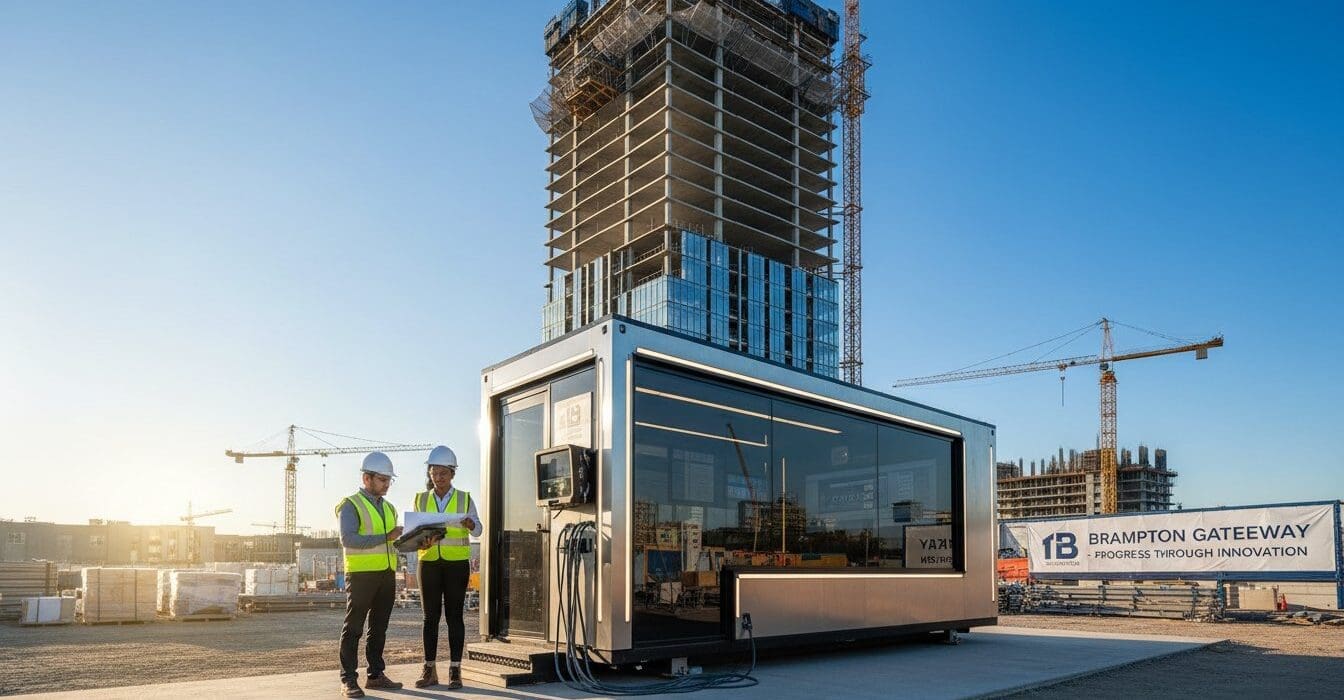
Construction Site Office Rental: A Developer’s Complete Guide
The success of a major development project hinges on meticulous planning and execution, but the central hub for that execution—the site office—is often a source of significant uncertainty. Navigating the complexities of construction site office rental in Canada can quickly become a challenge, fraught with concerns over hidden costs for delivery and setup, logistical hurdles with permits and utility hookups, and the critical need for a durable, secure space on an active job site. A misstep in this crucial decision can disrupt workflow, inflate budgets, and compromise your project’s professional image.
This guide is engineered to eliminate that uncertainty and empower you with expert advice. We will walk you through the entire process, from choosing the right size and features for your team to vetting reliable providers who offer transparent pricing in Canadian Dollars. You will gain the strategic insights needed to secure a cost-effective, fully compliant, and highly functional office for your project’s duration. Our commitment is to ensure you have a professional command centre that supports your unwavering commitment to excellence, facilitating a smooth and predictable rental experience from start to finish.
Key Takeaways
- A dedicated site office is a strategic command centre that is essential for driving project efficiency and maintaining professional oversight.
- Avoid overpaying by precisely defining your requirements for size, features, and amenities before you engage with rental providers.
- A successful construction site office rental strategy accounts for the total cost, including delivery, setup, and ancillary fees beyond the base C$ rate.
- The placement of your temporary office directly impacts workflow, site security, and overall project momentum; plan its location with care.
Why a Dedicated Construction Site Office is a Project Essential
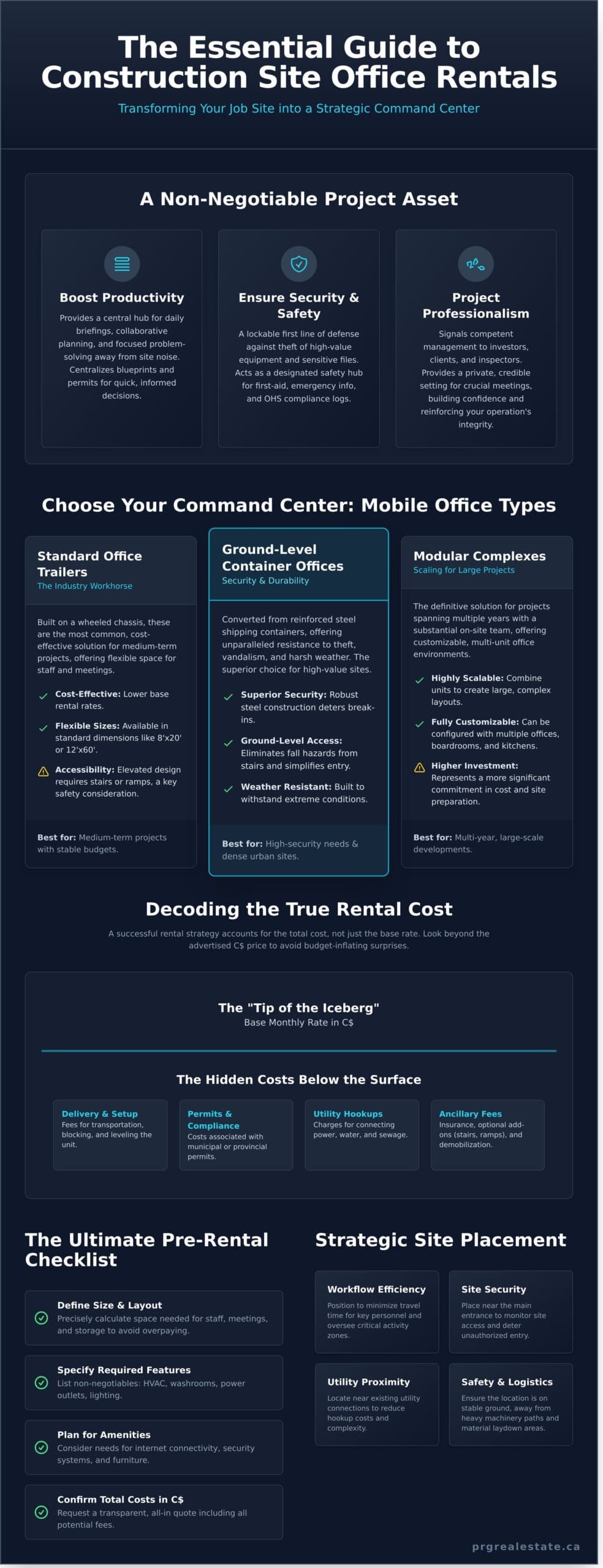
For any serious development project, managing operations from the cab of a truck or a makeshift corner is not a strategy for success—it’s a liability. A dedicated construction site office is a non-negotiable asset, serving as the central command center for the entire operation. It elevates the project from a chaotic job site to a professionally managed enterprise. Modern solutions, often in the form of versatile portable and modular buildings, provide a secure, climate-controlled environment that is critical for efficiency, compliance, and credibility. Investing in a proper on-site office is a direct investment in your project’s timeline, budget, and ultimate success.
Boosting On-Site Productivity and Coordination
A central office transforms on-site workflow from fragmented to focused. It provides a dedicated space for critical daily briefings, allowing superintendents, foremen, and trade partners to align on objectives and resolve issues collaboratively. More importantly, it offers a quiet, professional environment for focused planning, budget reviews, and complex problem-solving away from the noise and distractions of the site. Centralizing all essential documentation—from blueprints and permits to schedules and delivery slips—ensures every decision is informed, accurate, and immediately accessible, minimizing costly errors and delays.
Ensuring Security and Safety Compliance
A construction site is filled with high-value assets, from heavy equipment to sensitive technology and tools. A secure, lockable site office is the first line of defense against theft and vandalism, protecting laptops, surveying equipment, and confidential project files. It also functions as the project’s designated safety hub, providing a clean and accessible location for first-aid supplies, emergency contact information, and mandatory safety logs. In Canada, maintaining this formal site management presence is often essential for meeting provincial Occupational Health and Safety (OHS) regulations and avoiding potential stop-work orders.
Projecting Professionalism and Credibility
Perception is critical in the development industry. A well-maintained site office immediately signals to investors, lenders, and potential buyers that the project is managed with a high degree of professionalism and control. It provides a proper, private setting for crucial meetings with architects, engineers, municipal inspectors, and clients—building confidence that a makeshift tailgate meeting never could. Ultimately, a professional construction site office rental is a powerful tool for building trust and reinforcing the credibility of your entire operation, ensuring all stakeholders view your project as a serious and well-organized venture.
Key Types of Mobile Offices and Their Best-Use Cases
Selecting the optimal structure for your on-site headquarters is a critical decision that directly impacts operational efficiency, security, and budget. The right construction site office rental serves as the command centre for your project, and understanding the primary options is key to making a strategic choice. Beyond the structure itself, developers must also consider how the strategic placement of temporary facilities on site can enhance productivity and safety. Let’s explore the three main categories of mobile offices available in the Canadian market.
Standard Office Trailers: The Industry Workhorse
Built on a wheeled chassis for straightforward delivery and relocation, standard office trailers are the most common solution for medium-term projects. They are available in a range of standard sizes, such as 8’x20′ or 12’x60′, providing flexible space for site managers, administrative staff, and meetings. While highly cost-effective, their elevated design necessitates stairs or accessibility ramps, a key consideration for site logistics and safety compliance.
Ground-Level Container Offices: Security and Durability
For projects where security is paramount, ground-level offices converted from reinforced steel shipping containers offer an unparalleled solution. Their robust construction provides superior resistance to theft, vandalism, and harsh weather conditions. The primary advantage is direct ground-level access, eliminating fall hazards associated with stairs and simplifying entry. These units are the superior choice for high-value projects or sites in dense urban environments where asset protection is a top priority.
Modular Complexes: Scaling for Large-Scale Projects
When a development spans multiple years and requires a substantial on-site team, a modular complex is the definitive solution. These are not single trailers but multiple, interconnected units engineered to create a large, bespoke building. Layouts can be configured to include private offices, large conference rooms, kitchens, and washrooms, creating a fully functional operational headquarters. While representing a more significant investment, their scalability and customization offer unmatched flexibility for complex, long-duration projects demanding extensive on-site collaboration and management.
The Ultimate Checklist: Choosing the Right Rental for Your Site
Selecting the right construction site office rental is a critical strategic decision that directly impacts project efficiency and budget management. A methodical approach prevents overpaying for unnecessary space or features while ensuring your team has a productive and secure base of operations. This checklist provides a clear framework for assessing your needs, guaranteeing a seamless delivery and setup process from the moment you sign the agreement.
Calculating the Right Size and Layout
An accurate assessment of your spatial requirements is the foundation of a cost-effective rental. Before reviewing floor plans, define your operational footprint. A strategic evaluation of your needs ensures the mobile office serves as a project asset, not a logistical constraint. Consider the following:
- Personnel Capacity: Determine the maximum number of on-site staff, including project managers, engineers, and administrative personnel, who require dedicated desk space.
- Functional Zones: Do you require a private meeting area for stakeholder discussions, secure storage for documents and equipment, or a kitchenette for your team?
- Future Growth: For long-term projects, anticipate potential team expansion. Selecting a slightly larger unit or a modular option can prevent the need for a costly upgrade later.
Essential Features and Customizations to Consider
Modern site offices offer more than just basic shelter; they are command centres. Equipping your rental with the right features is non-negotiable for maintaining productivity and security. In Canada, robust climate control (HVAC) is essential for year-round comfort and performance. Other key features include integrated restrooms for convenience, high-security window bars, and reinforced steel doors to protect valuable assets. Ensure the unit is outfitted with sufficient data and electrical hookups to support all necessary technology and communications equipment.
Preparing Your Site: Utilities, Access, and Permits
A successful construction site office rental delivery depends entirely on diligent site preparation. Before the unit arrives, you must confirm the designated area is level, stable, and capable of supporting the structure’s weight. Access routes must be clear of obstructions to accommodate a large delivery truck and crane. Planning for utility connections—including electrical, water, and sewage—is a critical step that must align with site-wide logistics. Furthermore, ensuring your setup complies with provincial safety standards, which often align with comprehensive guidelines like the OSHA construction safety regulations, is paramount. Finally, consult with your local municipality to determine if any permits are required for placing a temporary structure on your property.
Understanding the Rental Process and True Costs
A strategic approach to a construction site office rental requires looking beyond the advertised monthly fee. The initial quote is merely the starting point; the true cost is revealed in the logistical details and contractual fine print. Understanding these elements is not just about budgeting—it is about protecting your project’s timeline and bottom line. A transparent process from a reputable provider is non-negotiable, and knowing the right questions to ask can save you thousands of Canadian dollars.
Decoding the Rental Agreement: Key Terms to Know
Your rental agreement is the definitive source of your rights and responsibilities. Before signing, scrutinize the contract for these critical terms to avoid costly assumptions:
- Minimum Rental Period: Most providers in Canada require a minimum term, often 3, 6, or 12 months. Clarify this upfront to align with your project schedule.
- Insurance and Liability: The agreement will specify the required liability coverage you must carry. Ensure your policy meets these minimums to protect against damage or theft.
- Maintenance and Repairs: Define who is responsible for routine maintenance versus significant repairs. Is there a 24/7 service line for urgent issues like a failed HVAC unit?
- Termination and Extension: Understand the financial penalties for early termination and the costs and notice period required for extending the lease if your project is delayed.
A Breakdown of Potential Costs Beyond the Base Rent
The total investment for your site office will include several ancillary costs that can significantly impact your budget. Be prepared to account for:
- Delivery and Installation: This is a major one-time expense, often running from C$2,000 to C$5,000+ depending on distance and site complexity. It includes transportation, crane services for placement, blocking, and levelling.
- Removal and Decommissioning: At the end of the project, you will incur a similar charge for the provider to dismantle and remove the unit from your site.
- Optional Add-Ons: Customizations like furniture packages, accessibility ramps, security systems with monitoring, and washroom facilities all come at an additional monthly cost.
- Damage Waivers or Deposits: Providers often charge a mandatory monthly damage waiver fee or require a substantial security deposit to cover potential damages during the rental period.
Top Questions to Ask Potential Rental Providers
To gain full clarity and compare providers effectively, your due diligence must include asking direct, comprehensive questions. A professional provider will welcome this scrutiny and provide clear answers.
- What is the total, all-in cost for my projected rental period, including delivery, removal, and all mandatory fees?
- What is your typical delivery lead time from contract signing to on-site installation?
- Who is responsible for arranging and paying for utility connections (hydro, water, septic)?
- What is your standard procedure and response time if the unit requires urgent repairs?
Navigating these details ensures your project remains on schedule and within budget. For a partner that excels in managing complex development logistics, let our development experts guide your project strategy.
Strategic Site Office Placement for Maximum Efficiency
The location of your site office is more than a matter of convenience; it is a strategic decision that directly impacts project efficiency, safety, and overall workflow. An optimally placed command centre ensures seamless communication, streamlined logistics, and effective oversight from groundbreaking to completion. Integrating your office into the broader site plan from the outset is a hallmark of meticulous project management and a critical step toward a successful build.
A well-thought-out placement strategy transforms your construction site office rental from a simple trailer into the operational heart of your project, ensuring every stakeholder, from site supervisors to visiting investors, can operate effectively.
Optimizing Workflow: Siting Your Office for Success
To maximize operational effectiveness, your site office must be positioned to enhance, not hinder, daily activities. This requires a forward-thinking approach that anticipates the project’s evolution. Key considerations include:
- Proximity to Entrance: Position the office near the primary site entrance to manage visitor access, sign-ins, and deliveries efficiently without disrupting core construction activities.
- Clear Lines of Sight: Ensure the office overlooks critical work zones, laydown areas, and high-traffic routes to provide supervisors with essential visibility for monitoring progress and safety.
- Future-Proof Location: Place the unit in an area that will not be compromised by future construction phases, such as excavation, foundation work, or crane placement, to avoid costly and disruptive relocations.
- Safety First: Locate the office away from designated high-traffic vehicle paths, hazardous material storage, and high-noise zones to ensure a safe administrative environment.
Integrating with Other Site Services
An effective site plan treats the office as an integral component of a larger ecosystem. Co-locating your construction site office rental with other essential services creates a logical and efficient hub that saves time and improves site morale. Strategic integration involves:
- Centralizing Resources: Position the office near material storage containers, tool cribs, and fabrication areas for simplified inventory management and access for foremen.
- Accessibility and Amenities: Ensure the office is close to designated staff parking and restroom facilities, creating a convenient and centralized administrative zone.
- Utility Connections: Plan the location to ensure straightforward and safe access to power grids, water lines, and data/telecom connections, minimizing trenching and cable runs.
This integrated approach fosters a cohesive site layout, reduces unnecessary movement, and reinforces a professional, well-managed project environment. Meticulous site planning is a core principle of successful development—a standard of excellence we uphold in every venture at PRG Real Estate.
Your Project’s Command Centre: The Final Blueprint
As this guide has established, the on-site office is the nerve centre of any successful development. Selecting the appropriate model and positioning it for maximum operational flow are not minor details—they are strategic decisions that directly impact your project’s timeline, budget, and overall success. A thoughtful approach to your construction site office rental transforms it from a temporary structure into a powerful tool for project management and execution.
This level of strategic thinking is the cornerstone of a profitable development, extending far beyond on-site logistics. As trusted advisors to Brampton’s leading construction projects, PRG Real Estate provides comprehensive, expert guidance through every complex phase, from initial land acquisition to final sale. Our unmatched expertise ensures your venture is built on a foundation of sound strategy and market intelligence. When you are ready to elevate your project from a plan to a landmark achievement, partner with the best. Plan your next development with Brampton’s top commercial realtors.
Frequently Asked Questions About Construction Site Office Rentals
How much does it cost to rent a construction office trailer?
The cost for a construction site office rental in Canada typically ranges from C$200 to C$600 per month, contingent on the unit’s size and features. A standard 8’x20′ trailer is at the lower end, while larger or more customized models are priced higher. Developers must also budget for additional expenses such as delivery, setup, and removal fees, which vary based on site location and accessibility. A detailed quote from a supplier is essential for accurate project forecasting.
What is typically included in a standard mobile office rental?
A standard rental package is designed for immediate operational readiness. It typically includes finished interior walls, durable flooring, secure doors and windows, an integrated HVAC system for climate control, and a basic electrical package with lighting and power outlets. Add-on features such as furniture packages, security systems, and accessibility ramps are usually available for an additional fee, allowing you to customize the space to meet precise project requirements and enhance on-site productivity.
Do I need a permit to place a temporary office on my construction site in Ontario?
Yes, in nearly all cases, a permit from the local municipality is required to place a temporary office on a construction site in Ontario. These structures are subject to the Ontario Building Code, and specific requirements can vary between municipalities like Toronto, Brampton, or Ottawa. It is a critical and non-negotiable step to consult with the local building department well in advance of delivery to ensure full compliance, avoid costly project delays, and maintain regulatory integrity.
How quickly can a rental office be delivered and set up?
For standard, in-stock mobile office units, delivery and setup can be executed with exceptional efficiency, often within 24 to 72 hours of finalizing the rental agreement. This rapid deployment hinges on a fully prepared site with clear, level access for the delivery vehicle. Custom-configured units or those requiring specific modifications will have a longer lead time. Strategic coordination with your provider is paramount to aligning delivery with your project’s critical path.
What are the typical electrical and utility requirements for a site office?
The standard electrical requirement for a site office is a 100-amp, 120/240-volt single-phase service. This connection must be completed by a licensed electrician to ensure safety and full code compliance prior to the office’s use. If the unit includes a washroom, dedicated connections for potable water and sanitary sewer lines will also be required. It is the developer’s responsibility to ensure these utilities are professionally installed and ready before the trailer arrives.
Can the office trailer be moved to a different location on the site during the project?
Yes, an office trailer can be relocated on-site, but this is a specialized task that requires professional coordination with the rental company. The provider will dispatch a dedicated crew and equipment to safely disconnect, move, and re-level the unit at the new location. This service incurs an additional cost and must be scheduled in advance. Attempting to move the unit with on-site construction equipment is strongly advised against as it can cause significant damage.
What is the difference between a mobile office and a modular building?
The key distinction between these structures lies in their scale, construction, and intended permanence. A mobile office is a single, self-contained unit built on a permanent chassis, designed for temporary use and ease of relocation. In contrast, a modular building is assembled on-site from multiple factory-built sections or “modules.” This method allows for larger, multi-story structures with greater design flexibility, suitable for long-term or even permanent applications that demand a more robust solution.