CategoriesBlog

Tenant Improvement Allowance: A Tenant’s Guide for Commercial Leases

Finding the ideal commercial space for your business is an exciting milestone. However, that excitement can quickly turn to anxiety when faced with a complex lease and the significant cost of transforming a bare shell into a functional, branded environment. The fear of hidden expenses and the pressure to negotiate favourable terms can be overwhelming for even the most experienced entrepreneurs.

This is precisely where understanding the tenant improvement allowance (TIA) becomes one of the most critical factors in your negotiation strategy. The TIA is a sum of money provided by the landlord to help you finance the construction and renovation of your new space, but securing a favourable deal requires professional insight and strategic planning.

In this guide, our team of expert commercial real estate professionals will equip you with the knowledge to navigate this crucial component of your lease. You will learn what a TIA typically covers, how to calculate the amount you need, and the proven negotiation tactics to secure the best possible terms. We are committed to ensuring your commercial investment is both strategic and successful, starting with a lease that empowers your business to thrive from day one.

Key Takeaways

  • Understand that a TIA is a strategic financial contribution from a landlord to fund your custom build-out, serving as a key incentive in commercial leasing.
  • Learn the critical distinction between TIA-covered ‘hard costs’ and non-covered ‘soft costs’ to budget your renovation project with professional accuracy.
  • Identify the key factors that provide leverage to successfully negotiate the maximum possible tenant improvement allowance for your commercial space.
  • Master the TIA process from the lease agreement to fund disbursement to ensure a smooth, efficient, and successful construction phase.

What is a Tenant Improvement Allowance (TIA)? The Fundamentals

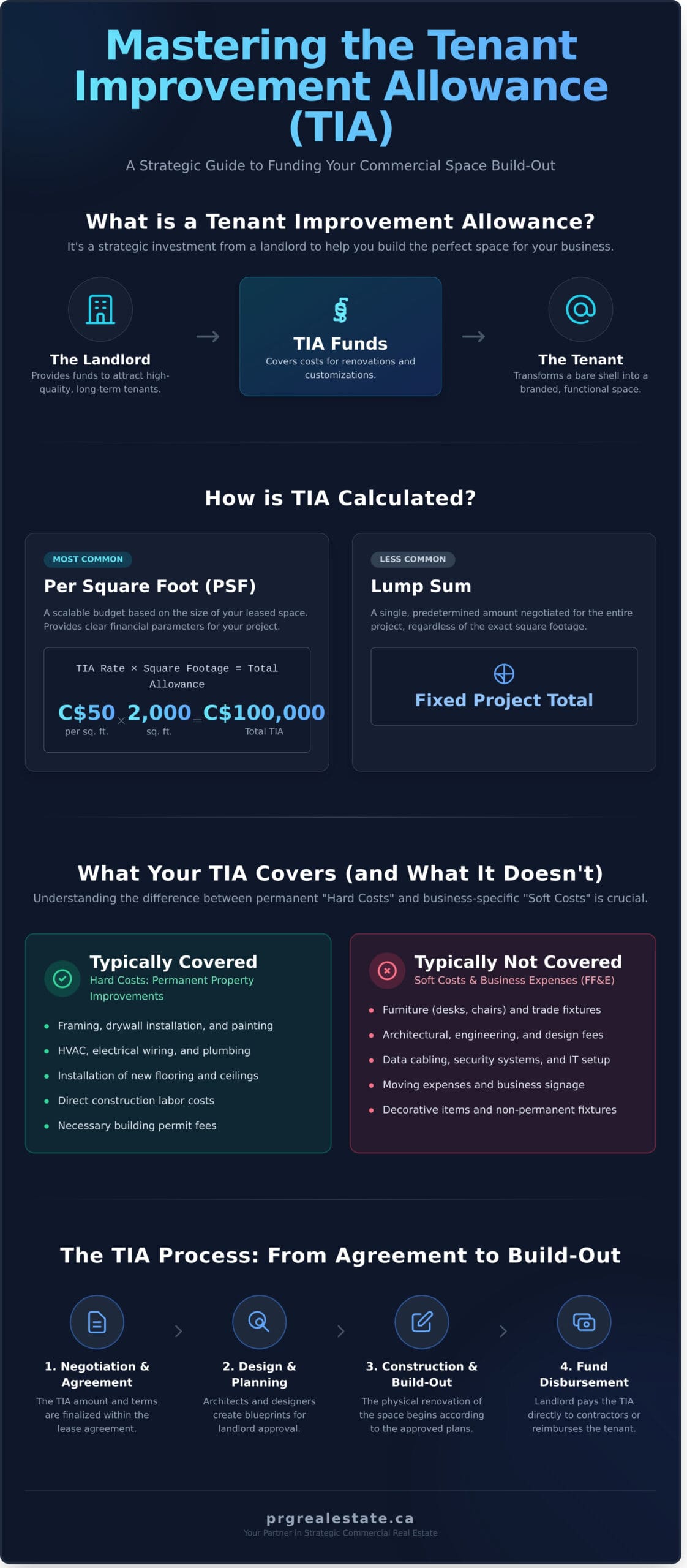
In commercial real estate, a tenant improvement allowance (TIA) is a sum of money provided by a landlord to a tenant to cover all or part of the costs associated with renovating or customizing a leased space. It is a powerful incentive designed to attract high-quality, long-term tenants by helping them transform a standard unit into a space that perfectly aligns with their business operations and brand identity.

Understanding the structure and purpose of this allowance is a critical first step for any business looking to lease commercial property. It is not a gift, but a strategic investment by the property owner to secure a reliable tenancy and enhance the value of their asset.

How TIA is Calculated: Per Square Foot vs. Lump Sum

The most common method for calculating a TIA, especially within the competitive Greater Toronto Area market, is on a per-square-foot (PSF) basis. This approach provides a clear and scalable budget. For example, if a landlord offers C$50 PSF for a 2,000-square-foot office in Brampton, your total allowance would be C$100,000. A less frequent alternative is a fixed lump sum, where a single, predetermined amount is negotiated for the entire project, regardless of square footage.

The Landlord’s Perspective: Why TIA is a Smart Investment

Landlords offer a tenant improvement allowance because it is a mutually beneficial arrangement that strengthens their investment. By understanding their motivation, tenants can frame their proposals more effectively during negotiations. Key landlord benefits include:

  • Securing Desirable Tenants: A competitive TIA helps landlords attract and retain stable, successful businesses in their properties for longer lease terms.
  • Increasing Asset Value: The renovations funded by the TIA-such as upgraded electrical, modern fixtures, or new layouts-become permanent improvements to the property, increasing its market value and appeal to future tenants.
  • A Powerful Negotiation Tool: The TIA is often a central point of negotiation, allowing landlords flexibility to close a deal that might otherwise stall on rental rates alone.

What Your TIA Covers (and What It Doesn’t)

A successful lease negotiation depends on a clear understanding of what your tenant improvement allowance can be used for. The fundamental distinction lies between “hard costs” and “soft costs.” Landlords provide this allowance to fund permanent, physical changes to the space-improvements that add value to the property itself and will remain after your tenancy ends. Understanding the nuances of how tenant improvement allowances work is crucial for accurately budgeting your build-out.

Eligible Expenses: Hard Construction Costs

Hard costs are tangible expenses directly related to the physical construction and alteration of the commercial space. These are the core improvements that transform a shell space into a functional environment for your business. Your tenant improvement allowance is almost exclusively designated for these types of expenditures.

  • Framing, drywall installation, and painting of new walls
  • HVAC system modifications, electrical wiring, and plumbing upgrades
  • Installation of new flooring (carpet, tile, hardwood) and ceilings
  • Labour costs directly associated with construction
  • Costs for necessary building permits

Commonly Excluded Items: Soft Costs & Business Expenses

Soft costs and other business-specific expenses are typically not covered because they are not permanent fixtures of the property. This category includes furniture, fixtures, and equipment (FF&E), which are movable and specific to your business operations. These items will be removed when you vacate the premises and therefore do not add long-term value to the landlord’s asset.

  • Furniture (desks, chairs, workstations) and trade fixtures
  • Architectural, engineering, and interior design fees
  • Data cabling, security systems, and IT infrastructure setup
  • Moving expenses, business signage, and decorative items
Typically Covered by TIA Typically Not Covered by TIA
Interior Walls & Doors Office Furniture & Cubicles
Electrical & Plumbing Computers & IT Equipment
HVAC & Ductwork Security Systems & Cameras
Flooring & Ceilings Architectural & Design Fees
Construction Labour & Permits Moving Costs & Signage

Crucially, these are general guidelines. The specifics of what is covered must be meticulously detailed in your lease agreement. A well-negotiated lease will eliminate ambiguity, ensuring both tenant and landlord have a clear, legally binding understanding of how the allowance funds will be allocated. Always seek professional guidance to ensure the terms align with your strategic objectives.

How to Negotiate the Best Possible Tenant Improvement Allowance

Entering lease negotiations is a standard and expected part of securing a commercial space. A landlord’s initial offer is a starting point, not a final decision. With a strategic and professional approach, you can secure the funding necessary to build out a space that perfectly aligns with your business objectives. Success hinges on understanding your leverage and presenting a compelling, data-backed case for the tenant improvement allowance you require.

Key Factors That Influence Your TIA Offer

A landlord’s willingness to invest in your build-out is a business decision calculated on risk and potential return. Several key factors strengthen your negotiating position and directly influence the TIA offer:

  • Your Financial Strength: A tenant with a strong credit history and solid financials represents a low-risk, high-value partner for the landlord.
  • The Length of the Lease Term: Offering to sign a longer lease (e.g., 7-10 years versus 3-5) provides the landlord with long-term, guaranteed income, making a larger TIA a more secure investment on their part.
  • The Current Condition of the Space: A raw ‘shell’ space will justifiably require a much larger TIA than a ‘second-generation’ space that only needs minor cosmetic updates.
  • Local Market Conditions: In a tenant’s market with higher vacancy rates, such as certain commercial districts in Brampton, landlords are more motivated to offer generous incentives to attract and secure quality tenants.

Actionable Strategies for a Successful Negotiation

Leverage is only effective when paired with a clear, professional strategy. To make a compelling case and secure the best possible terms, you should:

  • Obtain Detailed Construction Bids: Don’t rely on estimates. Presenting itemized bids from contractors adds significant weight to your request, transforming it from an ask into a data-backed business proposal. The legal framework around negotiating a tenant improvement allowance often hinges on such clear documentation.
  • Demonstrate Your Value: Showcase your business’s stability, growth potential, and how your presence will enhance the property’s overall tenant profile.
  • Be Prepared to Walk Away: Your most powerful negotiating tool is the ability to confidently pursue other options if the landlord’s terms are not financially viable for your business.

The Realtor’s Role: Your Advocate in Negotiations

Navigating these complex negotiations alone is a significant risk. An expert commercial realtor is an indispensable asset, providing critical market intelligence and professional advocacy. A top realtor understands current market-rate TIA values (e.g., C$50 vs. C$100 per square foot) and ensures your request is both competitive and realistic. They handle the intricate back-and-forth communication on your behalf, saving you valuable time while avoiding common pitfalls in complex lease language. Their expertise is your strategic advantage.

Partner with PRG’s experts to maximize your negotiation power.

The TIA Process: From Agreement to Build-Out and Payment

Once the tenant improvement allowance is finalized in your lease agreement, the process of transforming the space begins. A well-defined plan is crucial for a smooth and successful build-out, ensuring the project stays on schedule and within budget. This phase requires meticulous oversight and clear communication between you, your landlord, and your contractors.

Who Manages the Construction: Landlord vs. Tenant

A key strategic decision is determining who will oversee the construction. If the landlord manages the project, they leverage their existing contractor relationships, which can simplify the process. However, this often means less control for the tenant. When the tenant manages the build-out, they gain complete control over the design, quality, and timeline, ensuring the final space perfectly aligns with their brand vision. This choice is a critical point of negotiation.

Receiving Your Allowance: Disbursement Methods

In the Canadian commercial real estate market, funds from the allowance are typically disbursed in one of three ways, as stipulated in the lease:

  • Reimbursement: The tenant pays for all construction costs upfront and submits paid invoices and lien waivers to the landlord, who then reimburses them up to the agreed-upon allowance amount.
  • Direct Payment: The landlord pays contractors and suppliers directly from the allowance fund upon receiving approved invoices. This method reduces the tenant’s initial cash outlay.
  • Rent Abatement: If any portion of the TIA is unused, it may be applied as a credit toward future rent payments, though this is less common and must be explicitly negotiated.

Common Pitfalls to Avoid During the Build-Out

Executing a successful build-out requires avoiding common obstacles that can lead to costly delays and disputes. Proactive management is essential to protect your investment and ensure a timely opening. Key challenges to anticipate include:

  • Exceeding the Budget: Failing to account for all costs, from architectural drawings to final finishes, can quickly exhaust your allowance. Always include a contingency fund of 10-15%.
  • Lack of Landlord Approval: All plans, material changes, and contractor selections must receive written approval from the landlord to ensure they are eligible for TIA funds.
  • Permitting and Construction Delays: The process for securing municipal permits in Canada can be lengthy. Build these potential delays into your project timeline from the start.
  • Misunderstanding Eligible Costs: Be clear on what the tenant improvement allowance covers. It typically excludes trade fixtures, furniture, or moving expenses.

Navigating these complexities requires professional guidance. The expert team at PRG Real Estate Brokerage ensures our clients are positioned for success from negotiation to completion.

Secure Your Success with a Strategic Approach to Your TIA

Ultimately, a commercial lease is more than just a contract-it’s a strategic tool for your business’s growth. Understanding the fundamentals of a tenant improvement allowance is the first step toward creating a space that aligns with your objectives. A well-negotiated TIA not only funds your essential build-out but also reflects the strength of your entire lease agreement. Mastering the process, from defining the scope of work to navigating payment, is crucial for a successful outcome.

Navigating these complex negotiations requires professional expertise. As the Top Commercial Realtors in Brampton, PRG Real Estate has a proven track record in successful lease negotiations, backed by an unwavering commitment to client success. Don’t leave this critical investment to chance. Secure your ideal commercial space with expert guidance. Contact PRG today.

Let us help you lay the groundwork for your future success.

Frequently Asked Questions About Tenant Improvement Allowances

What is a standard tenant improvement allowance in Brampton or the GTA?

While there is no single standard, a typical tenant improvement allowance in Brampton and the GTA can range from C$20 to over C$100 per square foot. The final amount is highly negotiable and depends on factors like the building’s class, current market conditions, the length of the lease term, and the tenant’s financial strength. A longer lease term and a stronger tenant profile often result in a more generous allowance from the landlord.

What happens if my renovation costs are higher than the TIA?

If your total renovation expenses exceed the agreed-upon TIA, the tenant is responsible for paying the difference out of pocket. This is a common scenario, and it is critical to budget for potential overages before commencing work. Effective project management and detailed cost estimation are essential to ensure that your build-out aligns with both your vision and your financial plan, preventing unexpected financial strain on your business operations.

What happens if I don’t use the full tenant improvement allowance?

The treatment of unused funds depends entirely on the terms negotiated in your lease agreement. In many cases, any portion of the tenant improvement allowance that is not used is forfeited, meaning the landlord retains the funds. However, a well-negotiated lease may allow for the remaining balance to be applied as a credit toward future rent payments. It is crucial to clarify this point during lease negotiations to maximize the value of your allowance.

Is the tenant improvement allowance considered taxable income?

In Canada, a TIA is generally considered taxable income for the tenant if the tenant owns the improvements. However, the tenant can then claim capital cost allowance (depreciation) on these leasehold improvements over time. The specific tax implications can be complex and depend on the structure of the lease. We strongly advise consulting with a professional tax advisor to ensure compliance and to structure your agreement in the most financially advantageous way.

Can I use the TIA to pay for architectural or design fees?

Yes, a TIA can typically be used to cover both “hard costs,” like construction and materials, and “soft costs.” Soft costs include professional services such as architectural drawings, design consultations, engineering fees, and project management expenses. To ensure clarity and avoid disputes, your lease agreement should explicitly list all the permissible uses for the allowance funds, confirming that these essential professional fees are covered by the landlord’s contribution.

What is a ‘turn-key’ build-out and how does it differ from a TIA?

A ‘turn-key’ build-out is when the landlord manages and pays for the entire renovation process based on a pre-agreed plan, delivering a move-in-ready space to the tenant. In contrast, a tenant improvement allowance provides the tenant with a specific amount of capital to manage their own build-out. A TIA offers the tenant greater control over design and contractors, while a turn-key solution offers more convenience and less direct management responsibility for the tenant.

CategoriesBlog

How to Rent Office Space: A Complete Step-by-Step Guide

Securing the right commercial property is a critical milestone for any successful business. Yet, the process to rent office space can feel overwhelmingly complex, fraught with potential pitfalls from hidden costs in lease agreements to time wasted on unsuitable viewings. This uncertainty can stall momentum and create unnecessary risk, turning a strategic business decision into a source of significant stress.

At PRG Real Estate Brokerage, we believe this process should empower your business, not hinder it. That is why we have developed this complete, step-by-step guide. Our expertise is distilled into a clear, strategic framework designed to help you navigate the Canadian commercial real estate market with confidence. Follow our professional insights to master every stage-from defining your precise needs and budget to securing a lease agreement that fuels your company’s success and protects your bottom line.

Key Takeaways

  • A strategic assessment of your business requirements is the critical first step to prevent costly errors and streamline your property search.
  • Understand the key differences between traditional leases, serviced offices, and co-working spaces to identify the most strategic fit for your team.
  • Mastering lease negotiation is essential to secure favourable terms and achieve significant long-term savings when you rent office space.
  • Professional due diligence and a thorough review of the formal lease agreement are non-negotiable steps to protect your business interests before signing.

Step 1: Define Your Business’s Office Space Needs

Before you begin to rent office space, establishing a clear and strategic foundation is paramount. This initial planning phase is the most critical step in the entire process, preventing costly missteps and aligning your physical workspace with your long-term business objectives. A well-defined strategy ensures your new office is not just a location, but a strategic asset that supports your growth projections for the next three to five years.

As you map out your physical expansion, it’s wise to ensure your digital strategy can support this growth. A strong online presence is often the engine that drives the need for a larger office in the first place. For companies focused on scaling, partnering with a digital marketing agency like GoUP can be as fundamental as securing the right lease.

Calculating Your Budget

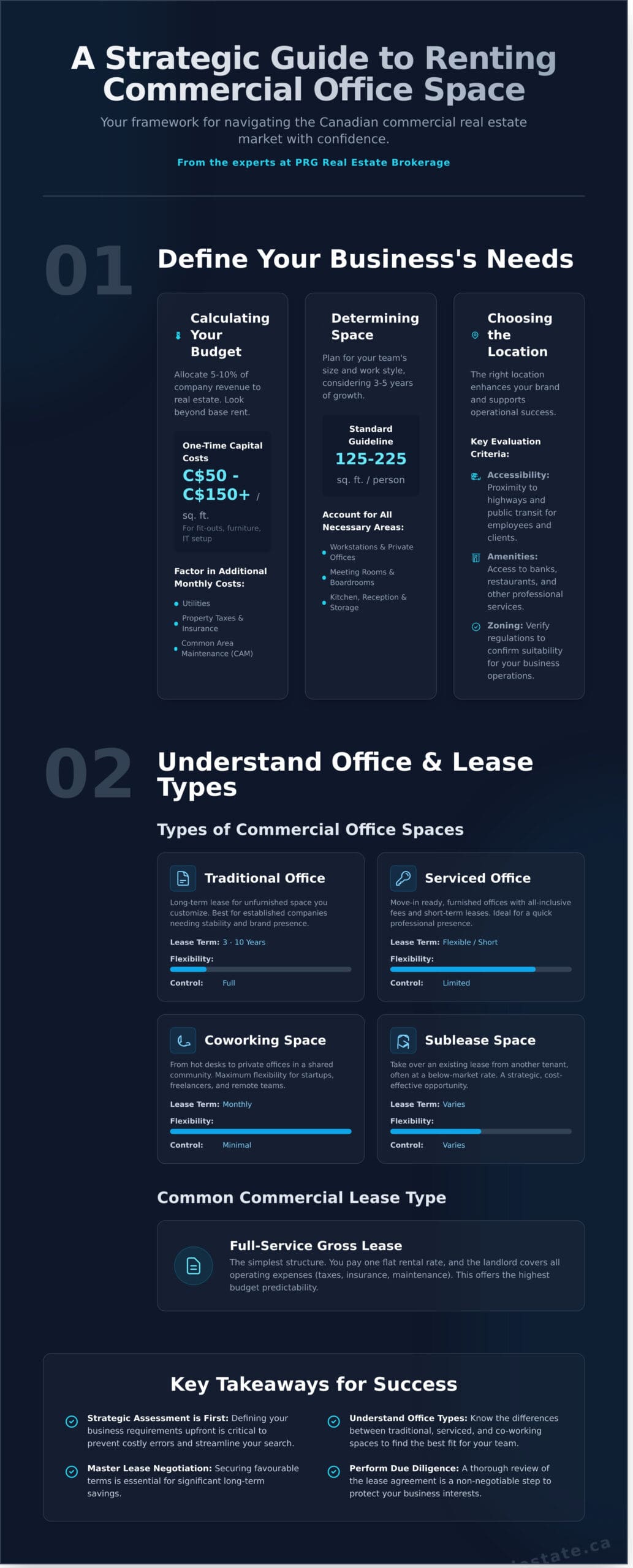
A successful lease begins with a comprehensive budget. Look beyond the base rent to determine your all-in monthly cost. In Canada, this often includes additional expenses such as utilities, property taxes, insurance, and Common Area Maintenance (CAM) fees, which are detailed in your commercial lease agreement. Furthermore, you must account for significant one-time capital expenditures like office fit-outs, furniture, and IT infrastructure setup, which can range from C$50 to over C$150 per square foot. A common guideline is to allocate 5-10% of your company’s revenue to real estate, though this figure varies significantly by industry.

Determining Space Requirements (Sq. Ft.)

Your space requirement, measured in square feet, directly impacts efficiency and employee satisfaction. A standard guideline is 125-225 square feet per person, but this depends on your operational model. Consider all necessary areas:

  • Open-plan workstations and private offices
  • Collaborative meeting rooms and boardrooms
  • Essential support spaces like a kitchen, reception area, and storage

The rise of hybrid work models may allow for a more efficient footprint, but it requires expert planning for shared desks (“hot-desking”) and technology-enabled collaboration zones.

Choosing the Right Location

The right location is a powerful statement about your brand and a key factor in operational success. Your analysis should prioritize accessibility for both employees and clients, considering proximity to major highways and public transit. Evaluate the surrounding amenities-such as banks, restaurants, and professional services-that contribute to a productive work environment. The location’s image must align with your company’s professional reputation. Finally, ensure you verify local zoning regulations to confirm the property is suitable for your specific business operations.

As you consider how your physical space reflects your brand, it’s also an opportune time to ensure your team’s professional image is just as polished. To support this, you can explore Headshots Photography and learn how it strengthens your company’s first impression online.

Step 2: Understand Office Types and Lease Structures

After completing the crucial first step of defining your office space needs with input from your team, you are positioned to evaluate the market. The process to rent office space is no longer a one-size-fits-all proposition. A strategic understanding of available office types and their corresponding lease structures is fundamental to controlling costs and ensuring your workspace aligns with your business objectives for long-term success.

Types of Commercial Office Spaces

Selecting the right environment is a critical decision that directly impacts your company culture, productivity, and budget. Each type of space offers a distinct set of advantages tailored to different business models and growth stages.

  • Traditional Office Space: This option involves a long-term lease (typically 3-10 years) for an unfurnished space that you can customize completely. It is the preferred choice for established companies seeking stability, a strong brand presence, and full control over their environment.
  • Serviced Offices/Executive Suites: These are move-in-ready, furnished offices with short-term, flexible leases. The monthly fee is all-inclusive, covering rent, utilities, internet, and access to shared amenities like reception services and meeting rooms. Ideal for businesses needing a professional presence quickly.
  • Coworking Spaces: Offering maximum flexibility, coworking environments provide options from a single “hot desk” to private offices within a shared, collaborative community. This is a highly effective solution for startups, freelancers, and remote teams seeking networking opportunities and minimal commitment.
  • Sublease Space: This involves taking over an existing lease from another tenant. Subleases are often available at a below-market rate and may come furnished. They represent a strategic, cost-effective opportunity, though with potentially less flexibility on terms than a direct lease.

Common Commercial Lease Types

Understanding the financial structure of your lease is just as important as choosing the physical space. In Canada, commercial leases typically fall into one of three main categories, each allocating responsibility for operating expenses differently.

  • Full-Service Gross Lease: The simplest structure. You pay a single, flat rental rate (e.g., C$6,000 per month), and the landlord is responsible for all operating expenses, including taxes, insurance, and maintenance. This offers budget predictability.
  • Triple Net (NNN) Lease: A common structure where you pay a lower base rent plus a proportionate share of the property’s operating costs: property taxes, building insurance, and Common Area Maintenance (CAM). While it offers transparency, monthly costs can fluctuate.
  • Modified Gross Lease: A hybrid agreement where the base rent includes some operating expenses, but not all. The lease explicitly defines which costs are covered by the landlord and which are passed on to the tenant. It represents a negotiated middle ground between a Gross and NNN lease.

Step 3: The Search Process and Property Tours

With your strategic requirements defined, the active search for your ideal commercial property begins. A comprehensive approach is critical to success. This involves leveraging a combination of modern online tools and the deep market knowledge of industry professionals. The goal is not just to find a space, but to find the right space-one that aligns perfectly with your operational needs and business objectives.

As you begin touring properties, remember that your evaluation must go beyond surface-level aesthetics. A successful tour is a functional assessment, ensuring the space can support your company’s growth and productivity for years to come.

Where to Find Office Space Listings

A multi-channel search strategy yields the best results. To build a strong list of potential properties, combine these effective methods:

  • Online Commercial Platforms: Dedicated online commercial real estate platforms offer extensive listings, allowing you to filter by location, size, and price.
  • Commercial Real Estate Brokers: An expert realtor provides access to exclusive or off-market listings that are not publicly advertised, giving you a significant competitive advantage.
  • Local Reconnaissance: Driving through your target neighbourhoods can reveal ‘For Lease’ signs on prime properties that may have limited online visibility.
  • Professional Networking: Connect with other business owners in your industry or area. Their firsthand experiences and recommendations can be invaluable.

What to Look for During a Tour

To properly evaluate each option when you rent office space, a methodical approach is essential. Arrive prepared with a detailed checklist based on the needs you identified in Step 2. Pay close attention to:

  • Core Infrastructure: Confirm the HVAC system is modern and functional. Assess the electrical capacity to ensure it can handle your equipment, and verify the availability of high-speed fibre internet.
  • Building Condition & Management: Observe the state of common areas, elevators, and washrooms. A well-maintained building often indicates proactive and professional property management. Note the quality of other tenants, as they form your business community.
  • Documentation: Take high-quality photos, videos, and detailed notes for each location. This documentation is crucial for making accurate side-by-side comparisons later.

The Value of a Commercial Realtor

Navigating the commercial real estate market alone can be complex and costly. A dedicated tenant representative or commercial realtor works exclusively for you, not the landlord. Their sole focus is to protect your interests and secure the most favourable terms possible. Their expert market knowledge is instrumental in identifying properties that offer the best value and negotiating a lease that aligns with your financial goals. From the initial search to the final signature, they manage the intricate details, allowing you to focus on your business. Partner with an expert commercial realtor to simplify your search.

Step 4: Making an Offer and Negotiating the Lease

You have identified the ideal property for your business. The next phase is the most critical for your long-term financial success: securing the space on favourable terms. This strategic process begins with a formal offer and culminates in a lease agreement that supports your business goals. Remember, nearly every clause in a commercial lease is negotiable, and expert guidance is paramount to achieving the best possible outcome.

Submitting a Letter of Intent (LOI)

The Letter of Intent is the foundational document that formally initiates negotiations. It outlines the primary business terms of your proposed lease, demonstrating your serious intent to the landlord. While typically non-binding, a professionally drafted LOI sets a confident and clear tone for the entire process. Key details include:

  • Offered Rent: The proposed base rent (e.g., C$22 per square foot net) and any additional rent.
  • Lease Term: The desired length of the lease, such as five or ten years, with any renewal options.
  • Key Dates: The target possession date and the proposed rent commencement date.
  • Tenant Improvements (TI): Any specific build-outs required and the requested TI allowance from the landlord to fund them.

Key Negotiation Points for a Successful Lease

A successful negotiation extends far beyond the rental rate. Our expertise ensures every critical component of the lease is structured to your advantage, protecting your investment and providing operational flexibility when you rent office space. We focus on securing favourable terms on the following points:

  • Rental Rate and Escalations: We work to secure a competitive market rate and negotiate firm caps on annual rent increases to ensure predictable overhead costs for your business.
  • Lease Term and Renewals: Achieving the right balance between a long-term, stable lease and the flexibility of renewal options is essential for future strategic planning.
  • Tenant Improvement (TI) Allowance: We negotiate to secure a substantial TI allowance from the landlord (e.g., C$40 per square foot) to fund your custom office build-out, minimizing your upfront capital expenditure.
  • Concessions: Securing concessions like a free-rent period at the beginning of your term is a common strategy we employ to improve your cash flow as you start operations.

The details negotiated at this stage will impact your business’s profitability for years to come. Navigating these complex terms requires market expertise and an unwavering commitment to excellence. The top commercial realtors at PRG Real Estate Brokerage ensure your lease becomes a strategic asset, structured for your long-term success.

Step 5: Due Diligence and Finalizing the Agreement

You have successfully navigated the search, tours, and negotiations. This final stage is the most critical checkpoint before making a long-term commitment. Meticulous attention to detail here transforms your decision to rent office space into a successful, legally sound investment for your business. This is where all verbal agreements are formalized and your operational transition begins.

The Formal Lease Review

Under no circumstances should you sign a commercial lease without a professional legal review. A qualified commercial real estate lawyer is an essential partner in this process. Their expertise is crucial for identifying potentially unfavourable clauses, hidden costs, and future risks that are often embedded in standard lease documents. They will ensure the terms negotiated in your Letter of Intent (LOI)-including rent, term length, and tenant improvement allowances-have been transferred accurately into the binding agreement. Key areas of focus include clauses on subleasing rights, default penalties, and your specific restoration obligations at the end of the term.

Final Steps Before Signing

Before you provide a final signature, completing a few logistical arrangements is essential for a seamless transition into your new office. This final checklist protects your interests and ensures you are prepared for day one of occupancy.

  • Secure Required Insurance: Arrange for the necessary business insurance as stipulated in the lease. This typically includes Commercial General Liability (CGL) and property/contents insurance. The landlord will require a certificate of insurance before granting you possession.
  • Conduct a Final Walkthrough: Visit the property one last time, ideally 24-48 hours before signing. Confirm its condition is as expected, all agreed-upon landlord work is complete, and no new damage has occurred. Document the walkthrough with photos for your records.
  • Prepare Funds: Prepare a certified cheque or bank draft for the security deposit and the first month’s rent (plus HST). These funds are typically due in C$ upon the execution of the lease.

Once you sign the lease, you have a legally binding contract. Ensuring every detail is correct is paramount to your long-term success. For expert guidance through this intricate final stage, trust the professionals at PRG Real Estate to secure a successful outcome for your business.

Secure Your Next Business Address with Confidence

Finding the right commercial property is a critical business decision. By clearly defining your operational needs, understanding the complexities of lease structures, and approaching negotiations with a clear objective, you position your company for long-term success. The process to rent office space can be intricate, but with a methodical approach, you can secure a location that truly empowers your team and supports your strategic growth.

Navigating this landscape requires specialized knowledge. Partnering with an expert team ensures every detail is managed with professionalism and your best interests are protected. At PRG Real Estate, we leverage our deep expertise in the Brampton and GTA commercial markets, a proven track record of successful lease negotiations, and access to exclusive and off-market listings to deliver exceptional results for our clients.

Start your search for the perfect office space with Brampton’s top commercial realtors.

Let us help you find the ideal space where your business will thrive.

Frequently Asked Questions About Renting Office Space

How much does it cost to rent a small office space?

The cost to rent a small office space in Canada varies significantly by location and building class. In major urban centres like Toronto or Vancouver, annual base rates can range from C$25 to C$60 per square foot, plus TMI (Taxes, Maintenance, Insurance). In smaller cities, rates may be more accessible, from C$15 to C$30. A professional brokerage provides precise, market-specific data to ensure your commercial investment is both strategic and successful.

What is a standard office lease term in Canada?

In the Canadian commercial real estate market, a standard office lease term typically ranges from three to five years. For larger corporations or tenants requiring significant customizations funded by the landlord, longer commitments of five to ten years are common. These extended terms provide stability for both parties and can offer the tenant greater leverage during negotiations. Securing favourable terms is a critical component of a successful leasing strategy and a core focus of our expert services.

Can I rent an office space for just one month?

While traditional commercial leases involve long-term commitments, securing office space for just one month is achievable through flexible workspace solutions. Co-working spaces and serviced office providers specialize in short-term agreements, offering fully furnished, move-in-ready offices on a monthly basis. These options provide exceptional agility for startups, project-based teams, or businesses testing a new market, eliminating the complexities and long-term obligations of a standard lease negotiation.

What is the difference between rentable and usable square feet?

Usable square footage refers to the private, exclusive area your business physically occupies. Rentable square footage, however, includes your usable space plus a calculated, pro-rata share of the building’s common areas like lobbies, hallways, and washrooms. This distinction is critical for your budget, as your lease payments are calculated based on the larger rentable square footage. A clear understanding of this “load factor” is fundamental to a transparent and equitable lease agreement.

Do I need a lawyer to rent office space?

Engaging a commercial real estate lawyer is a highly recommended and prudent step when you rent office space. While a professional realtor negotiates the business terms of the deal, a lawyer meticulously reviews the complex legal language within the lease document to protect your interests. Their expertise ensures the agreement is fair, mitigates your long-term risk, and contains no hidden unfavourable clauses. This legal oversight is a critical investment in securing a successful tenancy.

What is a Tenant Improvement (TI) Allowance and how does it work?

A Tenant Improvement (TI) Allowance is a sum of money provided by the landlord to help you customize the office space for your business needs. This allowance is typically quoted on a per-square-foot basis (e.g., C$50 per sq. ft.) and can be used for building offices, installing flooring, or updating lighting. It is a key negotiable item that can significantly reduce your initial capital expenditure, making it a powerful tool for a cost-effective and successful relocation.

CategoriesBlog

Office Space for Rent in Mississauga: A Tenant’s Guide for 2026

Securing the ideal office space is a critical strategic decision for any growing business, yet the process can be fraught with uncertainty. From navigating Mississauga’s diverse business districts to deciphering complex lease terms like TMI, the path to the perfect location is often overwhelming and filled with potential financial pitfalls. Making an informed choice when searching for office space for rent in Mississauga is paramount to your company’s success. This is where professional guidance and market intelligence become your most valuable assets.

Our comprehensive 2025 tenant’s guide is engineered to provide you with the clarity and confidence needed to make a successful real estate decision. We will explore Mississauga’s top commercial hubs, demystify current rental rates and the true all-in costs, and outline a proven strategic process for securing a space that perfectly aligns with your brand, budget, and future growth. Prepare to navigate the market like an expert and position your business for excellence.

Key Takeaways

  • Leverage Mississauga’s strategic location to your advantage by understanding its key business districts before you begin your search for an office space for rent mississauga.
  • Implement a proven 4-step process to efficiently navigate the market and secure an office space for rent mississauga that aligns perfectly with your company’s brand and budget.
  • Demystify the true cost of an office space for rent in Mississauga by mastering key financial terms to accurately forecast expenses and avoid hidden fees.
  • Discover how partnering with an expert commercial realtor provides a strategic advantage in negotiations and ensures a successful leasing outcome for your chosen property.

Decoding the Mississauga Office Market: An Overview for Tenants

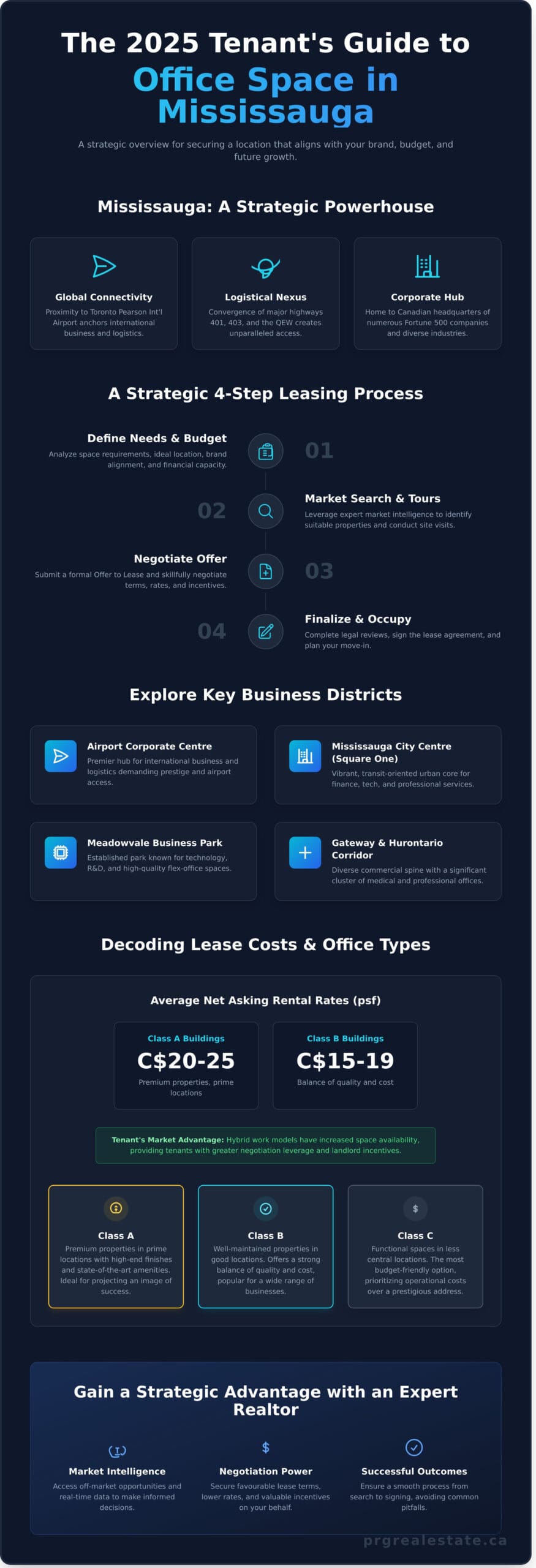
Positioned as a strategic powerhouse within the Greater Toronto Area, Mississauga offers a compelling alternative for businesses seeking growth, connectivity, and a diverse economic landscape. Its success is anchored by unparalleled logistical advantages, including close proximity to Toronto Pearson International Airport and the convergence of major highways 401, 403, and the QEW. This infrastructure has attracted a dynamic mix of industries, from global logistics firms and advanced manufacturing to the Canadian headquarters of numerous Fortune 500 companies. For a complete Overview of Mississauga and its corporate profile, it’s clear why it remains a top destination for ambitious enterprises. Currently, the market presents unique opportunities for tenants, with evolving vacancy rates creating a favourable environment for securing strategic lease terms.

Mississauga’s Key Business Districts Explored

Navigating the options for office space for rent mississauga requires understanding its distinct commercial nodes, each offering unique advantages:

  • Airport Corporate Centre: A premier hub ideal for international business, logistics, and corporate headquarters demanding prestige and unparalleled airport access.
  • Mississauga City Centre (Square One): The vibrant, transit-oriented urban core, perfect for finance, technology, and professional services firms seeking modern amenities.
  • Meadowvale Business Park: An established park known for its concentration of technology, R&D, and high-quality flex-office spaces.
  • Gateway & Hurontario Corridor: A diverse commercial spine recognized for its significant cluster of medical offices and various professional services.

Understanding Rental Rates and Trends

Leasing costs in Mississauga are competitive and vary based on building classification and location. As of recently, average net asking rates for Class A buildings typically range from C$20.00 to C$25.00 per square foot (psf), while Class B properties offer excellent value, often falling between C$15.00 and C$19.00 psf. The current market conditions, influenced by the adoption of hybrid work models, have shifted leverage towards tenants. This trend has increased the availability of high-quality spaces and landlord incentives, making it a prime time for businesses to secure or renegotiate favourable lease agreements. Expert guidance is essential to capitalize on these dynamics.

Types of Office Space for Rent in Mississauga

Securing the ideal office space is a strategic business decision that directly impacts your company’s brand, operational efficiency, and financial health. The right choice depends on a careful analysis of your business size, budget, and long-term growth objectives. A comprehensive understanding of the financial commitment is paramount, a topic expertly detailed in this Commercial Property Acquisition Guide from Forbes. To make a successful choice, it is essential to understand the primary categories of commercial properties available in the Mississauga market.

Traditional Leases: Class A, B, and C Buildings

Traditional leases offer stability and control, with options categorized by building quality and amenities. This classification system helps businesses align their physical space with their brand identity and budget.

  • Class A: These are premium properties in prime locations, representing the highest quality buildings in the market. They feature high-end finishes, state-of-the-art infrastructure, and extensive amenities. Class A spaces command the highest rental rates (C$) and are ideal for established firms seeking to project an image of success and excellence.
  • Class B: Offering a strong balance of quality and cost, Class B buildings are well-maintained properties in good locations. While they may lack the prestige of Class A, they provide a professional environment and are a popular choice for a wide range of successful businesses.
  • Class C: This category includes functional spaces in less central locations. While older and with fewer amenities, Class C buildings are the most budget-friendly option, making them a practical choice for businesses prioritizing operational costs over a prestigious address.

Flexible Options: Subleases and Serviced Offices

For businesses requiring greater agility, the market for office space for rent in Mississauga also offers several flexible alternatives to traditional long-term leases.

  • Subleasing: This involves taking over a portion or all of an office lease from an existing tenant. Subleases can offer significant benefits, including shorter terms and below-market rent. The primary drawback is a lack of flexibility, as your agreement is bound by the terms of the original master lease.
  • Serviced Offices & Co-working Spaces: These all-inclusive solutions provide fully furnished and equipped offices on short-term contracts. Ideal for startups, small teams, or companies testing the market, they eliminate the complexities of setup and management, offering a turnkey solution for immediate operational needs.

A Strategic 4-Step Process to Leasing Your Next Office

Securing the right office is a critical business decision that directly impacts your company’s success and growth. A methodical approach not only saves valuable time but also prevents costly oversights. Our proven 4-step framework is designed to demystify the leasing process, providing clarity and confidence from start to finish. This is the strategic advantage our expert realtors deliver, ensuring your next move is a successful one.

Step 1: Needs Analysis and Strategic Budgeting

The foundation of a successful search is a clear understanding of your requirements. We begin by defining your operational needs, from calculating the necessary square footage (typically 125-225 sq. ft. per employee) to identifying essential features like meeting rooms, client parking, and accessibility. Concurrently, we establish a comprehensive budget in Canadian Dollars (C$) that accounts for not just the base rent but also all additional costs, such as TMI (Taxes, Maintenance, and Insurance), to ensure complete financial clarity.

Step 2: Market Survey and Property Tours

With your criteria defined, we conduct an exhaustive market survey. Our expertise grants you access to both publicly listed and exclusive off-market opportunities, giving you a competitive edge when searching for office space for rent Mississauga. Understanding the broader trends detailed in reports like the Canadian Commercial Real Estate Market Outlook allows us to strategically shortlist properties. During tours, we help you evaluate critical factors like layout efficiency, building condition, and landlord reputation.

Step 3: The Offer and Letter of Intent (LOI)

Once you’ve identified an ideal property, the next step is to submit a Letter of Intent (LOI). This document serves as a non-binding starting point for negotiations, outlining the primary business terms of your offer. Key terms include:

  • Rental Rate (C$)
  • Lease Term (Years)
  • Possession Date
  • Any specific conditions or requests

Having a professional realtor draft and submit the LOI is crucial to positioning your offer effectively and protecting your interests from the outset.

Step 4: Lease Negotiation and Finalization

The final stage involves negotiating the intricate details of the formal lease agreement. Our team advocates on your behalf to secure favourable terms on critical clauses, such as renewal options, rent-free periods, and the Tenant Improvement (TI) allowance for customizing your space. We strongly advise a thorough legal review by your solicitor before signing. Once the lease is executed, we guide you through the final steps: submitting deposits, coordinating with the landlord, and planning a seamless move-in.

Navigating the Financials: Understanding Your Lease Costs

Securing a new office involves more than agreeing on a base rent. The complexities of commercial leases, from confusing terms to unexpected fees, can create significant financial challenges. Our commitment at PRG Real Estate Brokerage is to provide complete transparency, empowering you to make strategic and successful decisions. Understanding the full scope of your lease costs is the first step toward securing a property that aligns with your business objectives.

Gross Lease vs. Net Lease: What’s the Difference?

In the commercial real estate market, leases are typically structured in one of two ways. A Net Lease requires the tenant to pay a base monthly rent plus a proportionate share of the building’s operating expenses (TMI). In contrast, a Gross Lease bundles all costs into one flat monthly fee. For professional office space for rent in Mississauga, Net Leases are the industry standard, offering superior transparency by clearly itemizing all property-related expenses.

Decoding TMI: Taxes, Maintenance, and Insurance

TMI, often called “Additional Rent,” represents the three core operating expenses passed on from the landlord to the tenants. These costs are reconciled annually and cover:

  • Taxes: Your proportionate share of the municipal property taxes for the entire building.
  • Maintenance (CAM): Common Area Maintenance costs for the upkeep of shared spaces, including lobbies, landscaping, snow removal, and parking lots.
  • Insurance: Your share of the landlord’s premium for insuring the physical building and property.

To calculate your total rent, use this simple formula: (Base Rent per sq. ft. + TMI per sq. ft.) x Total Square Footage = Annual Rent. For example, a 2,000 sq. ft. office with a base rent of C$18/sq. ft. and TMI of C$12/sq. ft. would have a total monthly rent of C$5,000.

Budgeting for Other Expenses

A comprehensive budget must also account for other significant one-time and recurring costs. Be prepared for:

  • Tenant Improvement (TI) Allowance: Landlord-provided funds to help customize the space. This is a critical point of negotiation to minimize your out-of-pocket expenses.
  • Direct Costs & Setup: Budget for utilities (hydro, internet), dedicated parking fees, and the initial investment in furniture, IT infrastructure, and signage.
  • Upfront Payments: Most landlords require a security deposit and payment of the first and last month’s rent upon signing the lease.

Navigating these financial details demands expert guidance. Partnering with a professional team ensures every cost is identified and negotiated to your advantage, transforming your lease into a sound business investment. For expert advice on your next commercial lease, contact our team of top realtors.

Why You Need an Expert Commercial Realtor on Your Side

In today’s competitive market, some business owners may consider searching for commercial properties on their own to save on costs. However, securing the right lease is far more complex than a simple online search. Aligning with an expert commercial realtor is not an expense; it is a strategic investment in your business’s future. A professional partner mitigates risk, saves you invaluable time and capital, and ensures your real estate decisions align perfectly with your long-term objectives.

Unparalleled Market Access and Insight

The best opportunities are often not publicly listed. Our team at PRG provides exclusive access to off-market listings, giving you a critical advantage over the competition. We possess deep, data-driven knowledge of the local landscape, including landlord reputations, building histories, and recent deal precedents. This insight is crucial when evaluating office space for rent in Mississauga, ensuring you never overpay and secure a location that truly supports your success.

Professional Negotiation and Advocacy

A commercial lease is a complex legal document with significant financial implications. Our realtors act as your dedicated advocates, leveraging industry expertise to negotiate the most favourable terms on your behalf. We go beyond the base rent to secure advantages in critical areas:

  • Lease Rates and Escalations: Achieving competitive rates and predictable future costs.
  • Tenant Improvement (TI) Allowance: Negotiating funds from the landlord to customize your space.
  • Favourable Clauses: Protecting your interests regarding options to renew, sublease rights, and exclusivity.

Our meticulous review process identifies and addresses potentially harmful clauses, safeguarding your business from future liabilities.

A Streamlined, Efficient Process

Your time is best spent running your business, not navigating the intricate process of commercial real estate. We manage every detail, from the initial property search and site tours to offer preparation, negotiation, and the final lease signing. By entrusting the complexities to us, you can remain focused on your core operations with the full confidence that your real estate needs are being managed with the highest level of professionalism and integrity. Partner with PRG’s experts to find your ideal Mississauga office.

Partner with an Expert for Your Mississauga Office Search

Securing the right commercial lease is a critical decision for your business’s future. As this guide has shown, success requires a deep understanding of Mississauga’s dynamic market, a strategic approach to the leasing process, and a firm grasp of the associated financial commitments. Navigating these complexities is the key to finding the ideal office space for rent in Mississauga that aligns with your goals for 2025 and beyond.

You don’t have to manage this significant undertaking alone. Partnering with a proven expert provides a distinct advantage. The commercial real estate team at PRG Real Estate has a reputation built on unwavering integrity, expertise, and a history of successful transactions throughout the Greater Toronto Area. As part of the top 2% of all Royal LePage agents nationally, our commitment is to ensure your next move is a strategic and successful one.

Let our expert realtors guide your search for office space in Mississauga. Contact PRG today.

Take the definitive step toward finding the perfect space where your business can thrive.

Frequently Asked Questions About Office Space in Brampton & Mississauga

How much office space do I need per employee in 2025?

The traditional standard is evolving with the rise of hybrid work models. For 2025, we advise clients to plan for 100 to 150 square feet per employee. This modern approach reduces reliance on individual desks and allocates more area to shared, collaborative spaces like meeting rooms, lounges, and focus pods. This strategic layout supports flexibility and enhances team productivity in a dynamic work environment.

What is a typical lease term for commercial office space in Brampton & Mississauga?

In both Brampton and Mississauga, standard commercial lease terms typically range from five to ten years. Landlords favour these longer commitments for financial stability. While shorter terms of three to five years can sometimes be negotiated, they are less common and may come with less favourable rates. Securing an expert, such as PRG Real Estate Brokerage, to negotiate on your behalf is critical when looking for office space for rent in Mississauga or Brampton.

Can I negotiate the rental rate and other terms in the current market?

Absolutely. Negotiation is a fundamental part of securing a commercial lease, whether you’re looking in Brampton or Mississauga. Beyond the base rental rate (C$/sq. ft.), key negotiable terms include the length of the lease, rent-free periods, and tenant improvement allowances (TIA) to help cover fit-out costs. A skilled commercial real estate professional from PRG Real Estate Brokerage can leverage market conditions to secure the most advantageous terms for your business, ensuring a strategic and successful transaction.

What is the difference between ‘usable’ and ‘rentable’ square footage?

‘Usable’ square footage refers to the private area your business exclusively occupies. ‘Rentable’ square footage includes your usable space plus a calculated share of the building’s common areas, such as lobbies, hallways, and shared washrooms. It is important to understand that your lease payments are based on the rentable square footage, which is always a larger figure than the usable area.

What are the first steps I should take when I decide to look for office space?

Your first step is to clearly define your operational requirements: establish a realistic budget, determine your ideal location in Brampton or Mississauga, calculate the necessary square footage, and list any must-have amenities. The second, and most critical, step is to engage an expert commercial real estate brokerage like PRG Real Estate Brokerage. Their professional guidance is essential for navigating the market, identifying suitable properties, and negotiating a lease that aligns with your strategic goals.

How long does the entire process of finding and leasing an office typically take?

The timeline for securing a new office can vary significantly based on your specific needs. From the initial search to the final move-in, businesses should typically budget between three to nine months. This comprehensive process includes property tours, lease negotiations, legal review, and any required interior construction or fit-outs. Proactive planning is essential to ensure a smooth and successful relocation without disrupting your business operations.