
Brampton Investment Properties: A Strategic Guide for 2026
CategoriesBlog

Brampton Investment Properties: A Strategic Guide for 2026

Navigating the real estate market can be overwhelming, with endless listings that offer little context on their true long-term value. For investors looking at Brampton investment properties, this challenge is magnified by a dynamic and rapidly evolving landscape. Simply browsing what’s for sale isn’t a strategy; it’s a gamble. The fear of misinterpreting market signals or miscalculating potential returns can lead to costly indecision, preventing you from securing a valuable asset in one of the GTA’s most promising cities.

This strategic guide for 2026 is designed to eliminate that uncertainty. We go beyond generic listings to provide you with a professional framework for success. You will learn how to identify Brampton’s high-growth corridors, analyze the ROI of different property types with expert precision, and secure opportunities that align with your financial goals. Consider this your definitive resource for making a confident, results-driven investment decision in the Brampton market.

Key Takeaways

  • Learn why Brampton’s projected population and economic growth for 2026 make it a strategic location for real estate investment within the GTA.
  • Identify the most suitable property types for your portfolio, from high-demand residential rentals to lucrative commercial spaces.
  • Discover which specific Brampton neighbourhoods offer the highest potential for appreciation and positive cash flow for different investment models.
  • Master the essential metrics used by professional investors to analyze the financial viability of potential brampton investment properties.

Why Invest in Brampton Real Estate in 2026? Key Market Drivers

Brampton has decisively shed its identity as a mere suburb, emerging as a dynamic economic engine within the Greater Toronto Area. For astute investors, the city presents a compelling case built on unstoppable growth and strategic development. The coming years, particularly leading into 2026, are poised to unlock significant value across commercial sectors. Understanding the fundamental market drivers is the first step in capitalizing on the exceptional opportunities available in brampton investment properties. These drivers are rooted in powerful demographic shifts, transformative infrastructure projects, and a diversifying economic base.

Economic and Demographic Momentum

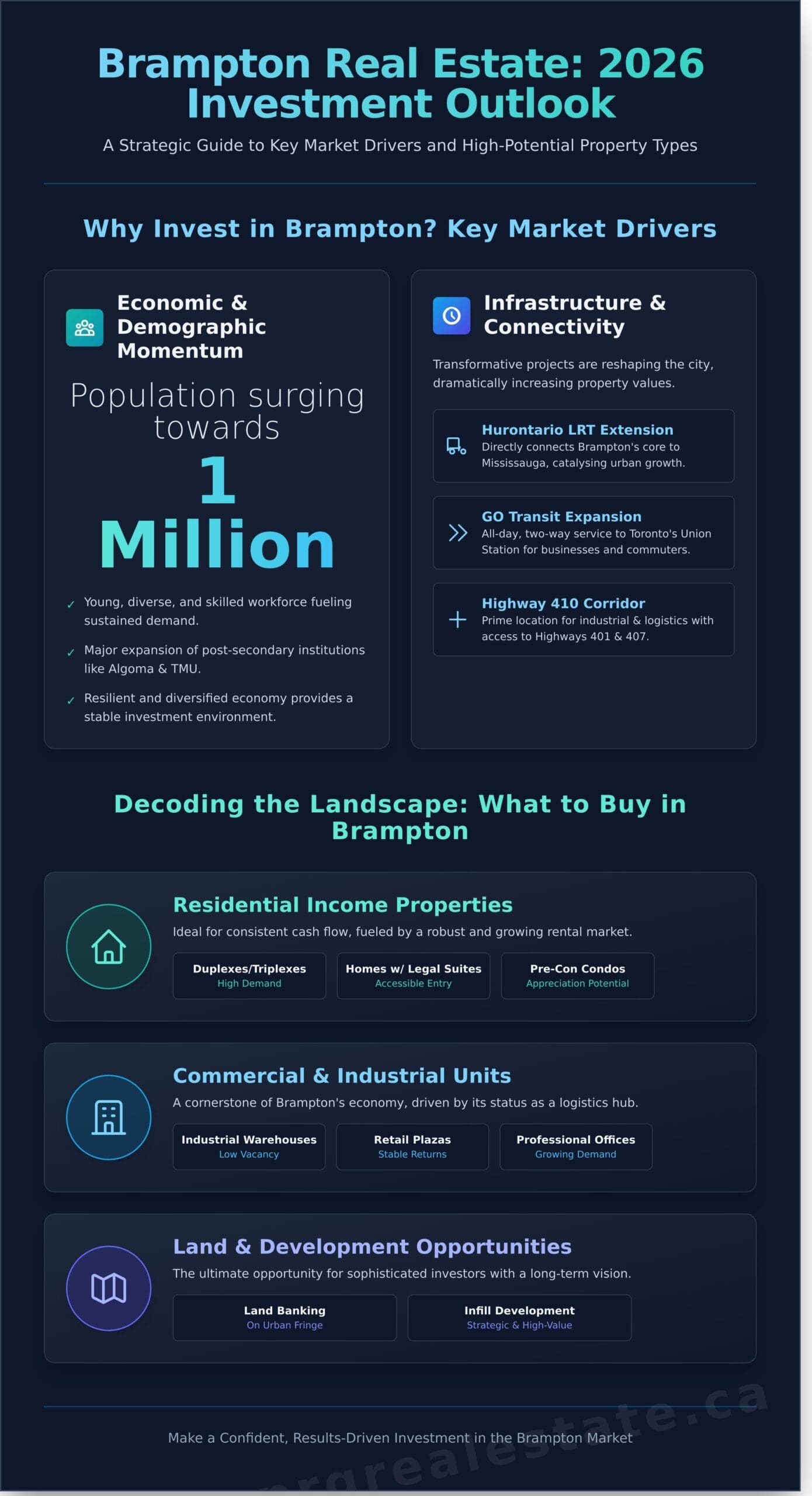
Brampton’s population is one of the fastest-growing in Canada, projected to continue its rapid expansion towards one million residents in the coming decades. This surge is fueled by a young, diverse, and skilled workforce, creating sustained demand for retail, office, and industrial space. The city’s economic foundation is further strengthened by the expansion of post-secondary institutions, including Algoma University and the planned Toronto Metropolitan University School of Medicine. For a comprehensive City of Brampton overview, the data confirms a resilient and diversified economy, providing a stable environment for long-term commercial investments. For a deeper look at how these economic sectors and residential trends are shaping the city’s future, the Brampton 2026 ultimate guide to living, working, and investing provides a comprehensive analysis of the key drivers at play.

Infrastructure and Connectivity

Strategic public investment is solidifying Brampton’s position as a critical logistics and transportation hub. Key projects set to reshape the city’s landscape include:

  • Hurontario LRT Extension: This light rail transit line will connect Brampton’s downtown core directly to Mississauga, enhancing mobility and catalysing urban intensification along the corridor.
  • GO Transit Expansion: The move towards two-way, all-day service on the Kitchener GO line provides seamless connectivity to Toronto’s Union Station, making Brampton more attractive for businesses and commuters.
  • Highway 410 Corridor: This vital artery offers unparalleled access to Highways 401 and 407, cementing the city’s status as a prime location for industrial, warehousing, and logistics operations.

These initiatives, coupled with city-led revitalization efforts, dramatically increase the intrinsic value of commercial properties in proximity and across the municipality.

These converging factors-a booming population, a strengthening economy, and massive infrastructure upgrades-create an undeniable momentum. For investors seeking robust returns and long-term growth, the data points clearly to the strategic advantages of acquiring brampton investment properties ahead of the curve. The city is not just growing; it is being strategically engineered for future prosperity.

Decoding Brampton’s Investment Property Landscape: What to Buy

Understanding Brampton’s economic drivers is the first step; the next is identifying which asset class aligns with your strategic goals. The city offers a diverse portfolio of opportunities, each with a unique risk and reward profile. A successful portfolio is built on a clear understanding of what to buy and where. At PRG Real Estate Brokerage, our expertise covers the full spectrum of Brampton investment properties, from residential income generators to large-scale commercial assets.

Residential Income Properties

Brampton’s rapidly growing population fuels a robust rental market, making multi-unit residential properties a strategic choice for consistent cash flow. Duplexes, triplexes, and purpose-built multi-family buildings are in high demand. Furthermore, the city’s framework for legal secondary suites has made single-family homes with basement apartments a highly popular and accessible entry point for investors. For those focused on long-term capital growth, pre-construction condos near transit corridors offer significant appreciation potential as the city continues to densify.

Commercial and Industrial Units

As a key logistics and transportation hub, Brampton’s industrial sector is a cornerstone of its economy. Small and medium-bay industrial warehouses consistently demonstrate low vacancy rates and strong rental growth, making them a premier commercial asset. This sustained demand is well-documented in official Brampton economic data. Retail plazas in high-traffic corridors like Queen Street and Bovaird Drive offer stable returns from a diversified tenant base, while professional office spaces near transit hubs like the Brampton GO Station cater to the growing service-based economy.

Land and Development Opportunities

For the sophisticated investor with a long-term vision, land represents the ultimate opportunity. Strategies range from land banking on the urban fringe in anticipation of future growth to infill development projects within established neighbourhoods. Securing and rezoning parcels for higher-density use can unlock substantial value, but this is an advanced strategy. It demands deep market knowledge, municipal navigation skills, and expert guidance to manage the complexities of the development process successfully.

Strategic Investment Zones: Where to Find Opportunity in Brampton

Identifying the right location is the cornerstone of any successful real estate venture. For astute investors analyzing brampton investment properties, success is found not just in what you buy, but precisely where you buy it. Understanding the city’s micro-markets is critical. Our expert analysis pinpoints the specific zones and corridors offering the highest potential for growth and return, providing a strategic roadmap for your capital deployment.

High-Demand Residential Pockets

Brampton’s population growth fuels relentless demand for quality housing, creating diverse opportunities for residential investors. A strategic approach involves targeting distinct neighbourhood profiles:

  • New Family Rentals: Master-planned communities like Credit Valley and Mount Pleasant are prime targets for new single-family rentals and townhomes, attracting high-quality tenants with modern amenities and reputable schools.
  • Urban Intensification: Downtown Brampton is undergoing significant revitalization, making it a hotspot for condominium developments and multi-unit conversions that appeal to professionals seeking a transit-centric lifestyle.
  • Value-Add Opportunities: Established neighbourhoods offer excellent potential for creating legal secondary suites, a proven strategy to maximize cash flow from existing single-family assets.

Key Commercial and Industrial Corridors

The city’s economic engine is powered by its world-class commercial and industrial hubs. The corridors flanking Highway 410 and proximate to Toronto Pearson Airport are epicentres for high-value industrial assets, including logistics, warehousing, and advanced manufacturing facilities. For retail and mixed-use investors, emerging nodes along major arteries like Queen Street and Bovaird Drive present significant opportunities to serve the city’s expanding residential footprint. A detailed review of official Brampton economic indicators and reports validates the immense potential concentrated in these core economic zones. These areas, particularly those impacted by transit expansion, are a focal point for the most strategic brampton investment properties and long-term portfolio growth. To understand how these high-growth neighbourhoods and commercial corridors fit into Brampton’s broader 2026 trajectory, explore our complete guide to Brampton’s 2026 growth pockets and investment opportunities.
Brampton Investment Properties: A Strategic Guide for 2026

Analyzing Your Investment: Key Metrics for Brampton Properties

Identifying a promising area is the first step. The next is performing a rigorous financial analysis to ensure the asset meets your strategic objectives. Top investors evaluate Brampton investment properties not on potential alone, but on precise, data-driven metrics. This section equips you with the essential tools to assess a deal with the same level of professional scrutiny, transitioning you from an information-seeker to a confident decision-maker.

Calculating Profitability: Cap Rate and ROI

To determine a property’s viability, two metrics are indispensable. The Capitalization Rate (Cap Rate) measures the property’s unleveraged annual return. It’s a quick way to compare similar assets. A higher cap rate generally suggests higher return, but potentially higher risk. Meanwhile, Return on Investment (ROI), specifically Cash-on-Cash Return, calculates the annual pre-tax cash flow relative to the total cash invested, providing a clear picture of your personal return.

Consider this example for a small Brampton commercial plaza:

  • Purchase Price: C$1,800,000
  • Gross Annual Rental Income: C$140,000
  • Operating Expenses (Taxes, Insurance, Maint.): C$32,000
  • Net Operating Income (NOI): C$108,000
  • Cap Rate Calculation: C$108,000 (NOI) / C$1,800,000 (Price) = 6.0%

In the current market, a Cap Rate between 5-7% for a quality Brampton commercial property indicates a solid opportunity, though this benchmark varies by asset class and location.

Financing Your Brampton Investment

Securing strategic financing is as crucial as finding the right property. In Canada, options for commercial investors include traditional commercial mortgages from major banks, credit unions, and alternative B-lenders. Obtaining pre-approval is a non-negotiable first step; it demonstrates your seriousness to sellers and defines your budget.

It is vital to understand that commercial financing differs significantly from residential. Lenders place greater emphasis on the property’s income-generating potential (its NOI) and the strength of its tenants, rather than solely on your personal income. Building a strong relationship with a commercial mortgage broker who understands the nuances of Brampton investment properties is a distinct competitive advantage. Navigating these complex financial instruments requires expert guidance to ensure your investment structure is optimized for long-term success. For expert analysis and access to our network of trusted lenders, connect with our team.

Partnering for Success: Securing Your Brampton Investment Property

Identifying promising areas for commercial investment in Brampton is the critical first step. However, transforming that knowledge into a profitable, secure asset requires expert execution and strategic guidance. The difference between a good investment and a landmark acquisition lies in the partner you choose to navigate the complexities of the market. This is where PRG Real Estate delivers unparalleled value, ensuring your capital is deployed with precision and foresight.

Our commitment is to move beyond transactional service and act as your strategic partner, aligning our expertise with your long-term wealth creation goals. We understand the unique challenges and opportunities inherent in acquiring high-value brampton investment properties and have built a reputation on delivering exceptional results.

The PRG Advantage: Expertise and Access

As the top commercial realtors in Brampton, our advantage is your advantage. We provide our clients with a decisive edge through:

  • Exclusive Market Intelligence: Access to proprietary data, trend analysis, and off-market opportunities not available to the general public.
  • A High-Calibre Network: Leverage our established relationships with developers, city planners, legal experts, and financial institutions to streamline every stage of your transaction.
  • Masterful Negotiation: Our team possesses the proven expertise to structure complex deals, navigate zoning regulations, and secure terms that maximize your return on investment.

Your Next Step Towards a Strategic Investment

You have the market knowledge; now it is time for decisive action. The path to securing premier brampton investment properties is clear: strategic selection guided by expert execution. We invite you to a confidential, no-obligation consultation to discuss your investment objectives and explore how PRG Real Estate can help you achieve them.

Don’t just identify opportunity-capitalize on it. Partner with the brokerage that sets the standard for commercial real estate excellence in Brampton. Your portfolio deserves nothing less.

Contact the PRG Real Estate team today to schedule your strategic investment consultation.

Secure Your Future with Strategic Brampton Real Estate Investments

As we have detailed, the landscape for Brampton real estate in 2026 is primed for strategic acquisition, underpinned by powerful economic drivers and significant infrastructure development. The keys to success are clear: investors must target high-growth zones and apply rigorous financial analysis to every opportunity. Capitalizing on the immense potential of brampton investment properties requires more than just capital; it demands market-specific expertise and decisive action.

To transform this knowledge into a high-performing asset, you need a partner whose expertise is unparalleled. PRG Real Estate is a team of specialists in Commercial & Investment Real Estate, armed with deep, data-driven expertise in Brampton’s market dynamics. As an award-winning Royal LePage® Red Diamond™ team, we have a proven track record of securing profitable outcomes for our clients. Align your portfolio with excellence. Start your strategic property search with Brampton’s leading experts. Your next successful investment is waiting.

Frequently Asked Questions About Brampton Investment Properties

Is Brampton a good place to invest in real estate in 2026?

Absolutely. Brampton is poised for significant growth, driven by major infrastructure projects, a rapidly expanding population, and a robust economic base. Its strategic location within the GTA innovation corridor makes it a prime target for both commercial and residential investors. Projections for 2026 indicate continued appreciation and strong rental demand, positioning Brampton as a top-tier market for strategic real estate investment. Our expert analysis confirms a positive outlook for discerning investors.

What is the average rental income for a property in Brampton?

Rental income in Brampton varies based on property type and location. As of recent market data, residential units can generate between C$2,200 to C$3,500+ per month. Commercial properties, particularly in high-traffic industrial or retail zones, are typically leased on a per-square-foot basis, often ranging from C$15 to C$30+ net annually. A detailed financial analysis by our team can provide precise projections for a specific asset to ensure optimal returns.

What are the busiest commercial areas in Brampton?

Brampton’s key commercial hubs offer diverse investment opportunities. Downtown Brampton remains a vibrant centre for retail and office space, while the Queen Street East and Main Street corridors are high-traffic retail arteries. For industrial and logistics investors, the areas surrounding Highway 410 and Pearson International Airport are exceptionally active, representing some of the most sought-after industrial real estate in the Greater Toronto Area. Our team has in-depth knowledge of each of these strategic zones.

How much down payment is required for an investment property in Ontario?

In Ontario, the minimum down payment for a non-owner-occupied investment property is 20% of the purchase price. This is a standard federal regulation for properties with one to four units. For commercial properties or those with more than four units, lenders may require a higher down payment, often in the range of 25% to 35%. We guide our clients through the financing process to ensure they are well-prepared and secure the most favourable terms.

What are the property taxes like in Brampton for investment properties?

Property taxes in Brampton are calculated based on the property’s assessed value, as determined by MPAC, multiplied by the City’s combined municipal and educational tax rates. While rates are subject to annual review, Brampton maintains a competitive tax environment within the Peel Region. Commercial and multi-residential properties are taxed at different rates than residential homes. We provide clients with a detailed breakdown of all carrying costs, including precise tax estimates, during due diligence.

Can you help me find multi-family homes for sale in Brampton?

Certainly. PRG Real Estate specializes in identifying and securing high-performance multi-family homes and other brampton investment properties. Our team provides VVIP access to on- and off-market listings, from duplexes to larger apartment buildings. We leverage our extensive network and deep market knowledge to connect our clients with assets that align perfectly with their portfolio objectives, ensuring a strategic and successful acquisition.

What is a good cap rate for an investment property in the GTA?

A good capitalization (cap) rate in the Greater Toronto Area typically falls between 4% and 6%, though this can fluctuate based on asset class, location, and market conditions. Industrial and multi-family properties may trade at lower cap rates due to high demand and stability, while retail or office properties might offer higher rates to reflect perceived risk. Our primary objective is to identify properties that offer a strong cap rate relative to their asset class and potential for appreciation.

Commercial Real Estate Investing: A Beginner's Guide
CategoriesBlog

Commercial Real Estate Investing: A Beginner’s Guide

The world of commercial real estate investing can seem like an exclusive club, reserved for seasoned developers with millions to spend in the Canadian market. For many aspiring investors, complex terms like ‘Cap Rate’ and ‘NOI’ feel like a foreign language, and the fear of a single costly mistake can be paralyzing. This uncertainty often prevents talented individuals from exploring one of the most powerful vehicles for building long-term wealth.

This guide is engineered to dismantle those barriers. At PRG Real Estate Brokerage, we believe that strategic success is built on a foundation of expert knowledge. Here, we will demystify the entire process, providing a clear roadmap for your journey. You will learn the fundamental principles, from understanding key performance metrics and exploring unique Canadian financing options to following a step-by-step framework for acquiring your first income-producing property.

Our commitment is to equip you with the strategic confidence to evaluate opportunities, mitigate risks, and assemble the expert team necessary for success. It’s time to move beyond apprehension and begin building a formidable investment portfolio with a partner dedicated to excellence.

Key Takeaways

  • Master the essential financial metrics that allow you to accurately evaluate a commercial property’s performance and potential return.
  • Discover strategic financing options and how to leverage borrowed capital to acquire valuable commercial assets, even without millions in cash.
  • Successful commercial real estate investing relies on a proven, step-by-step acquisition framework designed to maximize your outcome.
  • Understand how to identify and mitigate common risks, turning potential challenges into strategic advantages for your portfolio.

What is Commercial Real Estate? The Core Investment Types

Venturing into commercial real estate investing represents a strategic move from individual properties to business-centric assets. Unlike residential real estate, which involves properties for private living, commercial real estate (CRE) encompasses properties used exclusively for business activities. At its core, What is Commercial Real Estate? It is an asset class designed to generate profit through capital appreciation and, more significantly, rental income from tenants. The foundation of this model is the commercial lease-a long-term contract that provides a predictable and stable cash flow, making it a powerful tool for portfolio growth. However, this asset class operates on a different scale, demanding greater capital, expertise, and strategic management than typical residential investments.

The Main Categories of Commercial Property

A successful commercial real estate investing strategy begins with understanding the primary asset types, each with unique characteristics and market drivers:

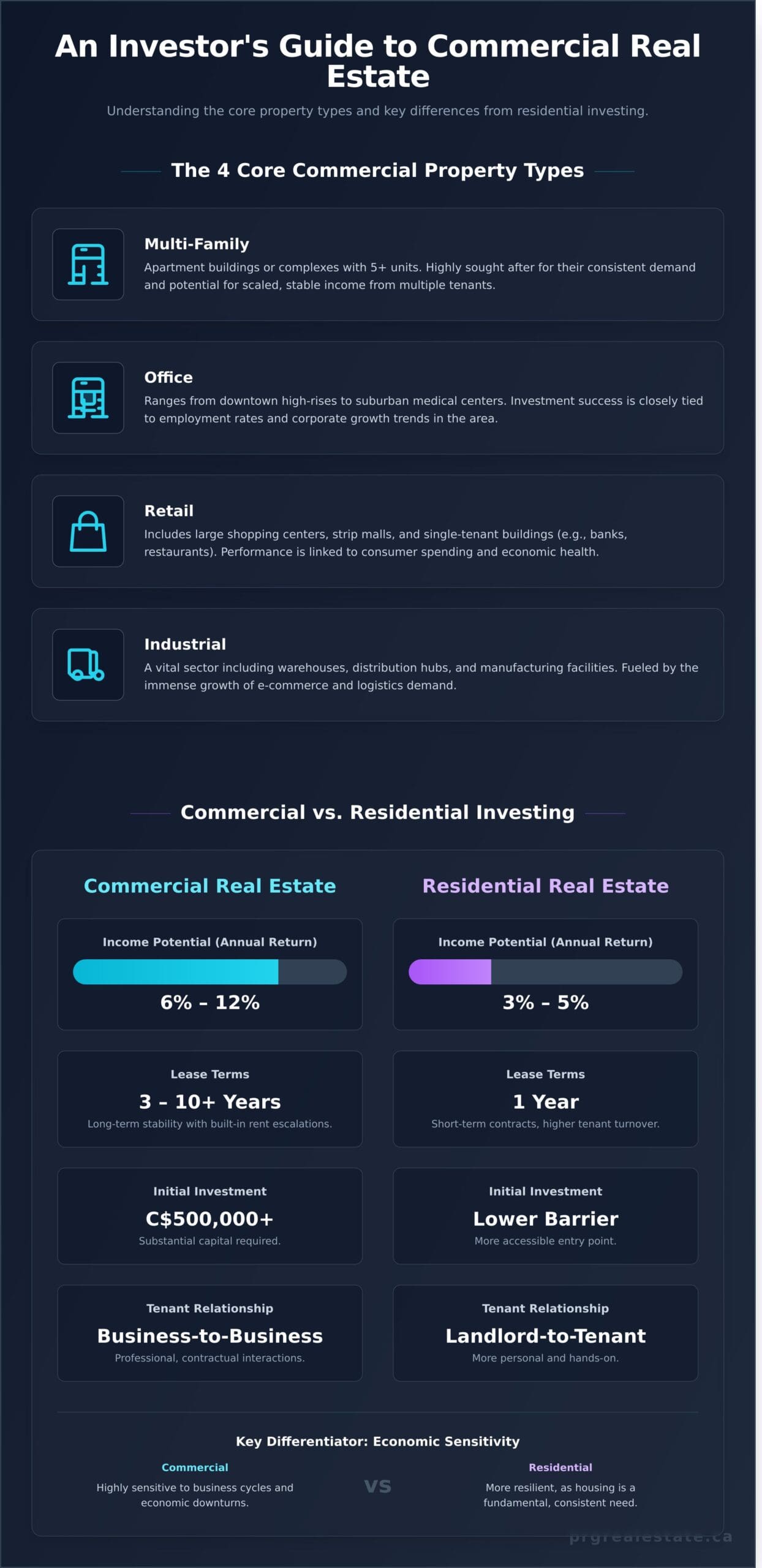
  • Multi-Family: This category includes apartment buildings or complexes with five or more individual units. In Canada, properties with 1-4 units are generally classified as residential. Multi-family assets are highly sought after for their consistent demand and potential for scaled income.
  • Office: These properties range from high-rise towers in downtown cores to suburban low-rise buildings and specialized medical office centers. Investment success is often tied to employment rates and corporate growth.
  • Retail: Encompassing everything from large shopping centres and neighbourhood strip malls to single-tenant buildings occupied by banks or restaurants. The performance of retail assets is closely linked to consumer spending and economic health.
  • Industrial: This vital sector includes warehouses, distribution hubs, and manufacturing facilities. Fueled by the growth of e-commerce and logistics, industrial properties have become a top-performing asset class in Brampton and across Canada.

Pros and Cons of Investing in Commercial vs. Residential

Navigating the transition from residential to commercial investing requires a clear understanding of the fundamental differences. While the potential rewards are significant, the challenges are equally distinct. The following table outlines the key distinctions to inform your strategic approach.

Aspect Commercial Real Estate Residential Real Estate
Income Potential Higher potential returns (typically 6-12% annually) Lower but often stable returns (typically 3-5% annually)
Lease Terms Long-term (3-10+ years), often with built-in rent escalations Short-term (typically 1 year)
Initial Investment (C$) Substantial capital required; often C$500,000+ Lower barrier to entry
Tenant Relationship Professional, business-to-business interaction More personal landlord-tenant dynamic
Economic Sensitivity Highly sensitive to business cycles and economic downturns More resilient, as housing is a fundamental need

Decoding the Numbers: Key Metrics for CRE Investors

Successful commercial real estate investing is a numbers game. While a property’s location and potential are important, the financial metrics are non-negotiable. Mastering these key performance indicators (KPIs) allows you to move beyond emotional decisions and conduct a strategic, data-driven analysis. These numbers provide a standardized framework to compare different assets, measure ongoing performance, and forecast future profitability with confidence.

To illustrate, let’s analyze a hypothetical small commercial property in Brampton with a purchase price of C$1,200,000 and a gross annual rental income of C$100,000.

Net Operating Income (NOI)

NOI is the foundation of almost every commercial real estate valuation. It represents the property’s profitability before accounting for financing. The calculation is straightforward: Gross Operating Income minus all Operating Expenses. These expenses include property taxes, insurance, maintenance, and property management fees. Crucially, debt service (your mortgage payment) is not included.

  • Gross Income: C$100,000
  • Operating Expenses: C$30,000
  • NOI = C$70,000

Capitalization (Cap) Rate

The Cap Rate measures the potential rate of return on an investment property, assuming an all-cash purchase. The formula is Cap Rate = NOI / Property Price. This metric is one of the most effective tools for comparing the relative value of similar properties. Understanding metrics like the Cap Rate is a fundamental step when you’re getting started in commercial real estate, as it provides a clear benchmark for performance. For our example:

  • Cap Rate = C$70,000 / C$1,200,000 = 5.83%

Cash-on-Cash Return

While the Cap Rate ignores financing, the Cash-on-Cash Return focuses on it. This metric is essential for investors using leverage, as it calculates the return on the actual capital you’ve invested (your down payment and closing costs). The formula is Annual Pre-Tax Cash Flow / Total Cash Invested. Continuing our example with a C$300,000 down payment and an annual mortgage payment of C$50,000:

  • Pre-Tax Cash Flow (NOI – Debt Service): C$70,000 – C$50,000 = C$20,000
  • Cash-on-Cash Return: C$20,000 / C$300,000 = 6.67%

How to Finance Your First Commercial Real Estate Investment

A common misconception is that entering the commercial real estate market requires millions in liquid cash. The reality is that strategic financing is the cornerstone of successful commercial real estate investing. The principle of leverage-using borrowed capital to acquire assets and amplify returns-allows savvy investors to control significant properties with a fraction of the total cost.

Unlike residential mortgages that heavily scrutinize personal income, commercial lenders focus primarily on the property’s financial viability. They analyze its potential Net Operating Income (NOI) and its ability to cover debt payments, measured by the Debt Service Coverage Ratio (DSCR). This is why a meticulously prepared business plan and a thorough property analysis are non-negotiable; they are your most critical tools for securing financing.

Traditional Commercial Mortgages

Major Canadian banks and credit unions are the primary sources for commercial mortgages. Lenders typically require a larger down payment than for residential properties, with Loan-to-Value (LTV) ratios usually ranging from 65% to 80%. This means you should anticipate a down payment of 20-35%. These loans often feature shorter amortization periods and terms (e.g., a 5-year term on a 20-year amortization), which may conclude with a balloon payment.

Canada Small Business Financing Program (CSBFP)

For entrepreneurs planning to purchase a property for their own business to operate from (owner-occupied), the government-backed CSBFP loan is an exceptional tool. Offered through most major lenders, this program can finance up to 90% of the property cost, drastically reducing the required down payment. It provides a strategic advantage for small business owners looking to build equity while running their operations.

Creative and Alternative Financing

Beyond traditional routes, several other avenues can fund your investment. These strategic options require expert guidance to navigate effectively:

  • Seller Financing: The property owner acts as the lender, offering more flexible terms. This is often an excellent solution for unique properties or buyers who don’t meet strict bank criteria.
  • Partnerships/Syndication: Pooling capital with other investors allows you to acquire larger, more valuable assets than you could alone, sharing both the risk and the reward.
  • For investors who prefer a more passive role, property investment firms specialize in this syndicated model, managing the entire process on your behalf. If this approach aligns with your goals, you can learn more about PRG MFT.

  • Private Mortgages: These short-term, asset-based loans from private lenders are ideal for securing a property quickly, financing renovations, or navigating complex situations where bank financing is not an option.

Commercial Real Estate Investing: A Beginner's Guide

Your 5-Step Roadmap to Acquiring a Commercial Property

Successful commercial property acquisition is not a single transaction but a strategic, multi-stage process. This five-step roadmap provides a clear framework for navigating the complexities of commercial real estate investing, ensuring each decision is built on a solid foundation of research and expert counsel. Following this disciplined approach mitigates risk and positions your investment for long-term success.

Steps 1 & 2: Define Your Strategy and Research Markets

Your journey begins with clarity. First, define your investment strategy by selecting a niche-be it industrial warehousing, retail plazas, or multi-family residential units. Each sector offers unique opportunities and demands a specific approach. Next, identify and analyze your target markets. In a dynamic region like the GTA, focusing on areas like Brampton requires a deep dive into economic indicators such as population growth, employment trends, and major infrastructure developments. This foundational research informs every subsequent step.

Step 3: Build Your Expert Team

No successful investor operates alone. Assembling a team of dedicated professionals is non-negotiable, as their specialized knowledge is essential for executing a flawless acquisition. Your core team should include:

  • Commercial Real Estate Broker: Your market expert, deal-finder, and chief negotiator who provides access to on- and off-market opportunities.
  • Real Estate Attorney: A legal professional to review purchase agreements, title documents, and contracts to protect your interests.
  • Accountant/CPA: A financial expert to advise on tax implications, ownership structures, and overall financial viability.

This expert team transforms a good opportunity into a great investment. Partner with Brampton’s top commercial realtors to build your team and gain an immediate strategic advantage.

Steps 4 & 5: Secure Financing and Conduct Due Diligence

With your strategy and team in place, the next stage is financial and operational validation. Securing pre-approval for financing from a Canadian lender is essential; it clarifies your purchasing power and strengthens your position when making an offer. Following this, the due diligence phase is where your investment is truly scrutinized. This critical process involves everything from physical property inspections and environmental site assessments to detailed financial audits and a thorough review of all tenant leases. Skipping this step is the costliest mistake an investor can make, as it is your primary opportunity to uncover and mitigate potential risks before closing the deal.

Managing Risks in Commercial Real Estate Investing

All investments carry inherent risk; the defining characteristic of a savvy investor is not the avoidance of risk, but its strategic management. A prudent approach to commercial real estate investing is built on a foundation of comprehensive due diligence and forward-thinking risk mitigation. This commitment to foresight protects your capital and positions your portfolio for resilient, long-term growth.

Market and Economic Risks

Economic downturns, interest rate fluctuations, and shifts in local market dynamics can directly impact tenant demand and property valuations. To safeguard your investment, focus on diversifying across stable asset classes and geographic areas within Brampton and the GTHA. Critically, avoid over-leveraging your assets. Maintaining a disciplined loan-to-value ratio ensures your portfolio can withstand periods of lower occupancy or economic pressure without threatening solvency.

Tenant and Vacancy Risks

The stability of your cash flow is directly tied to the quality and reliability of your tenants. The departure or bankruptcy of a major tenant can significantly impact your revenue. Effective mitigation strategies are non-negotiable:

  • Rigorous Tenant Screening: Conduct thorough financial and operational background checks on all prospective tenants to ensure their stability.
  • Lease Diversification: Whenever possible, secure multiple tenants within a property and strategically stagger their lease expiration dates. This prevents a mass vacancy and creates a more predictable income stream.

Liquidity and Capital Risks

Unlike stocks, commercial real estate is an illiquid asset-it cannot be sold quickly to generate cash. Furthermore, unexpected capital expenditures, such as a complete HVAC system replacement or urgent roof repairs, can arise. The most effective mitigation is maintaining a healthy capital reserve fund. This dedicated fund ensures you can cover unforeseen expenses and major repairs without compromising your financial position or being forced into a premature sale.

Successfully navigating the complexities of commercial real estate investing requires expert guidance. Partnering with a team that prioritizes strategic planning is the ultimate risk mitigation tool. To build a resilient and profitable portfolio in Brampton, connect with the experts at PRG Real Estate.

Your Strategic Next Step in Commercial Real Estate

You now possess the foundational knowledge to navigate the world of commercial properties. From understanding the nuances of different asset types to decoding key financial metrics and mapping out your acquisition roadmap, you are prepared to make informed decisions. This guide has provided the blueprint, but the most successful ventures are built with an expert architect.

Executing a successful strategy in commercial real estate investing demands market-leading expertise and unwavering integrity. At PRG Real Estate, our team, led by top commercial realtor Harsh Pabla, provides exactly that. We specialize in identifying and securing high-value strategic investments across Brampton and the GTA. Our mission extends beyond transactions; we are dedicated to building thriving communities and earning ‘clients for life’ through exceptional results.

Take the definitive step toward building your legacy. Start your investment journey with expert guidance. Contact PRG Real Estate today.

Frequently Asked Questions About Investing in Brampton Commercial Real Estate

How much money do I actually need to start investing in commercial real estate?

The capital required for commercial real estate investing is significant. In Canada, a typical down payment ranges from 25% to 35% of the purchase price. For a C$1 million property in Brampton, this means having C$250,000 to C$350,000 in liquid capital. You must also budget for additional expenses like land transfer tax, legal fees, and appraisal costs, which can add another 3-5% to the total upfront investment. A strategic financial plan is essential for success.

Is commercial real estate a better investment than stocks?

Both asset classes offer distinct advantages. Commercial real estate provides a tangible asset, potential for stable cash flow from leases, and significant tax benefits. Stocks, conversely, offer higher liquidity and a lower barrier to entry. The superior choice depends entirely on your personal financial goals, risk tolerance, and desire for active involvement. Many successful investors use both to build a diversified and resilient portfolio, maximizing long-term wealth creation.

What is the most profitable type of commercial real estate for a beginner?

For new investors, we advise a strategic approach focusing on assets with straightforward management and stable demand. In Brampton, smaller multi-unit industrial properties, well-located retail plazas, or small mixed-use buildings are excellent entry points. These property types often feature simpler NNN (triple net) lease structures and offer a more manageable introduction to tenant relations and property operations compared to large, complex office towers or specialized facilities.

How long does it take to buy a commercial property from start to finish?

The acquisition timeline for a commercial property is more extensive than for a residential purchase, reflecting the complexity of the transaction. From identifying a suitable asset to closing the deal, the process in Brampton typically takes 90 to 180 days. This period includes crucial steps such as securing financing, conducting thorough due diligence (including environmental and structural assessments), and negotiating intricate legal contracts. Partnering with an expert team is key to navigating this efficiently.

Can I manage a commercial property myself or do I need a property manager?

While self-management is possible for a small, single-tenant property, it is a demanding role. For multi-tenant buildings or for investors seeking a more passive role, engaging a professional property manager is a strategic decision. A dedicated manager handles tenant screening, rent collection, maintenance, and regulatory compliance. This expert oversight not only preserves the value of your asset but also maximizes its profitability by ensuring operational excellence and high tenant retention.

What are the main tax advantages of investing in commercial real estate?

A key advantage of commercial real estate investing in Canada is the significant tax benefits available to property owners. You can deduct numerous operating expenses, including mortgage interest, property taxes, insurance, and maintenance costs, against your rental income. Furthermore, you can claim Capital Cost Allowance (CCA), which allows you to depreciate the building’s value over time, creating a valuable tax shield that can substantially reduce your overall tax liability and enhance your net returns.