The Ontario Development Approval Process: A Developer's Complete Guide
CategoriesBlog

The Ontario Development Approval Process: A Developer’s Complete Guide

Transforming a visionary development concept into a shovel-ready project in Ontario is a significant undertaking, often perceived as a labyrinth of bureaucratic hurdles and potential financial pitfalls. The complexity of the ontario development approval process can be daunting, leaving even seasoned developers concerned about costly missteps, unpredictable timelines, and selecting the correct application path. At PRG, we believe that strategic preparation is the cornerstone of success and that expert knowledge is your most valuable asset.

This comprehensive guide is engineered to eliminate that uncertainty. We provide a clear, chronological roadmap that demystifies each critical stage-from pre-consultation and zoning by-law amendments to site plan control and final permits. You will gain the confidence to navigate municipal requirements effectively, forecast realistic project costs and timelines, and recognize precisely when professional intervention is key to achieving your development goals with unwavering excellence.

Key Takeaways

  • Identifying the correct application path for your project-whether a minor adjustment or a major policy change-is critical to avoiding costly delays.
  • Beyond initial zoning, the Site Plan Approval process is where the technical and design specifics that determine your project’s final look and function are finalized.
  • Gain a realistic understanding of project timelines and potential costs to build a pro-forma that withstands the rigours of the ontario development approval process.
  • Assembling a team of specialized experts is not an expense but a strategic investment that significantly increases your project’s probability of success.

Understanding the Foundation: Ontario’s Land Use Planning Framework

Successful real estate development is not a matter of chance; it is the result of strategic navigation through a complex regulatory landscape. In Ontario, this landscape is defined by a structured framework designed to ensure community growth is orderly, sustainable, and serves the public interest. At the core of the ontario development approval process is the provincial Planning Act, the primary legislation that dictates how land can be used. This creates a clear hierarchy of control, flowing from the province down to the local municipality. Every development proposal, from a minor variance to a major subdivision, must align with this established framework to achieve success.

The Key Players: Province, Municipalities, and the Developer

Navigating this process requires a clear understanding of the distinct roles of each key entity. Success depends on effectively managing the requirements and expectations at each level of this hierarchy:

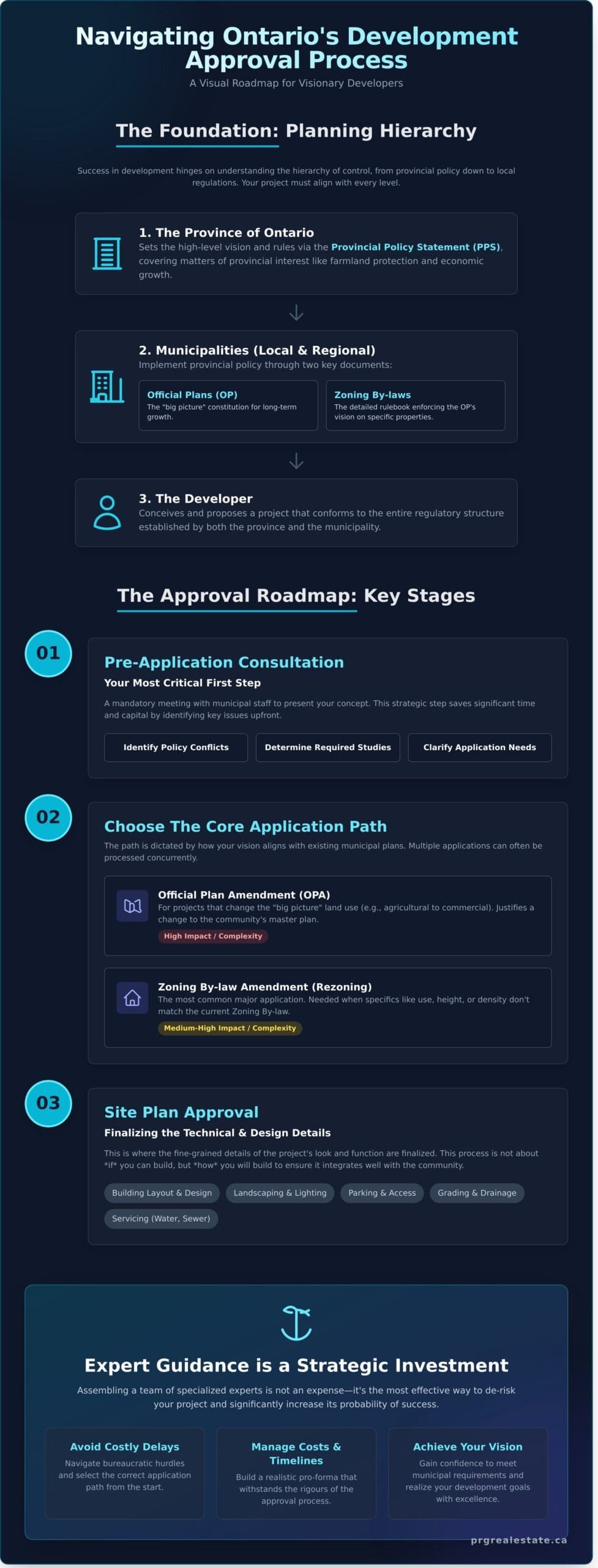
  • The Province of Ontario: Sets the high-level vision and rules for land use through the Provincial Policy Statement (PPS). The PPS provides overarching direction on matters of provincial interest, such as protecting farmland, managing natural resources, and promoting economic growth.
  • Municipalities: Local and regional governments are responsible for implementing provincial policies on the ground. They create detailed Official Plans to manage long-term growth and enact specific Zoning By-laws to regulate day-to-day land use with precision.
  • The Developer: As the proponent, your role is to conceive of a project that not only meets your investment objectives but also conforms to the entire regulatory structure established by both the province and the municipality.

Official Plans vs. Zoning By-laws: What’s the Difference?

Think of the Official Plan (OP) as a municipality’s “big picture” constitution for land use-a long-term vision outlining where residential, commercial, and industrial growth should occur. The Zoning By-law is the detailed rulebook that enforces this vision, specifying exactly what can be built on a property, including permitted uses, building heights, and setbacks. Your project must comply with both. If it doesn’t, you must apply for an Official Plan Amendment or a Zoning By-law Amendment. Should a municipality deny such an application, the decision can often be appealed to the Ontario Land Tribunal for a final ruling.

Pre-Application Consultation: Your Most Important First Step

Before a single drawing is finalized or an application fee is paid, the most critical step in the ontario development approval process is the Pre-Application Consultation. This is typically a mandatory meeting with municipal planning staff to present your preliminary concept. Its purpose is strategic: to identify key policy conflicts, required technical studies (e.g., traffic, environmental, servicing), and the specific requirements for a complete application. Engaging in this process early is not a formality; it is an essential investment that saves significant time and capital by preventing costly redesigns and unforeseen delays.

The Core Application Types: Which Path Will Your Project Take?

Navigating the ontario development approval process requires a strategic understanding of which application stream your project falls into. The path is dictated by how your vision aligns with the municipality’s existing land use policies. Think of it this way: are you proposing a minor tweak to the established rules, or a significant rewrite for your property’s future? Each scenario demands a different approach, governed by Ontario’s Land Use Planning Framework. Successfully managing these applications is critical, and it’s important to note that multiple submissions are often required and can be processed concurrently to optimize timelines.

Here are the most common application streams developers will encounter:

Official Plan Amendment (OPA): Changing the Big Picture

An OPA is necessary when your project’s proposed land use is fundamentally not permitted by the municipality’s Official Plan-the document that sets out the long-term vision for the community. For instance, seeking to build a commercial plaza on land designated for agricultural use would require an OPA. This is a significant and often lengthy process that demands expert navigation and a compelling planning rationale to justify the change to the community’s master plan.

Zoning By-law Amendment (Rezoning): Aligning Rules with Your Vision

This is the most common major application for new developments. A Zoning By-law Amendment, or rezoning, is required when your project’s specific use, density, height, or setbacks differ from the current zoning by-law. A classic example is proposing a mid-rise apartment building on a lot zoned exclusively for single-family homes. This application is essential for aligning the detailed local rules with your development goals.

Plan of Subdivision/Condominium: Creating New Parcels of Land

When a project involves dividing a large property into smaller, legally distinct parcels for sale, a Plan of Subdivision or Condominium is required. This process is foundational for creating new housing developments, office parks, and industrial lots. It’s crucial to distinguish between the two:

  • A Plan of Subdivision creates new, separate lots of land with frontage on a public road.
  • A Plan of Condominium creates legal title to individual units within a shared property, without subdividing the land itself.

Minor Variance & Consent to Sever: For Smaller Adjustments

For less complex changes, two more streamlined processes exist. A Minor Variance is sought for small deviations from the zoning by-law, such as a minor adjustment to a required building setback that doesn’t alter the general intent of the by-law. A Consent to Sever is used to create one or two new lots from an existing property. These applications are typically faster and less intensive than a full rezoning or OPA, making them ideal for smaller-scale projects.

The Site Plan Approval Process: Bringing Your Vision to Life on Paper

Once you have successfully navigated the initial zoning and policy hurdles, the ontario development approval process moves into a highly detailed, technical phase: Site Plan Approval. This stage transitions from the broad strokes of land use to the fine-grained details of your project’s physical design and function. Governed by Section 41 of the Planning Act, municipalities designate specific areas as ‘Site Plan Control Areas.’ If your property falls within one of these zones, securing Site Plan Approval is a mandatory step toward obtaining a building permit.

What a Site Plan Application Includes

A Site Plan Application is a comprehensive package of documents that provides a complete technical blueprint of your proposed development. It goes far beyond a simple sketch, requiring a suite of professional submissions that demonstrate the project’s viability, safety, and integration with the surrounding community. A typical submission package will include:

  • Detailed Architectural Drawings: Complete building elevations, floor plans, and cross-sections that illustrate the design, materials, and massing of all proposed structures.
  • Site Servicing and Grading Plans: Technical drawings showing connections to municipal water, sanitary, and storm sewers, as well as how the land will be graded for proper drainage.
  • Landscape, Parking, and Lighting Plans: Detailed layouts for all outdoor areas, including plant selections, parking stall configurations, barrier-free access, and specifications for exterior lighting to ensure safety without creating light pollution.
  • Supporting Technical Studies: Depending on the project’s scale, this may include a Stormwater Management Report, a Traffic Impact Study, an Arborist Report, and a Geotechnical Study.

Navigating the Circulation and Revision Cycle

Upon submission, your application is circulated to various municipal departments (e.g., Engineering, Planning, Parks and Recreation) and external agencies like the local Conservation Authority or regional government. Each department provides expert commentary based on their specific mandate. As detailed in Ontario’s official guide to the plan review and approval process, this collaborative review is fundamental. Receiving requests for revisions is a standard and expected part of this cycle. Successfully navigating this phase requires a skilled project manager who can efficiently coordinate responses from your team of consultants, ensuring a timely and strategic resolution to all comments.

The Site Plan Agreement: Your Legal Commitment

The culmination of a successful review is the Site Plan Agreement. This is a legally binding contract between you, the developer, and the municipality. It contractually obligates you to develop the property precisely in accordance with the approved plans and studies. This agreement is typically registered on the title of the property, binding all future owners. To guarantee the completion of required site works, the agreement will also outline financial securities, such as a Letter of Credit, that you must provide to the municipality. This ensures that public-facing elements like landscaping, sidewalks, and services are completed to the municipality’s standards.
The Ontario Development Approval Process: A Developer's Complete Guide

Timelines, Costs, and Key Challenges to Anticipate

For any developer, the most critical variables in a project’s pro-forma are time and money. Understanding the realistic timelines and costs associated with the ontario development approval process is not just beneficial-it is essential for financial viability. Proactive planning, informed by expert insight, is the most effective strategy to mitigate delays and prevent significant budget overruns. This section provides the strategic foresight needed to avoid common and costly mistakes.

Mapping the Timeline: How Long Does Approval Really Take?

While every project is unique, application timelines generally fall within predictable ranges. It is crucial to note that these are estimates and can vary significantly based on municipal staff resources, application complexity, and the potential for appeals.

  • Minor Variance or Consent: Typically the fastest, ranging from 3-6 months.
  • Site Plan Approval: A more detailed process that can take anywhere from 6-18 months, contingent on the project’s scale and technical requirements.
  • Zoning By-law Amendment / Official Plan Amendment (OPA): These are the most intensive applications, often requiring 12-24 months or more to secure a decision.

Budgeting for Success: Hard and Soft Development Costs

A comprehensive budget must account for costs incurred long before any ground is broken. These are broadly categorized as soft and hard costs.

Soft Costs are the upfront investments required to prepare and process your application. This capital is at risk before project approval is certain and includes municipal application fees, legal fees, and consultant fees for your team of planners, engineers, architects, and surveyors.

Hard Costs are typically paid later, after approvals are in place. These include substantial expenses like Development Charges (DCs), parkland dedication fees (or cash-in-lieu), and building permit fees, which are calculated based on the project’s final approved design.

Common Pitfalls and How to Avoid Them

Navigating the approval landscape requires diligence. Three common pitfalls consistently cause delays and escalate costs:

  • Incomplete Submissions: A poorly prepared application is the fastest route to delay. Municipalities will return incomplete packages, forcing you to restart the clock.
  • Underestimating Community Consultation: Neglecting early and meaningful engagement with community members and local councillors can lead to organized opposition and potential appeals.
  • Poor Consultant Coordination: A development team must operate in lockstep. A lack of coordination between planners, engineers, and architects can result in conflicting reports and costly revisions.

Successfully navigating the complexities of the development approval process in Ontario demands a team with a proven track record. At PRG Real Estate Brokerage, our expertise ensures your project is positioned for success from day one, transforming challenges into opportunities for growth.

Why Expert Guidance is Your Most Valuable Asset

Navigating the intricate landscape of land development is not a solo venture. Viewing professional consultation as a cost is a critical misstep; it is, in fact, a strategic investment in efficiency, risk mitigation, and profitability. The complexity of the ontario development approval process demands a multi-disciplinary team of experts working in concert. A well-coordinated team doesn’t just prevent costly errors and delays-it actively accelerates timelines and unlocks the full potential of your project.

Assembling Your Development A-Team

Success requires a roster of specialists, each with a critical role. Your core team is the foundation upon which a successful project is built, ensuring every technical, legal, and regulatory requirement is met with precision.

  • Planner: Your primary strategist and guide through the municipal bureaucracy. They prepare and submit applications, liaise with city staff, and ensure your proposal aligns with the Official Plan and zoning by-laws.
  • Engineer & Architect: The technical experts responsible for the project’s design and viability. They create the site plans, architectural drawings, and technical studies required to prove the project is feasible, safe, and serviceable.
  • Lawyer: Your legal counsel for drafting complex agreements, navigating land title issues, and representing your interests in negotiations or potential appeals to the Ontario Land Tribunal.

The Strategic Role of a Development-Focused Realtor

A specialized development realtor is more than an agent; they are a pivotal strategic partner from day one. Their value extends far beyond the transaction, providing the market intelligence and access needed to ensure your project is viable before you even begin the ontario development approval process. They provide crucial upfront market analysis and site selection advice, identifying parcels of land with the highest potential for rezoning and profitability.

Furthermore, their established relationships with landowners and industry players can unlock exclusive off-market opportunities and land assemblies that are never publicly listed. With a deep understanding of municipal politics and planning department priorities, they help position your project for a smoother, more predictable approvals journey. Their insight is foundational to achieving your development goals. Leverage our development expertise for your next project.

Your Strategic Partner in Navigating Ontario’s Development Landscape

Successfully navigating the intricate ontario development approval process demands more than a blueprint; it requires strategic foresight and deep-seated expertise. From understanding the foundational land use framework to mastering the site plan approval stage, the path to breaking ground is complex. The key to mitigating risks and maximizing your return on investment lies in securing expert guidance from a team that knows the terrain.

At PRG Real Estate, our proven expertise in GTA real estate development sets us apart. As top commercial realtors in Brampton, we are driven by a commitment to developing thriving communities, transforming ambitious visions into tangible assets. We leverage our industry leadership and unwavering dedication to excellence to streamline every stage of your project, ensuring your objectives are met with precision and efficiency.

Don’t let regulatory hurdles slow your progress. Navigate your development project with confidence. Contact PRG’s experts today. Your vision for a landmark development is within reach.

Frequently Asked Questions

What is the difference between an Official Plan and a Zoning By-law?

An Official Plan is a municipality’s strategic vision, outlining broad policies for long-term growth and land use. In contrast, a Zoning By-law is a detailed, legally binding document that implements the Official Plan’s vision. It specifies exactly how land can be used, dictating building heights, setbacks, and permitted uses for every property. Your development proposal must conform to both of these critical planning documents to secure approval.

Can I appeal a municipal decision on my development application?

Yes, in many cases, a municipal council’s decision on a development application can be appealed to the Ontario Land Tribunal (OLT). This applies if your application is refused or if the municipality fails to make a decision within the statutory timeframe. However, appeal rights are governed by strict rules and deadlines under the Planning Act. Securing expert representation is critical to navigate this complex process and build a strong case for a successful appeal.

What are Development Charges (DCs) and when do I have to pay them?

Development Charges (DCs) are fees levied by municipalities on new developments to help pay for the capital costs of growth-related infrastructure, such as roads, water systems, and emergency services. These charges ensure that the financial burden of new infrastructure does not fall solely on existing taxpayers. In Ontario, DCs are typically calculated and payable at the time a building permit is issued for the project, representing a significant financial milestone.

How important is community and public consultation in the approval process?

Community and public consultation is a critical and often mandatory component of the ontario development approval process. Engaging with local residents and stakeholders proactively can identify potential issues early, build support for your project, and mitigate the risk of appeals. A well-executed consultation strategy demonstrates a commitment to community building and can significantly streamline the path to receiving a final decision from council, preventing costly delays and fostering positive relationships.

What is the Ontario Land Tribunal (OLT) and what is its role?

The Ontario Land Tribunal (OLT) is an independent adjudicative body that resolves disputes related to land use planning. Its primary role is to hear appeals on decisions made by municipalities regarding applications under the Planning Act, such as Official Plan amendments and zoning changes. The OLT functions like a court for planning matters, making final, legally binding decisions based on evidence and provincial policies, ensuring consistent application of planning law across Ontario.

Do I need a lawyer for the development approval process?

While not mandatory for an initial application, engaging a planning lawyer is a strategic investment for navigating the complex ontario development approval process. An experienced lawyer ensures your application is robust, interprets intricate municipal and provincial policies, and provides critical representation during negotiations or appeals. For complex projects or any matter proceeding to the Ontario Land Tribunal, legal counsel is not just advisable-it is essential for protecting your interests and achieving a successful outcome.

Real Estate Development Consultation: A Guide to Maximizing Your Project's ROI
CategoriesBlog

Real Estate Development Consultation: A Guide to Maximizing Your Project’s ROI

The path from a promising plot of land to a completed, profitable development is fraught with complexity. Zoning regulations, municipal approvals, and financial projections can feel like an insurmountable maze, where a single misstep can jeopardize millions of Canadian dollars and derail your entire project. This is where strategic guidance becomes your most valuable asset. Engaging in professional real estate development consultation is not an expense; it is the critical investment that safeguards your vision and maximizes its financial potential from day one.

This comprehensive guide is designed to demystify the entire process. We will provide a clear, step-by-step roadmap, from initial feasibility studies and securing financing to navigating the intricate web of Canadian municipal approvals. You will gain the confidence and expert knowledge required to build a successful project without critical errors, ensuring your investment delivers the highest possible return. Prepare to transform your ambitious concept into a thriving reality, built on a foundation of expert strategy and flawless execution.

Key Takeaways

  • Shift your perspective from a single transaction to a strategic investment by understanding how a consultant maps out a project for maximum ROI.
  • Learn the five critical phases of the development lifecycle and how an expert guide ensures you navigate each stage with confidence and precision.
  • Discover the essential roles on a development ‘dream team’ and why your consultant is the most critical player for coordinating a successful outcome.
  • Arm yourself with the essential criteria for selecting the right real estate development consultation firm to protect your investment and drive profitability.

What is Real Estate Development Consultation? Your Strategic Blueprint for Success

Real estate development consultation is the strategic process of guiding a project from its initial concept to a successful and profitable completion. It moves beyond simple transactions to encompass the entire lifecycle of a development. While a comprehensive understanding of what is real estate development covers the multifaceted activities involved, a consultant acts as the project’s lead strategist or ‘quarterback’. Their role is to orchestrate every critical phase, ensuring all components align to achieve the highest possible return on investment.

This is fundamentally different from hiring a realtor to acquire land or a builder to handle construction. A development consultant’s primary objective is to ensure your project is feasible, profitable, and meticulously executed. We analyze market viability, navigate complex entitlements, and create a comprehensive blueprint that minimizes risk and maximizes value before a single shovel breaks ground. Our expert real estate development consultation provides the foresight and strategic direction essential for success in Canada’s competitive market.

Why You Can’t Afford to Skip Expert Consultation

Attempting to navigate the development landscape without an expert guide is a high-stakes gamble. A seasoned consultant provides the critical oversight needed to transform vision into reality, safeguarding your investment at every turn. Key advantages include:

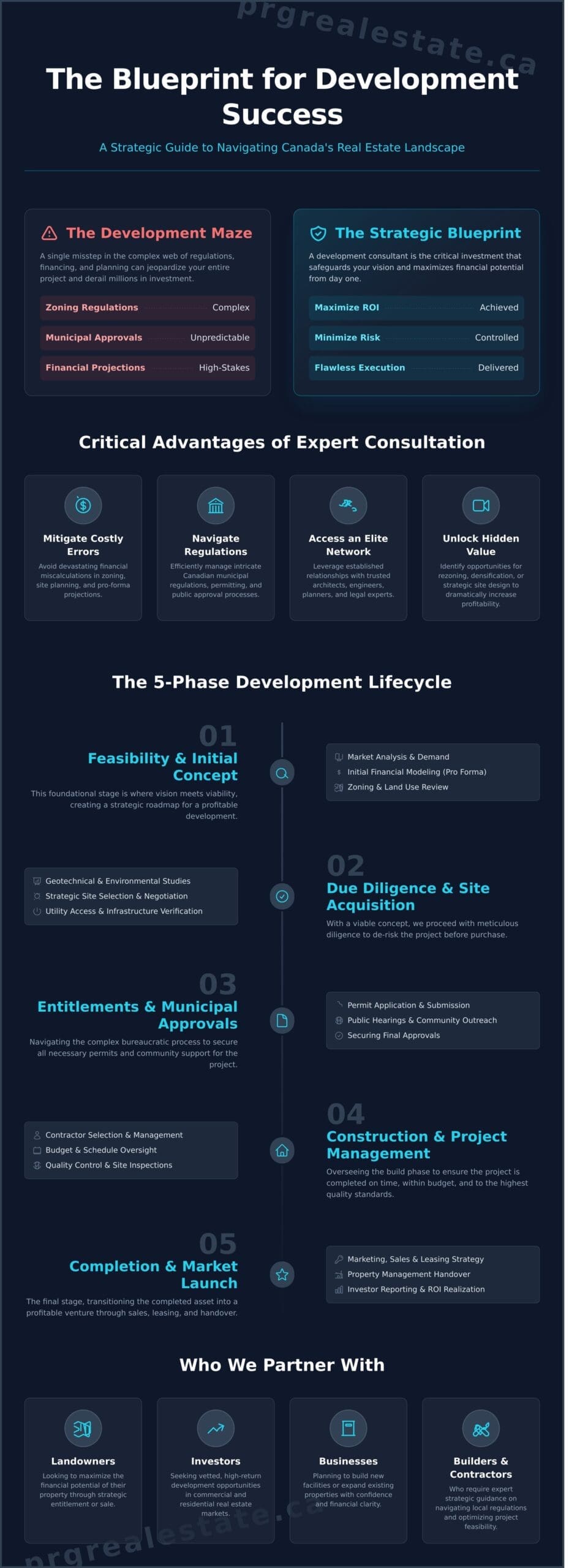
  • Mitigating Costly Errors: Avoid devastating financial miscalculations in zoning, site planning, and pro-forma projections that can derail a project.
  • Navigating Complex Regulations: Efficiently manage intricate Canadian municipal regulations, permitting, and the public approval processes that often cause significant delays.
  • Access to an Elite Network: Leverage our established relationships with trusted architects, engineers, planners, and legal experts to assemble a top-tier project team.
  • Unlocking Hidden Value: Identify opportunities for rezoning, densification, or strategic site design that can dramatically increase a property’s profitability.

Who Needs a Development Consultant?

Professional guidance is not reserved for large-scale developers. A wide range of stakeholders partner with us to achieve their development objectives:

  • Landowners looking to maximize the financial potential of their property through strategic entitlement or sale.
  • Investors seeking vetted, high-return development opportunities in the commercial and residential real estate markets.
  • Businesses planning to build new facilities or expand existing properties with confidence and financial clarity.
  • Builders and Contractors who require expert strategic guidance on navigating local regulations and optimizing project feasibility.

The 5 Key Phases of Development: A Consultant’s Step-by-Step Process

Navigating the complexities of property development requires a strategic, structured approach. Our real estate development consultation transforms this intricate process into a manageable, five-phase journey, providing the clarity and control necessary to make informed decisions. This framework ensures each stage builds logically upon the success of the last. A methodical process, as outlined in industry resources like the Prologis’ Guide to Real Estate Development, is not just best practice-it is essential for securing financing from Canadian institutions and gaining crucial municipal support for your project.

Phase 1: Feasibility & Initial Concept

This foundational stage is where vision meets viability. We conduct rigorous market analysis to confirm demand, perform initial financial modeling (pro forma) to project costs and return on investment, and review municipal zoning and land use policies to ensure alignment. The outcome is a clear, high-level concept and a strategic roadmap for a successful and profitable development.

Phase 2: Due Diligence & Site Acquisition

With a viable concept established, we proceed with meticulous due diligence to de-risk the project. This critical phase involves:

  • Coordinating essential technical studies, including geotechnical and environmental assessments.
  • Assisting in strategic site selection and the negotiation of purchase agreements.
  • Verifying utility access, servicing, and existing infrastructure capacity.
  • Developing a detailed project budget to secure initial financing commitments.

Phase 3: Entitlements & Municipal Approvals

Securing official approval is a pivotal milestone. Our experts manage the entire entitlements process, from submitting applications for rezoning and site plan approval to leading community engagement and presentations to planning committees. We navigate complex local bylaws and coordinate directly with city planners to address feedback and ensure all requirements are met efficiently.

Phase 4: Pre-Construction & Design

Here, the vision begins to take physical shape. We oversee the selection of a best-in-class team of architects, engineers, and contractors. Our role includes managing the detailed design and construction drawing process, implementing value engineering to optimize costs without compromising quality, and securing all necessary building permits to prepare for groundbreaking.

Phase 5: Construction & Project Delivery

The final phase focuses on execution and excellence. Our oversight continues through the construction process, managing budgets, timelines, and contractor communications to mitigate risks. We coordinate final inspections, secure occupancy permits, and ensure a seamless project handover, turning your approved design into a tangible, high-value asset.

Assembling Your Development Dream Team: Key Professionals and Their Roles

Executing a successful real estate development project is not a solo endeavour; it is a complex symphony of specialized expertise. Success hinges on assembling a team of top-tier professionals, each a master of their respective field. The value of a comprehensive real estate development consultation is its ability to act as the central point of contact, coordinating every expert and ensuring they are perfectly aligned with the project’s strategic goals, timeline, and budget. This orchestrated approach prevents costly delays, communication gaps, and critical budget overruns.

The Core Team: Architect, Planner, and Civil Engineer

Every project is built on a foundation of three key disciplines that transform a raw piece of land into a viable site. These professionals work in tandem to create the project’s blueprint.

  • Architect: Responsible for the building’s design, translating your vision into functional, aesthetic, and compliant construction plans.
  • Urban Planner: The strategic expert who navigates complex municipal zoning bylaws, official plans, and land-use policies to secure necessary approvals.
  • Civil Engineer: Manages the site’s essential infrastructure, including grading, servicing for water and sewer, and stormwater management systems.

Essential Technical & Legal Experts

Beyond the core design, a team of technical specialists is required to mitigate risk and ensure compliance with Canadian regulations. Their due diligence is critical for a secure investment.

  • Real Estate Lawyer: Handles all legal aspects, from the initial land acquisition and contract negotiation to navigating development agreements and final closing.
  • Geotechnical Engineer: Analyzes soil, rock, and groundwater conditions to provide critical recommendations for a stable and cost-effective foundation design.
  • Environmental Consultant: Conducts Phase I and II Environmental Site Assessments (ESAs) to identify and address any potential site contamination.

Financial and Sales Partners

Bringing the project to life and ensuring its commercial success requires strategic financial and sales expertise. These partners secure the necessary capital and drive revenue upon completion.

  • Mortgage Broker/Lender: Sources and structures the optimal construction financing and long-term mortgages required to fund the project.
  • Real Estate Brokerage: Develops and executes the marketing strategy, managing pre-construction sales, leasing campaigns, and the final sale of the completed assets.

Coordinating this diverse group of experts is the cornerstone of successful project management. Let PRG help you build your expert development team, ensuring seamless execution from concept to completion.

Real Estate Development Consultation: A Guide to Maximizing Your Project's ROI

Real estate development is a hyper-local discipline. A successful strategy in Toronto or Mississauga can fail in Brampton if it doesn’t account for the unique municipal vision, political climate, and community expectations. The Greater Toronto Area is not a monolithic market; it is a complex tapestry of distinct municipalities, each with its own official plans, zoning bylaws, and growth priorities. True success requires more than just capital; it demands an intimate understanding of regional infrastructure projects, like the Hurontario LRT extension, and how they will reshape communities. A strategic real estate development consultation provides this critical on-the-ground intelligence.

At PRG Real Estate Brokerage, our expertise is deeply rooted in this landscape. We don’t just see properties; we see potential shaped by local policy and future growth. Our established relationships with municipal planners, engineering departments, and local councils are a key asset, enabling us to streamline approvals and proactively address potential roadblocks before they become costly delays.

Understanding Brampton’s Official Plan & Zoning

Aligning your project with Brampton’s ‘2040 Vision’ is non-negotiable for securing approvals. This forward-thinking plan prioritizes sustainable, transit-oriented communities. We guide clients in navigating specific zoning bylaws for residential, commercial, and industrial lands, ensuring your proposal contributes to the city’s goals. Our focus is on identifying prime opportunities within key development corridors and intensification areas, such as those along Queen Street and around major transit hubs, to maximize your investment’s potential and secure municipal support.

Key Challenges in the GTA Market

Successfully developing in the GTA means strategically overcoming significant financial and logistical hurdles. Our consulting services are designed to mitigate these risks and protect your bottom line. Key challenges we help you master include:

  • Managing Costs: Navigating volatile land acquisition prices and high construction costs (C$) requires precise financial modeling and strategic procurement.
  • Navigating Municipal Fees: We provide clarity and strategic planning for Development Charges (DCs), parkland dedication fees, and other levies that can significantly impact project viability.
  • Stakeholder Engagement: Effectively addressing community feedback and satisfying stakeholder concerns is crucial for a smooth approvals process. We help craft a narrative that builds consensus and support.

Leveraging local knowledge is the difference between a stalled project and a thriving community. A comprehensive real estate development consultation with our team equips you with the strategic advantage needed to navigate this competitive landscape. Discover how our expertise can drive your project forward by exploring our services at prgrealestate.ca.

How to Choose the Right Real Estate Development Consultant

Selecting the right partner for your project is the single most important decision you will make at the outset. A top-tier consultant is more than a service provider; they are a strategic advisor whose expertise directly impacts your project’s viability and profitability. To make an informed choice, you need a clear framework for evaluation. This checklist empowers you to identify a partner committed to excellence and equipped to navigate the complexities of development.

Look for a Proven Track Record

A consultant’s past performance is the most reliable indicator of future success. Vague promises are insufficient; demand concrete evidence of their capabilities. When vetting potential partners for your real estate development consultation, insist on the following:

  • A comprehensive portfolio: Review their successfully completed projects, paying close attention to those that mirror the scale and scope of your own vision.
  • Relevant experience: Have they managed residential subdivisions, commercial plazas, or high-density infill projects in a market like Brampton? Their experience must be directly applicable.
  • Verified accolades: Look for credible client testimonials, case studies, and industry awards that substantiate their reputation for delivering results.

Verify Local Market Expertise

Real estate development is hyper-local. A consultant who lacks deep-rooted knowledge of your specific municipality is a liability. They must demonstrate an intricate understanding of Brampton’s unique regulatory landscape, including zoning bylaws, the Official Plan, and development charges. Ask them how they maintain relationships with key municipal staff and how they stay ahead of evolving policies that could impact your project timeline and budget.

Assess Their Network and Approach

An elite consultant brings more than just their own knowledge; they bring an established network of top-tier professionals, including architects, engineers, planners, and legal counsel. Their approach should be holistic and strategic, integrating every phase of the development cycle from initial feasibility studies to final approvals. Their communication must be clear, professional, and consistently focused on achieving your objectives. The right firm provides a comprehensive advisory service, ensuring every decision is aligned with your ultimate goals. See why PRG is the trusted choice for development in Brampton.

Transform Your Vision into a Landmark Success

Embarking on a real estate development project is a significant undertaking, where success is measured by both profitability and lasting community impact. As this guide has detailed, maximizing your ROI is not a matter of chance but the result of a meticulously executed strategy. It requires a deep understanding of the key development phases, the assembly of a skilled professional team, and invaluable local market knowledge. This is where professional real estate development consultation proves indispensable, providing the expert framework to navigate challenges and capitalize on opportunities.

At PRG Real Estate, we embody this strategic approach. With unparalleled expertise in the dynamic Brampton and GTA real estate markets, we have a proven track record of developing thriving communities. Our commitment is to provide unwavering strategic guidance, steering your project from its initial concept to a successful final sale. We don’t just manage projects; we build legacies and create clients for life.

Your ambition deserves a partner dedicated to excellence. Partner with PRG to bring your development vision to life. Contact our experts today.

Frequently Asked Questions

What is the first step in starting a real estate development project?

The foundational first step is a comprehensive feasibility study. This strategic assessment involves a detailed site analysis, rigorous market research, and the creation of a financial pro forma to project costs and potential returns. This due diligence is critical as it determines the project’s overall viability and informs every subsequent decision in the development lifecycle. Our experts guide you through this essential process to ensure your project is built on a solid foundation for success.

How much does real estate development consultation typically cost?

Consultation fees are structured to align with the scope and complexity of your project. Costs can be based on an hourly rate, a fixed fee for specific deliverables, or a percentage of the total project value. At PRG, we provide a transparent and detailed proposal outlining all associated costs in Canadian Dollars (C$) after an initial assessment of your objectives. This ensures you have a clear understanding of the investment required to leverage our expert guidance.

How long does the municipal approval process take in the GTA?

Navigating the municipal approval process in the Greater Toronto Area is a complex undertaking with variable timelines. For straightforward projects, approvals may take 12 to 18 months. However, more complex applications involving rezoning or Official Plan amendments can often extend to 24 months or longer. Our team’s expertise in dealing with various GTA municipalities helps streamline this process, manage expectations, and proactively address potential delays to keep your project moving forward efficiently.

Can a consultant help me secure financing for my project?

Absolutely. A key role of a development consultant is to position your project for successful financing. We prepare a comprehensive and professional financing package, including detailed market analysis, robust pro forma financials, and a compelling development plan. Leveraging our extensive network of lenders, from major Canadian banks to private capital firms, we connect you with the most suitable financing partners to ensure your project is capitalized for success from the outset.

What are the biggest risks in real estate development?

The primary risks in development include entitlement risk (failure to secure necessary approvals), construction risk (cost overruns and delays), and market risk (shifts in economic conditions or property values). Our strategic approach is designed to mitigate these challenges. We conduct exhaustive due diligence to minimize approval hurdles, implement rigorous project management to control costs and schedules, and provide expert market analysis to ensure your project remains profitable and resilient.

Is my property a good candidate for development?

Determining a property’s development potential requires a multi-faceted analysis of zoning by-laws, servicing capacity, site access, and current market demand. A professional real estate development consultation is the definitive method to evaluate your property’s highest and best use. Our experts provide a clear, data-driven assessment, uncovering hidden value and outlining a strategic path to maximize your asset’s potential and return on investment.

Real Estate Development in Brampton: The Ultimate 2026 Investor's Guide
CategoriesBlog

Real Estate Development in Brampton: The Ultimate 2026 Investor’s Guide

The path to successful development in Brampton is often obscured by complex municipal regulations and a daunting approvals process. For many investors, the city’s immense potential feels just out of reach, locked behind a wall of bureaucratic uncertainty and the challenge of identifying truly profitable opportunities. This complexity can stall even the most ambitious projects before they begin, leaving significant capital on the sidelines.

Yet, for those equipped with strategic insight and expert guidance, the landscape of real estate development Brampton offers unparalleled returns. The city is on a trajectory of explosive growth, creating a critical window for visionary developers to shape its future and secure high-value investments. The key is not just knowing *what* to build, but *where* and *how* to navigate the system with confidence and precision.

This definitive 2026 investor’s guide is your blueprint for success. We will demystify the municipal planning process, pinpoint the key residential, commercial, and industrial growth zones, and provide a clear, step-by-step framework for turning your vision into a landmark achievement. Unlock Brampton’s potential and build your legacy with the expert knowledge contained within.

Key Takeaways

  • Uncover the specific economic drivers and population growth trends that make Brampton a strategic hub for real estate investment and development.
  • Identify high-potential growth corridors and development zones by leveraging insights from Brampton’s Official Plan for your next real estate development Brampton project.
  • Explore the diverse spectrum of opportunities available, from high-density residential projects to strategic commercial and industrial builds.
  • Navigate the complexities of the municipal approval process with a clear, step-by-step overview designed to streamline your project’s timeline.

Why Brampton is a Prime Market for Real Estate Development

Brampton’s trajectory from a suburban hub to a dynamic urban centre presents an unparalleled opportunity for strategic investors and developers. Positioned as one of Canada’s fastest-growing and youngest cities, its rapid expansion is not speculative; it is fueled by robust economic drivers, significant infrastructure investment, and a clear, ambitious vision for the future. This explosive growth creates a sustained, high-stakes demand for innovative residential, commercial, and industrial projects, making the landscape for real estate development brampton exceptionally fertile.

Economic Growth and Population Boom

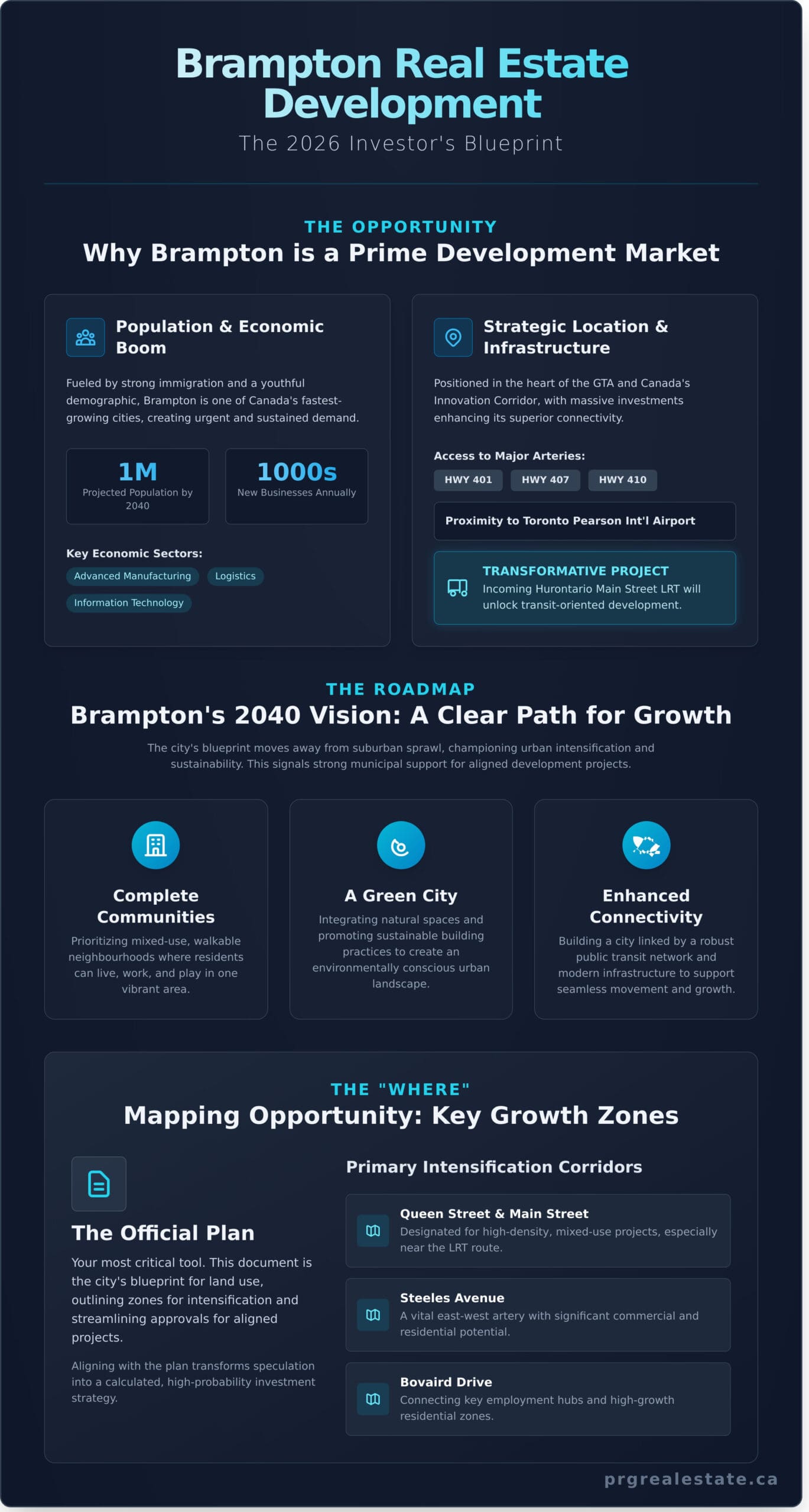
The core of Brampton’s development appeal lies in its powerful demographic and economic momentum. The city’s population is projected to approach one million by 2040, a boom driven by strong immigration and a youthful population. This rapid increase directly translates into urgent demand for diverse housing options. Economically, Brampton, Ontario, is a powerhouse in sectors critical to the Canadian economy, including advanced manufacturing, logistics, and information technology. This thriving job market, with thousands of new businesses establishing themselves annually, fuels the need for both modern residential communities and state-of-the-art commercial and industrial spaces to support them.

Strategic Location and Infrastructure Investment

Location is a fundamental asset, and Brampton’s is second to none. Situated in the heart of the Greater Toronto Area (GTA) and Canada’s Innovation Corridor, the city offers strategic access to major transportation arteries like Highways 401, 407, and 410, as well as proximity to Toronto Pearson International Airport. This connectivity is being significantly enhanced by transformative infrastructure projects. The incoming Hurontario Main Street Light Rail Transit (LRT) is a prime example, set to unlock unprecedented potential for high-density, transit-oriented development along one of the city’s main corridors.

Brampton’s 2040 Vision: A Blueprint for the Future

The City of Brampton has provided a clear roadmap for growth with its 2040 Vision document. This blueprint moves away from traditional suburban sprawl and champions a future built on principles of urban intensification and sustainability. For developers, this vision creates defined opportunities by prioritizing:

  • Complete Communities: Fostering mixed-use, walkable neighbourhoods where residents can live, work, and play.
  • A Green City: Integrating natural spaces and sustainable building practices into new developments.
  • Enhanced Connectivity: Building a city connected by a robust public transit network and modern infrastructure.

This forward-thinking plan signals strong municipal support for intelligent, high-quality real estate development brampton that aligns with a more urban, connected future.

Mapping Opportunity: Key Growth Areas and Development Zones

Identifying the ‘why’ behind Brampton’s growth is foundational; discerning the ‘where’ is what drives profitable outcomes. For astute investors and developers, success in real estate development brampton is not a matter of chance but of strategic navigation. The primary tool for this navigation is the City of Brampton’s Official Plan, a document that transforms speculation into a calculated investment strategy.

Understanding Brampton’s Official Plan

The Official Plan is the city’s comprehensive blueprint for managing growth and land use. It dictates where new residential, commercial, and industrial projects can be built, outlining policies for everything from building heights to environmental protection. For developers, this document is a strategic map, clearly identifying areas designated for intensification, mixed-use zoning, and infrastructure investment. Aligning projects with the Official Plan streamlines approvals and leverages publicly funded growth initiatives.

Spotlight on Major Growth Corridors

Brampton’s growth is strategically channelled along key transportation corridors. The Queen Street and Main Street corridors are designated as primary intensification areas, primed for high-density, mixed-use projects. The impending arrival of the Hurontario LRT is a game-changing catalyst, significantly elevating property values and demand for transit-oriented communities along its route. Developers should also monitor other major arterial roads designated for growth, including:

  • Steeles Avenue: A vital east-west artery with significant commercial and residential potential.
  • Bovaird Drive: Connecting key employment and residential zones.
  • Dixie Road: An established industrial and commercial hub ripe for modernization.

Emerging Neighbourhoods and Infill Potential

Beyond the central corridors, significant opportunity exists in emerging development zones and through strategic infill. Areas guided by secondary plans, such as Heritage Heights, are poised for structured, large-scale growth. Concurrently, infill development-the process of building on underutilized lots within existing neighbourhoods-offers a path for boutique residential and commercial projects. This often involves land assembly, the complex but rewarding process of acquiring adjacent properties to create a viable parcel. For detailed economic data and support, the City’s official Invest Brampton portal provides an essential resource for navigating these opportunities.

Types of Real Estate Development Opportunities in Brampton

Brampton’s dynamic growth and strategic location have created a landscape rich with diverse investment possibilities. For astute developers, understanding the specific needs of the market is paramount to capitalizing on these opportunities. The current economic drivers are fueling significant demand across residential, commercial, and industrial sectors, creating a robust environment for strategic real estate development brampton. Successfully navigating this landscape requires a deep understanding of municipal priorities, and the official Brampton Planning & Development portal provides an essential resource for aligning projects with the city’s vision.

Residential Development: Meeting Housing Demand

The city’s rapid population growth creates an urgent and sustained demand for new housing. Opportunities are abundant for developers who can deliver the right product, including:

  • High-Density Projects: High-rise and mid-rise condominiums are in high demand, particularly along key transit corridors like the Hurontario LRT and near GO Transit stations.
  • ‘Missing Middle’ Housing: There is a significant market for townhomes, stacked towns, and multiplexes that offer a bridge between single-family homes and high-rise living, providing more affordable options for families.
  • Niche Housing: Purpose-built student residences near post-secondary institutions and modern senior-focused housing communities represent strategic, underserved markets.

Commercial and Retail Development

As residential communities expand, the need for supporting commercial and retail infrastructure grows in tandem. The most promising opportunities lie in projects that create vibrant, walkable community hubs. This includes the development of new office spaces catering to the city’s growing professional services sector and modern retail plazas anchored by essential services. Mixed-use developments, which integrate ground-floor retail with residential units above, are particularly lucrative, especially when located near transit hubs and within master-planned communities.

Industrial and Logistics: Brampton’s Economic Engine

Brampton is a cornerstone of Canada’s supply chain, and its industrial sector is a primary economic engine. This creates an intense and ongoing demand for modern logistics and warehousing facilities. The key opportunities in industrial real estate development in Brampton involve constructing large-scale, high-ceiling distribution centres to serve the e-commerce boom. Furthermore, there is significant potential in redeveloping older, underutilized industrial properties into state-of-the-art facilities that meet the exacting standards of today’s global logistics leaders.

Real Estate Development in Brampton: The Ultimate 2026 Investor's Guide

Successfully executing any significant real estate development brampton hinges on navigating the City’s intricate approval process. This phase can seem daunting, but with a strategic approach, it becomes a clear and manageable pathway. Understanding the key stages, from initial due diligence to final council endorsement, is critical for mitigating risk, controlling timelines, and ensuring your project aligns with municipal objectives for a streamlined approval.

Stage 1: Pre-Application and Due Diligence

This foundational stage is where project viability is determined. Before any land acquisition, comprehensive due diligence-including market feasibility studies, environmental site assessments, and financial modeling-is essential. The next critical step is a pre-application consultation meeting with City of Brampton planning staff. This provides invaluable early feedback on your concept, identifies key policy considerations, and clarifies the specific applications required, setting a clear direction for your project.

Stage 2: Submitting Key Development Applications

Once your preliminary research is complete, the formal application process begins. While each project is unique, most will involve a combination of the following core submissions:

  • Zoning By-law Amendment: Required if your proposed land use or density does not conform to the current zoning. This application seeks to amend the municipal by-law to permit your development concept.
  • Site Plan Application: This application focuses on the detailed design and technical aspects of your project, including building placement, landscaping, parking, access, and servicing. It ensures the development is functional, safe, and well-integrated with its surroundings.
  • Plan of Subdivision: Necessary for projects that involve dividing a parcel of land into multiple lots or blocks for sale.

Stage 3: Public Consultation and Final Approval

After your applications are deemed complete, the project enters the public review phase. This typically involves public meetings where community members and stakeholders can provide feedback. Proactively addressing concerns and clearly communicating the project’s benefits are vital. Following this consultation, planning staff will prepare a final report with recommendations for Brampton City Council, which holds the ultimate authority for approval. Overcoming common hurdles, such as traffic concerns or heritage considerations, requires expert negotiation and a well-prepared strategy.

This multi-stage process demands precision and expert oversight to ensure a successful outcome. Let our experts manage the complexities of the approval process for you.

Partnering for Success: The PRG Advantage in Brampton Development

Navigating the complexities of Brampton’s development landscape demands more than a transactional agent; it requires a strategic partner with proven expertise and an unwavering commitment to your project’s success. At PRG Real Estate Brokerage, we provide the specialized guidance necessary to transform ambitious visions into profitable realities. Our deep market intelligence and results-oriented approach are engineered to maximize your return on investment and mitigate the risks inherent in any significant development venture.

Beyond Transactions: A Strategic Development Partner

A standard agent sees a property; a development specialist sees potential. PRG Real Estate Brokerage’s expertise in real estate development Brampton goes far beyond the Multiple Listing Service. We leverage our extensive local network and granular understanding of zoning bylaws, municipal planning, and future infrastructure projects to identify opportunities that others miss. This strategic foresight saves our clients invaluable time, capital, and protects them from costly missteps that can derail a project before it even begins.

How PRG Real Estate Brokerage Facilitates Land Acquisition and Assembly

Securing the right parcel of land is the critical foundation of any successful development. Our team excels in the nuanced and often challenging process of land acquisition and assembly, a core competency that sets us apart. We deliver a decisive advantage through:

  • Off-Market Opportunities: Proactively identifying and securing high-potential development sites before they ever reach the open market.
  • Complex Land Assembly: Skillfully negotiating with multiple landowners to consolidate fragmented parcels into a single, viable development site.
  • Expert Negotiation: Representing your interests with precision and authority to ensure optimal terms and value in every acquisition.

From Vision to Reality: Our Commitment to Your Project

Our role extends from initial site selection to final project completion. PRG Real Estate Brokerage acts as your central advisory hub, connecting you with our trusted network of industry-leading planners, architects, engineers, and legal experts. We guide you through due diligence, approvals, and strategic planning, ensuring every decision aligns with your objectives. This comprehensive partnership is rooted in our core mission: not just to close deals, but to play a pivotal role in developing thriving communities.

Your vision for development in Brampton deserves an elite partner dedicated to achieving exceptional results. Connect with a team that understands the stakes and has the expertise to deliver.

To discuss your development goals and discover the PRG Real Estate Brokerage advantage, contact our specialized development team today.

Transforming Vision into Value: Your Next Step in Brampton Development

As we’ve explored, Brampton’s trajectory presents a compelling window of opportunity for astute investors. From its designated growth corridors to the diverse range of potential projects, the city is a canvas for ambitious ventures. Realizing the full potential of real estate development Brampton offers requires expert navigation of municipal processes and a deep understanding of market drivers.

This is where professional guidance becomes your most valuable asset. At PRG Real Estate Brokerage, we provide strategic guidance from concept to completion. Our specialized expertise across commercial, residential, and land development, led by Harsh Pabla, a leading real estate expert, ensures your project is positioned for maximum success. Don’t just watch Brampton’s future unfold-be an architect of it. Discuss your development vision with Brampton’s leading real estate experts and let us transform your ambition into a landmark achievement.

Frequently Asked Questions About Real Estate Development in Brampton

What are Development Charges in Brampton and how are they calculated?

Development Charges (DCs) are fees levied by the City of Brampton on new land development to fund the capital costs of municipal infrastructure required to service that growth, such as roads, water systems, and emergency services. The calculation is based on the City’s Development Charges By-law, with rates in Canadian Dollars (C$) varying by the type of development (e.g., residential single-detached vs. apartment) and its scale. These charges ensure the financial burden of new infrastructure falls on developers.

How long does the entire real estate development process typically take in Brampton?

The timeline for a real estate development Brampton project varies significantly based on its scale and complexity. A straightforward project with existing zoning might move from acquisition to completion in 2-3 years. However, larger developments requiring Official Plan or Zoning By-law amendments can easily extend to 5-10 years or more. Key stages impacting this timeline include due diligence, municipal approvals, site plan control, and the construction phase itself, each with its own set of requirements.

Can I rezone a residential property for commercial use?

Rezoning a residential property for commercial use is achievable but requires a formal application for a Zoning By-law Amendment with the City of Brampton. The viability of this change is heavily dependent on the property’s designation within Brampton’s Official Plan. The process is rigorous, involving technical studies, public consultation, and final approval from City Council. An expert team can strategically navigate this complex municipal process to maximize the potential for a successful application and outcome.

What is the difference between Brampton’s Official Plan and its Zoning By-laws?

Brampton’s Official Plan is a high-level strategic document outlining the City’s long-term vision for growth and land use. It sets broad policies and designates general areas for residential, commercial, and industrial purposes. In contrast, the Zoning By-law is the specific legal tool that implements the Official Plan’s vision. It contains detailed, legally enforceable regulations for every property, dictating exact permitted uses, building heights, setbacks, and parking requirements, ensuring development aligns with the established framework.

What are the first steps I should take if I have a piece of land I want to develop?

The critical first step is to conduct comprehensive due diligence. This involves a detailed review of the property’s current zoning, its designation in the Official Plan, and the availability of municipal services. The next immediate action should be to assemble a team of seasoned professionals, including planners, engineers, and a brokerage with proven development expertise. This initial strategic alignment is essential for navigating the complex approvals process and ensuring project viability from the outset.

How can a real estate brokerage assist with securing financing for a development project?

An expert real estate brokerage acts as a strategic partner in securing development financing. Leveraging established relationships with a network of institutional lenders, private equity firms, and mortgage brokers, we connect you with the right capital partners. Our team assists in preparing a compelling and professional financing proposal, complete with detailed market analysis, pro forma financials, and a robust business case. This enhances credibility and significantly improves your ability to secure the necessary funding on favourable terms.