

Realtor Commission Brampton (2026): A Complete Guide to Fees
Selling your property is one of the most significant financial decisions you will make, yet the details surrounding agent fees can often feel opaque. For many homeowners, navigating the structure of the standard realtor commission Brampton requires clarity and confidence. The fear of overpaying, confusion over what services are included, and the anxiety of negotiation are common concerns that can add unnecessary stress to the selling process. Securing the right professional partnership is critical to protecting your investment and maximizing your final sale price.
This definitive guide is engineered to provide complete transparency. We will break down the typical commission structures you can expect in the Brampton market for 2026, detail the high-value services a top-tier agent provides, and empower you with the strategic insights needed to confidently discuss fees. You will gain a clear framework for evaluating different service models, ensuring you partner with a professional who delivers not just a transaction, but exceptional results and true value for your most important asset.
Key Takeaways
- Learn the standard commission structure in Brampton, including the typical 5% fee and how it is strategically divided between brokerages.
- Discover how a full-service commission is a direct investment into maximizing your property’s sale price through expert marketing and negotiation.
- Evaluate the differences between full-service and low-commission models to determine the optimal realtor commission brampton structure for your goals.
- Gain the insights needed to select a top-tier agent whose service and strategic approach deliver maximum return on your investment.
What is the Average Realtor Commission in Brampton?
When selling your property, understanding the associated costs is paramount to calculating your net proceeds. The most significant of these is the real estate agent’s commission. In Brampton, the standard commission structure is typically 5% of the home’s final sale price. This percentage is not arbitrary; it represents the comprehensive value and professional services provided by both the listing and buying real estate professionals who facilitate the transaction.
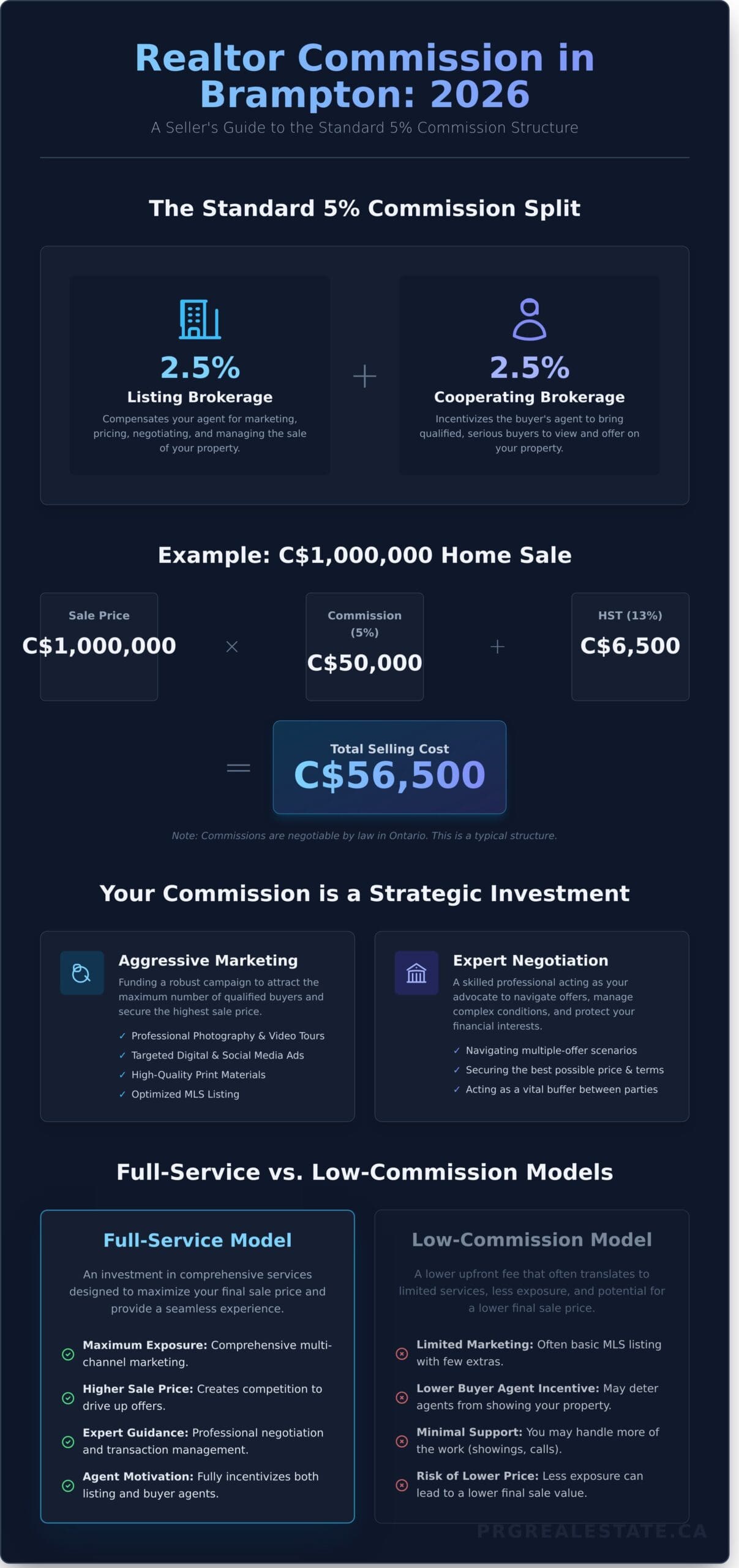
This 5% total is strategically divided to compensate both parties involved in the sale. Typically, it is split evenly:
- 2.5% for the Listing Brokerage: This compensates your agent (the seller’s agent) for their expertise in marketing, pricing, negotiating, and managing the sale of your property.
- 2.5% for the Cooperating Brokerage: This portion is offered to the buyer’s agent, creating a powerful incentive for them to bring qualified, serious buyers to your listing.
To illustrate, consider the sale of a home in Brampton for C$1,000,000. A 5% commission would amount to C$50,000. It is crucial to remember that Harmonized Sales Tax (HST) is applicable to this fee, bringing the total cost to C$56,500 (C$50,000 + 13% HST).
While 5% is a common benchmark for realtor commission Brampton, it is essential for sellers to know that these rates are not fixed. By law in Ontario, all real estate commissions are negotiable. The final rate should reflect the scope of services, the agent’s experience, and the strategic marketing plan proposed for your specific property.
Who Pays the Realtor Commission?
The total commission is paid by the home seller directly from the proceeds of the sale at closing. This single payment structure is designed to streamline the process and effectively motivate the entire real estate community. By offering a competitive commission to the buyer’s agent, sellers significantly widen their pool of potential buyers, ensuring their property receives maximum exposure and attracts the strongest possible offers. This entire fee, including the HST, is detailed on the seller’s statement of adjustments prepared by their lawyer.
Understanding the Listing Agreement
The Listing Agreement is the legally binding contract between you (the seller) and your chosen real estate brokerage. This document formalizes your partnership and outlines the terms of the sale. Key components include the total commission rate, the specific amount offered to the cooperating brokerage, the listing price, and the duration of the contract. It is imperative to review this document with unwavering attention to detail before signing, ensuring all terms align with your expectations and financial goals.
What Does a Full-Service Commission Actually Pay For?
When reviewing the potential costs of selling your home, the commission can appear to be a significant line item. However, it’s crucial to reframe this from a cost to a strategic investment. A full-service commission is not simply a fee for listing a property; it is a comprehensive package of services, expertise, and resources designed to maximize your final sale price and protect your interests throughout a complex transaction. This investment covers four critical areas: aggressive marketing, expert negotiation, significant time commitment, and the agent’s professional overhead.
Marketing: An Investment in Your Sale Price
To achieve the highest possible price, your property needs maximum exposure to qualified buyers. A portion of the commission directly funds a robust, multi-channel marketing campaign that goes far beyond a simple lawn sign. This strategic investment includes:
- Professional Media: High-resolution photography, cinematic video tours, and 3D virtual walkthroughs to make your listing stand out.
- Digital Advertising: Targeted social media campaigns and premium placement on major real estate portals.
- High-Quality Print: Professionally designed feature sheets and brochures for showings and open houses.
- MLS Listing Optimization: A detailed, compelling listing on the Multiple Listing Service to attract other agents and their buyers.
This comprehensive marketing effort creates a competitive environment, often leading to multiple offers and a sale price that far exceeds what could be achieved with minimal exposure.
Expertise: The Value of Professional Negotiation
This is where an elite agent provides an exceptional return on investment. We act as a vital buffer and a skilled negotiator, managing offers with strategic precision. Whether navigating a high-stakes, multiple-offer scenario to drive the price higher or resolving complex conditions on a challenging offer, our expertise protects your financial interests. The structure of a realtor commission in Brampton is designed to cover this high-level professional service, ensuring you have an advocate dedicated to securing the best possible terms and price.
Furthermore, a significant portion of the commission is reinvested into the professional infrastructure required to operate. This includes brokerage fees, mandatory errors and omissions insurance, annual licensing renewals with regulatory bodies like RECO, and continuous professional development. These costs are part of a regulated framework; in fact, ongoing reviews of Realtor commission regulations by government bodies like the Competition Bureau of Canada underscore the structured nature of the industry. This ensures you are represented by a qualified, insured, and accountable expert committed to excellence.
Full-Service vs. Low-Commission Realtors in Brampton: A Comparison
When evaluating the cost of selling a home, it’s crucial to understand that not all real estate service models are created equal. The conversation around realtor commission Brampton has evolved beyond a single standard, introducing options like “1% listing” or “flat-fee” brokerages. These models charge a discounted rate for the listing portion of the sale, often operating on an a la carte basis where services like professional photography or open house management incur extra fees. The rise of these varied models is a direct result of a competitive marketplace, a topic that has even prompted a Competition Bureau of Canada investigation into industry practices to ensure consumer choice.
| Feature | Full-Service Realtor | Low-Commission / Flat-Fee Realtor |
|---|---|---|
| Fee Structure | Typically a percentage of the final sale price (e.g., 5% total), split between listing and buyer agents. | A lower percentage (e.g., 1%) or flat fee for the listing agent, plus a separate, competitive commission for the buyer’s agent (e.g., 2.5%). |
| Marketing Budget | Comprehensive: professional photography, videography, staging consultations, premium online and print advertising. | Limited: basic MLS listing, minimal professional marketing, often with add-on fees for upgrades. |
| Agent Availability | Dedicated, hands-on support and strategic advice throughout the entire process. | May use a team or call-centre model, resulting in less direct, personalized contact with a single agent. |
| Scope of Services | End-to-end management, including market analysis, pricing strategy, showings, negotiation, and closing coordination. | Core listing services are covered, but negotiation support, showing management, and other key tasks may cost extra or be left to the seller. |
Pros and Cons of Low-Commission Models
The primary advantage is the immediate, tangible savings on the listing agent’s fee. However, this initial saving can be misleading. Sellers must recognize that to attract buyers, they will almost certainly need to offer a competitive cooperating commission (typically 2.5%) to the buyer’s agent. Furthermore, reduced-service models often mean a significantly smaller marketing budget and less hands-on guidance, which can negatively impact the final sale price and the seller’s net profit.
When Might a Discount Brokerage Make Sense?
A low-commission model may be viable in specific scenarios: a red-hot seller’s market with intense bidding wars, a highly desirable standard property in a prime neighbourhood, or for a seasoned seller comfortable managing parts of the transaction. Conversely, this approach is ill-advised for unique luxury homes, first-time sellers who require comprehensive guidance, or in a balanced market where expert marketing and negotiation are paramount. Ultimately, the cheapest option is not always the most profitable one; maximizing your net proceeds is the true measure of success.
Section 4: A Strategic Approach to Realtor Fees and Negotiation
Understanding and negotiating realtor fees is not about securing the lowest percentage; it is about engaging a partner who will deliver the highest net return on your property. A strategic approach empowers you to assess an agent’s true value and align their compensation with your financial success. This ensures the commission you pay is a direct investment in a superior outcome.
Before committing, it is essential to interview multiple real estate professionals. This process allows you to compare not only the proposed realtor commission Brampton agents offer but also their marketing strategies, local expertise, and negotiation philosophies. A top-tier agent will confidently justify their fee structure with a clear plan to maximize your sale price.
Questions to Ask a Potential Brampton Realtor
To properly vet a candidate and understand the value they provide, your interview should be direct and results-focused. Ask the following questions to gain critical insight:
- What is your total commission and how is it split? Understand what portion goes to the buyer’s agent and what is retained by the listing brokerage.
- What specific marketing services are included for this fee? This should include professional photography, virtual tours, staging consultations, digital advertising campaigns, and open house strategies.
- Can you provide a track record of your recent sales in my Brampton neighbourhood? Proven success in your specific market is non-negotiable.
- What is your strategy for negotiating offers to secure the best possible price and terms for me? An expert negotiator can often secure tens of thousands of dollars more for your home.
Negotiating on Value, Not Just Price
Frame the conversation around the comprehensive services being provided. An agent’s fee is an investment in their expertise, network, and marketing resources. While a lower rate may seem appealing, it is crucial to understand what might be compromised. The goal is not to find the cheapest agent, but the one who nets you the most money after all expenses.
Consider proposing a performance-based commission, such as a tiered rate that increases if the agent achieves a sale price significantly above asking. Furthermore, higher-priced properties may warrant a lower commission percentage, as the absolute dollar value of the fee remains substantial. A confident, results-driven realtor will be open to discussing a structure that aligns their success directly with yours. The ultimate objective is a partnership that delivers maximum value and a seamless, profitable transaction. To understand how our strategic approach delivers superior results, connect with our team of top Brampton realtors.
A Note on Commercial Real Estate Commissions
While the previous sections have focused on residential property sales, the conversation around realtor commission in Brampton shifts significantly when we enter the commercial real estate arena. These transactions are fundamentally different, involving higher stakes, greater complexity, and commission structures designed to reflect the specialized expertise required.
Why Commercial Commissions Are Different
Unlike the more standardized residential market, commercial real estate commissions are highly variable. This is a direct result of the intricacies involved in each deal. Key factors that influence the structure and amount of a commercial commission include:
- Increased Complexity and Due Diligence: Commercial transactions require a deep understanding of zoning bylaws, environmental assessments, tenant agreements, and property income analysis (cap rates). The due diligence period is far more intensive and prolonged.
- Longer Sales Cycles: Finding the right buyer for a commercial property and navigating negotiations can take many months, or even years, demanding sustained marketing efforts and specialized expertise.
- Specialized Valuation and Marketing: Valuing a commercial asset is less about comparable sales and more about its potential for revenue generation. Marketing these properties requires a strategic approach targeting a niche audience of investors and business owners.
- Diverse Commission Structures: Commercial deals often use tiered commissions (e.g., a higher percentage on the first C$1 million and a lower percentage on the balance) or have separate, distinct rates for leasing versus sales transactions.
Partnering with PRG for Maximum Commercial Value
In the high-stakes world of commercial real estate, your realtor’s fee is not a cost-it is a strategic investment in expertise, network, and results. At PRG Real Estate, our top commercial realtors focus on maximizing the value of your assets and developing thriving communities. We understand that navigating the nuances of a commercial realtor commission in Brampton is secondary to securing a profitable and sound deal.
Our team’s unparalleled market knowledge ensures your property is positioned correctly, marketed effectively, and negotiated with precision. We manage the immense complexity of commercial transactions, allowing you to focus on your business objectives. Choosing PRG means partnering with a brokerage committed to achieving superior outcomes for your portfolio. For expert guidance on your commercial property, contact PRG Real Estate.
Secure Your Highest Return: The Final Word on Realtor Commissions
Understanding the structure of real estate commissions is a critical step for any Brampton property owner. As we’ve detailed, the fee is not simply a cost but a strategic investment in expert marketing, skilled negotiation, and seamless transaction management. While low-commission models exist, the comprehensive service and market leverage of an elite realtor often result in a significantly higher final sale price, delivering a superior return on your investment.
Ultimately, navigating the standard realtor commission Brampton sellers can expect is about choosing a partner who provides undeniable value. At PRG Real Estate, our award-winning team is built on a reputation of trust and a commitment to excellence. As specialists in both commercial and residential real estate, we provide the strategic advice required to ensure you achieve the highest possible sale price for your asset.
Your property is a significant investment. Ensure it’s in the hands of professionals dedicated to maximizing its potential. Partner with Brampton’s top realtors to maximize your property’s value.
Frequently Asked Questions About Realtor Commissions
Is realtor commission negotiable in Ontario?
Yes, real estate commission is fully negotiable in Ontario. There is no standard or government-mandated rate. The commission is an agreement between the seller and their listing brokerage, reflecting the level of service, marketing strategy, and expertise provided. An elite agent will demonstrate how their strategic approach justifies their commission structure, aiming to secure you the highest possible return on your investment. This negotiation is a critical part of your listing agreement.
Who pays the realtor commission when a house is sold in Brampton?
The home seller is responsible for paying the total realtor commission. This amount is specified in the listing agreement and is typically paid from the sale proceeds at closing. This total commission is then split between the seller’s brokerage and the buyer’s brokerage. Understanding the complete structure of the realtor commission Brampton sellers pay is essential for accurately calculating your net proceeds and pricing your property effectively in the competitive market.
Do I have to pay HST on real estate commission in Canada?
Yes, HST (Harmonized Sales Tax) must be paid on real estate commissions in Ontario and throughout Canada. A realtor’s services are considered taxable, and the current HST rate of 13% in Ontario is applied to the total commission fee. This is a mandatory closing cost for sellers and should be factored into your budget. Your agent’s statement of account will clearly itemize the commission and the corresponding HST amount for your records.
What is a 1% commission realtor and what’s the catch?
A “1% commission” typically refers only to the listing agent’s portion of the fee and does not include the necessary commission offered to the buyer’s agent (usually 2.0-2.5%). The ‘catch’ often involves a limited-service model, which may exclude professional marketing, staging consultations, or dedicated negotiation support. A full-service brokerage provides a comprehensive strategy designed to maximize your property’s value, often resulting in a higher final sale price that outweighs the commission savings.
How is commission split between the buyer’s and seller’s agent?
The total commission is divided between the listing brokerage (representing the seller) and the cooperating brokerage (representing the buyer). While a 50/50 split is common, the exact division is determined by the seller in the listing agreement. For example, a 5% total commission might be split so that 2.5% goes to the listing brokerage and 2.5% is offered to the buyer’s brokerage. This cooperative commission is a powerful incentive for agents to show your property.
Can I sell my house myself to avoid paying commission?
Yes, you can sell your property as a For Sale By Owner (FSBO) to avoid paying the listing portion of the commission. However, to attract buyers represented by agents, you will likely still need to offer a commission to the buyer’s agent. Sellers who choose this route are solely responsible for all aspects of the sale, including market analysis, marketing, legal paperwork, and high-stakes negotiations-areas where a top-tier professional provides immense value and mitigates risk.
Are commercial real estate commissions higher than residential?
Commercial real estate commissions are not inherently higher, but they are often structured differently. They frequently use a sliding scale, where the percentage decreases as the transaction value increases-for example, 5% on the first C$1 million and 3% on the remainder. The final commission is highly negotiable and reflects the complexity, asset class, and significant due diligence required for commercial transactions, demanding the expertise of a seasoned commercial real estate professional.