Office Lease Negotiation: A Strategic Guide to Securing the Best Terms
Signing an office lease is one of the most significant financial commitments a business can make. Yet, many leaders enter this critical process feeling unprepared-overwhelmed by complex jargon like TMI and anxious about hidden costs that could derail their budget for years to come. The fear of being locked into an unfavourable, inflexible agreement is a valid concern that can stifle a company’s potential. This is where strategic office lease negotiation becomes your most powerful asset, transforming a daunting task into a decisive business advantage.
This expert guide is designed to move you from uncertainty to a position of strength. We will deconstruct the entire process, providing the expert insights needed to secure a lease that fuels your business growth, not hinders it. You will learn to decipher complex clauses, negotiate critical flexibility for future expansion or downsizing, and achieve the lowest possible total occupancy cost. Prepare to master the art of negotiation and secure terms that align perfectly with your strategic objectives, ensuring your commercial space becomes a true foundation for success.
Key Takeaways
- A successful negotiation is won before you meet the landlord; defining your operational and financial non-negotiables is the most critical first step.
- Look beyond the advertised base rent to understand the Total Cost of Occupancy (TCO), which reveals the true financial impact of the lease on your business.
- A strategic office lease negotiation prioritizes future flexibility through clauses like termination rights and expansion options, which are often as valuable as rent concessions.
- Securing expert representation is a strategic investment that levels the playing field, counters landlord-favoured terms, and protects your long-term interests.
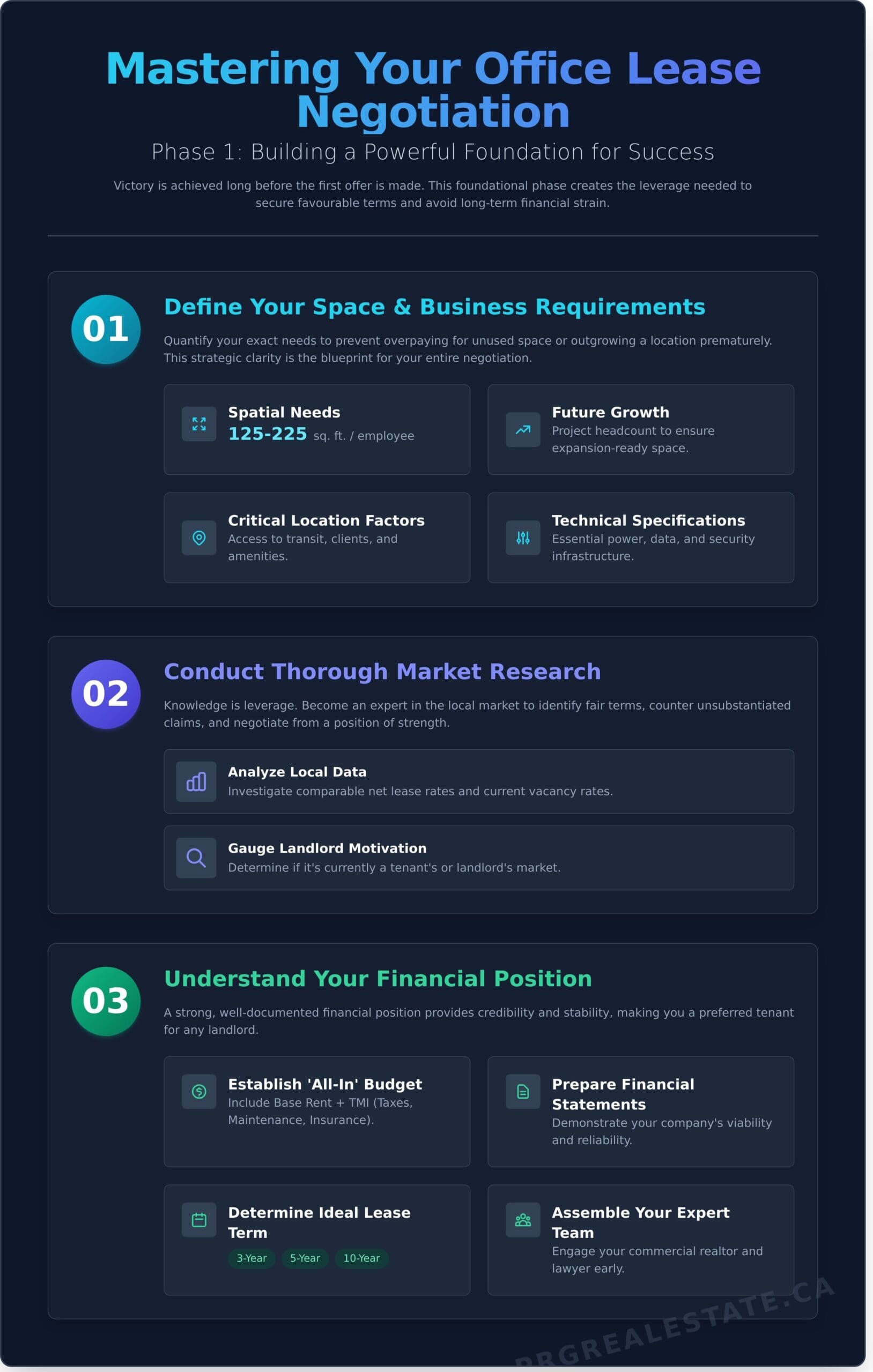
Phase 1: Building Your Foundation for a Successful Negotiation
In commercial real estate, victory is achieved long before the first offer is made. The most critical phase of any successful office lease negotiation is the preparation. Entering discussions without a clear, data-backed strategy is a direct path to unfavourable terms and long-term financial strain. A comprehensive understanding of your business needs, market dynamics, and financial standing is not just preparation-it is the creation of powerful leverage that positions you for success.
Defining Your Space and Business Requirements
Before you view a single property, you must quantify your exact needs. This strategic clarity prevents you from overpaying for unused space or outgrowing a location prematurely. A precise definition of your requirements is the blueprint for your search and negotiation.
- Spatial Needs: Calculate your required square footage, typically 125-225 sq. ft. per employee in Canada, depending on your industry and desired layout (open-concept vs. private offices).
- Future Growth: Project your headcount over the potential lease term to ensure the space can either accommodate expansion or includes favourable relocation clauses.
- Critical Location Factors: Identify non-negotiables such as access to major transit routes (e.g., GO Transit, Hwy 407), client accessibility, and employee amenities.
- Technical Specifications: Outline essential infrastructure for power, data, security, and any specialized layouts your operations demand.
Conducting Thorough Market Research
Knowledge of the local market is your greatest asset. Landlords are experts in their properties; you must become an expert in the market. A deep dive into local data, combined with a fundamental grasp of understanding lease agreements, empowers you to identify fair terms and counter unsubstantiated claims. In a market like Brampton, this means analyzing comparable net lease rates, understanding current vacancy rates to gauge landlord motivation, and determining if it’s currently a tenant’s or a landlord’s market.
Understanding Your Financial Position
A strong financial position is essential for credibility. Landlords prioritize stable, reliable tenants. Before negotiations begin, establish a realistic ‘all-in’ budget that includes not just the base rent but also Additional Rent or TMI (Taxes, Maintenance, and Insurance), which can significantly impact your monthly costs. Have your recent financial statements prepared to demonstrate your company’s viability and determine your ideal lease term-whether a flexible 3-year term or a more stable 5 or 10-year commitment. Assembling your expert team, including your commercial realtor and lawyer, ensures every decision is strategically sound and aligned with your long-term business objectives.
Phase 2: Negotiating the Core Financial Components
The advertised rental rate is merely the starting point of your financial commitment. A successful office lease negotiation requires a strategic deconstruction of every monetary clause to understand the total cost of occupancy. Mastering these core components is critical for protecting your bottom line and ensuring your lease remains financially sustainable for its entire term. Many expert lease negotiation strategies emphasize this deep financial diligence as a foundational step to securing a favourable deal.
Base Rent and Escalation Clauses
Your initial offer should be a data-backed figure below the landlord’s asking price to establish a strong negotiating position. Beyond the starting rate, you must control how it grows. We advise clients to pursue fixed annual rent increases (e.g., 2-3%) for budget predictability over volatile increases tied to the Consumer Price Index (CPI). A key objective is also to secure a rent abatement (rent-free) period at the start of the lease, which provides crucial capital to offset initial fit-up and moving costs.
Additional Rent: TMI and CAM Costs
In Canada, “additional rent”-often structured as TMI (Taxes, Maintenance, Insurance) or CAM (Common Area Maintenance)-covers your proportionate share of the building’s operating costs. These variable expenses can significantly impact your monthly payments. A critical objective is to negotiate a cap on annual increases for controllable operating expenses, protecting your business from unpredictable spikes. Furthermore, we insist on securing audit rights, which grant you the ability to verify the landlord’s expenses and ensure all charges are accurate and justified.
Tenant Improvement (TI) Allowance
The Tenant Improvement (TI) allowance is a vital contribution from the landlord, quoted in C$ per square foot, to fund the construction and customization of your office. A higher TI allowance reduces your out-of-pocket capital expenditure. The amount is highly negotiable and should align with your build-out requirements and the lease term. While a generous allowance is a major win, it’s important to understand that landlords often amortize this amount into the base rent. A sophisticated office lease negotiation strategically balances a robust TI allowance with a competitive rental rate.
Phase 3: Securing Flexibility with Non-Monetary Clauses
A strategic office lease negotiation extends far beyond the monthly rent. Non-monetary clauses provide critical operational flexibility, ensuring your lease is a strategic asset that supports your business’s growth trajectory rather than constraining it. These terms are just as valuable as financial concessions, as they protect your investment and provide long-term security against unforeseen market shifts and internal evolution.
Successfully negotiating these clauses gives your business the agility to adapt, pivot, and thrive. Here are the key areas where securing operational freedom is non-negotiable.
Lease Term, Renewals, and Termination
Your control over the lease’s lifespan is paramount. A well-negotiated agreement provides stability with built-in options for change. Key elements to focus on include:
- Renewal Options: Secure the right to renew with pre-determined terms, locking in rent calculation methods (e.g., based on Fair Market Value) to prevent unpredictable and costly hikes.
- Break Clause: This essential provision allows you to terminate the lease early under specific conditions, offering a vital escape route if your business needs to downsize or relocate unexpectedly.
- Force Majeure: This clause can excuse a tenant from lease obligations due to catastrophic, unforeseen events. In a modern business environment, its definition and scope require expert review.
Sublet and Assignment Rights
This clause is your primary exit strategy. If your business outgrows the space or needs to pivot, the right to sublease (renting a portion of your space to another tenant) or assign (transferring the entire lease) is invaluable. The goal of your office lease negotiation here is to ensure the landlord’s approval cannot be “unreasonably withheld, conditioned, or delayed,” a critical phrase that prevents them from arbitrarily rejecting a suitable replacement tenant.
Use, Alterations, and Exclusivity
These clauses dictate how you can operate within and customize your space. Negotiate for broad permissions to avoid future restrictions. For example, secure a broad “use” clause for “general office purposes” to accommodate changes in your business model. Similarly, negotiate the right to make non-structural alterations, like painting or installing partitions, without landlord consent. For client-facing businesses, an “exclusivity clause” can be a powerful tool, preventing the landlord from leasing space in the building to a direct competitor.
Advanced Tactics and Common Pitfalls to Avoid
Elevating your approach from a simple discussion to a strategic office lease negotiation is what separates a good deal from a great one. A truly successful outcome protects your business’s financial health and operational stability for years to come. This requires a professional mindset focused on creating leverage, anticipating challenges, and avoiding critical errors that can have long-term consequences.
Creating and Using Leverage
Leverage is the cornerstone of any successful negotiation. It’s not about being aggressive; it’s about creating a competitive environment where your tenancy is positioned as a valuable asset. Here’s how to build a strong negotiating position:
- Maintain Multiple Options: Never negotiate on a single property. When a landlord knows you have a viable, attractive alternative, they are far more motivated to offer competitive terms and concessions.
- Use a Detailed Letter of Intent (LOI): A comprehensive LOI is a strategic tool. It frames the entire negotiation by outlining your key business terms upfront, setting a professional tone and demonstrating you are a serious, organized potential tenant.
- Let Your Commercial Realtor Act as a Buffer: An expert realtor removes emotion from the process. They can push for difficult terms and act as an objective intermediary, preserving a positive landlord-tenant relationship while advocating firmly for your interests.
Common Landlord Ploys and How to Respond
Experienced landlords often rely on standard tactics. Recognizing them is the first step to countering them. Be wary of the “standard form lease”; it is never truly standard and is always drafted to heavily favour the landlord. Every clause is negotiable. Similarly, resist pressure to accept a weak landlord’s default clause-their obligations must be as binding as yours. Finally, meticulously scrutinize any “relocation clause” that allows the landlord to move you. Insist on terms that require them to cover 100% of the moving costs and provide a truly comparable or superior space.
Critical Mistakes to Avoid
A successful office lease negotiation is defined as much by the mistakes you avoid as the terms you win. These common oversights can cost your business tens of thousands of dollars in unforeseen expenses and liabilities.
- Signing a Personal Guarantee: This puts your personal assets on the line for your business’s debt. Never sign one without extensive review by your legal and financial advisors.
- Failing to Have a Lawyer Review the Lease: Your realtor negotiates the business terms, but only a qualified commercial real estate lawyer can identify the legal risks and hidden liabilities in the final document. This step is non-negotiable.
- Underestimating the Timeline: The entire process-from site selection to final signature-can easily take 6-12 months. Rushing leads to costly compromises and overlooked details.
Navigating these complexities requires strategic, expert guidance. Avoid costly mistakes. Let our experts guide you.
The PRG Advantage: Why Expert Representation is Non-Negotiable
Navigating the complexities of commercial real estate can be a formidable task. The market is inherently structured to favour landlords, who are experienced negotiators with their own expert teams. Attempting to manage an office lease negotiation alone means facing this imbalance without the strategic counsel needed to protect your interests. Partnering with an expert commercial real estate broker is not a luxury-it is a fundamental requirement for securing terms that support your business’s long-term success.
At PRG Real Estate Brokerage, our role is to level the playing field. We act exclusively as your advocate, leveraging deep market knowledge and negotiation prowess to save you time, minimize financial risk, and eliminate the stress associated with complex lease agreements.
Unparalleled Market Intelligence
Our strategic advantage begins with information. As the top commercial realtors in Brampton, we provide our clients with a decisive edge through access to off-market opportunities and proprietary data. We possess an intricate understanding of current lease rates, vacancy trends, and, crucially, the reputations of landlords and property management firms across the region. This insight ensures you make decisions based on a complete and accurate market picture.
Strategic Negotiation and Deal Structuring
A successful office lease negotiation is about more than just the rental rate. Our team knows the full spectrum of negotiable points, from standard landlord concessions like tenant improvement allowances to critical clauses governing renewal options and operating costs. We structure every deal to align precisely with your financial objectives and operational needs, acting as a vital intermediary to ensure your position is represented with strength and clarity.
From Search to Signature: A Seamless Process
Your focus should be on running your business, not managing the intricacies of a real estate transaction. We oversee the entire leasing process, from initial site selection to final signature. This includes coordinating with lawyers, architects, and contractors to ensure a smooth and efficient timeline. Our commitment extends beyond a single deal; we aim to build lasting partnerships, becoming your trusted advisors and earning our status as your ‘clients for life’.
Protect your investment and empower your business. Connect with PRG Real Estate Brokerage to ensure your next commercial lease is a strategic asset, not a liability.
Master Your Next Move: Finalizing Your Lease Strategy
Securing the right office space is a pivotal business decision. As this guide has detailed, success is built on a foundation of diligent preparation, a strategic approach to negotiating both financial and non-monetary clauses, and an awareness of common pitfalls. Mastering these elements transforms a lease from a simple expense into a powerful strategic asset that supports your company’s long-term growth and flexibility.
Navigating the complexities of an office lease negotiation demands market intelligence and seasoned expertise. At PRG Real Estate, our strategic approach is designed to deliver superior outcomes. With a proven track record of successful transactions and unparalleled expertise in Brampton’s commercial real estate market, we ensure your lease aligns perfectly with your long-term business objectives, securing terms that provide a distinct competitive advantage.
Secure your strategic advantage. Partner with Brampton’s top commercial realtors.
Take the definitive step toward securing a lease that empowers your business for years to come.
Frequently Asked Questions About Office Lease Negotiation
What is a gross lease versus a net lease, and which is better for a tenant?
A gross lease involves a single, all-inclusive rent payment where the landlord covers all operating expenses, such as taxes, maintenance, and insurance. In contrast, a net lease requires the tenant to pay a lower base rent plus a portion of these operating costs. For tenants seeking budget predictability and simplicity, a gross lease is typically the more strategic choice, as it eliminates the risk of fluctuating and unforeseen operational expenses impacting your monthly cash flow.
How much can you typically negotiate off the asking rent for an office space?
The potential reduction in asking rent is dictated by local market conditions in Canada. In a tenant-favourable market with high vacancy, negotiating a 10-20% reduction is a realistic objective. However, in a competitive, landlord-favourable market, a 3-5% discount may be the maximum achievable. An expert negotiation strategy often focuses on securing other valuable concessions, such as a period of free rent, which can substantially lower your total occupancy cost over the lease term.
What is a Letter of Intent (LOI) and is it legally binding?
A Letter of Intent (LOI) is a foundational document that outlines the primary business terms agreed upon by the tenant and landlord before drafting the formal lease. It establishes a clear framework for the deal. In Canada, an LOI is typically non-binding, meaning neither party is legally obligated to proceed with the transaction. However, it is a critical instrument for ensuring all key stakeholders are aligned on essential points like rent, term, and improvements before incurring legal fees.
Should I accept a personal guarantee clause in my office lease?
A personal guarantee clause makes you, the business owner, personally liable for the lease if your company defaults, putting your personal assets at significant risk. We strongly advise clients to resist this clause whenever possible. A superior alternative is to negotiate a larger security deposit, often equivalent to several months’ rent, or propose a limited guarantee that is capped at a specific dollar amount or time period, thereby protecting your personal wealth from corporate liability.
How long does the entire office lease negotiation process usually take?
The timeline for a comprehensive office lease negotiation varies based on the deal’s complexity. For a straightforward lease in an existing space, the process typically takes 2 to 4 months from the initial property search to the final execution. For larger spaces requiring significant tenant improvements or complex legal reviews, the timeline can easily extend to 6 to 9 months or more. Proactive planning and expert representation are essential to navigate this process efficiently and achieve your objectives.
What is a Tenant Improvement (TI) allowance and how much should I ask for?
A Tenant Improvement (TI) allowance is a negotiated sum of money provided by the landlord to help you customize the office space for your specific business needs. This allowance is quoted on a per-square-foot basis. In the Canadian market, a reasonable request can range from C$20-C$40 per square foot for minor updates to over C$100 per square foot for a raw or ‘shell’ space requiring a complete build-out. A successful office lease negotiation ensures this allowance is based on detailed construction quotes.