Brampton Commercial Property Listings: The Strategic Investor’s Guide for 2026
CategoriesBlog

Brampton Commercial Property Listings: The Strategic Investor’s Guide for 2026

The standard approach to finding commercial real estate in Brampton is fundamentally broken, potentially costing you millions in missed opportunities. You’re right to feel frustrated. Sifting through outdated public listings and trying to decipher complex zoning changes feels like a full-time job, one where the best deals are always snapped up before you even hear about them. It’s a system that leaves serious investors at a distinct disadvantage.

This guide is your strategic advantage. We will cut through the noise, providing you with an expert analysis of the current Brampton commercial property listings, identifying the specific growth zones poised for exponential returns by 2026, and revealing how to gain access to exclusive pre-listing and VVIP opportunities. We’ll explore the impact of the new Hurontario LRT on property values, break down key industrial and retail trends, and outline the exact steps our top realtors take to secure high-ROI assets for our clients.

Key Takeaways

  • Pinpoint Brampton’s high-growth commercial zones, including the vital Steeles Industrial corridor, to focus your investment search on areas with maximum potential.
  • Learn to evaluate different asset classes-from industrial to retail-by mastering key performance metrics like capitalization rates and price per square foot.
  • Successfully navigate the acquisition process for Brampton commercial property listings with a clear understanding of essential due diligence, including zoning verification and environmental assessments.
  • Understand the market forces that position Brampton as a top-tier logistics hub in the GTA, giving you a strategic advantage for your 2026 investment decisions.

Understanding the Brampton Commercial Listing Landscape in 2026

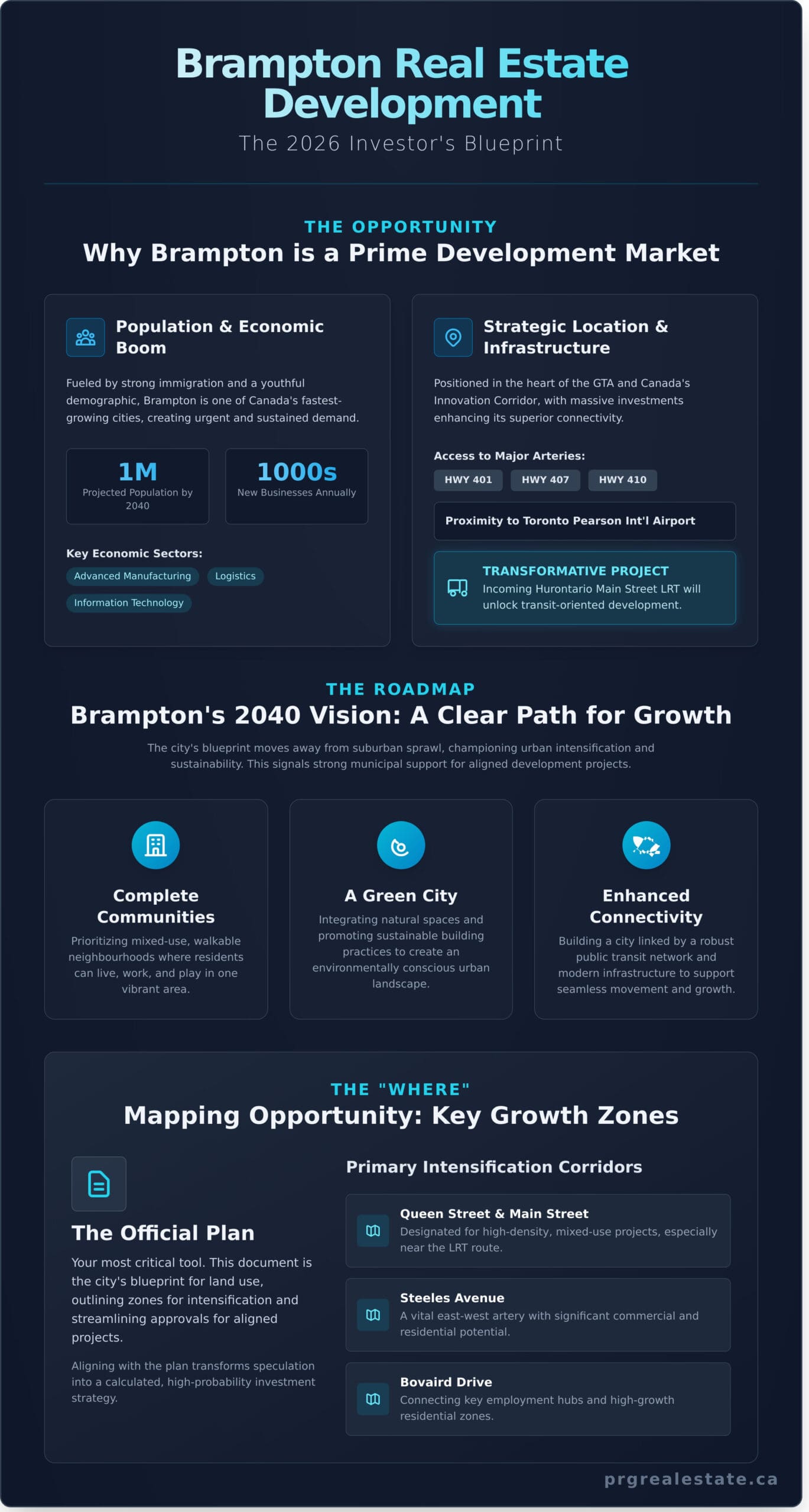
In 2026, the market for commercial real estate in Brampton isn’t just strong; it’s strategic. Viewing Brampton commercial property listings is more than searching for space; it’s tapping into the primary gateway of the Greater Toronto Area’s fastest-growing logistics and industrial hub. This market remains a top choice for savvy investors due to its robust economic fundamentals and unparalleled connectivity. Put simply, Brampton Commercial Real Estate is a high-velocity market driven by its critical proximity to Pearson International Airport and major 400-series highways.

However, accessing the most valuable opportunities requires looking beyond the surface. A significant portion of premier commercial properties are transacted off-market, exchanged through exclusive brokerage networks long before they reach public MLS portals. Understanding this distinction is the first step toward securing a strategic position in this dynamic environment.

The Economic Engine: Why Brampton Listings Command a Premium

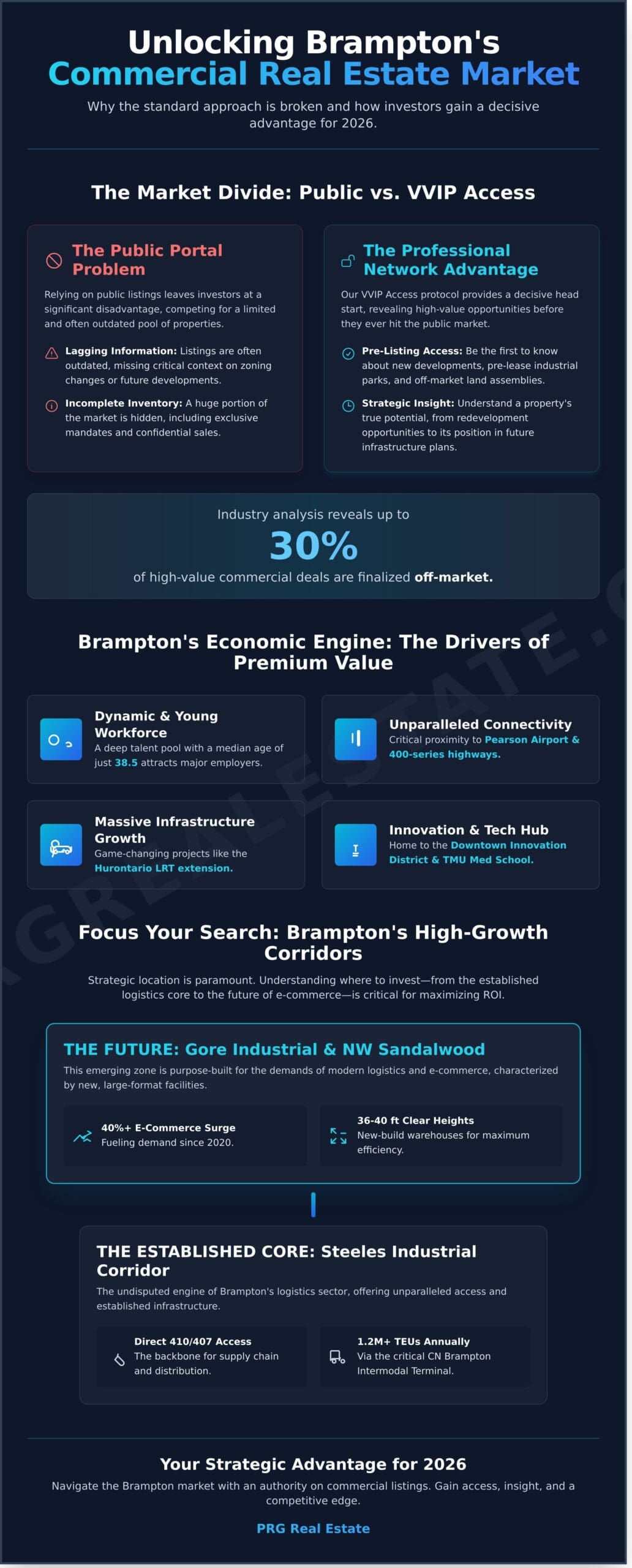
Brampton’s premium valuation is anchored by powerful economic drivers. With a median age of just 38.5, the city’s young and diverse workforce provides a deep talent pool that attracts major employers in manufacturing, logistics, and technology. This demographic demand is amplified by strategic city-building initiatives. The downtown Innovation District, anchored by the Toronto Metropolitan University’s School of Medicine and the Centre for Innovation, is actively cultivating a cluster of tech-oriented businesses, directly increasing demand for modern office and mixed-use listings. Major 2026 infrastructure projects, including the completed Hurontario LRT extension and ongoing upgrades to the 401/410 interchange, are enhancing transit connectivity and logistics efficiency. These projects are part of a massive investment strategy by the City of Brampton, designed to solidify its status as a core economic powerhouse.

Public Portals vs. Professional Brokerage Networks

Relying solely on generic search engines and public portals for Brampton commercial property listings provides an incomplete picture. Industry analysis reveals that up to 30% of high-value commercial deals are finalized before ever being advertised publicly. These off-market opportunities are where the most significant value is often found. The limitations of public data are clear:

  • Lagging Information: Listings are often outdated or lack critical context on zoning changes or upcoming area developments.
  • Incomplete Inventory: Exclusive mandates and confidential sales are never displayed, hiding a substantial portion of the market from view.
  • Lack of Strategic Insight: A public listing won’t tell you about a property’s potential for redevelopment or its position relative to future infrastructure.

This is precisely where PRG’s professional network delivers a decisive advantage. Our “VVIP Access” protocol ensures our clients are first to know about new development listings, pre-lease availabilities in future industrial parks, and off-market land assemblies. It’s not just about seeing listings; it’s about gaining a head start on the competition.

Brampton’s Commercial Growth Zones: Where to Look

A successful commercial investment in Brampton hinges on strategic location. The city’s economic landscape is not uniform; specific zones offer distinct advantages for industrial, retail, and office ventures. Understanding these growth corridors is the first step toward securing a high-performing asset. From the established logistics backbone to the revitalized urban core, identifying where to focus your search of Brampton commercial property listings is critical for maximizing your return on investment.

Industrial Hubs: Steeles and Gore Industrial Corridors

The Steeles Industrial corridor remains the engine of Brampton’s logistics sector, providing unparalleled access to Highways 410 and 407. Its strategic value is anchored by the nearby CN Brampton Intermodal Terminal, a facility handling over 1.2 million TEUs annually. Proximity to this hub dramatically reduces drayage costs, making properties here exceptionally valuable for supply chain and distribution companies. This area supports many of Brampton’s key economic sectors, particularly advanced manufacturing and food and beverage processing, which rely on its robust infrastructure.

While Steeles is the established core, the future of Brampton logistics is rising in Gore Industrial North and the Northwest Sandalwood Parkway area. Driven by e-commerce demand that has surged over 40% since 2020, this zone is characterized by new-build, large-format warehouses with 36-foot to 40-foot clear heights. However, finding an “Industrial Shop for Sale” here is exceptionally rare. The market is dominated by institutional investors and REITs, leading to vacancy rates below 1%. Securing these assets requires a proactive strategy, which is where our team’s market intelligence provides a distinct advantage in uncovering off-market opportunities.

Retail and Office Space: Queen Street and Downtown Revitalization

Brampton’s downtown core is undergoing a significant transformation, backed by the city’s multi-million-dollar investment in projects like the Centre for Innovation. This revitalization is creating prime opportunities for retail and office investors along the Queen Street corridor. We are seeing increased interest in mixed-use listings and storefront homes, which offer flexible formats for boutique retailers, cafes, and professional services looking to capture the growing foot traffic. These properties offer a unique blend of commercial utility and residential appeal.

Specialized demand is also concentrated around key institutions. The ongoing expansion of the Brampton Civic Hospital has created a powerful micro-market for medical and dental office space. The growing population in surrounding communities like Heart Lake and Peel Village ensures a steady client base for healthcare practitioners, making professional office listings within a 5-kilometer radius of the hospital a stable and lucrative investment. These spaces command premium lease rates due to their specific utility and location.

Finally, a critical factor for any investor is understanding how the Brampton Property Tax structure impacts profitability. Your Net Operating Income (NOI) can vary significantly depending on the zone. For instance, properties within the designated Downtown Brampton Community Improvement Plan (CIP) area may be eligible for tax-based grants that can improve cash flow, whereas industrial properties are subject to a different mill rate. A detailed financial analysis must account for these municipal nuances to accurately project an asset’s long-term performance.

Evaluating Listing Types: Retail, Industrial, and Office Space

A strategic investor understands that the term “commercial unit for sale Brampton” represents a diverse ecosystem of assets, each with unique performance metrics and market drivers. Successfully navigating the Brampton commercial property listings requires a sophisticated approach that goes beyond location. Your analysis must be grounded in key financial and operational data, including capitalization (cap) rates, price per square foot (PSF), and sector-specific vacancy trends. A lower cap rate, for instance, often indicates a lower-risk, high-demand property, while a higher rate might signal greater risk but a potentially higher return.

Decoding a listing is equally critical. Key terms provide a framework for your due diligence. Net Leasable Area (NLA), for example, refers to the exact square footage that generates income, excluding common areas like lobbies or hallways. Understanding Brampton’s specific Zoning Bylaws is non-negotiable; a property zoned M2 (General Industrial) permits a vastly different set of operations than one zoned C4 (Commercial), directly impacting its value and potential use. Our expertise ensures you interpret this data correctly to align an asset with your strategic goals.

Industrial and Warehouse Listings: The Logistics Goldmine

Brampton’s industrial sector is the engine of its commercial market. As of Q4 2023, industrial listings hold the lowest vacancy rates in the Greater Toronto Area, often hovering below 1.5%. We project that by 2026, “warehouse for sale” will be the most competitive search term in the region, fueled by unrelenting e-commerce growth and Brampton’s unmatched proximity to the 400-series highways and Pearson International Airport. When evaluating these assets, technical specifications are paramount:

  • Clear Heights: Modern logistics demand clear heights of 32 to 40 feet to accommodate advanced racking systems.
  • Loading Docks: The ratio of truck-level doors to square footage is a key efficiency metric. Look for a mix of truck-level and drive-in doors.
  • Bay Sizes: Column spacing, typically 50′ x 50′, dictates layout flexibility and workflow efficiency.

Investors are also finding tremendous value in evaluating older “industrial buildings for sale” for adaptive reuse, converting them into modern last-mile distribution centers to meet on-demand delivery needs.

Retail and Professional Office Listings

The retail and office landscape is evolving. The demand for massive retail footprints has been replaced by a focus on smaller, experience-driven spaces. With a population that surged by 10.6% between 2016 and 2021, as validated by the official 2021 Census data for Brampton, the city’s appetite for localized services is fueling the rise of boutique retail and mixed-use “storefront homes.”

Similarly, office listings are adapting to “work-from-anywhere” hybrid models. Companies are now seeking smaller, Class A office spaces with high-end amenities that foster collaboration, not just accommodate cubicles. For entrepreneurs, a “business for sale Brampton” listing often presents a turnkey opportunity. This involves acquiring not just the commercial lease or property, but also the existing business’s equipment, goodwill, and client base-a strategic way to enter the market with established operations.
Brampton Commercial Property Listings: The Strategic Investor’s Guide for 2026

How to Secure the Best Brampton Commercial Listings

Identifying promising Brampton commercial property listings is only the first step. Executing a successful acquisition requires a disciplined, strategic approach that protects your capital and secures your investment. In a competitive market like Brampton, where industrial vacancy rates hovered near a record low of 0.7% in Q4 2023, there is no room for error. The process moves from financial readiness to meticulous due diligence and concludes with expert negotiation.

Securing commercial financing is not a step you take after finding a property; it’s the prerequisite. Unlike residential mortgages, commercial lending is based on the asset’s income-generating potential and the borrower’s strength. Arriving at the negotiation table with financing pre-approved from an institution like BDC or a major Canadian bank demonstrates your seriousness and capacity to close, giving you immediate leverage.

The Due Diligence Checklist for Commercial Buyers

The due diligence period is your critical window to uncover any potential liabilities. A comprehensive investigation is non-negotiable and must be guided by experts. Our team ensures every client verifies these essential points:

  • Tax & Zoning Confirmation: We verify the property’s current standing directly through the City of Brampton’s official channels. Understanding the precise “City of Brampton Property Tax” liability is crucial for forecasting your net operating income. For large land parcels, this analysis prevents costly surprises that can derail an investment’s profitability.
  • Environmental Site Assessments (ESAs): A Phase I ESA is a mandatory report for nearly all commercial lenders. It investigates the property’s history for potential contamination. If any risks are identified, a Phase II ESA, which involves physical soil and water sampling, becomes necessary to quantify the issue. Skipping this can expose you to environmental remediation costs that can exceed the property’s value.

Negotiating in a High-Demand Market

A winning offer is not simply the highest price; it’s the most compelling package. We build our offers on a foundation of hard data, using recent transaction comparables from the Toronto Regional Real Estate Board (TRREB) and Argus-modelled cash flow projections to justify our valuation. This analytical approach removes emotion and positions your offer as a credible, market-based proposal.

This is where the distinction between a real estate agent and a certified Real Estate Broker becomes critical. While an agent can facilitate a sale, a commercial broker from PRG provides strategic counsel on deal structure, risk mitigation, and complex contract clauses. We navigate the nuances of the Agreement of Purchase and Sale for commercial properties, ensuring your interests are protected from offer to closing.

In multiple-offer scenarios, reputation is a powerful currency. Listing brokers know that an offer presented by PRG Real Estate is backed by a history of successful, high-value closings and unwavering integrity. This reputation ensures your offer gets the serious consideration it deserves, often providing the critical edge needed to secure premier assets. To execute a flawless acquisition strategy for the top Brampton commercial property listings, partner with PRG’s top commercial realtors today.

Why PRG Real Estate is the Authority on Brampton Listings

Selecting the right partner for your commercial real estate journey is the single most critical decision you’ll make. In a competitive market like Brampton, you need more than just an agent; you need a strategic advisor. Led by Broker of Record Harsh Pabla, the team at PRG Real Estate Brokerage has earned its reputation as the top commercial realtors in Brampton by delivering exceptional results, grounded in a philosophy of unwavering integrity and a commitment to having “Clients for Life.” We don’t just facilitate transactions; we build long-term partnerships that foster growth and success.

The PRG Real Estate Brokerage advantage is our synthesis of market intelligence, negotiation expertise, and a client-first ethos. Our strategic advice is rooted in comprehensive data analytics, forecasting trends in industrial, office, and retail sectors to ensure your investment is not just profitable today but positioned for future appreciation. We’ve demonstrated this commitment repeatedly. For a national logistics client, we identified and secured a 75,000 sq. ft. cross-dock facility near the CN Rail Intermodal Terminal, negotiating terms that saved them over C$500,000 in initial leasing costs. For a local tech startup, we located a flexible office space in the Brampton Innovation District that allowed them to scale from 10 to 50 employees within 18 months without needing to relocate.

Developing Thriving Communities through Strategic Investment

Our vision extends beyond individual properties. We are dedicated to developing thriving communities through sustainable and innovative real estate projects. We partner with developers to navigate the complexities of the City of Brampton’s planning department, leveraging our deep understanding of zoning regulations and development approvals. The PRG Real Estate Brokerage promise is clear: we provide the expert guidance necessary to ensure your commercial investments not only succeed but also contribute positively to the city’s economic landscape.

Start Your Search with Brampton’s Top Commercial Team

Initiating your search with us begins with a detailed strategic consultation to understand your precise operational needs and investment goals. This allows us to curate a personalized portfolio of opportunities, including off-market properties you won’t find on public sites. Our clients benefit from VVIP access to new commercial developments, giving you a crucial first-mover advantage. Don’t settle for a generic search; gain a competitive edge with PRG Real Estate Brokerage. View our exclusive Brampton commercial property listings here and contact our team to unlock your next opportunity.

Execute Your Strategic Brampton Investment in 2026

The path to a successful commercial investment in 2026 is clear. Brampton’s designated growth zones present significant opportunities, but capitalizing on them requires a strategic understanding of the unique demands of industrial, retail, and office properties. Navigating the competitive landscape of Brampton commercial property listings demands more than just access; it demands expert guidance to secure the right asset that aligns with your long-term financial goals.

That’s where an expert partnership becomes your greatest advantage. The team at PRG Real Estate brings a proven track record, with over $500M in real estate transactions and specialized expertise in GTA commercial development. Our status as Royal LePage® Red Diamond™ Award winners places us in the top 2% of agents in Canada, ensuring your investment is handled with an elite level of professionalism and market insight.

Don’t leave your 2026 portfolio to chance. Partner with Brampton’s Top Commercial Realtors Today and let our results-driven approach secure your next major acquisition.

Frequently Asked Questions About Brampton Commercial Real Estate

How do I find off-market commercial property listings in Brampton?

Accessing off-market deals requires a strong professional network. The most effective strategy is to partner with a well-connected commercial real estate brokerage. Top commercial realtors in Brampton maintain proprietary databases and have deep relationships with property owners, investors, and developers. This insider access allows them to present you with exclusive opportunities before they ever reach the public market, providing a significant competitive advantage for your investment strategy.

What is the average price per square foot for industrial space in Brampton in 2026?

Based on current market trends and analysis from Colliers’ Q1 2024 report, we project the average net asking rent for industrial space in Brampton to reach between C$24.00 and C$28.00 per square foot by 2026. This forecast reflects continued high demand and low vacancy rates in the GTA West market. These figures are estimates; for a precise valuation based on building class and location, a detailed market analysis is essential.

Are there specific zoning restrictions I should know about for retail listings in Downtown Brampton?

Yes, Downtown Brampton is governed primarily by the “Central Area Commercial” (CAC) zoning designation. While this permits a wide range of retail and service uses, there are key restrictions to consider. These often involve limitations on building height, mandatory parking requirements, and specific design guidelines under the Downtown Brampton Secondary Plan. Properties within a heritage conservation district also face additional regulations. Verifying a property’s specific permissions is a critical step in your due diligence process.

How does the Brampton property tax compare to other GTA cities like Mississauga?

Brampton’s commercial property tax rate is competitive within the GTA. For 2024, Brampton’s total commercial tax rate is approximately 1.34% of a property’s assessed value. This is slightly higher than Mississauga’s 2024 rate of about 1.25%. While the rate itself is a key factor, investors should also consider the city’s growth prospects, infrastructure investments, and development charges when evaluating the total cost and potential return on a commercial property investment.

Can a residential realtor help me buy a commercial building in Brampton?

It’s not advisable. Commercial and residential real estate transactions are fundamentally different, involving complex zoning analysis, environmental assessments, income-based property valuations (like cap rates), and intricate lease negotiations. A residential agent lacks the specialized expertise required for this level of due diligence. To protect your investment and ensure a successful outcome, you need a realtor with a proven track record in the commercial sector who understands its unique financial and legal complexities.

What are the most searched areas for commercial units for sale in Brampton?

The most in-demand areas are concentrated around major transportation corridors. The Bramalea industrial area, near Highways 410 and 407, remains a prime location for logistics and manufacturing. The Airport Road corridor is highly sought after for its proximity to Pearson International Airport. Additionally, the emerging Highway 50 and Queen Street East corridors are gaining significant traction from investors and businesses looking for new development and retail opportunities in a growing part of the city.

Is it better to buy or lease commercial space in the current 2026 market?

The decision to buy or lease depends entirely on your business’s financial position and long-term strategy. Buying offers the benefits of building equity, stable operating costs, and potential asset appreciation, but it requires substantial upfront capital. Leasing provides greater flexibility, lower initial costs, and fewer maintenance responsibilities, making it ideal for new or growing businesses. A strategic analysis of your capital, growth projections, and market tolerance is necessary to make the optimal choice.

How do I verify the zoning of a commercial listing in Brampton?

The most direct way to verify zoning is by using the City of Brampton’s official interactive zoning map available on their website. For definitive confirmation, you can apply for a Zoning Certificate or Property Information Report from the city’s planning department. An experienced commercial realtor will handle this verification as a standard part of their due diligence, interpreting the by-laws to ensure your intended use for any of the Brampton commercial property listings is fully permitted.

Commercial Real Estate Agent Brampton: Strategic Guidance for 2026 Investors
CategoriesBlog

Commercial Real Estate Agent Brampton: Strategic Guidance for 2026 Investors

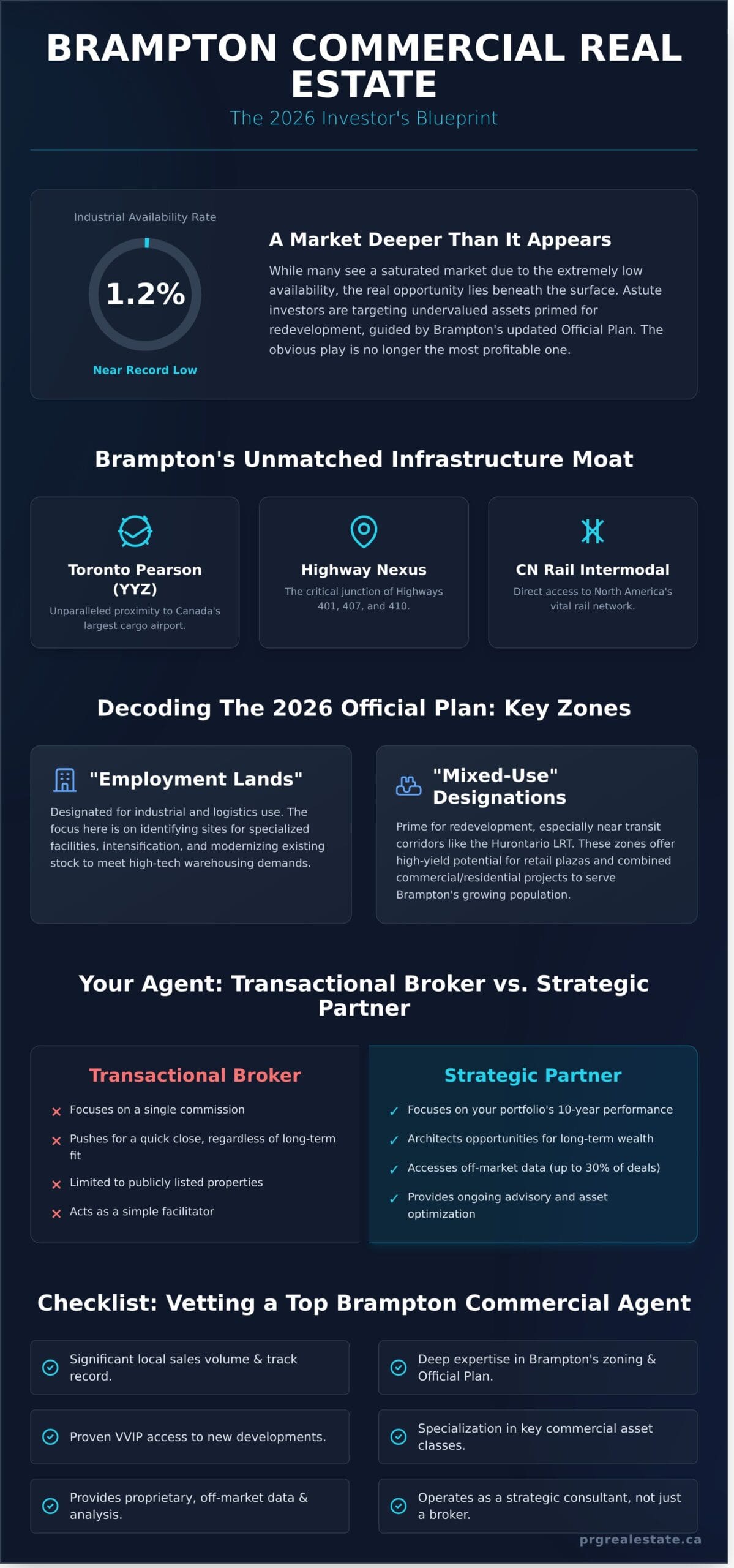
Most investors will miss Brampton’s most profitable commercial real estate opportunities by 2026. While many fixate on the city’s near-record-low 1.2% industrial availability rate and see only saturation, a select few are identifying undervalued assets primed for redevelopment under Brampton’s updated Official Plan. It’s a market where the obvious play is no longer the most strategic one.

It’s understandable to feel hesitant. The combination of fluctuating interest rates, which have compressed cap rates over the last 18 months, and complex municipal zoning changes can make the market feel impenetrable without elite guidance. Finding the right commercial real estate agent Brampton isn’t just an advantage; it’s a necessity. This guide promises to deliver the strategic clarity you need to move with confidence. We will reveal the proven methodologies our top-rated brokerage uses to uncover exclusive off-market properties, secure favourable zoning for high-yield projects, and lock in long-term, high-credit tenants for maximum ROI. Prepare to learn the key submarkets to watch and the tactics required to build a resilient commercial portfolio in Brampton for years to come.

Key Takeaways

  • Learn to identify high-potential investment zones by understanding the strategic differences between “Employment Lands” and “Mixed-Use” designations in Brampton’s 2026 Official Plan.
  • Discover which commercial asset classes, from specialized industrial facilities to high-growth retail plazas, are positioned for maximum returns in Brampton’s evolving market.
  • Develop a checklist to vet a top commercial real estate agent Brampton, focusing on critical metrics like significant sales volume and VVIP access to new developments.
  • Understand how the role of a modern commercial realtor has shifted from a transaction facilitator to a strategic consultant essential for navigating 2026 market complexities.

The Role of a Commercial Real Estate Agent in Brampton’s 2026 Market

In the evolving landscape of 2026, the function of a commercial real estate agent has fundamentally shifted. Gone are the days of simple transaction facilitation. Today, a top-tier commercial real estate agent is a strategic asset manager, architecting opportunities for business growth and long-term wealth creation. This is especially true in a dynamic city like Brampton, where market intelligence and foresight are paramount to securing high-performance assets.

Despite global economic recalibrations, Brampton’s position as the “Logistic Capital of Canada” remains secure. Its unmatched proximity to Toronto Pearson International Airport (YYZ), the nexus of the 401, 407, and 410 highways, and the critical CN Rail Intermodal Terminal creates an infrastructure moat that insulates its industrial sector. For 2026 investors, this means that while other markets may face volatility, Brampton’s core logistics and warehousing demand provides a stable and compelling foundation for investment.

Understanding this market requires a specialist. Unlike residential real estate, which focuses on emotional appeal and neighbourhood amenities, commercial transactions are driven by pure financial metrics: capitalization rates, net operating income, and zoning regulations. The complexity of a Commercial property overview, from M2-zoned industrial properties to C4-zoned retail plazas, demands a dedicated professional who navigates these nuances daily. A residential agent, however skilled, simply doesn’t possess the specialized financial modelling and legal expertise required for a C$10 million warehouse acquisition or a multi-unit plaza lease negotiation.

Why Local Brampton Expertise Matters Now

Hyper-local knowledge is the definitive competitive advantage. An expert commercial real estate agent Brampton understands the city isn’t a monolith but a collection of distinct micro-markets. The industrial corridors along Steeles Avenue West, valued for their 400-series highway access, present entirely different opportunities than the Queen Street corridor, which is undergoing a significant transformation. The Hurontario LRT, with its projected 2024 completion, is already driving up valuations for properties within an 800-meter radius of its new stations, creating prime opportunities for mixed-use and retail redevelopment. A local specialist also provides access to programs like the Downtown Brampton BIA’s façade improvement grants, which can directly impact an investor’s bottom line.

Strategic vs. Transactional Brokerage

A transactional broker focuses on a single commission. A strategic partner focuses on your portfolio’s 10-year performance. This distinction is critical. Transactional agents often miss the long game, pushing for a quick close that may not align with future appreciation or redevelopment potential. The PRG approach is built on an unwavering commitment to becoming “Clients for Life.” We don’t just find you a property in 2026; we provide the advisory to optimize its performance through 2036. This philosophy is powered by access to proprietary, off-market data. In a market as tight as Brampton, upwards of 30% of the most desirable assets trade hands before ever being publicly listed. This is the data that matters, and it’s only available through deep local relationships and a reputation for excellence.

Asset Class Specialization: Finding Value in Every Sector

Success in Brampton’s 2026 commercial real estate market won’t come from a one-size-fits-all approach. It demands a granular understanding of each asset class and its unique drivers. A top-tier commercial real estate agent Brampton doesn’t just find properties; they identify strategic opportunities by dissecting market trends sector by sector. From the logistics corridors humming with activity to the new retail formats serving a booming population, discerning investors know that value is found in the details.

Industrial & Logistics Dominance

Brampton remains the undisputed heart of the GTA’s industrial market, a status cemented by its strategic location. Proximity to Toronto Pearson International Airport and the convergence of Highways 410, 407, and 401 create an unparalleled logistics network. This keeps industrial demand exceptionally high, with vacancy rates consistently hovering below 2%. For 2026, the opportunity lies beyond standard warehousing. Investors should target specialized facilities like third-party logistics (3PL) hubs, cold storage for the grocery sector, and food-grade production buildings. Analyzing the current roster of industrial buildings for sale reveals a clear distinction: small-bay units (under 20,000 sq. ft.) cater to local businesses and command high lease rates per square foot, while large-bay facilities (over 100,000 sq. ft.) attract national distributors on long-term leases, offering stable returns.

Retail and Mixed-Use Opportunities

With a population that grew by 10.6% between the 2016 and 2021 censuses, Brampton’s consumer base is expanding rapidly. This growth fuels a dynamic retail sector. Forward-thinking investors are looking at mixed-use developments that integrate retail with residential, such as the “Storefront Home” model in new master-planned communities. When evaluating a commercial unit for sale in Brampton for retail viability, a rigorous analysis is crucial. Key metrics include daily foot traffic counts, neighbourhood demographics, and the strength of co-tenants. For plaza investors, a detailed credit-tenant analysis is non-negotiable, focusing on the financial stability of anchor tenants like major banks or national grocery chains to secure long-term income.

While the traditional office market adapts to hybrid work models, specialized sectors are thriving. The demand for professional medical buildings, particularly near Brampton Civic Hospital, remains incredibly strong due to an aging population and non-discretionary healthcare spending. These assets offer exceptional stability with long-term tenants. Another growing niche is smaller, move-in-ready office suites equipped with modern tech infrastructure and flexible layouts, designed to attract startups and professional service firms that have downsized their physical footprint but still require a premium corporate address.

For investors with a long-term vision, development land presents the highest potential for appreciation. The most promising opportunities are parcels located along major transit corridors, such as the Hurontario Main Street LRT and the expanded Bramalea GO Station. Identifying land already zoned for high-density residential or mixed-use development is key to mitigating risk. Navigating municipal zoning bylaws and the City of Brampton’s Official Plan requires an expert partner whose professional standing is in good order with the Real Estate Council of Ontario (RECO). This ensures your investment strategy is built on a foundation of regulatory compliance and expert insight. Understanding which asset class aligns with your portfolio is the first step; connect with our advisory team to perform a strategic analysis of your 2026 investment options.

Successful commercial real estate investment in Brampton isn’t just about location; it’s about understanding the city’s strategic vision. The City of Brampton’s Official Plan is the blueprint for future growth, and by 2026, its policies will have profoundly shaped property values and development potential. Investors who fail to grasp the nuances of this plan risk acquiring assets with limited upside or unforeseen restrictions.

A critical distinction lies in land designations. “Employment Lands” are specifically zoned for industrial, warehousing, and office uses, forming the backbone of Brampton’s economic engine. In contrast, “Mixed-Use” corridors, particularly along major arterials, are designated for higher-density projects combining retail, commercial, and residential components. For ambitious projects, land assembly—the strategic acquisition of multiple adjacent properties—is often required. This is a complex, high-stakes process involving discreet negotiations and a deep understanding of individual landowner motivations. An expert commercial real estate agent Brampton is indispensable in mitigating these risks, liaising directly with city planners to verify development feasibility and de-risk your purchase before you commit significant capital.

Transit-Oriented Development (TOD)

Brampton’s commitment to public transit is creating concentrated pockets of high-value opportunity. The Hurontario LRT, slated for completion in 2024, and the corresponding “Main Street North” redevelopment plan are set to transform key corridors. Real estate studies consistently show that commercial properties within a 500-meter radius of major transit hubs can command a 15-20% value premium. Strategic acquisition near future GO Transit expansion points, like those along the upgraded Kitchener line, offers a direct path to long-term appreciation.

Zoning Bylaws and Permitted Uses

Zoning details can make or break an investment. A common pitfall is purchasing a “warehouse for sale” only to discover its zoning prohibits your specific logistics or manufacturing operation due to noise or emission bylaws. Navigating these rules may require a minor variance application for small adjustments or a full rezoning for a change of use—a costly and lengthy process. Furthermore, for most commercial and industrial sites in Brampton, a Phase I & II Environmental Site Assessment is not just recommended; it’s essential due diligence to uncover potential soil or groundwater contamination liabilities.

Understanding this intricate regulatory environment is fundamental. It requires a partner who can interpret municipal code, anticipate planning hurdles, and align your investment goals with the city’s approved vision for growth. This proactive guidance ensures your 2026 investment strategy is built on a solid foundation of compliance and strategic foresight.

Commercial Real Estate Agent Brampton: Strategic Guidance for 2026 Investors

How to Vet a Commercial Real Estate Agent: A 2026 Checklist

Selecting your representative in Brampton’s competitive commercial market is the single most critical decision you’ll make. The right agent is more than a facilitator; they are a strategic partner whose expertise directly impacts your ROI. For 2026 and beyond, your vetting process must be rigorous, focusing on four non-negotiable pillars: a verifiable track record, an exclusive network, elite data access, and uncompromising integrity.

A proven track record is measured in closed deals, not just years of experience. Demand to see a portfolio of significant sales volume specifically within Brampton’s commercial sector, such as industrial properties near the CN Rail Yard or retail plazas along Queen Street. An elite commercial real estate agent Brampton leverages more than the public MLS. They subscribe to and analyze data from premium platforms like CoStar and Altus Group’s REALNET, which provide granular insights on vacancy rates, absorption trends, and comparable sales down to the square foot. Even more valuable are their proprietary off-market lists, which contain opportunities that never face public competition.

The VVIP Access Advantage

Top-performing agents cultivate deep relationships with developers, granting them VVIP access to new commercial condo units or land acquisition opportunities before they are ever marketed. This network is a powerful asset, particularly for investors seeking to secure premier locations in projects like the Brampton Business Centre. At PRG, our connections mean we are often the first to be consulted on confidential “business for sale in Brampton” opportunities, giving our clients a decisive first-mover advantage.

Finally, integrity is the foundation of a successful long-term partnership. A slogan like “unwavering commitment to excellence” must be backed by transparent practices and a fiduciary-first mindset. It’s the difference between an agent who pushes a quick deal and a strategist who advises you to walk away from a transaction that doesn’t align with your five-year goals. This philosophy is central to our goal of building relationships with “clients for life,” ensuring our advice is always aligned with your best interests, not our commission.

Evaluating Agent Transparency

An agent’s transparency is a direct reflection of their integrity. You must ask direct questions about commission structures and their policy on dual agency. Verify their performance claims through third-party validation. For example, the prestigious Royal LePage® Red Diamond™ Award is given to only the top 2% of its agents across Canada, offering objective proof of elite performance. True expert advice is data-driven and objective; a sales pitch is transactional and emotional. Choose the expert.

Your 2026 investment strategy deserves a partner who meets these stringent criteria. Don’t settle for average representation when market-leading expertise is available. To ensure your next commercial acquisition is guided by proven success and unparalleled market intelligence, connect with PRG Real Estate’s top commercial team today.

Why PRG is the Strategic Choice for Brampton Commercial Real Estate

Selecting the right advisory team is the single most critical decision an investor will make ahead of 2026. In a market as dynamic as Brampton’s, your success depends not just on the property you acquire, but on the strategic intelligence guiding that acquisition. Pabla Realtor Group (PRG) isn’t simply a brokerage; we are a results-driven team of specialists engineered to maximize your portfolio’s potential and deliver measurable returns.

Our firm is led by Broker of Record, Harsh Pabla, an award-winning professional whose reputation is built on a foundation of unwavering integrity and a track record of success. His consistent achievement of the Royal LePage® Red Diamond™ Award, placing him in the top 2% of agents nationwide, is a testament to the high-caliber results he delivers. This leadership instills a culture of excellence throughout our team, ensuring every client benefits from elite-level expertise and a commitment to achieving their financial objectives.

This commitment is codified in our “Clients for Life” philosophy. Where other firms focus on closing a single deal, we focus on opening a long-term strategic partnership. We manage the relationship, not just the transaction. This means providing ongoing advisory services, portfolio performance reviews, and proactive identification of future acquisition or disposition opportunities that align with your evolving goals. We don’t just find you a property; we help you build a legacy.

At PRG, our promise extends beyond individual transactions to the community itself. We are dedicated to facilitating innovative, sustainable, and forward-thinking developments that contribute to a thriving Brampton. When you partner with us, you’re investing in a team that is shaping the future of the city’s commercial landscape for the better.

Our Multi-Disciplinary Approach

Our integrated structure gives our clients a decisive market advantage. The seamless collaboration between our residential and commercial teams provides unparalleled insight into mixed-use development projects, ensuring commercial viability is supported by real-time residential demand data. From initial site acquisition and zoning analysis to project completion, our comprehensive development services offer a single, expert point of contact. For a deeper analysis of market trends, explore our Brampton Commercial Real Estate Guide.

Getting Started with PRG

Your 2026 investment strategy begins with a conversation. We invite you to book a confidential consultation to outline your objectives with a top commercial real estate agent Brampton investors rely on. Our process involves creating a customized property search meticulously calibrated to your specific ROI requirements, whether it’s targeting assets with a 6% cap rate or identifying value-add opportunities with clear upside potential. Let’s build your future success together. Partner with Brampton’s top commercial realtors today.

Secure Your 2026 Brampton Investment Advantage

As we look toward 2026, Brampton’s commercial landscape presents immense opportunities for prepared investors. Your success will hinge on navigating the city’s complex zoning regulations and identifying true value across all asset classes. This isn’t a market for guesswork; it’s a market that demands a strategic partner with a proven record of excellence. Choosing the right commercial real estate agent Brampton provides isn’t just a transaction, it’s a decisive competitive edge.

At PRG Real Estate, our performance is quantified by results. As recipients of the Royal LePage® Red Diamond™ Award, our team ranks in the top 2% of agents across Canada. We leverage specialized expertise in Brampton’s development sector to deliver our clients unparalleled guidance and access to high-potential opportunities. Our commitment is to transform your investment goals into tangible, high-value assets.

The time to build your 2026 strategy is now. Secure Your Strategic Advantage with PRG Real Estate and partner with a team dedicated to your long-term success.

Frequently Asked Questions

What is the current state of the Brampton commercial real estate market in 2026?

The Brampton commercial real estate market in 2026 is characterized by robust industrial demand and evolving retail needs. Industrial vacancy rates remain exceptionally low, hovering around 1.5%, driven by the city’s logistics and advanced manufacturing sectors. Meanwhile, retail is shifting towards mixed-use developments, particularly along key transit corridors like the Hurontario LRT. Office space is stabilizing with a focus on high-quality, flexible workspaces to accommodate hybrid models.

How do commercial real estate commissions work in Ontario?

Commercial real estate commissions in Ontario are negotiable and typically paid by the seller or landlord. The total commission, often ranging from 3% to 6% of the sale price or lease value, is split between the brokerages representing the seller/landlord and the buyer/tenant. For example, a common structure on a C$10 million sale might be 3% on the first C$1 million and 1.5% on the balance, divided between the two parties.

What is the difference between a real estate agent and a commercial broker?

A commercial broker possesses specialized expertise and licensing focused exclusively on investment and business properties, whereas a real estate agent often handles residential transactions. Brokers undergo more extensive training to manage complex issues like commercial zoning, property valuation, environmental assessments, and intricate lease negotiations. This focused knowledge is critical for navigating the financial and legal nuances inherent in commercial real estate acquisitions and dispositions.

Can a residential realtor help me buy a warehouse in Brampton?

It’s highly inadvisable to use a residential realtor for a commercial purchase like a warehouse. They lack the critical expertise in industrial zoning laws, loading dock specifications, ceiling height requirements, and Phase I Environmental Assessments. A successful industrial investment requires a specialist who understands the logistics sector’s unique demands. Engaging a dedicated commercial professional ensures your asset meets both operational needs and long-term investment criteria.

How does the Hurontario LRT affect commercial property taxes in Brampton?

The Hurontario LRT is projected to increase commercial property values along its route, which will lead to higher property tax assessments by MPAC. Properties located within a 500-meter radius of an LRT station are expected to see assessment values climb by 10-20% over the five years following the line’s full operational launch. Investors should proactively factor this phased tax increase into their financial models to accurately forecast net operating income.

What are the most profitable commercial asset classes in the GTA right now?

Industrial properties and multi-family residential buildings are the top-performing commercial asset classes in the Greater Toronto Area for 2026. The industrial sector, especially logistics and cold storage facilities in Brampton and Mississauga, is experiencing rental growth above 7% year-over-year due to e-commerce demand. Multi-family assets provide stable returns, with vacancy rates below 2% across the GTA, ensuring consistent cash flow and strong appreciation.

How do I find off-market commercial properties in Brampton?

Finding off-market properties requires leveraging the network of a deeply connected commercial real estate agent in Brampton. These exclusive opportunities aren’t publicly listed and are sourced through established relationships with property owners, developers, and financial institutions. Our team at PRG Real Estate utilizes a proprietary database and decades of market presence to provide our clients with VVIP access to these strategic investment opportunities before they become common knowledge.

What environmental checks are required for commercial property in Ontario?

A Phase I Environmental Site Assessment (ESA) is the standard due diligence requirement for commercial property transactions in Ontario. This assessment investigates the property’s historical use to identify any potential for contamination. If the Phase I ESA flags potential risks, a Phase II ESA is then mandated. The Phase II assessment involves collecting and analyzing soil and groundwater samples to confirm the presence and extent of any contaminants.

Brampton Investment Properties: A Strategic Guide for 2026
CategoriesBlog

Brampton Investment Properties: A Strategic Guide for 2026

Navigating the real estate market can be overwhelming, with endless listings that offer little context on their true long-term value. For investors looking at Brampton investment properties, this challenge is magnified by a dynamic and rapidly evolving landscape. Simply browsing what’s for sale isn’t a strategy; it’s a gamble. The fear of misinterpreting market signals or miscalculating potential returns can lead to costly indecision, preventing you from securing a valuable asset in one of the GTA’s most promising cities.

This strategic guide for 2026 is designed to eliminate that uncertainty. We go beyond generic listings to provide you with a professional framework for success. You will learn how to identify Brampton’s high-growth corridors, analyze the ROI of different property types with expert precision, and secure opportunities that align with your financial goals. Consider this your definitive resource for making a confident, results-driven investment decision in the Brampton market.

Key Takeaways

  • Learn why Brampton’s projected population and economic growth for 2026 make it a strategic location for real estate investment within the GTA.
  • Identify the most suitable property types for your portfolio, from high-demand residential rentals to lucrative commercial spaces.
  • Discover which specific Brampton neighbourhoods offer the highest potential for appreciation and positive cash flow for different investment models.
  • Master the essential metrics used by professional investors to analyze the financial viability of potential brampton investment properties.

Why Invest in Brampton Real Estate in 2026? Key Market Drivers

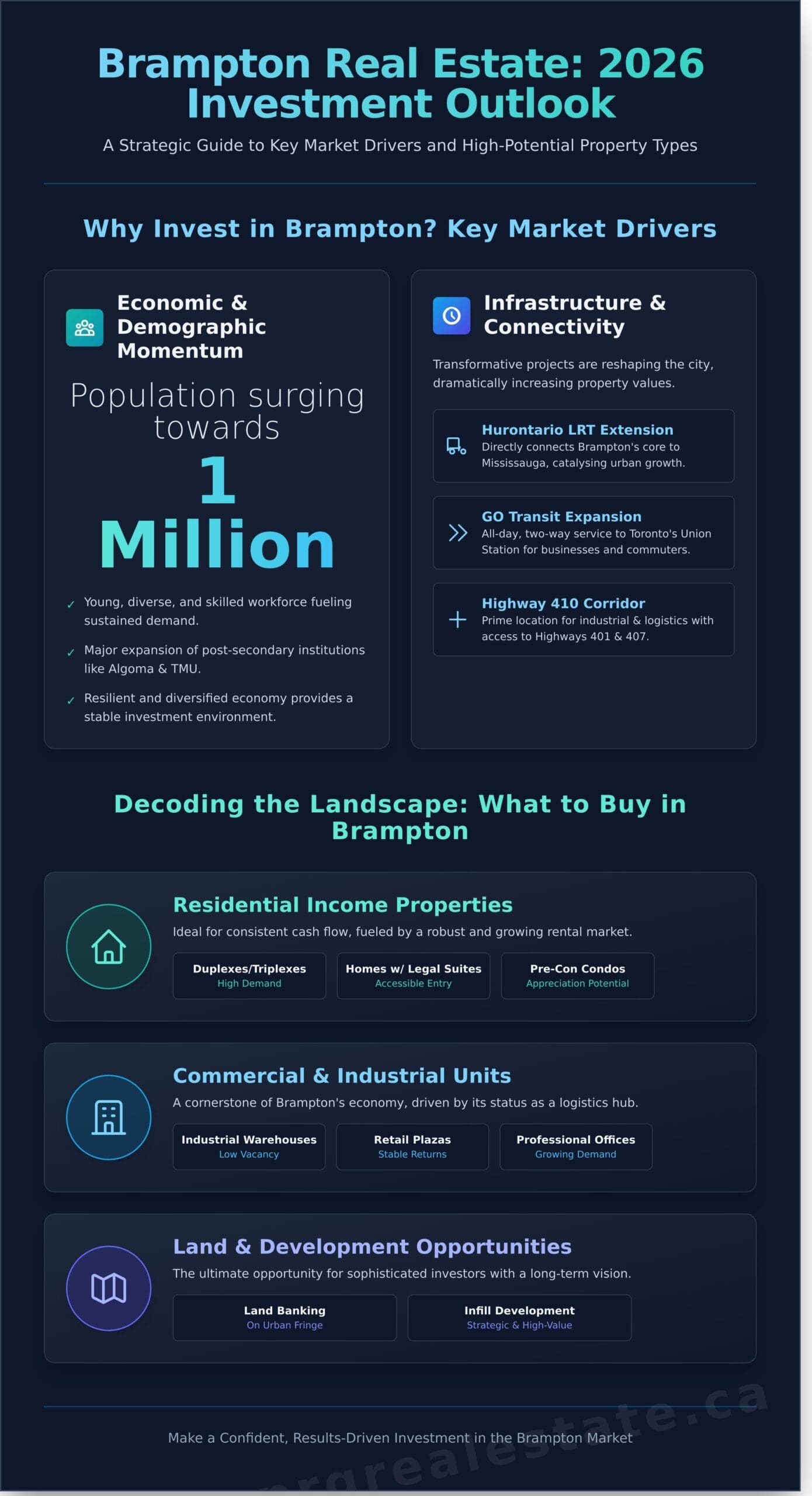
Brampton has decisively shed its identity as a mere suburb, emerging as a dynamic economic engine within the Greater Toronto Area. For astute investors, the city presents a compelling case built on unstoppable growth and strategic development. The coming years, particularly leading into 2026, are poised to unlock significant value across commercial sectors. Understanding the fundamental market drivers is the first step in capitalizing on the exceptional opportunities available in brampton investment properties. These drivers are rooted in powerful demographic shifts, transformative infrastructure projects, and a diversifying economic base.

Economic and Demographic Momentum

Brampton’s population is one of the fastest-growing in Canada, projected to continue its rapid expansion towards one million residents in the coming decades. This surge is fueled by a young, diverse, and skilled workforce, creating sustained demand for retail, office, and industrial space. The city’s economic foundation is further strengthened by the expansion of post-secondary institutions, including Algoma University and the planned Toronto Metropolitan University School of Medicine. For a comprehensive City of Brampton overview, the data confirms a resilient and diversified economy, providing a stable environment for long-term commercial investments. For a deeper look at how these economic sectors and residential trends are shaping the city’s future, the Brampton 2026 ultimate guide to living, working, and investing provides a comprehensive analysis of the key drivers at play.

Infrastructure and Connectivity

Strategic public investment is solidifying Brampton’s position as a critical logistics and transportation hub. Key projects set to reshape the city’s landscape include:

  • Hurontario LRT Extension: This light rail transit line will connect Brampton’s downtown core directly to Mississauga, enhancing mobility and catalysing urban intensification along the corridor.
  • GO Transit Expansion: The move towards two-way, all-day service on the Kitchener GO line provides seamless connectivity to Toronto’s Union Station, making Brampton more attractive for businesses and commuters.
  • Highway 410 Corridor: This vital artery offers unparalleled access to Highways 401 and 407, cementing the city’s status as a prime location for industrial, warehousing, and logistics operations.

These initiatives, coupled with city-led revitalization efforts, dramatically increase the intrinsic value of commercial properties in proximity and across the municipality.

These converging factors-a booming population, a strengthening economy, and massive infrastructure upgrades-create an undeniable momentum. For investors seeking robust returns and long-term growth, the data points clearly to the strategic advantages of acquiring brampton investment properties ahead of the curve. The city is not just growing; it is being strategically engineered for future prosperity.

Decoding Brampton’s Investment Property Landscape: What to Buy

Understanding Brampton’s economic drivers is the first step; the next is identifying which asset class aligns with your strategic goals. The city offers a diverse portfolio of opportunities, each with a unique risk and reward profile. A successful portfolio is built on a clear understanding of what to buy and where. At PRG Real Estate Brokerage, our expertise covers the full spectrum of Brampton investment properties, from residential income generators to large-scale commercial assets.

Residential Income Properties

Brampton’s rapidly growing population fuels a robust rental market, making multi-unit residential properties a strategic choice for consistent cash flow. Duplexes, triplexes, and purpose-built multi-family buildings are in high demand. Furthermore, the city’s framework for legal secondary suites has made single-family homes with basement apartments a highly popular and accessible entry point for investors. For those focused on long-term capital growth, pre-construction condos near transit corridors offer significant appreciation potential as the city continues to densify.

Commercial and Industrial Units

As a key logistics and transportation hub, Brampton’s industrial sector is a cornerstone of its economy. Small and medium-bay industrial warehouses consistently demonstrate low vacancy rates and strong rental growth, making them a premier commercial asset. This sustained demand is well-documented in official Brampton economic data. Retail plazas in high-traffic corridors like Queen Street and Bovaird Drive offer stable returns from a diversified tenant base, while professional office spaces near transit hubs like the Brampton GO Station cater to the growing service-based economy.

Land and Development Opportunities

For the sophisticated investor with a long-term vision, land represents the ultimate opportunity. Strategies range from land banking on the urban fringe in anticipation of future growth to infill development projects within established neighbourhoods. Securing and rezoning parcels for higher-density use can unlock substantial value, but this is an advanced strategy. It demands deep market knowledge, municipal navigation skills, and expert guidance to manage the complexities of the development process successfully.

Strategic Investment Zones: Where to Find Opportunity in Brampton

Identifying the right location is the cornerstone of any successful real estate venture. For astute investors analyzing brampton investment properties, success is found not just in what you buy, but precisely where you buy it. Understanding the city’s micro-markets is critical. Our expert analysis pinpoints the specific zones and corridors offering the highest potential for growth and return, providing a strategic roadmap for your capital deployment.

High-Demand Residential Pockets

Brampton’s population growth fuels relentless demand for quality housing, creating diverse opportunities for residential investors. A strategic approach involves targeting distinct neighbourhood profiles:

  • New Family Rentals: Master-planned communities like Credit Valley and Mount Pleasant are prime targets for new single-family rentals and townhomes, attracting high-quality tenants with modern amenities and reputable schools.
  • Urban Intensification: Downtown Brampton is undergoing significant revitalization, making it a hotspot for condominium developments and multi-unit conversions that appeal to professionals seeking a transit-centric lifestyle.
  • Value-Add Opportunities: Established neighbourhoods offer excellent potential for creating legal secondary suites, a proven strategy to maximize cash flow from existing single-family assets.

Key Commercial and Industrial Corridors

The city’s economic engine is powered by its world-class commercial and industrial hubs. The corridors flanking Highway 410 and proximate to Toronto Pearson Airport are epicentres for high-value industrial assets, including logistics, warehousing, and advanced manufacturing facilities. For retail and mixed-use investors, emerging nodes along major arteries like Queen Street and Bovaird Drive present significant opportunities to serve the city’s expanding residential footprint. A detailed review of official Brampton economic indicators and reports validates the immense potential concentrated in these core economic zones. These areas, particularly those impacted by transit expansion, are a focal point for the most strategic brampton investment properties and long-term portfolio growth. To understand how these high-growth neighbourhoods and commercial corridors fit into Brampton’s broader 2026 trajectory, explore our complete guide to Brampton’s 2026 growth pockets and investment opportunities.

Brampton Investment Properties: A Strategic Guide for 2026

Analyzing Your Investment: Key Metrics for Brampton Properties

Identifying a promising area is the first step. The next is performing a rigorous financial analysis to ensure the asset meets your strategic objectives. Top investors evaluate Brampton investment properties not on potential alone, but on precise, data-driven metrics. This section equips you with the essential tools to assess a deal with the same level of professional scrutiny, transitioning you from an information-seeker to a confident decision-maker.

Calculating Profitability: Cap Rate and ROI

To determine a property’s viability, two metrics are indispensable. The Capitalization Rate (Cap Rate) measures the property’s unleveraged annual return. It’s a quick way to compare similar assets. A higher cap rate generally suggests higher return, but potentially higher risk. Meanwhile, Return on Investment (ROI), specifically Cash-on-Cash Return, calculates the annual pre-tax cash flow relative to the total cash invested, providing a clear picture of your personal return.

Consider this example for a small Brampton commercial plaza:

  • Purchase Price: C$1,800,000
  • Gross Annual Rental Income: C$140,000
  • Operating Expenses (Taxes, Insurance, Maint.): C$32,000
  • Net Operating Income (NOI): C$108,000
  • Cap Rate Calculation: C$108,000 (NOI) / C$1,800,000 (Price) = 6.0%

In the current market, a Cap Rate between 5-7% for a quality Brampton commercial property indicates a solid opportunity, though this benchmark varies by asset class and location.

Financing Your Brampton Investment

Securing strategic financing is as crucial as finding the right property. In Canada, options for commercial investors include traditional commercial mortgages from major banks, credit unions, and alternative B-lenders. Obtaining pre-approval is a non-negotiable first step; it demonstrates your seriousness to sellers and defines your budget.

It is vital to understand that commercial financing differs significantly from residential. Lenders place greater emphasis on the property’s income-generating potential (its NOI) and the strength of its tenants, rather than solely on your personal income. Building a strong relationship with a commercial mortgage broker who understands the nuances of Brampton investment properties is a distinct competitive advantage. Navigating these complex financial instruments requires expert guidance to ensure your investment structure is optimized for long-term success. For expert analysis and access to our network of trusted lenders, connect with our team.

Partnering for Success: Securing Your Brampton Investment Property

Identifying promising areas for commercial investment in Brampton is the critical first step. However, transforming that knowledge into a profitable, secure asset requires expert execution and strategic guidance. The difference between a good investment and a landmark acquisition lies in the partner you choose to navigate the complexities of the market. This is where PRG Real Estate delivers unparalleled value, ensuring your capital is deployed with precision and foresight.

Our commitment is to move beyond transactional service and act as your strategic partner, aligning our expertise with your long-term wealth creation goals. We understand the unique challenges and opportunities inherent in acquiring high-value brampton investment properties and have built a reputation on delivering exceptional results.

The PRG Advantage: Expertise and Access

As the top commercial realtors in Brampton, our advantage is your advantage. We provide our clients with a decisive edge through:

  • Exclusive Market Intelligence: Access to proprietary data, trend analysis, and off-market opportunities not available to the general public.
  • A High-Calibre Network: Leverage our established relationships with developers, city planners, legal experts, and financial institutions to streamline every stage of your transaction.
  • Masterful Negotiation: Our team possesses the proven expertise to structure complex deals, navigate zoning regulations, and secure terms that maximize your return on investment.

Your Next Step Towards a Strategic Investment

You have the market knowledge; now it is time for decisive action. The path to securing premier brampton investment properties is clear: strategic selection guided by expert execution. We invite you to a confidential, no-obligation consultation to discuss your investment objectives and explore how PRG Real Estate can help you achieve them.

Don’t just identify opportunity-capitalize on it. Partner with the brokerage that sets the standard for commercial real estate excellence in Brampton. Your portfolio deserves nothing less.

Contact the PRG Real Estate team today to schedule your strategic investment consultation.

Secure Your Future with Strategic Brampton Real Estate Investments

As we have detailed, the landscape for Brampton real estate in 2026 is primed for strategic acquisition, underpinned by powerful economic drivers and significant infrastructure development. The keys to success are clear: investors must target high-growth zones and apply rigorous financial analysis to every opportunity. Capitalizing on the immense potential of brampton investment properties requires more than just capital; it demands market-specific expertise and decisive action.

To transform this knowledge into a high-performing asset, you need a partner whose expertise is unparalleled. PRG Real Estate is a team of specialists in Commercial & Investment Real Estate, armed with deep, data-driven expertise in Brampton’s market dynamics. As an award-winning Royal LePage® Red Diamond™ team, we have a proven track record of securing profitable outcomes for our clients. Align your portfolio with excellence. Start your strategic property search with Brampton’s leading experts. Your next successful investment is waiting.

Frequently Asked Questions About Brampton Investment Properties

Is Brampton a good place to invest in real estate in 2026?

Absolutely. Brampton is poised for significant growth, driven by major infrastructure projects, a rapidly expanding population, and a robust economic base. Its strategic location within the GTA innovation corridor makes it a prime target for both commercial and residential investors. Projections for 2026 indicate continued appreciation and strong rental demand, positioning Brampton as a top-tier market for strategic real estate investment. Our expert analysis confirms a positive outlook for discerning investors.

What is the average rental income for a property in Brampton?

Rental income in Brampton varies based on property type and location. As of recent market data, residential units can generate between C$2,200 to C$3,500+ per month. Commercial properties, particularly in high-traffic industrial or retail zones, are typically leased on a per-square-foot basis, often ranging from C$15 to C$30+ net annually. A detailed financial analysis by our team can provide precise projections for a specific asset to ensure optimal returns.

What are the busiest commercial areas in Brampton?

Brampton’s key commercial hubs offer diverse investment opportunities. Downtown Brampton remains a vibrant centre for retail and office space, while the Queen Street East and Main Street corridors are high-traffic retail arteries. For industrial and logistics investors, the areas surrounding Highway 410 and Pearson International Airport are exceptionally active, representing some of the most sought-after industrial real estate in the Greater Toronto Area. Our team has in-depth knowledge of each of these strategic zones.

How much down payment is required for an investment property in Ontario?

In Ontario, the minimum down payment for a non-owner-occupied investment property is 20% of the purchase price. This is a standard federal regulation for properties with one to four units. For commercial properties or those with more than four units, lenders may require a higher down payment, often in the range of 25% to 35%. We guide our clients through the financing process to ensure they are well-prepared and secure the most favourable terms.

What are the property taxes like in Brampton for investment properties?

Property taxes in Brampton are calculated based on the property’s assessed value, as determined by MPAC, multiplied by the City’s combined municipal and educational tax rates. While rates are subject to annual review, Brampton maintains a competitive tax environment within the Peel Region. Commercial and multi-residential properties are taxed at different rates than residential homes. We provide clients with a detailed breakdown of all carrying costs, including precise tax estimates, during due diligence.

Can you help me find multi-family homes for sale in Brampton?

Certainly. PRG Real Estate specializes in identifying and securing high-performance multi-family homes and other brampton investment properties. Our team provides VVIP access to on- and off-market listings, from duplexes to larger apartment buildings. We leverage our extensive network and deep market knowledge to connect our clients with assets that align perfectly with their portfolio objectives, ensuring a strategic and successful acquisition.

What is a good cap rate for an investment property in the GTA?

A good capitalization (cap) rate in the Greater Toronto Area typically falls between 4% and 6%, though this can fluctuate based on asset class, location, and market conditions. Industrial and multi-family properties may trade at lower cap rates due to high demand and stability, while retail or office properties might offer higher rates to reflect perceived risk. Our primary objective is to identify properties that offer a strong cap rate relative to their asset class and potential for appreciation.

Realtor Commission Brampton (2026): A Complete Guide to Fees
CategoriesBlog

Realtor Commission Brampton (2026): A Complete Guide to Fees

Selling your property is one of the most significant financial decisions you will make, yet the details surrounding agent fees can often feel opaque. For many homeowners, navigating the structure of the standard realtor commission Brampton requires clarity and confidence. The fear of overpaying, confusion over what services are included, and the anxiety of negotiation are common concerns that can add unnecessary stress to the selling process. Securing the right professional partnership is critical to protecting your investment and maximizing your final sale price.

This definitive guide is engineered to provide complete transparency. We will break down the typical commission structures you can expect in the Brampton market for 2026, detail the high-value services a top-tier agent provides, and empower you with the strategic insights needed to confidently discuss fees. You will gain a clear framework for evaluating different service models, ensuring you partner with a professional who delivers not just a transaction, but exceptional results and true value for your most important asset.

Key Takeaways

  • Learn the standard commission structure in Brampton, including the typical 5% fee and how it is strategically divided between brokerages.
  • Discover how a full-service commission is a direct investment into maximizing your property’s sale price through expert marketing and negotiation.
  • Evaluate the differences between full-service and low-commission models to determine the optimal realtor commission brampton structure for your goals.
  • Gain the insights needed to select a top-tier agent whose service and strategic approach deliver maximum return on your investment.

What is the Average Realtor Commission in Brampton?

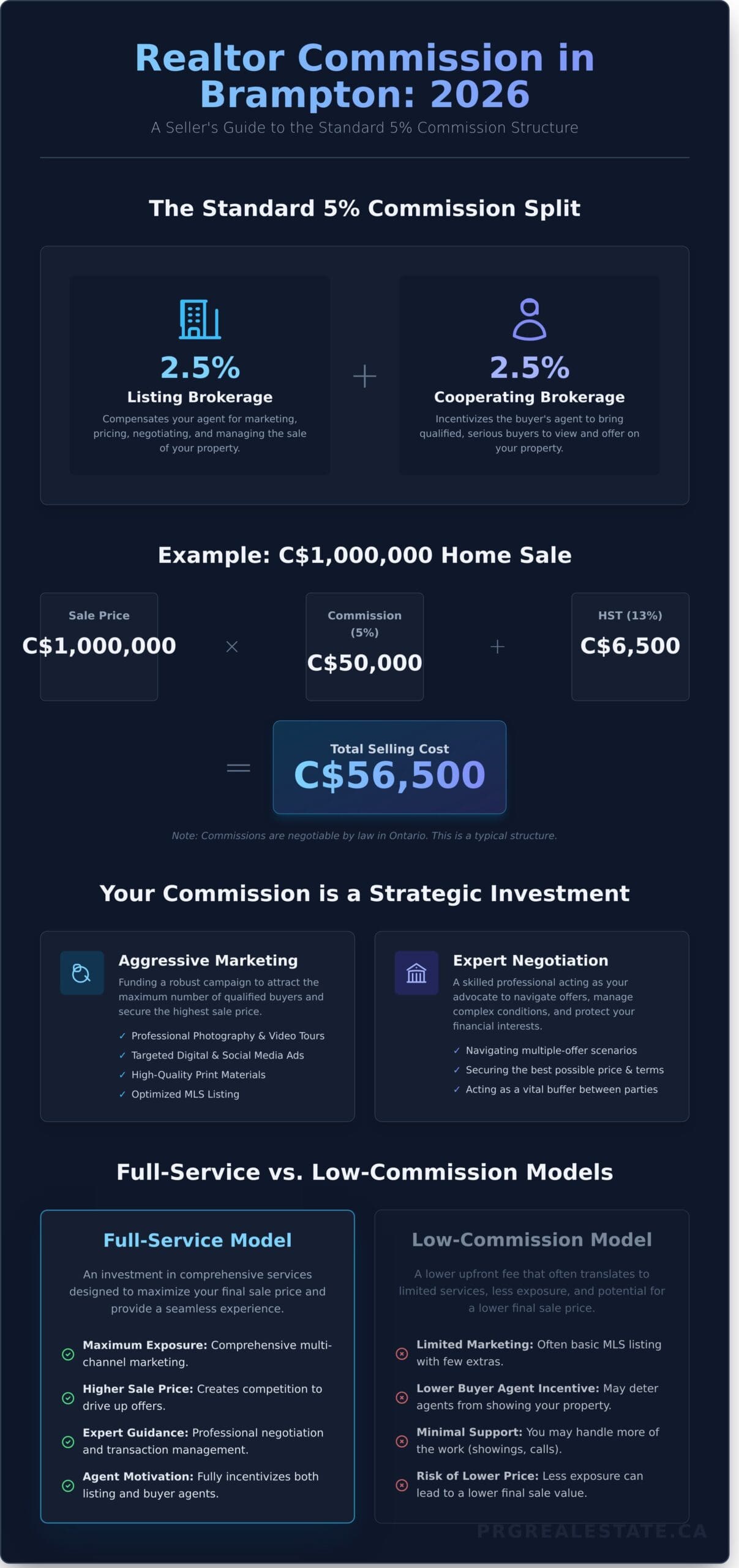
When selling your property, understanding the associated costs is paramount to calculating your net proceeds. The most significant of these is the real estate agent’s commission. In Brampton, the standard commission structure is typically 5% of the home’s final sale price. This percentage is not arbitrary; it represents the comprehensive value and professional services provided by both the listing and buying real estate professionals who facilitate the transaction.

This 5% total is strategically divided to compensate both parties involved in the sale. Typically, it is split evenly:

  • 2.5% for the Listing Brokerage: This compensates your agent (the seller’s agent) for their expertise in marketing, pricing, negotiating, and managing the sale of your property.
  • 2.5% for the Cooperating Brokerage: This portion is offered to the buyer’s agent, creating a powerful incentive for them to bring qualified, serious buyers to your listing.

To illustrate, consider the sale of a home in Brampton for C$1,000,000. A 5% commission would amount to C$50,000. It is crucial to remember that Harmonized Sales Tax (HST) is applicable to this fee, bringing the total cost to C$56,500 (C$50,000 + 13% HST).

While 5% is a common benchmark for realtor commission Brampton, it is essential for sellers to know that these rates are not fixed. By law in Ontario, all real estate commissions are negotiable. The final rate should reflect the scope of services, the agent’s experience, and the strategic marketing plan proposed for your specific property.

Who Pays the Realtor Commission?

The total commission is paid by the home seller directly from the proceeds of the sale at closing. This single payment structure is designed to streamline the process and effectively motivate the entire real estate community. By offering a competitive commission to the buyer’s agent, sellers significantly widen their pool of potential buyers, ensuring their property receives maximum exposure and attracts the strongest possible offers. This entire fee, including the HST, is detailed on the seller’s statement of adjustments prepared by their lawyer.

Understanding the Listing Agreement

The Listing Agreement is the legally binding contract between you (the seller) and your chosen real estate brokerage. This document formalizes your partnership and outlines the terms of the sale. Key components include the total commission rate, the specific amount offered to the cooperating brokerage, the listing price, and the duration of the contract. It is imperative to review this document with unwavering attention to detail before signing, ensuring all terms align with your expectations and financial goals.

What Does a Full-Service Commission Actually Pay For?

When reviewing the potential costs of selling your home, the commission can appear to be a significant line item. However, it’s crucial to reframe this from a cost to a strategic investment. A full-service commission is not simply a fee for listing a property; it is a comprehensive package of services, expertise, and resources designed to maximize your final sale price and protect your interests throughout a complex transaction. This investment covers four critical areas: aggressive marketing, expert negotiation, significant time commitment, and the agent’s professional overhead.

Marketing: An Investment in Your Sale Price

To achieve the highest possible price, your property needs maximum exposure to qualified buyers. A portion of the commission directly funds a robust, multi-channel marketing campaign that goes far beyond a simple lawn sign. This strategic investment includes:

  • Professional Media: High-resolution photography, cinematic video tours, and 3D virtual walkthroughs to make your listing stand out.
  • Digital Advertising: Targeted social media campaigns and premium placement on major real estate portals.
  • High-Quality Print: Professionally designed feature sheets and brochures for showings and open houses.
  • MLS Listing Optimization: A detailed, compelling listing on the Multiple Listing Service to attract other agents and their buyers.

This comprehensive marketing effort creates a competitive environment, often leading to multiple offers and a sale price that far exceeds what could be achieved with minimal exposure.

Expertise: The Value of Professional Negotiation

This is where an elite agent provides an exceptional return on investment. We act as a vital buffer and a skilled negotiator, managing offers with strategic precision. Whether navigating a high-stakes, multiple-offer scenario to drive the price higher or resolving complex conditions on a challenging offer, our expertise protects your financial interests. The structure of a realtor commission in Brampton is designed to cover this high-level professional service, ensuring you have an advocate dedicated to securing the best possible terms and price.

Furthermore, a significant portion of the commission is reinvested into the professional infrastructure required to operate. This includes brokerage fees, mandatory errors and omissions insurance, annual licensing renewals with regulatory bodies like RECO, and continuous professional development. These costs are part of a regulated framework; in fact, ongoing reviews of Realtor commission regulations by government bodies like the Competition Bureau of Canada underscore the structured nature of the industry. This ensures you are represented by a qualified, insured, and accountable expert committed to excellence.

Full-Service vs. Low-Commission Realtors in Brampton: A Comparison

When evaluating the cost of selling a home, it’s crucial to understand that not all real estate service models are created equal. The conversation around realtor commission Brampton has evolved beyond a single standard, introducing options like “1% listing” or “flat-fee” brokerages. These models charge a discounted rate for the listing portion of the sale, often operating on an a la carte basis where services like professional photography or open house management incur extra fees. The rise of these varied models is a direct result of a competitive marketplace, a topic that has even prompted a Competition Bureau of Canada investigation into industry practices to ensure consumer choice.

Feature Full-Service Realtor Low-Commission / Flat-Fee Realtor
Fee Structure Typically a percentage of the final sale price (e.g., 5% total), split between listing and buyer agents. A lower percentage (e.g., 1%) or flat fee for the listing agent, plus a separate, competitive commission for the buyer’s agent (e.g., 2.5%).
Marketing Budget Comprehensive: professional photography, videography, staging consultations, premium online and print advertising. Limited: basic MLS listing, minimal professional marketing, often with add-on fees for upgrades.
Agent Availability Dedicated, hands-on support and strategic advice throughout the entire process. May use a team or call-centre model, resulting in less direct, personalized contact with a single agent.
Scope of Services End-to-end management, including market analysis, pricing strategy, showings, negotiation, and closing coordination. Core listing services are covered, but negotiation support, showing management, and other key tasks may cost extra or be left to the seller.

Pros and Cons of Low-Commission Models

The primary advantage is the immediate, tangible savings on the listing agent’s fee. However, this initial saving can be misleading. Sellers must recognize that to attract buyers, they will almost certainly need to offer a competitive cooperating commission (typically 2.5%) to the buyer’s agent. Furthermore, reduced-service models often mean a significantly smaller marketing budget and less hands-on guidance, which can negatively impact the final sale price and the seller’s net profit.

When Might a Discount Brokerage Make Sense?

A low-commission model may be viable in specific scenarios: a red-hot seller’s market with intense bidding wars, a highly desirable standard property in a prime neighbourhood, or for a seasoned seller comfortable managing parts of the transaction. Conversely, this approach is ill-advised for unique luxury homes, first-time sellers who require comprehensive guidance, or in a balanced market where expert marketing and negotiation are paramount. Ultimately, the cheapest option is not always the most profitable one; maximizing your net proceeds is the true measure of success.

Realtor Commission Brampton (2026): A Complete Guide to Fees

Section 4: A Strategic Approach to Realtor Fees and Negotiation

Understanding and negotiating realtor fees is not about securing the lowest percentage; it is about engaging a partner who will deliver the highest net return on your property. A strategic approach empowers you to assess an agent’s true value and align their compensation with your financial success. This ensures the commission you pay is a direct investment in a superior outcome.

Before committing, it is essential to interview multiple real estate professionals. This process allows you to compare not only the proposed realtor commission Brampton agents offer but also their marketing strategies, local expertise, and negotiation philosophies. A top-tier agent will confidently justify their fee structure with a clear plan to maximize your sale price.

Questions to Ask a Potential Brampton Realtor

To properly vet a candidate and understand the value they provide, your interview should be direct and results-focused. Ask the following questions to gain critical insight:

  • What is your total commission and how is it split? Understand what portion goes to the buyer’s agent and what is retained by the listing brokerage.
  • What specific marketing services are included for this fee? This should include professional photography, virtual tours, staging consultations, digital advertising campaigns, and open house strategies.
  • Can you provide a track record of your recent sales in my Brampton neighbourhood? Proven success in your specific market is non-negotiable.
  • What is your strategy for negotiating offers to secure the best possible price and terms for me? An expert negotiator can often secure tens of thousands of dollars more for your home.

Negotiating on Value, Not Just Price

Frame the conversation around the comprehensive services being provided. An agent’s fee is an investment in their expertise, network, and marketing resources. While a lower rate may seem appealing, it is crucial to understand what might be compromised. The goal is not to find the cheapest agent, but the one who nets you the most money after all expenses.

Consider proposing a performance-based commission, such as a tiered rate that increases if the agent achieves a sale price significantly above asking. Furthermore, higher-priced properties may warrant a lower commission percentage, as the absolute dollar value of the fee remains substantial. A confident, results-driven realtor will be open to discussing a structure that aligns their success directly with yours. The ultimate objective is a partnership that delivers maximum value and a seamless, profitable transaction. To understand how our strategic approach delivers superior results, connect with our team of top Brampton realtors.

A Note on Commercial Real Estate Commissions

While the previous sections have focused on residential property sales, the conversation around realtor commission in Brampton shifts significantly when we enter the commercial real estate arena. These transactions are fundamentally different, involving higher stakes, greater complexity, and commission structures designed to reflect the specialized expertise required.

Why Commercial Commissions Are Different

Unlike the more standardized residential market, commercial real estate commissions are highly variable. This is a direct result of the intricacies involved in each deal. Key factors that influence the structure and amount of a commercial commission include:

  • Increased Complexity and Due Diligence: Commercial transactions require a deep understanding of zoning bylaws, environmental assessments, tenant agreements, and property income analysis (cap rates). The due diligence period is far more intensive and prolonged.
  • Longer Sales Cycles: Finding the right buyer for a commercial property and navigating negotiations can take many months, or even years, demanding sustained marketing efforts and specialized expertise.
  • Specialized Valuation and Marketing: Valuing a commercial asset is less about comparable sales and more about its potential for revenue generation. Marketing these properties requires a strategic approach targeting a niche audience of investors and business owners.
  • Diverse Commission Structures: Commercial deals often use tiered commissions (e.g., a higher percentage on the first C$1 million and a lower percentage on the balance) or have separate, distinct rates for leasing versus sales transactions.

Partnering with PRG for Maximum Commercial Value

In the high-stakes world of commercial real estate, your realtor’s fee is not a cost-it is a strategic investment in expertise, network, and results. At PRG Real Estate, our top commercial realtors focus on maximizing the value of your assets and developing thriving communities. We understand that navigating the nuances of a commercial realtor commission in Brampton is secondary to securing a profitable and sound deal.

Our team’s unparalleled market knowledge ensures your property is positioned correctly, marketed effectively, and negotiated with precision. We manage the immense complexity of commercial transactions, allowing you to focus on your business objectives. Choosing PRG means partnering with a brokerage committed to achieving superior outcomes for your portfolio. For expert guidance on your commercial property, contact PRG Real Estate.

Secure Your Highest Return: The Final Word on Realtor Commissions

Understanding the structure of real estate commissions is a critical step for any Brampton property owner. As we’ve detailed, the fee is not simply a cost but a strategic investment in expert marketing, skilled negotiation, and seamless transaction management. While low-commission models exist, the comprehensive service and market leverage of an elite realtor often result in a significantly higher final sale price, delivering a superior return on your investment.

Ultimately, navigating the standard realtor commission Brampton sellers can expect is about choosing a partner who provides undeniable value. At PRG Real Estate, our award-winning team is built on a reputation of trust and a commitment to excellence. As specialists in both commercial and residential real estate, we provide the strategic advice required to ensure you achieve the highest possible sale price for your asset.

Your property is a significant investment. Ensure it’s in the hands of professionals dedicated to maximizing its potential. Partner with Brampton’s top realtors to maximize your property’s value.

Frequently Asked Questions About Realtor Commissions

Is realtor commission negotiable in Ontario?

Yes, real estate commission is fully negotiable in Ontario. There is no standard or government-mandated rate. The commission is an agreement between the seller and their listing brokerage, reflecting the level of service, marketing strategy, and expertise provided. An elite agent will demonstrate how their strategic approach justifies their commission structure, aiming to secure you the highest possible return on your investment. This negotiation is a critical part of your listing agreement.

Who pays the realtor commission when a house is sold in Brampton?

The home seller is responsible for paying the total realtor commission. This amount is specified in the listing agreement and is typically paid from the sale proceeds at closing. This total commission is then split between the seller’s brokerage and the buyer’s brokerage. Understanding the complete structure of the realtor commission Brampton sellers pay is essential for accurately calculating your net proceeds and pricing your property effectively in the competitive market.

Do I have to pay HST on real estate commission in Canada?

Yes, HST (Harmonized Sales Tax) must be paid on real estate commissions in Ontario and throughout Canada. A realtor’s services are considered taxable, and the current HST rate of 13% in Ontario is applied to the total commission fee. This is a mandatory closing cost for sellers and should be factored into your budget. Your agent’s statement of account will clearly itemize the commission and the corresponding HST amount for your records.

What is a 1% commission realtor and what’s the catch?

A “1% commission” typically refers only to the listing agent’s portion of the fee and does not include the necessary commission offered to the buyer’s agent (usually 2.0-2.5%). The ‘catch’ often involves a limited-service model, which may exclude professional marketing, staging consultations, or dedicated negotiation support. A full-service brokerage provides a comprehensive strategy designed to maximize your property’s value, often resulting in a higher final sale price that outweighs the commission savings.

How is commission split between the buyer’s and seller’s agent?

The total commission is divided between the listing brokerage (representing the seller) and the cooperating brokerage (representing the buyer). While a 50/50 split is common, the exact division is determined by the seller in the listing agreement. For example, a 5% total commission might be split so that 2.5% goes to the listing brokerage and 2.5% is offered to the buyer’s brokerage. This cooperative commission is a powerful incentive for agents to show your property.

Can I sell my house myself to avoid paying commission?

Yes, you can sell your property as a For Sale By Owner (FSBO) to avoid paying the listing portion of the commission. However, to attract buyers represented by agents, you will likely still need to offer a commission to the buyer’s agent. Sellers who choose this route are solely responsible for all aspects of the sale, including market analysis, marketing, legal paperwork, and high-stakes negotiations-areas where a top-tier professional provides immense value and mitigates risk.

Are commercial real estate commissions higher than residential?

Commercial real estate commissions are not inherently higher, but they are often structured differently. They frequently use a sliding scale, where the percentage decreases as the transaction value increases-for example, 5% on the first C$1 million and 3% on the remainder. The final commission is highly negotiable and reflects the complexity, asset class, and significant due diligence required for commercial transactions, demanding the expertise of a seasoned commercial real estate professional.

Free Commercial Property Valuation: Accurately Determine Your Property's Worth
CategoriesBlog

Free Commercial Property Valuation: Accurately Determine Your Property’s Worth

Navigating the complexities of the Canadian commercial real estate market can be a significant challenge. You know your property is a valuable asset, but generic online calculators offer vague estimates, and the jargon of formal appraisals-from cap rates to Net Operating Income-can feel overwhelming. You need a clear, accurate picture of your property’s worth without committing to a costly formal appraisal. This is precisely why we’ve created this definitive guide, offering you a professional and free commercial property valuation to empower your investment strategy.

In the following sections, we will demystify the core valuation methods used by industry leaders and break down the key factors that influence your property’s value in today’s market. Our goal is to equip you with the clarity and confidence needed to make strategic decisions. Discover the true potential of your asset and receive a complimentary, data-backed assessment from PRG Real Estate, Brampton’s top commercial realtors, to help you determine your next move.

Key Takeaways

  • Understand why standard online valuation tools are inaccurate for commercial assets, which are primarily valued on their income-generating potential, not just comparable sales.
  • Discover the three core valuation methodologies-the Income, Sales Comparison, and Cost Approaches-that top brokers and appraisers use to determine a property’s true market worth.
  • Identify the key local market factors in Brampton and the GTA, from zoning regulations to economic trends, that directly impact your commercial property’s current and future value.
  • Learn how to leverage a Broker Opinion of Value (BOV) as a strategic tool for decision-making and receive your expert, no-obligation free commercial property valuation.

Why Online Valuation Tools Can’t Price Your Commercial Property

In today’s digital world, many investors search for a “Zillow for commercial properties”-a simple tool for an instant valuation. However, this concept is fundamentally flawed. Unlike residential homes, commercial assets are valued primarily as income-generating businesses, not just on square footage and recent sales. An automated estimate cannot grasp the complex financial and operational details that determine a commercial property’s true market worth, leading to significant miscalculations and missed opportunities.

The Problem with Automated Valuation Models (AVMs)

Automated Valuation Models (AVMs) are built on publicly available data, which is often incomplete or confidential for commercial transactions in Canada. These algorithms excel at comparing standardized residential properties but fail when faced with the unique nature of commercial real estate. An AVM cannot analyze the intricate details of a lease agreement, differentiate between a Triple Net (NNN) and a Gross lease, or understand how specific features like zoning restrictions, loading dock capacity, or ceiling clear height impact a property’s utility and value.

Key Data Points That Require Human Analysis

A strategic and accurate valuation requires an expert’s ability to interpret critical data points that algorithms overlook. Our approach to providing a free commercial property valuation is rooted in a comprehensive analysis that considers the complete financial picture of your asset. This includes a deep dive into factors that require professional judgment, such as:

  • Tenant Creditworthiness: The financial stability of your tenants is paramount. A long-term lease with a national, credit-rated corporation holds significantly more value than one with a new, unproven business.
  • Lease Terms & Structure: We meticulously review lease lengths, renewal options, and rent escalation clauses. The structure of the lease directly impacts your net operating income and, therefore, the property’s value.
  • Capital Expenditures: An expert assessment identifies deferred maintenance and potential future costs-like a roof replacement or HVAC system upgrade-that will affect the property’s cash flow and marketability.
  • Local Brampton Market Dynamics: As the top commercial realtors in Brampton, our team possesses on-the-ground knowledge of upcoming developments, infrastructure projects, and shifting tenant demand that generic data models will always miss.

Ultimately, a precise valuation is a blend of art and science, combining financial analysis with deep market insight. It requires an understanding of the established methods of professional commercial property valuation and the expertise to apply them to the unique context of your property and the local market. This level of detail is essential for making informed investment decisions.

The 3 Core Methods of Professional Commercial Property Valuation

Determining the true market value of a commercial asset is not guesswork; it is a strategic discipline built on established, industry-standard methodologies. At PRG, our experts don’t rely on a single data point. Instead, we synthesize insights from three core valuation approaches to provide a comprehensive and defensible assessment. Understanding these methods is the first step in appreciating the expert analysis that underpins a truly accurate, free commercial property valuation.

The Sales Comparison Approach (Market Approach)

Think of this as valuing your asset by examining what similar properties in the Canadian market have recently sold for. It’s a direct reflection of what buyers are currently willing to pay. Our experts perform a detailed analysis, comparing your property against others based on critical factors:

  • Location: Proximity to key arteries, transit, and amenities.
  • Size & Layout: Gross leasable area and functional design.
  • Age & Condition: The physical state and need for capital improvements.
  • Zoning: Permitted use and future development potential.

While highly effective, this method’s precision is contingent on the availability of recent, truly comparable sales, which can be scarce for unique assets.

The Cost Approach

This method answers a fundamental question: what would it cost to construct a replacement property from scratch today? The calculation is direct: Land Value + Replacement Construction Cost – Accumulated Depreciation = Property Value. Depreciation accounts for physical wear, functional inefficiencies, and external economic factors. This approach is most valuable for new constructions or special-purpose properties, such as a community centre or a custom-built industrial facility, where sales and income data are limited.

The Income Capitalization Approach

For an investor, a commercial property is an income-generating machine. This approach values the asset based on its capacity to produce cash flow. We first determine the Net Operating Income (NOI)-the property’s annual income after all operating expenses are paid. This NOI is then divided by a Capitalization (Cap) Rate, which reflects the prevailing rate of return for similar properties in the market. As the premier method for office buildings, retail plazas, and multi-family apartments, it directly links a property’s value to its financial performance, providing the insight you need from a free commercial property valuation.

Free Commercial Property Valuation: Accurately Determine Your Property's Worth

Key Factors That Directly Impact Your Property’s Value in Brampton

While valuation methods provide a framework, the true market value of your commercial property is determined by a strategic analysis of tangible, on-the-ground factors. An expert appraisal moves beyond theory to scrutinize the specific variables that buyers and investors prioritize. Understanding these elements allows you to see your asset through the eyes of the market, identifying both its strengths and areas for potential improvement.

Property-Specific Financials

The financial performance of your property is the bedrock of its value, directly feeding into the Income Approach calculation. A strong and stable cash flow is paramount for attracting premium offers.

  • Rent Roll Analysis: We assess the quality and diversity of your tenants. A property with long-term leases to national, credit-worthy tenants is inherently more valuable than one with short-term leases to small, independent businesses.
  • Lease Terms: Favourable terms, such as built-in annual rent escalations and limited landlord responsibilities (as in a triple net lease), create predictable revenue growth and reduce risk for a new owner.
  • Operating Expenses: A history of well-managed expenses, including property taxes, insurance, and maintenance, demonstrates efficiency and maximizes the Net Operating Income (NOI)-a critical driver of value.

Physical and Locational Attributes

A property’s physical characteristics and its strategic position within Brampton are fundamental to its desirability and long-term potential. Location isn’t just a mantra; in the GTA, it’s a primary value multiplier.

  • Location and Accessibility: Proximity to major transportation arteries like Highways 410, 407, and 401 is a significant advantage, particularly for industrial and logistics properties. High visibility and easy access for retail and office spaces also command higher values.
  • Building Condition: The age, construction quality, and recent capital expenditures (e.g., new roof, updated HVAC) are closely examined. A well-maintained building with minimal deferred maintenance is valued more highly.
  • Zoning and Development Potential: Current zoning regulations dictate the property’s use. However, its potential for future development, intensification, or rezoning can unlock substantial hidden value that a standard analysis might miss.

Brampton Market Dynamics

No property exists in a vacuum. Its value is directly influenced by the real-time conditions of the local Brampton and wider GTA market. This is where our deep market intelligence provides a decisive edge.

  • Supply and Demand: We analyze the current inventory for your specific asset class. Brampton’s tight industrial market, for example, has driven significant value appreciation due to high demand and limited supply.
  • Vacancy Rates and Market Rents: Low local vacancy rates indicate a healthy market, allowing landlords to command higher average rental rates per square foot, which in turn boosts potential income.
  • Prevailing Cap Rates: The capitalization rate is a direct reflection of investor sentiment and perceived risk for similar properties in the area. We track these rates meticulously to ensure your valuation is aligned with current market expectations.

These intricate factors and their interplay are precisely what our team at PRG Real Estate evaluates. A comprehensive understanding is essential for an accurate appraisal. To see how these elements apply to your asset, we invite you to request a free commercial property valuation from our experts. Our detailed analysis ensures you have the strategic insights needed to make informed decisions. Learn more about our approach at prgrealestate.ca.

How to Get Your Free, Professional Broker Opinion of Value (BOV)

Making a strategic decision about your commercial asset starts with a precise understanding of its current market value. A Broker Opinion of Value (BOV) from PRG Real Estate is a powerful tool designed to provide you with the clarity and confidence needed to optimize your investment strategy. We have streamlined our process to deliver expert insights efficiently and professionally.

What is a Broker Opinion of Value?

A BOV, often called a Comparative Market Analysis (CMA), is an expert assessment of your property’s market value conducted by an active commercial realtor with on-the-ground experience. It differs significantly from a formal appraisal, which is a legally binding document typically required by lenders for financing. A BOV is a strategic report that leverages real-time sales data and deep market intelligence, making it the ideal instrument for owners considering a sale, exploring refinancing options, or conducting a strategic portfolio review.

The PRG Valuation Process: What to Expect

Our commitment to excellence is reflected in our efficient and thorough valuation process. We respect your time and provide a clear, confidential path to the insights you need for your free commercial property valuation.

  • Step 1: Initial Consultation. We begin with a confidential discussion to understand your specific property, your long-term objectives, and any unique factors influencing your asset.
  • Step 2: Submission of Key Documents. To ensure maximum accuracy, we request essential documents such as the current rent roll and recent profit and loss (P&L) statements.
  • Step 3: In-Depth Market Analysis. Our team of top commercial realtors conducts a rigorous analysis, evaluating your property against comparable sales, active listings, and prevailing economic conditions in the Brampton market.
  • Step 4: Report Delivery and Discussion. We deliver a comprehensive valuation report and schedule a follow-up meeting to discuss the findings, answer your questions, and outline potential strategies to maximize your return.

Your Complimentary Valuation Report Includes:

Your final report is more than just a number; it is a detailed market intelligence document designed to empower your next move. The insights provided by the experts at PRG Real Estate will give you a decisive advantage.

  • A clear, estimated value range for your property in the current market.
  • A detailed analysis of comparable recent sales and active listings in your area.
  • Expert commentary on current Brampton and GTA market trends affecting your property’s value.

Ready to unlock the true potential of your commercial asset? Take the first step toward a more strategic and profitable future.

Request Your Confidential Valuation from Our Experts.

Secure Your Investment with a Professional Property Valuation

Determining the true worth of your commercial property is a critical strategic decision that generic online estimators simply cannot support. As we’ve covered, a credible valuation moves beyond simple algorithms, requiring an expert analysis of the three core valuation methods and the specific market factors impacting property values right here in Brampton.

Your asset deserves a precise and professional assessment. Let our team of top commercial real estate specialists provide you with a complimentary and confidential free commercial property valuation. This in-depth Broker Opinion of Value is grounded in real-time, local market data and is tailored to the unique characteristics of your property, providing the clarity you need to act with confidence.

Unlock the true potential of your investment. Request Your Free, No-Obligation Property Valuation Today.

Frequently Asked Questions About Your Property Valuation

What is the difference between a broker valuation (BOV) and a formal appraisal?

A Broker Opinion of Value (BOV) is a market-based estimate provided by a real estate professional to determine a probable selling price, used for strategic planning and listing decisions. In contrast, a formal appraisal is a legally binding valuation conducted by a licensed appraiser, typically required by lenders for financing or for legal matters. Our BOV provides expert insight into current market dynamics to inform your investment strategy and potential listing price.

How long does it take to receive my free commercial property valuation?

Our team of top commercial realtors is committed to providing a swift and accurate analysis. Once we receive all the necessary property information, you can typically expect to receive your comprehensive free commercial property valuation within 2 to 4 business days. This efficient turnaround ensures you have the timely data needed to make informed, strategic decisions regarding your asset without delay, reflecting our commitment to client success and results-oriented service.

Is the information I provide kept confidential?

Absolutely. PRG Real Estate operates with unwavering integrity and a commitment to client confidentiality. All information and documentation you provide for your property valuation are handled with the utmost discretion and are used exclusively for the purpose of creating your market analysis. Our reputation is built on trust and loyalty, and we guarantee that your sensitive financial and property data will be kept secure and private throughout the entire process.

Am I obligated to list my property with you if I request a valuation?

There is absolutely no obligation to list your property with PRG Real Estate. We offer this valuation as a professional courtesy to help you understand the current market value of your asset. Our goal is to provide strategic insights and build long-term relationships based on trust and expertise. Should you decide to sell in the future, we are confident our results-oriented approach will make us your first choice, but the decision remains entirely yours.

How often should I get my commercial property valued?

For strategic asset management, we recommend valuing your commercial property at least once a year to stay ahead of market fluctuations. However, an updated valuation is crucial following significant events such as major capital improvements, changes in tenancy or lease terms, local zoning amendments, or substantial shifts in the economic landscape. Proactive valuation ensures your investment strategy remains aligned with current market realities and maximizes potential returns.

What documents do I need to provide for an accurate valuation?

To provide the most accurate and strategic valuation, we require key documents that detail your property’s financial performance and physical condition. Please provide the current rent roll, income and expense statements for the last 2-3 years, a recent property tax bill, and a list of any significant capital expenditures made in the past five years. This data allows our experts to conduct a thorough and precise analysis of your asset’s market position.

Brampton Zoning Bylaws: A Guide for Property Owners & Investors
CategoriesBlog

Brampton Zoning Bylaws: A Guide for Property Owners & Investors

Navigating the dense and often confusing world of municipal regulations can be the single greatest barrier between you and the full potential of your property. For homeowners and investors alike, a clear understanding of the Brampton zoning bylaws is not just an advantage-it’s an essential component of any successful real estate strategy. The official documents can be overwhelming, leaving you uncertain about what you can build, how to verify a property’s designation, or how recent changes might impact your investment.

This expert guide from PRG Real Estate Brokerage is designed to cut through that complexity. We provide the strategic insights you need to confidently check a property’s current zoning, understand precisely what you are permitted to build, and navigate the process for seeking amendments. Consider this your definitive resource for transforming regulatory hurdles into strategic opportunities, empowering you to make informed decisions and unlock your property’s true value in Brampton’s dynamic market.

Key Takeaways

  • Understand how zoning dictates a property’s permitted uses and regulations, which is the first step in unlocking its true investment potential.
  • Discover how to use the City of Brampton’s official online tools to quickly and accurately identify the specific zoning for any residential or commercial property.
  • Learn the critical difference between applying for a Minor Variance and a full Zoning By-law Amendment to ensure you follow the most efficient path for your project.
  • Stay ahead of market changes by understanding how the city’s ongoing review of Brampton zoning bylaws will impact future development and property values.

What Are Zoning Bylaws & Why They Matter in Brampton

For any developer, investor, or property owner in Brampton, a comprehensive understanding of zoning is not just an advantage-it’s a necessity. In essence, what are zoning bylaws? They are the municipal rulebook for land use, dictating precisely what can be built on a property and how that property can be used. The primary purpose is to ensure orderly and compatible development, preventing conflicts like a new industrial plant being built next to a quiet residential neighbourhood. This strategic organization is fundamental to fostering sustainable community growth and directly impacts property values, development potential, and the overall economic landscape of the city.

In the City of Brampton, the cornerstone of these regulations is the Comprehensive Zoning By-law 270-2004. This document translates the high-level vision of the Brampton Official Plan-which outlines long-term growth goals-into specific, legally enforceable rules for every parcel of land. While the Official Plan sets the “what” and “why” of development, the zoning by-law defines the “how” and “where,” making it the critical day-to-day guide for all development projects.

The Impact on Commercial Investors

For commercial investors, navigating the brampton zoning bylaws is the first step in any successful due diligence process. These regulations are the gatekeepers of your investment’s potential, defining critical parameters such as:

  • Permitted Uses: Dictates the exact type of business you can operate, from retail and office space to industrial or institutional uses.
  • Building Specifications: Governs the maximum building height, size (Gross Floor Area), and density permitted on the lot.
  • Parking and Landscaping: Sets minimum requirements for vehicle parking spaces, loading zones, and green space, which can significantly affect site layout and project costs.

Misinterpreting these rules can lead to costly delays or a complete project failure. Expert guidance is essential to ensure your commercial vision aligns with municipal regulations from day one.

The Impact on Residential Property Owners

Zoning bylaws also have a profound impact on residential properties, shaping how homeowners can use and enhance their most valuable asset. These rules are designed to protect neighbourhood character, ensure safety, and maintain property values for the entire community. Key residential regulations include:

  • Structures and Additions: Governs the construction of home additions, decks, sheds, and fences, including placement and size limits.
  • Secondary Dwelling Units: Provides the specific legal framework for adding basement apartments or garden suites, a crucial factor for generating rental income.
  • Lot Restrictions: Defines setbacks (the required distance from property lines), maximum lot coverage, and height restrictions to maintain aesthetic consistency and prevent overcrowding.

Decoding Brampton’s Key Zoning Designations (By-law 270-2004)

For any developer, mastering the local zoning framework is the first step toward a successful project. In Brampton, this framework is primarily defined by Zoning By-law 270-2004, a comprehensive document that dictates land use across the city. This by-law strategically divides the municipality into distinct categories-such as Residential, Commercial, and Industrial-to ensure organized, sustainable growth. Each designation comes with a precise set of rules governing permitted uses, building height, setbacks, and lot coverage. For developers, a comprehensive understanding of these regulations is not just beneficial-it’s fundamental. The provincial framework, detailed in Ontario’s Citizen’s Guide to Land-Use Planning, provides the context for how municipal bylaws like Brampton’s are created and enforced.

Crucially, developers must be aware that while these general categories provide a guide, many properties fall under specific ‘exception zones’ with unique, site-specific permissions or restrictions. Therefore, verifying the exact zoning for a target address is a non-negotiable step in your due diligence process. Navigating the nuances of the brampton zoning bylaws is critical to unlocking a property’s true potential.

Primary Residential Zones (R)

Residential zones are foundational to Brampton’s community structure, designed to accommodate a range of housing types. Key designations include:

  • R1, R2, etc.: These zones typically permit lower-density housing, such as single-detached (R1) and semi-detached (R2) homes, forming the backbone of many suburban neighbourhoods.
  • RM (Residential Multiple): These zones are designated for higher-density development, including townhouses, stacked townhomes, and apartment buildings, often located along transit corridors.

Certain residential zones also permit ancillary uses like home-based businesses, provided they meet specific criteria regarding traffic, signage, and scale.

Primary Commercial Zones (C)

Brampton’s commercial zones are structured hierarchically to create vibrant economic hubs, from local corner stores to major retail destinations. The C1 to C4 designations generally scale in intensity, allowing for a strategic distribution of business activity. For instance, a C1 (Local Commercial) zone supports small-scale retail and services catering to the immediate community, while a C3 (Regional Commercial) zone accommodates large shopping centres and big-box stores. These zones are vital for creating employment and providing essential services to residents.

Industrial & Employment Zones (M, E)

The M (Industrial) and E (Employment) zones are the engines of Brampton’s economy. M zones are designated for a wide range of industrial activities, including manufacturing, warehousing, and logistics. In contrast, E zones are typically reserved for business parks, corporate offices, and research facilities, often with higher architectural and landscaping standards. These zones are strategically located with access to major transportation networks, reinforcing Brampton’s position as a key economic hub in the Greater Toronto Area.

How to Find the Zoning for Any Brampton Property: A Step-by-Step Guide

Before assessing a property’s development potential, a developer’s first strategic move is to confirm its designation under the current brampton zoning bylaws. This critical due diligence ensures your project vision aligns with municipal regulations, preventing costly setbacks and legal challenges. Fortunately, the City of Brampton provides powerful online tools to streamline this process. All you need to begin is the property’s municipal address.

Using the Interactive Zoning Map

The most direct method for determining a property’s zoning designation is through the city’s official online mapping tool. This resource provides immediate access to the essential data required for your initial analysis. The process is straightforward:

  • Step 1: Navigate to the City of Brampton’s Interactive Zoning Map. Use the search bar to enter the full property address.
  • Step 2: Click on the highlighted property parcel on the map. A pop-up window will appear displaying detailed information.
  • Step 3: Locate the “Zoning” field within this window and note the specific zone code, such as ‘R1A-1234’ or ‘C4’. This code is the key to unlocking all applicable regulations for the site.

Interpreting the Zoning Information

With the zone code identified, the next step is to cross-reference it with the comprehensive zoning bylaw document. This document details what is permissible for that specific code, including permitted uses, building setbacks, height restrictions, and parking requirements. It is crucial to pay close attention to any ‘exception numbers’ appended to the code, as these introduce site-specific rules that can significantly alter development potential.

Navigating the nuances of the full bylaw requires precision and expertise. Misinterpreting a single clause or exception can jeopardize an entire project. Contact our team for an expert interpretation of your property’s zoning. We provide the clarity and strategic advice needed to move your development forward with confidence.

Brampton Zoning Bylaws: A Guide for Property Owners & Investors

A property’s existing zoning is not always the final word. Ambitious developers and investors often identify opportunities that require a strategic change to a property’s permitted use or density. Whether you intend to build a multi-unit residential building on a lot zoned for single-family homes or simply need a small adjustment to accommodate a specific design, navigating the required changes is a complex process. The path you take depends entirely on the scale of your proposed deviation from the current Brampton zoning bylaws.

Understanding the distinction between a major Zoning Bylaw Amendment and a Minor Variance is critical to managing timelines, budgets, and expectations. Both processes require a formal application to the City of Brampton, but they serve different purposes and follow vastly different paths to approval.

The Zoning Bylaw Amendment Process

A Zoning Bylaw Amendment is required for significant, fundamental changes to a property’s land use. This is the correct path for proposals such as increasing density, changing a commercial property to residential, or introducing a new use not currently permitted. This is a lengthy, multi-stage process that includes pre-application consultation with City staff, a formal application, public meetings, and a final decision by City Council. Success is never guaranteed, and a professionally prepared, compelling case is essential.

Applying for a Minor Variance

When a project requires only a small deviation from the zoning bylaw, a Minor Variance application is the appropriate tool. This is used for adjustments like a minor reduction in a required setback, a small increase in building height, or a slight change in parking requirements. The application is made to Brampton’s Committee of Adjustment, which will grant approval only if the request successfully meets four key tests mandated by Ontario’s Planning Act, proving it is minor, desirable, and maintains the intent of the Official Plan and zoning bylaw.

The Strategic Advantage of Expert Guidance

Attempting to navigate zoning changes without expert representation is a significant risk. A seasoned real estate development professional can provide a critical initial assessment of your proposal’s viability, preventing wasted time and investment. They are instrumental in preparing robust applications, liaising with city planners, and representing your interests at public meetings or Committee of Adjustment hearings. Partnering with an expert doesn’t just simplify the process-it strategically positions your project for approval and maximizes your return on investment. For expert advice on navigating your development project, contact PRG Real Estate Brokerage.

The Future of Brampton Zoning: What the New Bylaw Review Means for You

The landscape of real estate development in Brampton is on the verge of a significant transformation. The City is currently undertaking a comprehensive Zoning By-law Review, a critical initiative designed to modernize its regulatory framework. The primary goal is to replace the outdated By-law 270-2004 with a new, streamlined set of rules that align with the vision laid out in the Brampton Plan, the city’s new Official Plan.

For savvy developers and investors, this review is not just a procedural update; it represents a fundamental shift in how land can be utilized. Understanding these proposed changes is essential for identifying future opportunities and making strategic investment decisions that will capitalize on Brampton’s growth trajectory. A forward-thinking approach requires looking beyond current land use permissions and evaluating a property’s potential under the new Brampton zoning bylaws.

Key Proposed Changes for Investors

This review is engineered to foster a more modern, dense, and economically vibrant city. For investors, the most impactful proposals center on strategic growth and flexibility. Key changes to monitor include:

  • Intensification Along Transit Corridors: Expect significant increases in permitted density and height around major transit hubs and avenues, such as the Queen Street and Hurontario LRT lines, creating prime opportunities for high-density residential and mixed-use projects.
  • Flexible Mixed-Use Zones: The introduction of new mixed-use zoning categories is intended to encourage the development of complete communities where residents can live, work, and play, reducing reliance on traditional, segregated land use.
  • Support for Economic Growth: The new bylaw aims to simplify regulations for commercial and industrial developments, making it easier to establish businesses and employment hubs that will drive Brampton’s economy forward.

How to Stay Informed

Navigating this period of regulatory change demands diligence and expert insight. The most reliable source for official documents and timelines is the City of Brampton’s official project page. The city will also hold public consultations, offering a vital opportunity for stakeholders to provide feedback.

However, interpreting the complex implications of these draft policies requires specialized expertise. At PRG Real Estate, our team is actively monitoring every stage of the bylaw review process. We provide our clients with strategic analysis, ensuring their investment decisions are based on a comprehensive understanding of both current regulations and future potential. Don’t just adapt to the future-anticipate it. Partner with a team that understands the future of Brampton real estate.

Unlock Your Property’s Potential with Zoning Expertise

As this guide has shown, mastering Brampton’s dynamic property landscape begins with a firm grasp of its foundational zoning regulations. Understanding the intricacies of the brampton zoning bylaws-from decoding specific designations in By-law 270-2004 to strategically preparing for the upcoming city-wide review-is the key to unlocking your property’s true potential and avoiding costly compliance issues. However, navigating this complex framework requires more than just information; it demands expert guidance and strategic insight to capitalize on every opportunity.

At PRG Real Estate, our commitment to excellence is built on a deep understanding of this very landscape. Our team of top commercial realtors brings a proven track record of guiding investors and developers through Brampton’s most complex transactions. We leverage our specialized expertise in the local commercial and development sectors to provide strategic advice that transforms zoning knowledge into maximum investment potential. Don’t leave your success to chance. Let our top commercial realtors help you navigate Brampton’s zoning bylaws. Contact PRG Real Estate today.

Partner with us to turn regulatory challenges into profitable opportunities.

Frequently Asked Questions About Brampton Zoning Bylaws

What is the difference between the Brampton Official Plan and the Zoning Bylaw?

The Official Plan is Brampton’s strategic, long-term vision for community growth, outlining general policies on land use. In contrast, the Zoning Bylaw is the legally enforceable instrument that implements this vision. It dictates the specific, day-to-day rules for every property, detailing permitted uses, building heights, setbacks, and parking requirements. For developers, the Zoning Bylaw is the primary regulatory document governing a project’s viability and compliance.

Can I operate a business from my home in Brampton?

Yes, home-based businesses are permitted in many residential zones, but they are subject to strict regulations within the zoning bylaw. These rules are designed to maintain the residential character of neighbourhoods and typically restrict client traffic, exterior signage, outdoor storage, and the number of non-resident employees. It is critical to verify the specific permissions and limitations for your property’s zoning category before commencing operations.

How do I make a complaint about a potential zoning violation?

To report a suspected zoning infraction, you must file a formal complaint with the City of Brampton’s Enforcement and By-law Services division. This can be done by calling 311 or using the City’s online reporting portal. To ensure an effective investigation, you must provide the specific municipal address of the property in question and a clear, detailed description of the potential violation for review by a By-law Enforcement Officer.

What does it mean if a property has a ‘legal non-conforming’ status?

A ‘legal non-conforming’ status means a property’s use, building, or structure was lawfully established but no longer complies with the current brampton zoning bylaws due to a subsequent amendment. This status allows the existing use to continue indefinitely. However, it cannot be expanded or enlarged, and if the structure is substantially destroyed, it may be required to be rebuilt in full conformity with the current bylaw.

How much does it cost and how long does it take to get a zoning amendment?

Securing a zoning bylaw amendment is a significant undertaking in both time and capital. Application fees payable to the City of Brampton can start from C$15,000 and increase based on the project’s complexity. The process, from pre-application consultation to final council decision, typically requires a minimum of 9 to 12 months, but can easily extend further depending on the required technical studies, public consultation, and potential appeals.

Are there special zoning rules for properties in heritage districts?

Yes, properties within Brampton’s designated Heritage Conservation Districts are subject to an additional layer of stringent regulation. Any proposed development, alteration, or demolition must not only comply with the underlying zoning but also receive approval from the Brampton Heritage Board. These special rules are enforced to preserve the district’s unique historical and architectural character, often impacting everything from building materials to facade design.

The 8 Main Types of Commercial Real Estate: A Guide for Investors
CategoriesBlog

The 8 Main Types of Commercial Real Estate: A Guide for Investors

Navigating the world of commercial real estate can feel complex, with a landscape of terminology and classifications that can seem intimidating to even the most ambitious investor. However, making a strategic and successful investment in the Brampton & GTA market hinges on a clear understanding of the fundamental types of commercial real estate. From the high-rise office towers shaping the skyline to the bustling retail centres and sprawling industrial parks, each property category presents a unique set of opportunities and challenges.

This definitive guide is designed to demystify the market. We will provide an expert breakdown of the eight main property categories, exploring the purpose, potential, and key considerations for each-from office and retail to multifamily and special-purpose properties. By the end, you will have the foundational knowledge required to identify which asset classes align with your investment goals and to discuss your strategy with absolute confidence.

Key Takeaways

  • Commercial real estate is divided into core categories like office and retail, and specialized niches, each with unique risk and return profiles.
  • Mastering the different types of commercial real estate-from industrial to multifamily-is the first step to aligning an asset with your investment goals.
  • Your investment strategy, risk tolerance, and available capital will determine whether a core property, a specialized asset, or undeveloped land is the right choice for you.
  • Market dynamics in Brampton and the GTA vary significantly across property classes, making local expertise essential for strategic investment decisions.

What is Commercial Real Estate (CRE) and How Does It Differ from Residential?

Embarking on a commercial real estate venture requires a strategic mindset, beginning with a clear understanding of the asset class itself. At its core, commercial real estate (CRE) refers to any Commercial property used exclusively for business-related purposes or to provide a workspace. Unlike residential real estate, which is purchased for private living, the primary objective of a CRE investment is to generate profit, either through consistent rental income or long-term capital appreciation. Mastering the various types of commercial real estate is the foundational step toward building a successful and resilient portfolio.

The distinction between commercial and residential extends far beyond purpose. Key operational differences that every investor must recognize include:

  • Lease Terms: CRE leases are typically longer, often spanning 5 to 10 years or more, and are far more complex than standard residential agreements, frequently involving detailed clauses on maintenance, insurance, and property taxes.
  • Financing in Canada: Securing a commercial mortgage in Canada generally requires a larger down payment and is evaluated based on the property’s income-generating potential, not just the borrower’s personal credit.
  • Tenant Relationships: Interactions are business-to-business (B2B), focusing on professional partnerships that support the tenant’s operational success and the landlord’s return on investment.

The Investor vs. The User Perspective

Engagement with CRE typically falls into two categories. The investor acquires property with the sole intention of leasing it to tenants to generate cash flow and build equity. In contrast, the user, or owner-occupier, purchases or leases a property to operate their own business. While both are making a significant investment, their goals-and therefore their evaluation criteria-are fundamentally different, with one focused on returns and the other on operational utility.

Key Metrics in CRE You Should Know

To evaluate and compare different types of commercial real estate, investors rely on specific financial metrics. Two of the most critical are:

  • Net Operating Income (NOI): This is the property’s total income after deducting all operating expenses. NOI is the purest measure of a property’s ability to generate profit.
  • Capitalization Rate (Cap Rate): Calculated by dividing the NOI by the property’s current market value, the cap rate represents the potential rate of return on the investment.

A comprehensive understanding of these metrics provides the data-driven insight necessary for making strategic acquisition decisions and achieving excellence in your investment journey.

The Core Four: Office, Industrial, Retail, and Multifamily Properties

When investors begin exploring the various types of commercial real estate, their focus inevitably lands on four foundational pillars: office, industrial, retail, and multifamily. These categories represent the bulk of the commercial market, and nearly every business or investor will interact with them at some point. Each asset class operates within its own distinct market, driven by unique economic factors and tenant demands. Understanding the nuanced risk and reward profile of each is a critical first step for anyone serious about investing in different types of real estate.

Office Space: The Hub of Business

Office properties are buildings designed for professional and administrative services. Investment value is often determined by a classification system: Class A properties are premium, modern buildings in prime locations; Class B are well-maintained but older; and Class C are functional spaces requiring updates. Subtypes range from downtown high-rises and suburban office parks to specialized medical office buildings. In Canada, the market is adapting to post-pandemic trends, with a growing demand for flexible layouts and high-quality, amenity-rich hybrid workspaces.

Industrial Properties: The Engine of Commerce

Industrial real estate encompasses facilities used for producing, storing, and distributing goods. This broad category includes everything from heavy manufacturing plants and light assembly workshops to the massive warehouses and distribution centres that form the backbone of modern logistics. Driven by the relentless growth of e-commerce, the Canadian industrial sector has seen unprecedented demand. Key features that determine value include clear ceiling height, the number of loading docks, and efficient truck and transportation access.

Retail Properties: The Face of Consumerism

As the public face of commerce, retail real estate includes all properties where businesses sell goods and services directly to consumers. This spans a wide array of formats, such as neighbourhood strip malls, large community shopping centres anchored by a major grocery or department store, and standalone urban storefronts. The success of a retail investment is heavily dictated by three factors: location, foot traffic, and the strength of its anchor tenants. The sector continues to evolve, with a strategic shift towards experiential retail and mixed-use developments.

Multifamily Housing: A Residential-Commercial Hybrid

Multifamily property is defined as a residential building containing five or more individual housing units. While used for residential purposes, it is classified as commercial real estate because it is owned and operated as a business to generate income. This includes everything from low-rise apartment buildings to high-rise complexes, student housing, and senior living communities. Multifamily is one of the most sought-after types of commercial real estate for its reputation of providing stable cash flow and consistent demand, driven by the fundamental need for housing.

Beyond the Core: Specialized Commercial Real Estate Categories

Beyond the foundational asset classes, a diverse world of specialized commercial properties offers strategic opportunities for discerning investors. These niche assets, designed for specific industries or functions, can deliver exceptional returns. While they demand a higher degree of market knowledge, they often operate with less competition, providing a distinct advantage. Exploring these alternative types of commercial real estate is essential for building a truly diversified and high-performance portfolio.

Hospitality: Hotels and Lodging

Hospitality properties are assets dedicated to providing accommodation, dining, and other services to travellers and tourists. The sector’s performance is intrinsically linked to the health of the Canadian economy, tourism trends, and corporate travel budgets. Strategic investors closely monitor general industry data and market reports to assess market viability. This category includes:

  • Full-Service Hotels: Offering extensive amenities like on-site restaurants, conference facilities, and concierge services.
  • Limited-Service Motels: Providing basic, efficient accommodation without extensive on-site amenities.
  • Extended-Stay Hotels: Featuring rooms with kitchenettes designed for guests requiring longer-term stays.

A critical factor for any investor is the high degree of operational management required, which is far more intensive than a typical net-lease property and directly impacts profitability.

Special Purpose Properties: Unique and Custom-Built

This broad category encompasses properties constructed for a single, specific use, making them unique within the market. Examples are incredibly varied and demonstrate the vast scope of investment opportunities among different types of commercial real estate, including car washes, movie theatres, self-storage facilities, private schools, and places of worship. The primary investment challenge lies in their limited adaptability; if the specialized tenant vacates, repurposing the property can be costly and complex. However, these assets often benefit from stable, long-term leases with a single tenant, providing a predictable income stream for investors with the foresight to secure a strong operator.

The 8 Main Types of Commercial Real Estate: A Guide for Investors

Land and Development: The Foundation for Future Growth

While most investors focus on existing structures, land represents a fundamental and distinct category among the various types of commercial real estate. It is the raw material from which all future value is created, offering significant potential for appreciation through strategic development. Investing in land is not about immediate cash flow; it is a forward-thinking strategy focused on capitalizing on future growth, demographic shifts, and infrastructure expansion.

At PRG Real Estate Brokerage, our expertise extends beyond transactions to encompass the entire development lifecycle. We guide our clients in identifying and acquiring high-potential land parcels, from raw, unserviced tracts to fully entitled, shovel-ready sites. Our strategic approach is designed to unlock maximum value and lay the groundwork for thriving communities and successful commercial ventures.

Types of Commercial Land

Understanding the classification of commercial land is critical for any investor. Each type presents unique opportunities and challenges:

  • Greenfield Land: This refers to undeveloped land, typically in suburban or rural areas adjacent to urban expansion. Greenfield sites offer a blank canvas for large-scale master-planned communities or extensive commercial complexes, representing pure growth potential.
  • Infill Land: These are vacant or underutilized parcels within already developed urban or suburban areas. Infill opportunities are highly sought after due to their access to existing infrastructure, services, and established markets, making them ideal for targeted, high-density projects.
  • Brownfield Land: This category includes former industrial or commercial properties where redevelopment is complicated by potential environmental contamination. While they require remediation, Canadian municipal and provincial governments often offer incentives to encourage their revitalization, turning liabilities into valuable assets.

Key Considerations for Land Investment

Unlike other types of commercial real estate, land’s value is entirely prospective. Success hinges on rigorous due diligence and expert analysis. Key factors include:

  • Zoning and Entitlements: A property’s current zoning and its potential for rezoning are the most critical value drivers. Navigating municipal Official Plans and securing development approvals is a complex process that demands specialized expertise.
  • Access to Infrastructure: The feasibility and cost of connecting a site to essential utilities-such as water, sewer, hydro, and roads-must be thoroughly evaluated. Proximity to major transportation corridors is also paramount.
  • Investment Horizon: Land investment is inherently a long-term strategy. Returns are realized upon sale to a developer or through the development process itself, which can take several years.

Navigating the complexities of land acquisition and development requires deep market knowledge and strategic foresight. Our expertise ensures your investments are positioned for success. Explore development opportunities with our expert team.

How to Choose the Right Commercial Property for Your Goals

Understanding the various types of commercial real estate is the foundational step. The next, more critical phase is strategically aligning a specific property class with your unique financial objectives, capital availability, and risk tolerance. The optimal investment is not a one-size-fits-all solution; it is a calculated decision engineered to produce a specific, desired outcome.

To clarify this process, we have outlined three common investor profiles. Identifying which profile best describes your goals will provide a clear direction for your investment journey.

For the Cash Flow Investor: Stability and Income

For investors prioritizing consistent, predictable returns, multifamily and industrial properties are premier choices. These assets, often secured by long-term leases with stable tenants, generate reliable monthly income. Similarly, retail properties with triple-net (NNN) leases in high-traffic locations offer a hands-off investment, as tenants are typically responsible for taxes, insurance, and maintenance, ensuring a pure stream of passive revenue for the owner.

For the Appreciation Investor: Growth and Value-Add

Investors with a primary focus on capital growth should target assets with significant value-add potential. This includes acquiring land in developing corridors poised for future growth or purchasing Class B/C office or retail properties that can be renovated and repositioned to command higher rents and a greater sale price. For those with significant capital and a high-risk tolerance, ground-up development projects represent the pinnacle of appreciation strategy, offering substantial returns upon successful completion.

For the Business Owner: Finding a Home for Your Operations

For business owners, the property choice is a direct function of operational necessity. A logistics company requires an industrial warehouse with high ceilings and excellent transportation access, while a law firm needs a professional Class A or B office space that reflects its brand prestige. The critical decision is whether to lease or buy-a choice that profoundly impacts both cash flow and long-term equity. This decision must be weighed carefully against your company’s growth projections and capital strategy.

Once the physical space is secured, branding extends beyond the building itself. For many service-based businesses, their vehicles become mobile billboards. It’s a powerful marketing strategy to build a local presence, and interested owners can explore Commercial Vehicle Wraps to see how this is done effectively.

Aligning your goals with the right types of commercial real estate is fundamental to building a successful portfolio. To ensure your next investment is both strategic and successful, connect with the experts at PRG Real Estate for unparalleled market insight and execution.

Partner with an Expert to Navigate the Brampton CRE Market

Understanding the various types of commercial real estate is the foundational step in building a successful investment portfolio. However, translating that knowledge into a profitable acquisition requires a deep, localized understanding of market dynamics. The opportunities and risks associated with an industrial property in Brampton are vastly different from those of a retail space in Mississauga or a multi-family unit in the Greater Toronto Area. Success is not just about choosing the right property type; it’s about choosing the right property in the right location, at the right time.

This is where strategic partnership becomes your most valuable asset. Navigating the complexities of the CRE market demands expert guidance to mitigate risk and maximize returns. As a major financial decision, your investment deserves the highest level of professional diligence and market intelligence.

Why Local Expertise Matters

A top commercial realtor provides more than just listings; they offer a decisive competitive advantage. At PRG Real Estate, our team possesses an intricate understanding of the Brampton and GTA landscape. This expertise includes:

  • In-depth Market Intelligence: We have firsthand knowledge of local zoning laws, upcoming municipal development plans, and granular market trends that dictate property value and potential.
  • Exclusive Access: Our extensive network provides access to off-market listings and opportunities that are not available to the public, giving our clients a first-mover advantage.
  • Strategic Connections: We connect our clients with a trusted network of local contacts, from city planners and lawyers to lenders and contractors, ensuring a seamless transaction from start to finish.

Your Next Step in Commercial Real Estate

Your journey begins by clearly defining your financial goals, risk tolerance, and operational capacity. The most successful investors align their strategy with the types of commercial real estate that best suit their objectives. Whether you are seeking stable, long-term cash flow from a multi-family property or higher-risk, higher-reward potential from a development project, clarity is key.

Let our commitment to excellence and unwavering integrity guide your next move. We are not just transactional agents; we are strategic partners dedicated to building “clients for life” by ensuring your commercial investments are both strategic and successful. Take the definitive step toward achieving your investment goals.

Contact PRG Real Estate to begin your strategic property search.

Mastering the landscape of commercial real estate begins with a clear understanding of your options. As we’ve explored, the various types of commercial real estate-from the foundational stability of multifamily and industrial properties to the dynamic potential of retail, office, and specialized assets-each present distinct pathways to portfolio growth. The most critical takeaway is that successful investing isn’t just about choosing a property; it’s about strategically aligning that asset class with your precise financial goals, risk tolerance, and long-term vision.

Making the right choice in the competitive Brampton and Greater Toronto Area market requires more than just knowledge-it demands proven expertise and a track record of success. As an award-winning team, PRG Real Estate delivers the strategic guidance that empowers investors, developers, and business owners to make confident, high-value decisions. We are committed to ensuring your commercial investments are not just profitable, but perfectly aligned with your ambitions. Ready to transform your vision into a tangible asset? Partner with Brampton’s top commercial realtors to find your ideal property. Your next successful investment is within reach.

Frequently Asked Questions About Commercial Real Estate

Is multifamily real estate considered commercial or residential?

In Canada, the classification depends on the number of units. Properties with four or fewer units are typically considered residential, qualifying for residential mortgages. However, buildings with five or more units are classified as commercial real estate. This distinction is critical as it dictates the type of financing, valuation methods, and regulatory standards that apply to the asset. For investors, multifamily properties offer a unique blend of residential stability with the scale of a commercial investment.

What is the difference between Class A, Class B, and Class C office buildings?

This classification system grades office buildings based on their quality and amenities. Class A properties are the most prestigious, typically new or extensively renovated buildings in prime locations with high-end finishes and top-tier tenants. Class B buildings are older but well-maintained, offering functional space at more competitive lease rates. Class C properties are the oldest, often requiring significant capital improvements and are attractive to tenants seeking the most affordable rents in a given area.

What is a triple net (NNN) lease and which property types use it?

A triple net (NNN) lease is a lease structure where the tenant is responsible for paying not only their base rent but also the three “nets”: property taxes, building insurance, and common area maintenance (CAM) costs. This arrangement shifts the financial responsibility for most operating expenses to the tenant, providing the landlord with a highly predictable income stream. NNN leases are most common with single-tenant retail, industrial properties, and some freestanding office buildings.

Can I invest in commercial real estate as an individual, or is it only for companies?

Individuals can absolutely invest in commercial real estate. While large corporations are major players, individual investors can purchase properties directly, form partnerships, or invest through vehicles like Real Estate Investment Trusts (REITs). Many investors choose to create a corporation for liability protection and potential tax advantages. Partnering with an expert brokerage is essential for an individual to navigate the complexities of commercial transactions and secure a strategic acquisition.

Which type of commercial real estate has the highest return on investment?

The highest return on investment (ROI) is not tied to a single asset class but is dependent on market cycles, location, asset management, and entry price. Historically, industrial and multifamily properties have demonstrated strong, consistent performance in the Canadian market due to high demand. However, opportunistic investors can find exceptional returns in all types of commercial real estate, from retail to office, by identifying undervalued assets or value-add opportunities. A successful strategy requires expert market analysis.

How do I get financing to buy a commercial property?

Securing commercial financing in Canada typically requires a more substantial down payment than residential loans, often 25-35% or more. Lenders, including major banks and credit unions, will rigorously evaluate the property’s income-generating potential-specifically its Debt Service Coverage Ratio (DSCR)-as well as your personal financial strength and business plan. A comprehensive proposal, accurate property appraisal, and a strong professional team are critical components for a successful financing application.

Your Expert Guide to Brampton Residential Real Estate
CategoriesBlog

Your Expert Guide to Brampton Residential Real Estate

Navigating the dynamic Brampton housing market can feel overwhelming. Faced with thousands of listings, complex market data, and the constant fear of making a poor investment, many prospective buyers and sellers find the process stressful and uncertain. Making a confident, strategic decision in the world of brampton residential real estate requires more than just access to information; it demands expert interpretation and a clear, results-oriented plan.

This is your definitive guide to achieving that clarity. Here, we will cut through the noise to deliver the critical insights you need to move forward with confidence. You will gain a comprehensive understanding of Brampton’s diverse neighbourhood trends, learn to interpret key market data, and master the proven steps for securing your perfect home or maximizing your sale. Prepare to transform uncertainty into a decisive advantage, ensuring your next real estate transaction is both successful and seamless.

Key Takeaways

  • Discover how to evaluate Brampton’s top neighbourhoods based on housing styles, price points, and lifestyle amenities to find your perfect fit.
  • Navigate the complexities of the brampton residential real estate market with a strategic roadmap for securing your ideal property on favourable terms.
  • Learn proven strategies for sellers to position a Brampton property effectively, leading to a faster sale and a maximized return on investment.
  • Understand the critical advantages expert guidance provides in market analysis, negotiation, and achieving your long-term financial objectives.

Why Brampton? An Overview of the Lifestyle & Real Estate Market

Brampton stands as one of the most dynamic and rapidly expanding cities within the Greater Toronto Area. Renowned for its vibrant multicultural community, it offers a compelling blend of sophisticated urban amenities and expansive natural green spaces. This unique combination makes navigating the brampton residential real estate market a strategic move for families seeking community, professionals requiring connectivity, and investors targeting long-term growth. The city’s forward-thinking approach to development ensures it remains a premier destination for those looking to build a prosperous future.

The Brampton Advantage: Community, Connectivity, and Growth

The city’s economic strength is undeniable, anchored by major employment hubs in advanced manufacturing, logistics, and a burgeoning innovation sector. A deep dive into Brampton’s history and growth reveals a strategic evolution into a key economic player. This growth is supported by exceptional connectivity, including direct access to Highways 410 and 407, extensive GO Transit services for seamless commutes to Toronto, and a robust local transit system. Lifestyle amenities are abundant, from premier shopping at Bramalea City Centre to recreational opportunities at Heart Lake Conservation Area, offering a well-rounded, high-quality living experience.

Decoding the Brampton Real Estate Market: Current Trends

A strategic analysis of the current market reveals distinct opportunities across various property types. As of early 2024, benchmark prices in Brampton are approximately:

  • Detached Homes: C$1.2 Million
  • Semi-Detached Homes: C$950,000
  • Condominium Apartments: C$600,000

The market is currently in a phase of stabilization, with sales volumes moderating and properties averaging slightly more days on market. This shift provides discerning buyers with greater negotiating leverage. Key influencing factors remain national interest rate policies and local inventory levels, making expert guidance essential for capitalizing on emerging trends in the brampton residential real estate landscape.

For those interested in comparative market analysis, resources like zhreality.cz/clanky provide a look at how similar trends are tracked in major European real estate markets like Prague.

Exploring Brampton’s Top Residential Neighbourhoods

Selecting the right neighbourhood is a critical step in any strategic property acquisition. Brampton’s diverse communities cater to a wide range of lifestyles and investment profiles, from tranquil, family-oriented suburbs to vibrant urban centres. The city’s dynamic growth and varied housing stock, detailed in the authoritative 2021 Census data for Brampton, provide a wealth of opportunities for discerning buyers. Understanding these key areas is fundamental to navigating the brampton residential real estate landscape with confidence.

Heart Lake & Snelgrove: Ideal for Growing Families

Known for its abundant green spaces, including the expansive Heart Lake Conservation Area, this northern region is a premier destination for families. The area boasts a reputation for community safety and access to highly-regarded schools and recreational facilities. The housing stock is predominantly composed of spacious single-family detached homes, often featuring generous lots ideal for outdoor living. Property values for detached homes in this desirable area typically start around C$1 million.

  • Best for: Families seeking a safe, community-focused environment with ample recreational opportunities.

Downtown Brampton & Bramalea: Hubs for Professionals and Commuters

For professionals and commuters, the convenience of Downtown Brampton and the established community of Bramalea is unparalleled. With direct access to the Brampton GO Station and major highways, connectivity to Toronto and the GTA is seamless. These areas offer a diverse mix of housing, from modern high-rise condominiums and townhouses to charming heritage homes. Residents enjoy an urban lifestyle with amenities like Gage Park, the Rose Theatre, and a bustling farmers’ market. Condos can be found starting in the C$500,000s, with townhomes and detached properties scaling upwards.

  • Best for: Young professionals, commuters, and those who value a vibrant, amenity-rich urban lifestyle.

Castlemore & Vales of Castlemore: The Epitome of Luxury Living

Representing the pinnacle of luxury in the brampton residential real estate market, Castlemore is defined by prestige and exclusivity. This area features grand, executive-style homes on expansive lots, characterized by high-end finishes and custom architecture. The community exudes a sophisticated atmosphere, with manicured streetscapes and proximity to exclusive amenities like private golf courses. These premium properties command higher price points, typically starting from C$1.8 million and exceeding C$3 million for the most distinguished estates.

  • Best for: Discerning buyers and executives seeking premium, large-scale properties in an exclusive and prestigious setting.

The Strategic Process of Buying a Home in Brampton

Navigating the Brampton residential real estate market is a strategic undertaking where preparation and expert guidance are paramount. Success is not accidental; it is the result of a deliberate, well-executed plan. This process, when managed by a top-tier real estate professional, transforms a complex challenge into a clear, manageable journey, ensuring your investment is both sound and rewarding.

Step 1: Financial Readiness and Mortgage Pre-Approval

Before viewing a single property, securing a mortgage pre-approval is the critical first step. In Brampton’s competitive landscape, a pre-approval letter signals to sellers that you are a serious, qualified buyer. Lenders will require documentation such as proof of income (pay stubs, T4s), recent bank statements, and a summary of your assets and liabilities. This process also provides a clear budget, accounting for the down payment (minimum 5% in Canada) and closing costs like Land Transfer Tax and legal fees.

Step 2: Navigating Listings and Property Showings

An expert realtor provides access to the full scope of MLS listings, often before they appear on public websites. During showings, it is essential to look past cosmetic staging and assess a home’s core components-the roof, windows, furnace, and foundation. To truly understand a property’s value, you must also understand its community. Visiting a neighbourhood at various times reveals its true character, from morning traffic to evening activity. This on-the-ground intelligence, combined with official Brampton census data on demographics and housing, provides a complete picture for making an informed decision.

Step 3: Crafting a Winning Offer in a Competitive Market

Submitting an offer is a strategic negotiation. A standard offer includes conditions for financing and a home inspection, which protect your interests. However, in Brampton’s frequent multiple-offer scenarios, a more aggressive strategy may be required. This could involve a significant deposit, flexible closing dates, or minimizing conditions with your agent’s guidance. An experienced realtor provides the critical negotiation leverage needed to structure a compelling offer that stands out while mitigating your risk, securing your position in the vibrant brampton residential real estate market.

Your Expert Guide to Brampton Residential Real Estate

Maximizing Your Return: Selling Your Brampton Property

Selling your property is one of the most significant financial transactions you will undertake. In a dynamic market like Brampton, simply listing your home on the MLS is not a strategy for success. Achieving the highest possible sale price in the shortest amount of time requires a strategic, data-driven approach. A professional brokerage moves beyond the basics to actively manage every stage of the sale, ensuring your investment in your brampton residential real estate asset yields its maximum potential.

Strategic Pricing: The Key to Attracting the Right Buyers

The most critical step in the selling process is setting the correct price from day one. Our process begins with a detailed Comparative Market Analysis (CMA), which analyzes recent sales of similar properties, current listings, and local market trends. Overpricing can deter qualified buyers and lead to your property languishing on the market, while underpricing risks leaving significant money on the table. A strategic price point, informed by expert analysis, is designed to generate immediate interest and drive competitive offers.

Effective Marketing to Showcase Your Home’s Value

First impressions are everything. To capture the attention of today’s discerning buyers, your property must be presented with excellence. A comprehensive marketing strategy elevates your home above the competition and includes:

  • Professional Visuals: High-resolution photography, cinematic video tours, and immersive 3D walkthroughs that allow buyers to experience the home before they even visit.
  • Targeted Digital Campaigns: Reaching qualified buyers where they spend their time online, through targeted social media advertising and placement on high-traffic real estate portals.
  • Expert Home Preparation: Guidance on decluttering, minor repairs, and professional staging to ensure your home shows at its absolute best, creating an emotional connection with prospective buyers.

Negotiation and Closing: Securing the Best Possible Deal

Receiving an offer is only the beginning. An expert negotiator is your greatest asset in navigating counter-offers, complex conditions, and competing bids to secure the most favourable terms. We manage the entire process with unwavering professionalism, from offer acceptance to coordinating with legal and financial professionals for a seamless closing. Our commitment is to protect your interests and ensure you achieve the best possible outcome. To implement a winning sales strategy for your property, connect with our team of experts today.

Why Partner with PRG: Your Brampton Real Estate Experts

Choosing the right partner for your brampton residential real estate journey is the most critical decision you will make. In a dynamic market, navigating the complexities alone or with a generic firm can lead to missed opportunities and costly errors. At PRG Real Estate Brokerage, we deliver more than just a transaction; we provide a strategic partnership built on unparalleled expertise, unwavering integrity, and a commitment to achieving your financial goals. Our results-oriented approach is designed to secure your success, whether you are buying your first home or selling a significant property.

Unmatched Local Knowledge vs. National Aggregators

While national websites provide surface-level data, they lack the critical, on-the-ground intelligence that defines a successful investment. Our team lives and works in Brampton, offering a nuanced understanding of neighbourhood dynamics, school district performance, upcoming zoning changes, and future infrastructure developments that algorithms simply cannot capture. This insider knowledge gives our clients a decisive competitive advantage in the market.

A Strategic Approach to Your Investment

Our philosophy is simple: we aim to be your “clients for life.” This means we focus on building long-term wealth, not just closing a single deal. We provide a results-driven methodology tailored to your unique objectives, ensuring every decision supports your financial future. For buyers, we identify properties with strong growth potential. For sellers, we implement strategic marketing to maximize return on investment. This commitment to excellence sets the standard for success in the market.

The Power of an Award-Winning Team

Excellence isn’t just a goal; it’s our track record. Led by Broker of Record Harsh Pabla, our team’s performance has been recognized with prestigious honours, including the Royal LePage® Red Diamond™ Award, placing us in the top 2% of agents nationwide. This level of achievement is a direct result of our dedication to client success and our mastery of the local market.

Don’t settle for average results. Partner with the experts who consistently deliver excellence in Brampton’s real estate landscape. Achieve your real estate goals with Brampton’s top realtors.

Your Strategic Partner in Brampton Real Estate

This guide has demonstrated the immense opportunity within Brampton’s dynamic market, from its diverse, thriving neighbourhoods to the strategic nuances of buying and selling property. Success in the competitive landscape of brampton residential real estate is not just about finding a property; it’s about making a sound, strategic investment for your future.

To navigate this journey with precision and confidence, you need an elite team. PRG Real Estate represents the pinnacle of market expertise. As Royal LePage® Red Diamond™ Award winners and ranking in the Top 2% of Royal LePage agents nationwide, our team’s proficiency spans residential, commercial, and development projects, ensuring you receive unparalleled guidance. Our commitment to excellence is the foundation of our success-and yours.

Take the decisive next step. Connect with PRG’s expert residential realtors today and turn your real estate goals into reality.

Frequently Asked Questions About Brampton Real Estate

What is the average price for a detached home in Brampton right now?

The benchmark price for a detached home in Brampton currently sits around C$1.2 million. This figure represents a market average and varies significantly based on the specific neighbourhood, property size, and level of finish. For a precise, data-driven valuation tailored to your criteria, it is essential to consult with an expert realtor. Our team provides clients with strategic analysis to ensure they understand the true market value of any property they consider purchasing.

Is Brampton a good city for real estate investment in 2025?

Brampton is strategically positioned for strong real estate investment performance in 2025. The city’s significant infrastructure projects, including major transit expansions and new post-secondary campuses, are powerful drivers of future growth. This, combined with a robust local economy and consistent population increases, creates a high-potential environment for property value appreciation. A well-advised investment in Brampton offers excellent prospects for long-term capital growth and portfolio enhancement.

What are the property taxes like in Brampton compared to other GTA cities?

While Brampton’s residential property tax rate is higher than that of some other GTA cities like Toronto, it’s crucial to evaluate the total tax amount. Brampton’s more accessible average home prices often result in an annual property tax bill that is comparable to, or even lower than, what one might pay for a similar property in a more expensive municipality. We provide our clients with a complete financial overview, including tax implications, for any prospective property.

Which Brampton neighbourhoods have the best-rated schools?

Several Brampton neighbourhoods are highly regarded for their top-tier educational institutions. Communities such as Heart Lake, Credit Valley, and Fletcher’s Meadow consistently feature schools with high ratings from independent evaluators like the Fraser Institute. When assisting our clients, we provide detailed school catchment data and local insights to ensure their real estate decisions align perfectly with their family’s academic priorities and long-term objectives.

How quickly are homes selling in the Brampton market currently?

The velocity of the brampton residential real estate market is dynamic and subject to seasonal trends. Currently, a well-priced and effectively marketed property averages 20-25 days on the market. In high-demand areas or during peak seasons, this timeline can be considerably shorter. Our strategic approach to pricing and marketing is engineered to position your property for a swift and successful transaction, maximizing your return in a competitive environment.

What’s the first step I should take if I want to buy a home in Brampton?

The most critical first step is to secure a mortgage pre-approval from a financial institution. This crucial document defines your purchasing power and positions you as a credible buyer. Your next step should be to engage an elite real estate team. Partnering with seasoned professionals ensures you receive expert guidance, gain access to exclusive opportunities, and can navigate the complexities of the brampton residential real estate market with unwavering confidence.

Choosing the Top Commercial Realtors in Brampton: Your Definitive Guide
CategoriesBlog

Choosing the Top Commercial Realtors in Brampton: Your Definitive Guide

In Brampton’s dynamic commercial real estate landscape, the difference between a successful investment and a costly mistake often comes down to one critical factor: the expertise of your representative. Navigating complex zoning laws, identifying off-market opportunities, and negotiating favourable terms requires more than just a license; it demands strategic insight and proven local knowledge. The challenge lies in discerning which commercial realtors in Brampton possess the elite capabilities to truly protect and maximize your capital, leaving many investors worried about making the wrong choice in a high-stakes transaction.

This definitive guide is engineered to eliminate that uncertainty. We will break down the essential qualities that distinguish top-tier professionals from the rest, empowering you with a clear framework for evaluation. You will learn precisely what to look for in a partner who can deliver a strategic advantage. By the end, you will have the confidence to select a realtor who will not only navigate the market’s complexities but will secure superior terms and drive the success of your commercial venture.

Key Takeaways

  • Understand the critical distinctions between commercial and residential real estate to ensure you partner with a specialist; for complex local deals, you need expert commercial realtors Brampton.
  • The top commercial realtors in Brampton leverage deep knowledge of the city’s unique logistics and industrial landscape to secure a strategic advantage for your investment.
  • Learn a proven framework for vetting any potential commercial realtors Brampton team by evaluating their documented track record, negotiation expertise, and client success stories.
  • Discover why the resources, network, and analytical support of an elite brokerage are just as critical as the individual agent in maximizing your outcome.

Why You Need a Specialist: Commercial vs. Residential Realtors

Entering the world of commercial real estate is fundamentally different from buying or selling a home. The financial stakes are significantly higher, the transactions are layered with complexity, and the path to a successful outcome demands a level of strategic insight that goes far beyond the residential market. Choosing a specialist isn’t a luxury; it’s a critical business decision that directly impacts your bottom line. An expert partner possesses the unique skills, market intelligence, and connections necessary to protect your investment and maximize its potential.

The Difference in Expertise and Training

A residential agent focuses on homes; a commercial specialist focuses on assets. The training and expertise required are worlds apart. True commercial realtors brampton possess a deep understanding of municipal zoning bylaws, land use policies, and development regulations specific to the Peel Region. Their skillset is rooted in financial analysis, evaluating properties based on capitalization rates, cash flow, and return on investment (ROI). While the foundational duties of a real estate broker are consistent, the application in business-to-business negotiations-driven by data and financial projections-requires a distinct and more rigorous approach.

Navigating Complex Transactions

The intricacies of a commercial deal can be overwhelming without a seasoned guide. Consider the following distinctions:

  • Lease Agreements: Commercial leases are highly detailed legal documents, often spanning dozens of pages and covering everything from triple-net costs to tenant improvement allowances.
  • Due Diligence: This process goes far beyond a simple home inspection, involving environmental site assessments, structural engineering reports, and comprehensive financial audits.
  • Financing: Securing a commercial mortgage in Canada involves different lenders, stricter qualification criteria, and more complex underwriting processes than residential loans.

Access to the Right Network

The most valuable opportunities in commercial real estate are often never publicly listed. An elite commercial realtor provides access to this exclusive “off-market” inventory through a cultivated network of developers, investors, business owners, and city planners. This network also extends to a trusted circle of lawyers, accountants, and contractors who specialize in the commercial sector, ensuring every stage of your transaction is managed by a proven expert. This strategic access is what separates a standard transaction from a landmark investment.

Key Services a Top Brampton Commercial Realtor Provides

Engaging a premier commercial real estate partner means accessing a suite of services that extends far beyond simple transactions. It’s about forging a strategic alliance focused on maximizing your return on investment and achieving your long-term business objectives. An elite firm doesn’t just facilitate deals; it creates opportunities, mitigates risk, and provides the market intelligence necessary to make confident decisions. This is the standard of full-service excellence you should demand.

Buyer and Tenant Representation

For businesses and investors seeking to acquire or lease space, our role is to act as your dedicated advocate. We translate your operational needs and financial goals into a precise property strategy, ensuring every decision aligns with your vision. Our representation includes:

  • Comprehensive Needs Analysis: Meticulously defining your property requirements, from square footage and zoning to logistics and future growth potential.
  • Targeted Property Identification: Leveraging market access and proprietary data to identify and shortlist on- and off-market properties that meet your exact criteria.
  • Expert Negotiation: Securing the most favourable purchase agreements or lease terms on your behalf, protecting your interests at every stage.
  • Diligent Closing Process: Guiding you through the complexities of due diligence, financing, and closing to ensure a seamless and successful acquisition.

Seller and Landlord Representation

When selling or leasing a commercial asset, maximizing its value is paramount. Our approach combines data-driven valuation with aggressive, targeted marketing to position your property for optimal results in a competitive market. We manage the entire process to deliver superior outcomes:

  • Accurate Property Valuation: Performing in-depth market analysis to establish a competitive and accurate valuation that attracts serious prospects.
  • Strategic Marketing Execution: Developing and launching a bespoke marketing plan to showcase your asset to a curated audience of qualified buyers or tenants.
  • Prospect Vetting and Management: Rigorously qualifying all potential prospects and professionally managing property tours and inquiries.
  • Offer Negotiation: Skillfully negotiating all offers to achieve the highest possible sale price or rental rate, ensuring your financial objectives are met.

Strategic Investment and Market Analysis

The most successful commercial real estate decisions are built on a foundation of expert analysis. Top commercial real estate professionals in Brampton provide more than listings; they deliver actionable market intelligence. This level of strategic counsel, as promoted by industry leaders like the National Association of REALTORS®, is what distinguishes a transactional agent from a true investment partner. We provide our clients with a decisive advantage by:

  • Delivering Market Insights: Offering expert analysis of Brampton’s economic trends, development pipeline, and high-growth corridors.
  • Assessing Investment Potential: Conducting rigorous financial modeling to analyze the potential returns and inherent risks of specific properties.
  • Advising on Portfolio Strategy: Helping you build, diversify, and optimize your real estate portfolio for long-term wealth creation.

How to Evaluate and Choose the Right Commercial Realtor in Brampton

Selecting the right representative for your commercial real estate needs is a critical investment decision. The right partner provides strategic guidance that extends far beyond a single transaction. To ensure you are working with one of the best commercial realtors in Brampton, conduct thorough due diligence. This actionable checklist will empower you to identify a true expert who can protect your interests and maximize your returns.

Scrutinize Their Track Record and Specialization

Tangible results are the ultimate measure of a realtor’s capability. Don’t hesitate to request a portfolio of their recent transactions specifically within Brampton. Verify that their experience aligns with your asset class-be it industrial warehousing, retail storefronts, or office space. It’s crucial to confirm they have successfully navigated deals of a similar size and complexity to your own. You can also confirm their professional registration and good standing through the official Real Estate Council of Ontario (RECO), ensuring you are partnering with a licensed and accountable professional.

Check Client Testimonials and References

A top realtor’s reputation is built on a history of client success. Look for detailed reviews and case studies on their website, Google Business Profile, and professional networking sites. While online testimonials provide a good overview, you should also ask for direct references from past clients whose needs mirror your own. A truly confident and successful agent will have a long list of satisfied partners who can speak to their expertise, integrity, and results.

The Initial Consultation: Questions to Ask

The initial meeting is your opportunity to interview a potential partner and assess their strategic thinking. An elite commercial realtor should be able to provide insightful, data-driven answers. Come prepared with specific questions to gauge their market knowledge and approach:

  • What is your strategy for my specific needs (buying, selling, or leasing)?
  • How do you see the Brampton commercial market evolving in the next 12-24 months?
  • Based on my goals, what are the biggest challenges and opportunities for me right now?
  • What is your communication protocol, and how frequently will I receive updates?

Their responses will reveal their depth of expertise and whether their professional style aligns with your expectations.

Choosing the Top Commercial Realtors in Brampton: Your Definitive Guide

The Brampton Advantage: Why Local Market Expertise is Non-Negotiable

In commercial real estate, a generalist approach is a significant liability. This is especially true in a market as dynamic and complex as Brampton. As one of Canada’s fastest-growing cities and a critical logistics hub, Brampton’s economic landscape presents unique opportunities and challenges. To capitalize on them, investors and business owners require a partner with a granular, on-the-ground understanding that only a true local specialist can provide. This is where strategic advantage is won or lost.

Deep Understanding of Local Zoning and Development Plans

Navigating Brampton’s future requires more than just reading a map; it demands an expert interpretation of the city’s trajectory. A deep familiarity with Brampton’s Official Plan, intricate zoning by-laws, and future infrastructure projects-from transit expansions to new highway corridors-is critical. This foresight allows elite commercial realtors in Brampton to identify areas poised for significant appreciation, ensuring our clients’ investments are not just sound for today, but strategically positioned for tomorrow’s growth.

Relationships with Key Local Stakeholders

The most valuable commercial opportunities are often secured long before they reach the public market. Our team has cultivated long-standing, professional relationships with the City of Brampton’s economic development office, influential property owners, and key business leaders. This powerful network provides our clients with a distinct advantage: exclusive access to off-market deals and invaluable insights that turn insider knowledge into a tangible competitive edge.

Accurate, Hyper-Local Property Valuation

Understanding the true value of a commercial property in Brampton requires a nuanced perspective. The metrics for an industrial warehouse near the 410/407 exchange are vastly different from a retail storefront in a burgeoning residential node. We leverage real-time data on lease rates and proprietary sales comparables to deliver precise, hyper-local valuations. This meticulous approach ensures our clients sell for maximum return, avoid overpaying on acquisitions, and make decisions with absolute confidence.

Leverage our unparalleled local expertise for your next move.

What Sets an Elite Brokerage Apart: Beyond the Transaction

An exceptional agent is a powerful asset, but their effectiveness is amplified by the brokerage they represent. In the high-stakes world of commercial real estate, an individual’s expertise is magnified by the firm’s resources, reputation, and operational excellence. Choosing a realtor means choosing their entire support system-a strategic decision that directly influences the success of your investment and the protection of your assets.

A Proven System and a Team-Based Approach

Top-tier brokerages operate on proven systems designed for maximum efficiency and client success. This means your agent isn’t juggling marketing, paperwork, and research alone. At PRG Real Estate Brokerage, our realtors are backed by a dedicated administrative and marketing team, freeing them to focus exclusively on high-value tasks: strategy, negotiation, and client service. A collaborative environment ensures multiple experts review your deal, uncovering opportunities and mitigating risks that a solo agent might miss. This is powered by access to advanced research tools and proprietary property databases, delivering a distinct competitive advantage.

Industry Awards and Recognition

Accolades from respected industry bodies serve as powerful, third-party validation of a brokerage’s performance. Awards like the Royal LePage® Red Diamond™ Award, which recognizes the top 2% of agents nationwide, are not just for display. They signify a consistent track record of high-volume success and unwavering client satisfaction, proven through repeat business and referrals. When you partner with a firm whose agents are recognized as industry leaders, you align with proven excellence. This level of achievement is a key differentiator when selecting from the many commercial realtors Brampton has to offer.

A ‘Clients for Life’ Philosophy

Perhaps the most significant distinction of an elite brokerage is its perspective on client relationships. The goal is not a single transaction but a long-term strategic partnership. This ‘clients for life’ philosophy is built on a foundation of unwavering integrity and trust. It means providing candid advice, portfolio reviews, and proactive market insights long after a deal is closed. This commitment transforms your realtor into a dedicated commercial real estate advisor, ensuring your best interests are always the primary focus and your portfolio continues to thrive.

This holistic approach-combining individual talent with institutional power-is what defines a leading brokerage and ensures superior results for every client. When you choose PRG Real Estate Brokerage, you aren’t just hiring an agent; you are partnering with an entire ecosystem dedicated to achieving your goals.

Secure Your Commercial Success with Brampton’s Elite

Choosing your representative in Brampton’s dynamic commercial market is a critical business decision. The key takeaway is clear: success requires more than a generalist. It demands a specialist with deep-rooted local expertise and a strategic vision that extends beyond a single transaction. This is the definitive standard set by the top commercial realtors Brampton has to offer-a standard we proudly embody at PRG Real Estate.

Our team’s commitment to excellence has earned us the prestigious Royal LePage® Red Diamond™ Award, placing us in the top 2% of realtors nationally. We don’t just facilitate deals; we build ‘clients for life’ through unwavering integrity and results-driven strategies. Your commercial objectives deserve nothing less than elite representation.

Ready to partner with a team that will champion your investment goals? Partner with Brampton’s leading commercial real estate experts today. Let’s build your success story.

Frequently Asked Questions About Commercial Real Estate in Brampton

What is the difference between a commercial real estate agent and a broker?

In Ontario, a real estate salesperson (often called an agent) is licensed to facilitate property transactions but must work under a registered brokerage. A broker has completed further education and licensing requirements, allowing them to manage a brokerage and supervise other agents. At PRG, our team comprises highly qualified professionals, including a Broker of Record, ensuring every transaction is handled with the highest level of expertise and regulatory compliance.

How are commercial realtors typically compensated for their services?

Commercial realtors are compensated through a commission, which is a percentage of the property’s sale price or the total lease value. This fee is typically paid by the seller or landlord upon the successful closing of the transaction. The specific commission rate is negotiable and is outlined in the representation agreement. This performance-based structure ensures our objectives are perfectly aligned with yours: to secure the most strategic and favourable outcome for your investment.

What are the main types of commercial properties available in Brampton?

Brampton’s dynamic economy features a diverse range of commercial properties. The most prominent types include industrial facilities like warehouses and manufacturing plants, particularly near major transportation corridors. You will also find extensive retail spaces, from storefronts in plazas to large-format stores. Additionally, the market includes professional office buildings and multi-family residential properties, such as apartment buildings, offering a wide spectrum of investment opportunities for our clients.

How long does a typical commercial real estate transaction take from start to finish?

The timeline for a commercial real estate transaction varies based on complexity, financing, and negotiations. On average, a straightforward purchase can take anywhere from 60 to 120 days from an accepted offer to closing. This period allows for critical steps such as property inspections, environmental assessments, securing financing, and legal reviews. Our team at PRG expertly manages every stage to ensure an efficient process, mitigating delays and protecting your interests.

Can a commercial realtor help me find a property to lease, not just buy?

Absolutely. Our services extend to both sales and leasing. As top commercial realtors in Brampton, we provide comprehensive tenant representation services. This involves understanding your business’s operational needs, identifying suitable properties for lease, and negotiating favourable terms with landlords. Whether you are starting a new venture or relocating an established business, our strategic approach ensures you secure the ideal space to facilitate your success.

What should I have prepared before my first meeting with a commercial realtor?

To maximize our initial consultation, it is beneficial to have a clear vision of your objectives. Please prepare a summary of your business needs, including space requirements, desired location, and budget (in CAD). For buyers, having proof of funds or a financing pre-approval letter is a significant advantage. The more information you provide, the more effectively our team can develop a tailored strategy to achieve your real estate goals.

Real Estate Development in Brampton: The Ultimate 2026 Investor's Guide
CategoriesBlog

Real Estate Development in Brampton: The Ultimate 2026 Investor’s Guide

The path to successful development in Brampton is often obscured by complex municipal regulations and a daunting approvals process. For many investors, the city’s immense potential feels just out of reach, locked behind a wall of bureaucratic uncertainty and the challenge of identifying truly profitable opportunities. This complexity can stall even the most ambitious projects before they begin, leaving significant capital on the sidelines.

Yet, for those equipped with strategic insight and expert guidance, the landscape of real estate development Brampton offers unparalleled returns. The city is on a trajectory of explosive growth, creating a critical window for visionary developers to shape its future and secure high-value investments. The key is not just knowing *what* to build, but *where* and *how* to navigate the system with confidence and precision.

This definitive 2026 investor’s guide is your blueprint for success. We will demystify the municipal planning process, pinpoint the key residential, commercial, and industrial growth zones, and provide a clear, step-by-step framework for turning your vision into a landmark achievement. Unlock Brampton’s potential and build your legacy with the expert knowledge contained within.

Key Takeaways

  • Uncover the specific economic drivers and population growth trends that make Brampton a strategic hub for real estate investment and development.
  • Identify high-potential growth corridors and development zones by leveraging insights from Brampton’s Official Plan for your next real estate development Brampton project.
  • Explore the diverse spectrum of opportunities available, from high-density residential projects to strategic commercial and industrial builds.
  • Navigate the complexities of the municipal approval process with a clear, step-by-step overview designed to streamline your project’s timeline.

Why Brampton is a Prime Market for Real Estate Development

Brampton’s trajectory from a suburban hub to a dynamic urban centre presents an unparalleled opportunity for strategic investors and developers. Positioned as one of Canada’s fastest-growing and youngest cities, its rapid expansion is not speculative; it is fueled by robust economic drivers, significant infrastructure investment, and a clear, ambitious vision for the future. This explosive growth creates a sustained, high-stakes demand for innovative residential, commercial, and industrial projects, making the landscape for real estate development brampton exceptionally fertile.

Economic Growth and Population Boom

The core of Brampton’s development appeal lies in its powerful demographic and economic momentum. The city’s population is projected to approach one million by 2040, a boom driven by strong immigration and a youthful population. This rapid increase directly translates into urgent demand for diverse housing options. Economically, Brampton, Ontario, is a powerhouse in sectors critical to the Canadian economy, including advanced manufacturing, logistics, and information technology. This thriving job market, with thousands of new businesses establishing themselves annually, fuels the need for both modern residential communities and state-of-the-art commercial and industrial spaces to support them.

Strategic Location and Infrastructure Investment

Location is a fundamental asset, and Brampton’s is second to none. Situated in the heart of the Greater Toronto Area (GTA) and Canada’s Innovation Corridor, the city offers strategic access to major transportation arteries like Highways 401, 407, and 410, as well as proximity to Toronto Pearson International Airport. This connectivity is being significantly enhanced by transformative infrastructure projects. The incoming Hurontario Main Street Light Rail Transit (LRT) is a prime example, set to unlock unprecedented potential for high-density, transit-oriented development along one of the city’s main corridors.

Brampton’s 2040 Vision: A Blueprint for the Future

The City of Brampton has provided a clear roadmap for growth with its 2040 Vision document. This blueprint moves away from traditional suburban sprawl and champions a future built on principles of urban intensification and sustainability. For developers, this vision creates defined opportunities by prioritizing:

  • Complete Communities: Fostering mixed-use, walkable neighbourhoods where residents can live, work, and play.
  • A Green City: Integrating natural spaces and sustainable building practices into new developments.
  • Enhanced Connectivity: Building a city connected by a robust public transit network and modern infrastructure.

This forward-thinking plan signals strong municipal support for intelligent, high-quality real estate development brampton that aligns with a more urban, connected future.

Mapping Opportunity: Key Growth Areas and Development Zones

Identifying the ‘why’ behind Brampton’s growth is foundational; discerning the ‘where’ is what drives profitable outcomes. For astute investors and developers, success in real estate development brampton is not a matter of chance but of strategic navigation. The primary tool for this navigation is the City of Brampton’s Official Plan, a document that transforms speculation into a calculated investment strategy.

Understanding Brampton’s Official Plan

The Official Plan is the city’s comprehensive blueprint for managing growth and land use. It dictates where new residential, commercial, and industrial projects can be built, outlining policies for everything from building heights to environmental protection. For developers, this document is a strategic map, clearly identifying areas designated for intensification, mixed-use zoning, and infrastructure investment. Aligning projects with the Official Plan streamlines approvals and leverages publicly funded growth initiatives.

Spotlight on Major Growth Corridors

Brampton’s growth is strategically channelled along key transportation corridors. The Queen Street and Main Street corridors are designated as primary intensification areas, primed for high-density, mixed-use projects. The impending arrival of the Hurontario LRT is a game-changing catalyst, significantly elevating property values and demand for transit-oriented communities along its route. Developers should also monitor other major arterial roads designated for growth, including:

  • Steeles Avenue: A vital east-west artery with significant commercial and residential potential.
  • Bovaird Drive: Connecting key employment and residential zones.
  • Dixie Road: An established industrial and commercial hub ripe for modernization.

Emerging Neighbourhoods and Infill Potential

Beyond the central corridors, significant opportunity exists in emerging development zones and through strategic infill. Areas guided by secondary plans, such as Heritage Heights, are poised for structured, large-scale growth. Concurrently, infill development-the process of building on underutilized lots within existing neighbourhoods-offers a path for boutique residential and commercial projects. This often involves land assembly, the complex but rewarding process of acquiring adjacent properties to create a viable parcel. For detailed economic data and support, the City’s official Invest Brampton portal provides an essential resource for navigating these opportunities.

Types of Real Estate Development Opportunities in Brampton

Brampton’s dynamic growth and strategic location have created a landscape rich with diverse investment possibilities. For astute developers, understanding the specific needs of the market is paramount to capitalizing on these opportunities. The current economic drivers are fueling significant demand across residential, commercial, and industrial sectors, creating a robust environment for strategic real estate development brampton. Successfully navigating this landscape requires a deep understanding of municipal priorities, and the official Brampton Planning & Development portal provides an essential resource for aligning projects with the city’s vision.

Residential Development: Meeting Housing Demand

The city’s rapid population growth creates an urgent and sustained demand for new housing. Opportunities are abundant for developers who can deliver the right product, including:

  • High-Density Projects: High-rise and mid-rise condominiums are in high demand, particularly along key transit corridors like the Hurontario LRT and near GO Transit stations.
  • ‘Missing Middle’ Housing: There is a significant market for townhomes, stacked towns, and multiplexes that offer a bridge between single-family homes and high-rise living, providing more affordable options for families.
  • Niche Housing: Purpose-built student residences near post-secondary institutions and modern senior-focused housing communities represent strategic, underserved markets.

Commercial and Retail Development

As residential communities expand, the need for supporting commercial and retail infrastructure grows in tandem. The most promising opportunities lie in projects that create vibrant, walkable community hubs. This includes the development of new office spaces catering to the city’s growing professional services sector and modern retail plazas anchored by essential services. Mixed-use developments, which integrate ground-floor retail with residential units above, are particularly lucrative, especially when located near transit hubs and within master-planned communities.

Industrial and Logistics: Brampton’s Economic Engine

Brampton is a cornerstone of Canada’s supply chain, and its industrial sector is a primary economic engine. This creates an intense and ongoing demand for modern logistics and warehousing facilities. The key opportunities in industrial real estate development in Brampton involve constructing large-scale, high-ceiling distribution centres to serve the e-commerce boom. Furthermore, there is significant potential in redeveloping older, underutilized industrial properties into state-of-the-art facilities that meet the exacting standards of today’s global logistics leaders.

Real Estate Development in Brampton: The Ultimate 2026 Investor's Guide

Successfully executing any significant real estate development brampton hinges on navigating the City’s intricate approval process. This phase can seem daunting, but with a strategic approach, it becomes a clear and manageable pathway. Understanding the key stages, from initial due diligence to final council endorsement, is critical for mitigating risk, controlling timelines, and ensuring your project aligns with municipal objectives for a streamlined approval.

Stage 1: Pre-Application and Due Diligence

This foundational stage is where project viability is determined. Before any land acquisition, comprehensive due diligence-including market feasibility studies, environmental site assessments, and financial modeling-is essential. The next critical step is a pre-application consultation meeting with City of Brampton planning staff. This provides invaluable early feedback on your concept, identifies key policy considerations, and clarifies the specific applications required, setting a clear direction for your project.

Stage 2: Submitting Key Development Applications

Once your preliminary research is complete, the formal application process begins. While each project is unique, most will involve a combination of the following core submissions:

  • Zoning By-law Amendment: Required if your proposed land use or density does not conform to the current zoning. This application seeks to amend the municipal by-law to permit your development concept.
  • Site Plan Application: This application focuses on the detailed design and technical aspects of your project, including building placement, landscaping, parking, access, and servicing. It ensures the development is functional, safe, and well-integrated with its surroundings.
  • Plan of Subdivision: Necessary for projects that involve dividing a parcel of land into multiple lots or blocks for sale.

Stage 3: Public Consultation and Final Approval

After your applications are deemed complete, the project enters the public review phase. This typically involves public meetings where community members and stakeholders can provide feedback. Proactively addressing concerns and clearly communicating the project’s benefits are vital. Following this consultation, planning staff will prepare a final report with recommendations for Brampton City Council, which holds the ultimate authority for approval. Overcoming common hurdles, such as traffic concerns or heritage considerations, requires expert negotiation and a well-prepared strategy.

This multi-stage process demands precision and expert oversight to ensure a successful outcome. Let our experts manage the complexities of the approval process for you.

Partnering for Success: The PRG Advantage in Brampton Development

Navigating the complexities of Brampton’s development landscape demands more than a transactional agent; it requires a strategic partner with proven expertise and an unwavering commitment to your project’s success. At PRG Real Estate Brokerage, we provide the specialized guidance necessary to transform ambitious visions into profitable realities. Our deep market intelligence and results-oriented approach are engineered to maximize your return on investment and mitigate the risks inherent in any significant development venture.

Beyond Transactions: A Strategic Development Partner

A standard agent sees a property; a development specialist sees potential. PRG Real Estate Brokerage’s expertise in real estate development Brampton goes far beyond the Multiple Listing Service. We leverage our extensive local network and granular understanding of zoning bylaws, municipal planning, and future infrastructure projects to identify opportunities that others miss. This strategic foresight saves our clients invaluable time, capital, and protects them from costly missteps that can derail a project before it even begins.

How PRG Real Estate Brokerage Facilitates Land Acquisition and Assembly

Securing the right parcel of land is the critical foundation of any successful development. Our team excels in the nuanced and often challenging process of land acquisition and assembly, a core competency that sets us apart. We deliver a decisive advantage through:

  • Off-Market Opportunities: Proactively identifying and securing high-potential development sites before they ever reach the open market.
  • Complex Land Assembly: Skillfully negotiating with multiple landowners to consolidate fragmented parcels into a single, viable development site.
  • Expert Negotiation: Representing your interests with precision and authority to ensure optimal terms and value in every acquisition.

From Vision to Reality: Our Commitment to Your Project

Our role extends from initial site selection to final project completion. PRG Real Estate Brokerage acts as your central advisory hub, connecting you with our trusted network of industry-leading planners, architects, engineers, and legal experts. We guide you through due diligence, approvals, and strategic planning, ensuring every decision aligns with your objectives. This comprehensive partnership is rooted in our core mission: not just to close deals, but to play a pivotal role in developing thriving communities.

Your vision for development in Brampton deserves an elite partner dedicated to achieving exceptional results. Connect with a team that understands the stakes and has the expertise to deliver.

To discuss your development goals and discover the PRG Real Estate Brokerage advantage, contact our specialized development team today.

Transforming Vision into Value: Your Next Step in Brampton Development

As we’ve explored, Brampton’s trajectory presents a compelling window of opportunity for astute investors. From its designated growth corridors to the diverse range of potential projects, the city is a canvas for ambitious ventures. Realizing the full potential of real estate development Brampton offers requires expert navigation of municipal processes and a deep understanding of market drivers.

This is where professional guidance becomes your most valuable asset. At PRG Real Estate Brokerage, we provide strategic guidance from concept to completion. Our specialized expertise across commercial, residential, and land development, led by Harsh Pabla, a leading real estate expert, ensures your project is positioned for maximum success. Don’t just watch Brampton’s future unfold-be an architect of it. Discuss your development vision with Brampton’s leading real estate experts and let us transform your ambition into a landmark achievement.

Frequently Asked Questions About Real Estate Development in Brampton

What are Development Charges in Brampton and how are they calculated?

Development Charges (DCs) are fees levied by the City of Brampton on new land development to fund the capital costs of municipal infrastructure required to service that growth, such as roads, water systems, and emergency services. The calculation is based on the City’s Development Charges By-law, with rates in Canadian Dollars (C$) varying by the type of development (e.g., residential single-detached vs. apartment) and its scale. These charges ensure the financial burden of new infrastructure falls on developers.

How long does the entire real estate development process typically take in Brampton?

The timeline for a real estate development Brampton project varies significantly based on its scale and complexity. A straightforward project with existing zoning might move from acquisition to completion in 2-3 years. However, larger developments requiring Official Plan or Zoning By-law amendments can easily extend to 5-10 years or more. Key stages impacting this timeline include due diligence, municipal approvals, site plan control, and the construction phase itself, each with its own set of requirements.

Can I rezone a residential property for commercial use?

Rezoning a residential property for commercial use is achievable but requires a formal application for a Zoning By-law Amendment with the City of Brampton. The viability of this change is heavily dependent on the property’s designation within Brampton’s Official Plan. The process is rigorous, involving technical studies, public consultation, and final approval from City Council. An expert team can strategically navigate this complex municipal process to maximize the potential for a successful application and outcome.

What is the difference between Brampton’s Official Plan and its Zoning By-laws?

Brampton’s Official Plan is a high-level strategic document outlining the City’s long-term vision for growth and land use. It sets broad policies and designates general areas for residential, commercial, and industrial purposes. In contrast, the Zoning By-law is the specific legal tool that implements the Official Plan’s vision. It contains detailed, legally enforceable regulations for every property, dictating exact permitted uses, building heights, setbacks, and parking requirements, ensuring development aligns with the established framework.

What are the first steps I should take if I have a piece of land I want to develop?

The critical first step is to conduct comprehensive due diligence. This involves a detailed review of the property’s current zoning, its designation in the Official Plan, and the availability of municipal services. The next immediate action should be to assemble a team of seasoned professionals, including planners, engineers, and a brokerage with proven development expertise. This initial strategic alignment is essential for navigating the complex approvals process and ensuring project viability from the outset.

How can a real estate brokerage assist with securing financing for a development project?

An expert real estate brokerage acts as a strategic partner in securing development financing. Leveraging established relationships with a network of institutional lenders, private equity firms, and mortgage brokers, we connect you with the right capital partners. Our team assists in preparing a compelling and professional financing proposal, complete with detailed market analysis, pro forma financials, and a robust business case. This enhances credibility and significantly improves your ability to secure the necessary funding on favourable terms.