Commercial Real Estate Agent Brampton: Strategic Guidance for 2026 Investors
CategoriesBlog

Commercial Real Estate Agent Brampton: Strategic Guidance for 2026 Investors

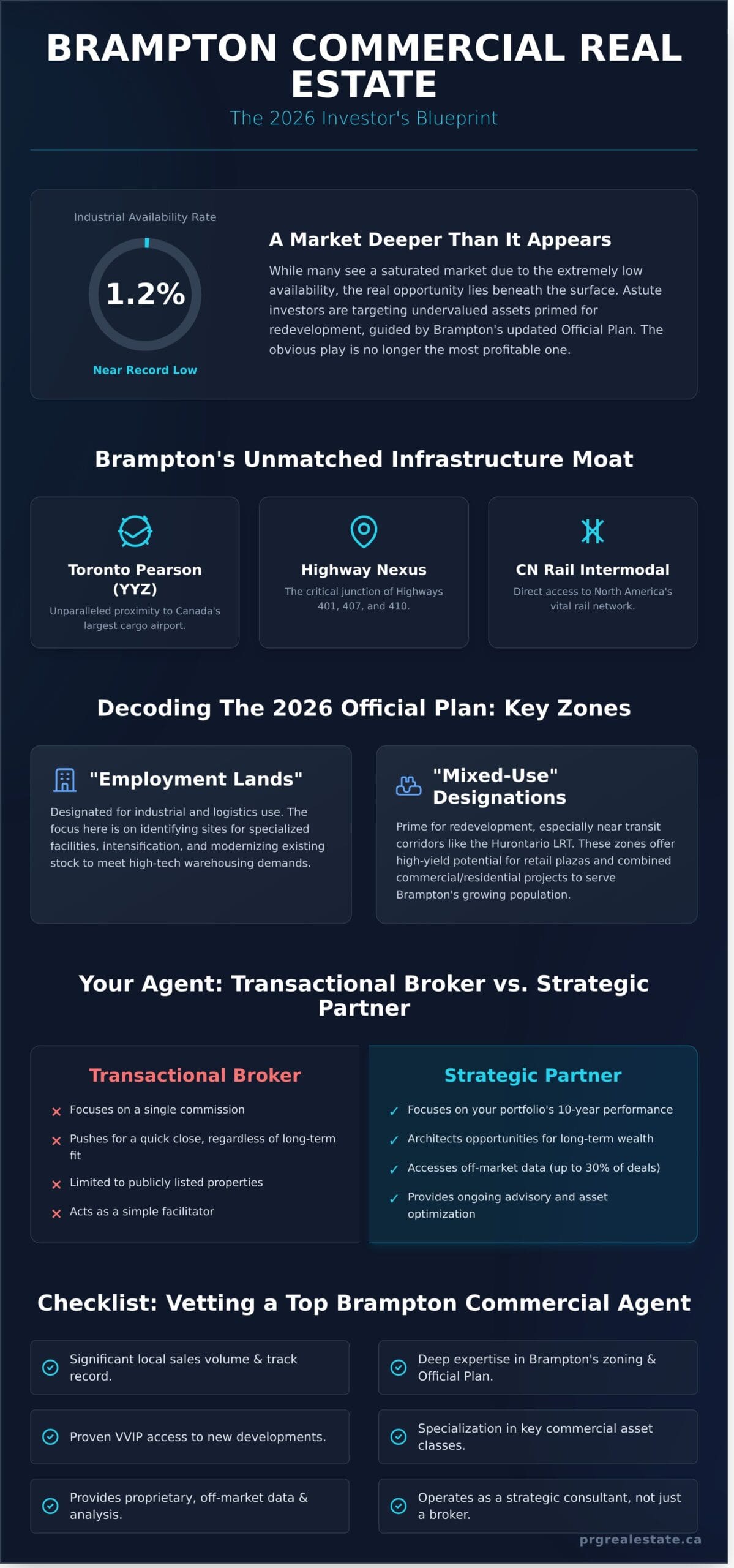
Most investors will miss Brampton’s most profitable commercial real estate opportunities by 2026. While many fixate on the city’s near-record-low 1.2% industrial availability rate and see only saturation, a select few are identifying undervalued assets primed for redevelopment under Brampton’s updated Official Plan. It’s a market where the obvious play is no longer the most strategic one.

It’s understandable to feel hesitant. The combination of fluctuating interest rates, which have compressed cap rates over the last 18 months, and complex municipal zoning changes can make the market feel impenetrable without elite guidance. Finding the right commercial real estate agent Brampton isn’t just an advantage; it’s a necessity. This guide promises to deliver the strategic clarity you need to move with confidence. We will reveal the proven methodologies our top-rated brokerage uses to uncover exclusive off-market properties, secure favourable zoning for high-yield projects, and lock in long-term, high-credit tenants for maximum ROI. Prepare to learn the key submarkets to watch and the tactics required to build a resilient commercial portfolio in Brampton for years to come.

Key Takeaways

  • Learn to identify high-potential investment zones by understanding the strategic differences between “Employment Lands” and “Mixed-Use” designations in Brampton’s 2026 Official Plan.
  • Discover which commercial asset classes, from specialized industrial facilities to high-growth retail plazas, are positioned for maximum returns in Brampton’s evolving market.
  • Develop a checklist to vet a top commercial real estate agent Brampton, focusing on critical metrics like significant sales volume and VVIP access to new developments.
  • Understand how the role of a modern commercial realtor has shifted from a transaction facilitator to a strategic consultant essential for navigating 2026 market complexities.

The Role of a Commercial Real Estate Agent in Brampton’s 2026 Market

In the evolving landscape of 2026, the function of a commercial real estate agent has fundamentally shifted. Gone are the days of simple transaction facilitation. Today, a top-tier commercial real estate agent is a strategic asset manager, architecting opportunities for business growth and long-term wealth creation. This is especially true in a dynamic city like Brampton, where market intelligence and foresight are paramount to securing high-performance assets.

Despite global economic recalibrations, Brampton’s position as the “Logistic Capital of Canada” remains secure. Its unmatched proximity to Toronto Pearson International Airport (YYZ), the nexus of the 401, 407, and 410 highways, and the critical CN Rail Intermodal Terminal creates an infrastructure moat that insulates its industrial sector. For 2026 investors, this means that while other markets may face volatility, Brampton’s core logistics and warehousing demand provides a stable and compelling foundation for investment.

Understanding this market requires a specialist. Unlike residential real estate, which focuses on emotional appeal and neighbourhood amenities, commercial transactions are driven by pure financial metrics: capitalization rates, net operating income, and zoning regulations. The complexity of a Commercial property overview, from M2-zoned industrial properties to C4-zoned retail plazas, demands a dedicated professional who navigates these nuances daily. A residential agent, however skilled, simply doesn’t possess the specialized financial modelling and legal expertise required for a C$10 million warehouse acquisition or a multi-unit plaza lease negotiation.

Why Local Brampton Expertise Matters Now

Hyper-local knowledge is the definitive competitive advantage. An expert commercial real estate agent Brampton understands the city isn’t a monolith but a collection of distinct micro-markets. The industrial corridors along Steeles Avenue West, valued for their 400-series highway access, present entirely different opportunities than the Queen Street corridor, which is undergoing a significant transformation. The Hurontario LRT, with its projected 2024 completion, is already driving up valuations for properties within an 800-meter radius of its new stations, creating prime opportunities for mixed-use and retail redevelopment. A local specialist also provides access to programs like the Downtown Brampton BIA’s façade improvement grants, which can directly impact an investor’s bottom line.

Strategic vs. Transactional Brokerage

A transactional broker focuses on a single commission. A strategic partner focuses on your portfolio’s 10-year performance. This distinction is critical. Transactional agents often miss the long game, pushing for a quick close that may not align with future appreciation or redevelopment potential. The PRG approach is built on an unwavering commitment to becoming “Clients for Life.” We don’t just find you a property in 2026; we provide the advisory to optimize its performance through 2036. This philosophy is powered by access to proprietary, off-market data. In a market as tight as Brampton, upwards of 30% of the most desirable assets trade hands before ever being publicly listed. This is the data that matters, and it’s only available through deep local relationships and a reputation for excellence.

Asset Class Specialization: Finding Value in Every Sector

Success in Brampton’s 2026 commercial real estate market won’t come from a one-size-fits-all approach. It demands a granular understanding of each asset class and its unique drivers. A top-tier commercial real estate agent Brampton doesn’t just find properties; they identify strategic opportunities by dissecting market trends sector by sector. From the logistics corridors humming with activity to the new retail formats serving a booming population, discerning investors know that value is found in the details.

Industrial & Logistics Dominance

Brampton remains the undisputed heart of the GTA’s industrial market, a status cemented by its strategic location. Proximity to Toronto Pearson International Airport and the convergence of Highways 410, 407, and 401 create an unparalleled logistics network. This keeps industrial demand exceptionally high, with vacancy rates consistently hovering below 2%. For 2026, the opportunity lies beyond standard warehousing. Investors should target specialized facilities like third-party logistics (3PL) hubs, cold storage for the grocery sector, and food-grade production buildings. Analyzing the current roster of industrial buildings for sale reveals a clear distinction: small-bay units (under 20,000 sq. ft.) cater to local businesses and command high lease rates per square foot, while large-bay facilities (over 100,000 sq. ft.) attract national distributors on long-term leases, offering stable returns.

Retail and Mixed-Use Opportunities

With a population that grew by 10.6% between the 2016 and 2021 censuses, Brampton’s consumer base is expanding rapidly. This growth fuels a dynamic retail sector. Forward-thinking investors are looking at mixed-use developments that integrate retail with residential, such as the “Storefront Home” model in new master-planned communities. When evaluating a commercial unit for sale in Brampton for retail viability, a rigorous analysis is crucial. Key metrics include daily foot traffic counts, neighbourhood demographics, and the strength of co-tenants. For plaza investors, a detailed credit-tenant analysis is non-negotiable, focusing on the financial stability of anchor tenants like major banks or national grocery chains to secure long-term income.

While the traditional office market adapts to hybrid work models, specialized sectors are thriving. The demand for professional medical buildings, particularly near Brampton Civic Hospital, remains incredibly strong due to an aging population and non-discretionary healthcare spending. These assets offer exceptional stability with long-term tenants. Another growing niche is smaller, move-in-ready office suites equipped with modern tech infrastructure and flexible layouts, designed to attract startups and professional service firms that have downsized their physical footprint but still require a premium corporate address.

For investors with a long-term vision, development land presents the highest potential for appreciation. The most promising opportunities are parcels located along major transit corridors, such as the Hurontario Main Street LRT and the expanded Bramalea GO Station. Identifying land already zoned for high-density residential or mixed-use development is key to mitigating risk. Navigating municipal zoning bylaws and the City of Brampton’s Official Plan requires an expert partner whose professional standing is in good order with the Real Estate Council of Ontario (RECO). This ensures your investment strategy is built on a foundation of regulatory compliance and expert insight. Understanding which asset class aligns with your portfolio is the first step; connect with our advisory team to perform a strategic analysis of your 2026 investment options.

Successful commercial real estate investment in Brampton isn’t just about location; it’s about understanding the city’s strategic vision. The City of Brampton’s Official Plan is the blueprint for future growth, and by 2026, its policies will have profoundly shaped property values and development potential. Investors who fail to grasp the nuances of this plan risk acquiring assets with limited upside or unforeseen restrictions.

A critical distinction lies in land designations. “Employment Lands” are specifically zoned for industrial, warehousing, and office uses, forming the backbone of Brampton’s economic engine. In contrast, “Mixed-Use” corridors, particularly along major arterials, are designated for higher-density projects combining retail, commercial, and residential components. For ambitious projects, land assembly—the strategic acquisition of multiple adjacent properties—is often required. This is a complex, high-stakes process involving discreet negotiations and a deep understanding of individual landowner motivations. An expert commercial real estate agent Brampton is indispensable in mitigating these risks, liaising directly with city planners to verify development feasibility and de-risk your purchase before you commit significant capital.

Transit-Oriented Development (TOD)

Brampton’s commitment to public transit is creating concentrated pockets of high-value opportunity. The Hurontario LRT, slated for completion in 2024, and the corresponding “Main Street North” redevelopment plan are set to transform key corridors. Real estate studies consistently show that commercial properties within a 500-meter radius of major transit hubs can command a 15-20% value premium. Strategic acquisition near future GO Transit expansion points, like those along the upgraded Kitchener line, offers a direct path to long-term appreciation.

Zoning Bylaws and Permitted Uses

Zoning details can make or break an investment. A common pitfall is purchasing a “warehouse for sale” only to discover its zoning prohibits your specific logistics or manufacturing operation due to noise or emission bylaws. Navigating these rules may require a minor variance application for small adjustments or a full rezoning for a change of use—a costly and lengthy process. Furthermore, for most commercial and industrial sites in Brampton, a Phase I & II Environmental Site Assessment is not just recommended; it’s essential due diligence to uncover potential soil or groundwater contamination liabilities.

Understanding this intricate regulatory environment is fundamental. It requires a partner who can interpret municipal code, anticipate planning hurdles, and align your investment goals with the city’s approved vision for growth. This proactive guidance ensures your 2026 investment strategy is built on a solid foundation of compliance and strategic foresight.
Commercial Real Estate Agent Brampton: Strategic Guidance for 2026 Investors

How to Vet a Commercial Real Estate Agent: A 2026 Checklist

Selecting your representative in Brampton’s competitive commercial market is the single most critical decision you’ll make. The right agent is more than a facilitator; they are a strategic partner whose expertise directly impacts your ROI. For 2026 and beyond, your vetting process must be rigorous, focusing on four non-negotiable pillars: a verifiable track record, an exclusive network, elite data access, and uncompromising integrity.

A proven track record is measured in closed deals, not just years of experience. Demand to see a portfolio of significant sales volume specifically within Brampton’s commercial sector, such as industrial properties near the CN Rail Yard or retail plazas along Queen Street. An elite commercial real estate agent Brampton leverages more than the public MLS. They subscribe to and analyze data from premium platforms like CoStar and Altus Group’s REALNET, which provide granular insights on vacancy rates, absorption trends, and comparable sales down to the square foot. Even more valuable are their proprietary off-market lists, which contain opportunities that never face public competition.

The VVIP Access Advantage

Top-performing agents cultivate deep relationships with developers, granting them VVIP access to new commercial condo units or land acquisition opportunities before they are ever marketed. This network is a powerful asset, particularly for investors seeking to secure premier locations in projects like the Brampton Business Centre. At PRG, our connections mean we are often the first to be consulted on confidential “business for sale in Brampton” opportunities, giving our clients a decisive first-mover advantage.

Finally, integrity is the foundation of a successful long-term partnership. A slogan like “unwavering commitment to excellence” must be backed by transparent practices and a fiduciary-first mindset. It’s the difference between an agent who pushes a quick deal and a strategist who advises you to walk away from a transaction that doesn’t align with your five-year goals. This philosophy is central to our goal of building relationships with “clients for life,” ensuring our advice is always aligned with your best interests, not our commission.

Evaluating Agent Transparency

An agent’s transparency is a direct reflection of their integrity. You must ask direct questions about commission structures and their policy on dual agency. Verify their performance claims through third-party validation. For example, the prestigious Royal LePage® Red Diamond™ Award is given to only the top 2% of its agents across Canada, offering objective proof of elite performance. True expert advice is data-driven and objective; a sales pitch is transactional and emotional. Choose the expert.

Your 2026 investment strategy deserves a partner who meets these stringent criteria. Don’t settle for average representation when market-leading expertise is available. To ensure your next commercial acquisition is guided by proven success and unparalleled market intelligence, connect with PRG Real Estate’s top commercial team today.

Why PRG is the Strategic Choice for Brampton Commercial Real Estate

Selecting the right advisory team is the single most critical decision an investor will make ahead of 2026. In a market as dynamic as Brampton’s, your success depends not just on the property you acquire, but on the strategic intelligence guiding that acquisition. Pabla Realtor Group (PRG) isn’t simply a brokerage; we are a results-driven team of specialists engineered to maximize your portfolio’s potential and deliver measurable returns.

Our firm is led by Broker of Record, Harsh Pabla, an award-winning professional whose reputation is built on a foundation of unwavering integrity and a track record of success. His consistent achievement of the Royal LePage® Red Diamond™ Award, placing him in the top 2% of agents nationwide, is a testament to the high-caliber results he delivers. This leadership instills a culture of excellence throughout our team, ensuring every client benefits from elite-level expertise and a commitment to achieving their financial objectives.

This commitment is codified in our “Clients for Life” philosophy. Where other firms focus on closing a single deal, we focus on opening a long-term strategic partnership. We manage the relationship, not just the transaction. This means providing ongoing advisory services, portfolio performance reviews, and proactive identification of future acquisition or disposition opportunities that align with your evolving goals. We don’t just find you a property; we help you build a legacy.

At PRG, our promise extends beyond individual transactions to the community itself. We are dedicated to facilitating innovative, sustainable, and forward-thinking developments that contribute to a thriving Brampton. When you partner with us, you’re investing in a team that is shaping the future of the city’s commercial landscape for the better.

Our Multi-Disciplinary Approach

Our integrated structure gives our clients a decisive market advantage. The seamless collaboration between our residential and commercial teams provides unparalleled insight into mixed-use development projects, ensuring commercial viability is supported by real-time residential demand data. From initial site acquisition and zoning analysis to project completion, our comprehensive development services offer a single, expert point of contact. For a deeper analysis of market trends, explore our Brampton Commercial Real Estate Guide.

Getting Started with PRG

Your 2026 investment strategy begins with a conversation. We invite you to book a confidential consultation to outline your objectives with a top commercial real estate agent Brampton investors rely on. Our process involves creating a customized property search meticulously calibrated to your specific ROI requirements, whether it’s targeting assets with a 6% cap rate or identifying value-add opportunities with clear upside potential. Let’s build your future success together. Partner with Brampton’s top commercial realtors today.

Secure Your 2026 Brampton Investment Advantage

As we look toward 2026, Brampton’s commercial landscape presents immense opportunities for prepared investors. Your success will hinge on navigating the city’s complex zoning regulations and identifying true value across all asset classes. This isn’t a market for guesswork; it’s a market that demands a strategic partner with a proven record of excellence. Choosing the right commercial real estate agent Brampton provides isn’t just a transaction, it’s a decisive competitive edge.

At PRG Real Estate, our performance is quantified by results. As recipients of the Royal LePage® Red Diamond™ Award, our team ranks in the top 2% of agents across Canada. We leverage specialized expertise in Brampton’s development sector to deliver our clients unparalleled guidance and access to high-potential opportunities. Our commitment is to transform your investment goals into tangible, high-value assets.

The time to build your 2026 strategy is now. Secure Your Strategic Advantage with PRG Real Estate and partner with a team dedicated to your long-term success.

Frequently Asked Questions

What is the current state of the Brampton commercial real estate market in 2026?

The Brampton commercial real estate market in 2026 is characterized by robust industrial demand and evolving retail needs. Industrial vacancy rates remain exceptionally low, hovering around 1.5%, driven by the city’s logistics and advanced manufacturing sectors. Meanwhile, retail is shifting towards mixed-use developments, particularly along key transit corridors like the Hurontario LRT. Office space is stabilizing with a focus on high-quality, flexible workspaces to accommodate hybrid models.

How do commercial real estate commissions work in Ontario?

Commercial real estate commissions in Ontario are negotiable and typically paid by the seller or landlord. The total commission, often ranging from 3% to 6% of the sale price or lease value, is split between the brokerages representing the seller/landlord and the buyer/tenant. For example, a common structure on a C$10 million sale might be 3% on the first C$1 million and 1.5% on the balance, divided between the two parties.

What is the difference between a real estate agent and a commercial broker?

A commercial broker possesses specialized expertise and licensing focused exclusively on investment and business properties, whereas a real estate agent often handles residential transactions. Brokers undergo more extensive training to manage complex issues like commercial zoning, property valuation, environmental assessments, and intricate lease negotiations. This focused knowledge is critical for navigating the financial and legal nuances inherent in commercial real estate acquisitions and dispositions.

Can a residential realtor help me buy a warehouse in Brampton?

It’s highly inadvisable to use a residential realtor for a commercial purchase like a warehouse. They lack the critical expertise in industrial zoning laws, loading dock specifications, ceiling height requirements, and Phase I Environmental Assessments. A successful industrial investment requires a specialist who understands the logistics sector’s unique demands. Engaging a dedicated commercial professional ensures your asset meets both operational needs and long-term investment criteria.

How does the Hurontario LRT affect commercial property taxes in Brampton?

The Hurontario LRT is projected to increase commercial property values along its route, which will lead to higher property tax assessments by MPAC. Properties located within a 500-meter radius of an LRT station are expected to see assessment values climb by 10-20% over the five years following the line’s full operational launch. Investors should proactively factor this phased tax increase into their financial models to accurately forecast net operating income.

What are the most profitable commercial asset classes in the GTA right now?

Industrial properties and multi-family residential buildings are the top-performing commercial asset classes in the Greater Toronto Area for 2026. The industrial sector, especially logistics and cold storage facilities in Brampton and Mississauga, is experiencing rental growth above 7% year-over-year due to e-commerce demand. Multi-family assets provide stable returns, with vacancy rates below 2% across the GTA, ensuring consistent cash flow and strong appreciation.

How do I find off-market commercial properties in Brampton?

Finding off-market properties requires leveraging the network of a deeply connected commercial real estate agent in Brampton. These exclusive opportunities aren’t publicly listed and are sourced through established relationships with property owners, developers, and financial institutions. Our team at PRG Real Estate utilizes a proprietary database and decades of market presence to provide our clients with VVIP access to these strategic investment opportunities before they become common knowledge.

What environmental checks are required for commercial property in Ontario?

A Phase I Environmental Site Assessment (ESA) is the standard due diligence requirement for commercial property transactions in Ontario. This assessment investigates the property’s historical use to identify any potential for contamination. If the Phase I ESA flags potential risks, a Phase II ESA is then mandated. The Phase II assessment involves collecting and analyzing soil and groundwater samples to confirm the presence and extent of any contaminants.

Retail Space for Sale GTA: The Ultimate 2026 Buyer's Guide
CategoriesBlog

Retail Space for Sale GTA: The Ultimate 2026 Buyer’s Guide

The Greater Toronto Area’s retail market presents a landscape of immense opportunity-and significant challenges. For entrepreneurs and investors alike, navigating the search for retail space for sale GTA can be an overwhelming ordeal, marked by high stakes, complex zoning laws, and the persistent fear of hidden costs. It’s a dynamic market where strategic decisions define success, and a single misstep can prove exceptionally costly to your business or portfolio.

This is where clarity and expert guidance become your most valuable assets. Our Ultimate 2026 Buyer’s Guide is engineered to cut through the noise, providing the strategic insights you need to confidently evaluate a property’s financial viability, identify locations primed for high visibility, and understand the nuances of the GTA’s key retail hubs. Prepare to move beyond uncertainty and secure the perfect commercial space with unwavering confidence and a clear path to success.

Key Takeaways

  • Strategically match your business model to the right type of retail property-from high-street storefronts to plaza units-to maximize your investment’s potential.
  • Master a due diligence checklist to evaluate properties beyond the asking price, assessing crucial factors like zoning, demographic trends, and long-term asset value.
  • Confidently navigate the complex purchase process for any retail space for sale GTA, from securing commercial financing to successfully closing the deal.
  • Learn how partnering with a commercial real estate specialist provides a critical advantage through expert negotiation and access to off-market opportunities.

Decoding the GTA Retail Landscape: Types of Spaces & Key Markets

Securing the right commercial property is a strategic imperative for any successful business or investor. The Greater Toronto Area presents a dynamic and complex market, where understanding the nuances of property types and regional economic drivers is paramount. Before diving into specific listings, it’s essential to grasp the fundamentals of what is commercial property and how its different forms serve distinct strategic goals. A well-informed approach ensures your investment aligns perfectly with your operational needs and long-term financial objectives.

Types of Retail Properties Explained

Choosing the correct asset class is the first step in refining your search for retail space for sale GTA. Each property type offers unique advantages:

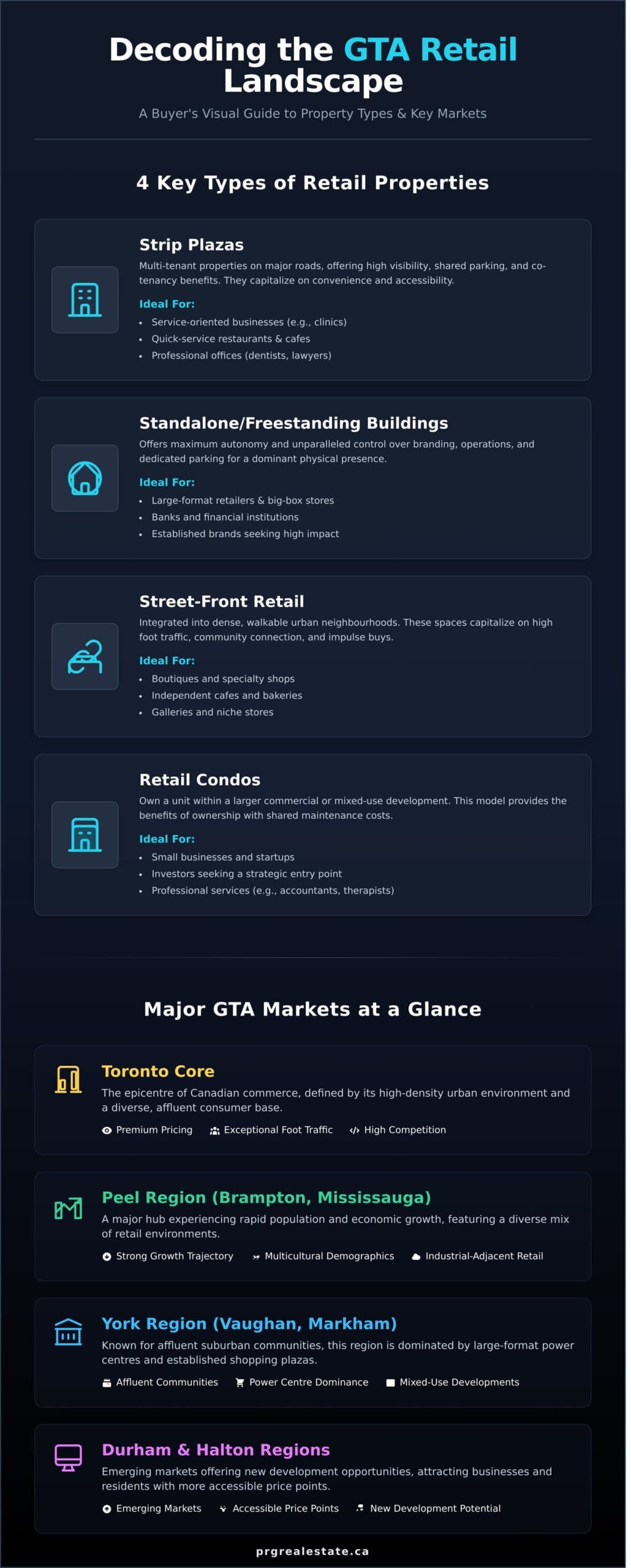
  • Strip Plazas: These multi-tenant properties offer high visibility on major arterial roads and benefit from shared parking and co-tenancy. They are ideal for service-oriented businesses like clinics, quick-service restaurants, and professional offices that thrive on convenience and accessibility.
  • Standalone/Freestanding Buildings: Offering maximum autonomy, these properties provide unparalleled control over branding, operations, and parking. They are a prime choice for large-format retailers, banks, and established brands seeking a dominant physical presence.
  • Street-Front Retail: Integrated into dense, walkable urban neighbourhoods, these spaces capitalize on high foot traffic. They are perfectly suited for boutiques, cafes, and specialty shops that benefit from a strong community connection and impulse buys.
  • Retail Condos: This model allows you to own a unit within a larger commercial plaza or mixed-use development. It provides the benefits of property ownership with shared maintenance costs, making it a strategic entry point for small businesses and investors.

Major GTA Markets at a Glance

The GTA is not a monolith; each region presents a distinct investment landscape with its own consumer demographics and growth trajectory.

  • Toronto Core: The epicentre of Canadian commerce, characterized by high-density, a diverse consumer base, and premium pricing. Foot traffic is exceptional, but so is the competition.
  • Peel Region (Brampton, Mississauga): A hub of rapid population and economic growth. This area features a strong mix of industrial-adjacent retail and bustling suburban shopping centres catering to a multicultural demographic.
  • York Region (Vaughan, Markham): Known for its affluent suburban communities, York is dominated by large power centres, established plazas, and a growing number of mixed-use developments.
  • Durham & Halton Regions: These are emerging markets offering significant new development opportunities and more accessible price points. They are attracting both new businesses and residents, signaling strong future growth potential.

The Investor’s Checklist: How to Evaluate a Retail Property

Securing a high-value commercial property requires a strategic evaluation that extends far beyond the initial asking price. Seasoned investors understand that true value is uncovered through meticulous due diligence, focusing on the tangible metrics that drive long-term profitability. This checklist provides the expert framework to assess any retail space for sale in the GTA, ensuring your capital is deployed with precision and foresight.

Location & Accessibility Analysis

The adage “location, location, location” is paramount in retail. A comprehensive analysis involves more than a simple map search. Your due diligence should include:

  • Traffic and Demographics: Verify vehicle and pedestrian traffic counts using municipal data or third-party studies. Analyze neighbourhood demographics to ensure the local consumer base aligns with your target market’s spending habits.
  • Visibility and Access: Evaluate the property’s street-front visibility, potential for prominent signage, and ease of access for customers, including parking availability and entry/exit points.
  • Retail Synergy: Assess proximity to anchor tenants (like major grocery stores or banks) and complementary businesses that draw a consistent flow of potential customers to the area.

Zoning, Condition, and Permitted Use

Operational viability depends on the property’s physical and legal standing. Before proceeding, you must confirm the site’s suitability. Investigate municipal zoning bylaws and future land use plans to ensure your intended use is permitted. A professional Property Condition Assessment (PCA) is non-negotiable; it uncovers the true state of the building’s structure, roof, and essential systems, identifying potentially costly future repairs. If the property has existing tenants, a thorough review of all lease agreements is critical to understand current income, terms, and obligations.

Financial Due Diligence: Beyond the Price Tag

A successful investment is built on sound financial analysis. Go beyond the surface-level numbers to calculate the property’s true potential. Key metrics include the Capitalization (Cap) Rate, which indicates the rate of return based on expected income. You must also project the Cash-on-Cash Return to understand your ROI on the actual capital invested. Scrutinize all operating expenses, from property taxes and insurance to common area maintenance (CAM) costs. Finally, comparing the property to recent, similar sales (comparables) is fundamental. For a definitive standard on this process, investors should align their analysis with Canada’s official property valuation guidelines, which set the benchmark for accurate market assessment.

Retail Space for Sale GTA: The Ultimate 2026 Buyer's Guide

The Purchase Process: From Securing Financing to Closing the Deal

Navigating the acquisition of commercial real estate is a disciplined, multi-stage process that demands precision and strategic insight. Unlike residential transactions, purchasing retail space for sale in the GTA involves greater complexity and higher stakes. Understanding this path is the first step toward a successful investment. At PRG Real Estate Brokerage, we demystify this journey, guiding you from initial financial preparations to the final transfer of ownership with unwavering expertise.

Step 1: Financing and Pre-Approval

Securing financing for a commercial property is fundamentally different from a residential mortgage. Lenders assess the property’s potential income and your business’s financial health, not just personal credit. A comprehensive business plan and detailed financial statements are non-negotiable. We strongly advise obtaining financing pre-approval before beginning your search. This step not Monly defines your budget but also positions you as a credible, serious buyer in a competitive market. Options range from traditional bank loans to CMHC-insured financing and private lending solutions.

Step 2: Making an Offer and Negotiation

Once you identify a target property, the next step is structuring a compelling offer. This typically begins with a Letter of Intent (LOI) to outline key terms, followed by a formal, legally binding Agreement of Purchase and Sale (APS). Strategic negotiation is critical, focusing on more than just price. Key terms include:

  • Purchase Price: The initial offer and subsequent counter-offers.
  • Closing Date: The timeline for finalizing the transaction.
  • Conditions (Clauses): Safeguards that must be met, such as securing financing, satisfactory building inspections, and environmental assessments.

An expert commercial realtor is your greatest asset here, leveraging market knowledge to negotiate terms that protect your interests and optimize your investment.

Step 3: Due Diligence and Closing

After an offer is accepted, the conditional or “due diligence” period begins. This is a critical window to verify every aspect of the property with a team of professionals, including lawyers, accountants, and inspectors. Key activities include conducting a title search, performing environmental site assessments (ESAs), and confirming the property’s physical condition and zoning compliance. Analyzing the investment against current Canadian commercial real estate market trends ensures its long-term viability. Once all conditions are waived and financing is finalized, your lawyer will prepare the statement of adjustments and facilitate the transfer of ownership, officially closing the deal on your new retail space.

Why Partner with a Commercial Real Estate Specialist?

Identifying potential properties is a crucial first step, but securing the right asset on optimal terms requires a level of expertise that goes far beyond public listings. In the highly competitive Greater Toronto Area, the difference between a profitable investment and a costly mistake often comes down to the partner you choose. Attempting to navigate this complex market alone or with a generalist realtor can expose you to unseen risks, missed opportunities, and unfavourable negotiations.

A dedicated commercial real estate specialist acts as your strategic advisor, providing the market intelligence and industry access necessary to achieve your investment objectives. Their value is measured not in commissions, but in the long-term success of your acquisition.

The Strategic Advantage of Market Expertise

Partnering with a top-tier commercial realtor provides an immediate and decisive competitive advantage. This expertise manifests in several critical areas:

  • Access to Off-Market Properties: Gain exclusive entry to a pipeline of retail properties that are not advertised publicly, giving you the first opportunity to evaluate and acquire premier assets.
  • Deep Regulatory Knowledge: Navigate complex local zoning, municipal bylaws, and future development plans with confidence, ensuring your chosen property aligns with your business goals and avoids costly compliance issues.
  • Expert Valuation and Analysis: Leverage sophisticated, data-driven valuation techniques to ensure you pay the right price. We analyze sales comparables, income potential, and market trends to protect your capital.
  • An Established Professional Network: Instantly connect with our trusted network of commercial lawyers, lenders, contractors, and inspectors, streamlining every stage of the transaction.

How PRG Real Estate Delivers Results

At PRG Real Estate, our entire approach is engineered to deliver superior outcomes for our clients seeking retail space for sale GTA-wide. We don’t just facilitate transactions; we build strategic partnerships. Our focus on data-driven investment analysis means every recommendation is backed by rigorous market intelligence. We employ proven negotiation tactics to secure the most favourable terms, from price to closing conditions, safeguarding your interests at every turn.

Our commitment is to become your trusted advisors for life. This philosophy drives our unwavering dedication to client success, from securing your first property in Brampton’s commercial core to expanding your portfolio into the GTA’s emerging markets.

Your Next Steps to Acquiring Retail Property

The path to acquiring your ideal retail property begins with a clear, strategic plan. We start with a no-obligation consultation to understand your specific business objectives, investment criteria, and long-term vision. From there, we develop a customized property search and acquisition strategy tailored to your unique needs.

Take the decisive step towards securing your next commercial investment. Schedule your strategic consultation with our experts today.

Your Next Step Towards Commercial Excellence in the GTA

Navigating the Greater Toronto Area’s dynamic commercial landscape requires a strategic, informed approach. As this guide has detailed, your success hinges on a deep understanding of the diverse property types across key markets, conducting meticulous due diligence using a comprehensive investor’s checklist, and mastering the legal and financial complexities of the purchase process. Ultimately, the most critical factor in securing a profitable retail space for sale GTA is partnering with a specialist who provides expert guidance.

At PRG Real Estate, our team embodies this specialized expertise. We deliver a proven, results-oriented approach focused on identifying and securing strategic investments that align with your long-term portfolio goals. Led by our award-winning Broker of Record, Harsh Pabla, our firm’s unwavering commitment to excellence ensures you receive unparalleled market insight and formidable negotiation power. Don’t leave your next major acquisition to chance; partner with a team built on trust, loyalty, and a track record of success.

Connect with PRG’s top commercial realtors to find your ideal retail space.

Your 2025 commercial real estate success story starts now.

Frequently Asked Questions About Retail Space for Sale in the GTA

What is a ‘Cap Rate’ and how is it used to evaluate retail properties?

The Capitalization Rate, or ‘Cap Rate,’ is a fundamental metric in commercial real estate. It is calculated by dividing a property’s Net Operating Income (NOI) by its current market value, expressed as a percentage. Investors utilize the Cap Rate to efficiently compare the profitability and risk profile of various properties. A higher Cap Rate generally suggests a higher potential return on investment but may also indicate greater associated risk.

How much capital do I need for a down payment on a commercial retail space in the GTA?

In Canada, commercial mortgages require a more substantial down payment than residential loans. For a retail property in the Greater Toronto Area, prospective buyers should prepare for a minimum down payment ranging from 25% to 35% of the total purchase price. This figure can fluctuate based on the lender’s criteria, the property’s specifics, and your financial strength. Consulting a commercial mortgage specialist is a crucial step to determine your exact capital requirements.

What are the main differences between buying a retail property versus leasing one?

Buying a retail property is a strategic investment that allows you to build equity, gain from potential appreciation, and maintain full control over your premises. In contrast, leasing offers greater flexibility, requires significantly less upfront capital, and typically places the burden of major property maintenance on the landlord. The optimal decision depends on your company’s long-term strategic goals, financial capacity, and operational needs, weighing the benefits of ownership against the flexibility of leasing.

How long does the entire process of buying a retail space typically take?

The timeline for acquiring a commercial retail space varies based on transaction complexity. From the initial property search and analysis to the final closing, the process typically spans from three to nine months. This period includes critical stages such as conducting comprehensive due diligence, securing appropriate financing, and finalizing all legal documentation. Engaging an expert commercial real estate team is essential to navigate this process efficiently and avoid unnecessary delays.

What are the most common mistakes first-time commercial investors make?

First-time investors often make the critical error of performing inadequate due diligence, overlooking crucial details like zoning restrictions, environmental reports, and building condition. Another frequent mistake is underestimating the total acquisition and operational costs. Attempting to navigate the market for retail space for sale GTA without representation from a seasoned commercial realtor can lead to a misaligned investment that fails to meet strategic objectives.

Can I buy a retail property through my corporation?

Yes, purchasing commercial real estate through a corporation is a standard and often advantageous practice. This structure provides a crucial layer of liability protection, separating your personal assets from your business interests. It can also offer distinct tax efficiencies. To ensure you establish the most beneficial ownership structure for your investment goals, it is imperative to seek professional advice from your legal and accounting advisors before proceeding with an acquisition.

Mastering Commercial Real Estate Negotiation: A Strategic Guide
CategoriesBlog

Mastering Commercial Real Estate Negotiation: A Strategic Guide

In the high-stakes world of commercial real estate, the difference between a landmark acquisition and a costly liability is determined at the negotiation table. The anxiety is palpable: the fear of overpaying, the risk of overlooking a hidden clause in a complex contract, or the feeling of being outmaneuvered by a more experienced party. True success in this arena hinges on mastering the art and science of commercial real estate negotiation, transforming potential vulnerabilities into strategic advantages.

This definitive guide is designed to elevate your approach from uncertain to authoritative. We will provide you with the essential strategies and expert-level tactics used by top professionals across Canada to command every stage of the discussion. You will learn how to confidently dissect terms, leverage information, and protect your financial interests with unwavering precision. Prepare to navigate your next transaction with the control and confidence required to secure the best possible outcome for your investment.

Key Takeaways

  • Establish a strategic advantage before talks begin by conducting thorough due diligence and defining your non-negotiable investment objectives.
  • A successful commercial real estate negotiation focuses on strategic, interest-based tactics to create value, not just argue over the price.
  • Protect your investment by mastering the critical contract clauses within the Purchase and Sale Agreement that can make or break your deal.
  • Leverage the expertise of a seasoned commercial realtor to act as your strategic advocate and guide through the complexities of high-stakes transactions.

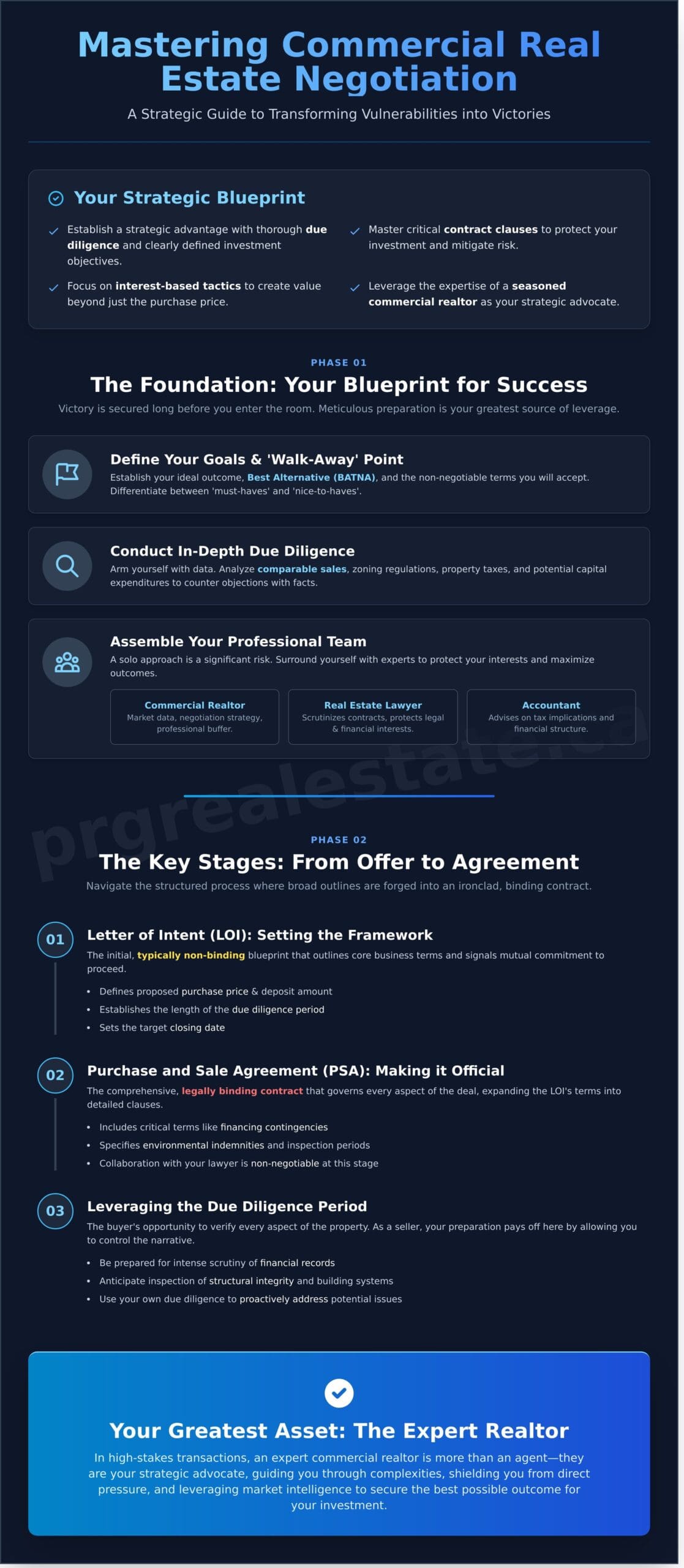
The Foundation: How to Prepare for a Winning Negotiation

In the high-stakes world of commercial real estate, victory is not achieved at the closing table-it’s secured long before you ever enter the room. A successful commercial real estate negotiation hinges on meticulous preparation. This foundational stage is your single greatest source of leverage, allowing you to enter discussions from a position of strategic strength, not hopeful reaction. By establishing clear objectives and conducting deep research, you build an unshakeable case for your property’s value.

Defining Your Goals and ‘Walk-Away’ Point

Clarity of purpose is non-negotiable. Before engaging with any potential buyer, you must define your precise objectives. This involves establishing your ideal outcome (target price, closing timeline, specific conditions) and, just as critically, your Best Alternative to a Negotiated Agreement (BATNA). Your BATNA informs your ‘walk-away’ point-the absolute minimum price and set of terms you will accept. Differentiating between your ‘must-haves’ and ‘nice-to-haves’ provides the flexibility needed to concede on minor points while holding firm on what truly matters.

Conducting In-Depth Due Diligence

True market intelligence goes far beyond a simple asking price. A comprehensive due diligence process involves a deep analysis of comparable sales (comps) to validate your valuation. It’s essential to investigate municipal zoning regulations, current property taxes, and any potential future assessments that could impact value. A thorough property condition assessment will identify capital expenditures a buyer may use as a bargaining chip. Understanding these commercial real estate fundamentals and the specific market trends in Brampton and the Greater Toronto Area (GTA) equips you with the data needed to counter any objection with confidence.

Assembling Your Professional Team

Navigating a complex commercial real estate negotiation alone is a significant risk. Assembling a dedicated team of professionals is a strategic investment that protects your interests and maximizes your outcome. Your core team should include:

  • An Expert Commercial Realtor: Provides critical market data, develops negotiation strategy, and acts as a professional buffer between you and the buyer.
  • A Real Estate Lawyer: Scrutinizes every detail of the Agreement of Purchase and Sale, ensuring your legal and financial interests are protected.
  • An Accountant: Advises on the tax implications and verifies the financial structure of the deal to ensure its long-term viability for your portfolio.

The Key Stages: From Initial Offer to Final Agreement

A successful commercial real estate negotiation is not a single event but a structured process. Each stage, from the initial handshake to the final signature, presents a strategic opportunity to strengthen your position and maximize your return. Understanding these distinct phases is essential for any seller looking to prevent costly errors and secure the best possible outcome for their asset. Each step builds upon the last, moving from a broad outline to a binding, ironclad contract.

The Letter of Intent (LOI): Setting the Framework

The Letter of Intent (LOI) serves as the initial blueprint for the transaction. While typically non-binding in Canada, it outlines the core business terms and demonstrates a mutual commitment to proceed. An effective LOI clearly defines key parameters, including:

  • The proposed purchase price
  • The initial deposit amount
  • The length of the due diligence period
  • The target closing date

This document is your first real test of the buyer’s seriousness and flexibility. Crucially, always ensure your legal counsel includes language explicitly stating the LOI is non-binding until a formal Purchase and Sale Agreement is executed.

The Purchase and Sale Agreement (PSA): Making it Official

Once the LOI is agreed upon, the transaction moves to the Purchase and Sale Agreement (PSA). This is the comprehensive, legally binding contract that will govern every aspect of the deal. Here, the broad strokes of the LOI are expanded into detailed clauses, including critical terms like financing contingencies, environmental indemnities, and specific inspection periods. Collaborating closely with your lawyer is non-negotiable at this stage. A detailed strategic negotiation analysis reveals that the fine print in the PSA dictates the balance of power and risk. This document is the definitive roadmap to closing.

Leveraging the Due Diligence Period

The due diligence period is the buyer’s opportunity to verify every aspect of the property, from its structural integrity to its financial records. As a seller, you must be prepared for this scrutiny. If unforeseen issues arise-such as a necessary roof repair or an environmental concern-they become powerful renegotiation tools for the buyer. However, this is also your final opportunity to control the narrative. By proactively addressing potential findings, you can offer strategic concessions, such as a price reduction or a credit at closing, to keep the deal on track and prevent it from collapsing before it becomes firm.

Proven Negotiation Strategies to Secure the Best Terms

Mastering the art of commercial real estate negotiation means moving beyond a simple back-and-forth on price. True success lies in a strategic, interest-based approach that uncovers creative solutions, builds leverage, and secures the most advantageous terms for your asset. It’s about understanding the psychology of the deal and controlling the flow of the conversation to achieve your primary objectives.

Think Beyond Price: Uncovering Mutual Interests

A truly strategic deal addresses more than just the final number. By asking insightful questions, you can uncover the buyer’s core motivations. Do they need a rapid closing to meet an operational deadline? Are there specific tax implications in the Canadian market driving their timeline? Offering a concession that is low-cost to you-like a flexible possession date-can often secure a higher price or fewer conditions, transforming a potential deadlock into a win-win agreement and building valuable goodwill.

Controlling the Narrative and Creating Leverage

In any high-stakes negotiation, the party with superior information holds a distinct advantage. Your position is strengthened by what you don’t reveal. Never disclose your ‘walk-away’ price or any sense of urgency to sell. The most powerful tool in your arsenal is your Best Alternative to a Negotiated Agreement (BATNA)-whether it’s another interested buyer or the financial stability to hold the property. Projecting the confidence that you are prepared to walk away from an unfavourable deal is paramount.

Common Tactics and How to Respond

Sophisticated buyers often employ proven tactics. Recognizing them is the first step to effectively countering them and protecting your interests:

  • The Low-Ball Offer: Do not be offended or dismiss it outright. Respond professionally with a reasonable counter-offer, reinforcing your position with market data, recent comparable sales, and the unique value proposition of your property.
  • The Nibble: After agreeing on major terms, a buyer may ask for small, last-minute concessions just before closing. Address these strategically. Either stand firm or concede on a minor point in exchange for one of your own to prevent an erosion of your deal’s value.
  • Good Cop/Bad Cop: One person on the buyer’s team may seem aggressive while another appears reasonable. Recognize this as a tactic to pressure you. Ignore the dynamic and focus exclusively on the objective merits and figures of the deal.
  • Time Pressure: A buyer may create artificial deadlines to force a hasty decision. Maintain control of the timeline. A rushed decision is rarely the best one, so insist on the time required for proper due diligence.

Mastering Commercial Real Estate Negotiation: A Strategic Guide

Decoding the Fine Print: Critical Contract Clauses

While the purchase price often dominates headlines, the true success of a transaction is forged in the details of the Agreement of Purchase and Sale (APS). This legally binding document outlines the precise terms, rights, and obligations of each party. A masterful commercial real estate negotiation hinges on strategically shaping these clauses to protect your interests and ensure a smooth path to closing. Overlooking this fine print is a risk no serious seller can afford. Your legal and real estate advisors are indispensable partners in navigating this complexity.

Representations and Warranties (‘Reps & Warranties’)

These are statements of fact that you, the seller, guarantee to be true at the time of closing. As a seller, your objective is to limit these representations to matters within your direct knowledge and to negotiate the shortest possible “survival period”-the timeframe after closing during which you remain liable for a breach. Common examples include:

  • Your legal authority to sell the property.
  • Compliance with current environmental regulations.
  • The absence of any pending or threatened litigation.

Contingencies: Understanding the Buyer’s Safety Nets

Contingencies are conditions that must be met for the deal to become firm, effectively serving as the buyer’s contractual escape hatches. Your goal is to negotiate for tight, well-defined deadlines to minimize uncertainty. Key contingencies to manage include the buyer’s right to secure financing, conduct satisfactory due diligence (inspections), and obtain necessary zoning or land-use approvals. A firm, non-conditional offer is always the strongest position for a seller.

Closing Adjustments, Prorations, and Credits

The final financial accounting of the deal occurs at closing. It is critical to understand how costs are divided. Prorations are standard adjustments for shared, ongoing expenses like property taxes, tenant rent, and utilities, which are split between you and the buyer based on the closing date. You may also negotiate credits to the buyer in lieu of performing repairs discovered during due diligence. A meticulous review of the final Statement of Adjustments with your lawyer is essential to ensure accuracy and protect your bottom line.

Navigating the intricacies of the APS is where expert guidance provides its greatest value. An experienced advisory team ensures every clause is structured to your advantage, securing the successful outcome your asset deserves. For strategic support in your next transaction, partner with the experts at PRG Real Estate Brokerage.

The PRG Advantage: Why an Expert Realtor is Your Greatest Asset

Executing a successful sale requires more than just a willing buyer; it demands strategic expertise and flawless execution. The process of commercial real estate negotiation is a high-stakes discipline where minor oversights can result in significant financial consequences. An elite commercial realtor from PRG Real Estate is not merely an agent; they are your strategist, advocate, and guide, transforming a complex transaction into a streamlined success. Partnering with an expert is a direct investment in maximizing your return.

Unmatched Market Intelligence and Valuation

Our team provides a decisive edge with access to proprietary sales data and off-market opportunities that are invisible to the public. We deliver an objective, data-driven valuation of your asset, establishing a powerful and defensible negotiating position from the outset. This intelligence ensures you command the highest possible price in any market cycle, preventing you from leaving money on the table or misjudging your asset’s true worth in the Canadian market.

Strategic Counsel and an Emotional Buffer

High-value negotiations can become tense and emotionally charged. Our realtors act as a crucial buffer, managing difficult conversations and filtering out unproductive communication to keep the focus strictly on your financial goals. We provide the clear-headed, strategic counsel needed to navigate every stage of the deal. We advise on:

  • When to apply pressure and push for better terms.
  • When to make a strategic concession to maintain momentum.
  • When the terms are no longer favourable and it is time to walk away.

Let our experts lead your next negotiation and secure the optimal outcome for your portfolio.

Mastery of the Process and Paperwork

A successful negotiation culminates in a flawless closing. Our experts masterfully manage the intricate timeline of a transaction, ensuring all deadlines for due diligence, contingencies, and deposits are met without fail. We coordinate seamlessly with lawyers, lenders, and inspectors, managing the complex flow of documents from the initial Letter of Intent (LOI) to the final closing statements. This meticulous oversight prevents costly delays and protects your interests at every step.

Secure Your Advantage: The Final Word on Negotiation

Mastering the art of commercial real estate negotiation is a strategic discipline built on meticulous preparation and a deep understanding of the process. From conducting thorough due diligence to decoding critical contract clauses, every step is an opportunity to strengthen your position. However, the most significant advantage is not just what you know, but who you have in your corner.

The team at PRG Real Estate brings a results-oriented approach to every transaction, backed by unparalleled expertise in the Brampton and GTA commercial markets. Our proven track record of successful, high-value transactions is a testament to our commitment to achieving your financial goals. Don’t leave your investment to chance; align with a partner dedicated to excellence.

Secure your strategic advantage. Partner with Brampton’s top commercial realtors today.

Your next landmark investment awaits.

Frequently Asked Questions About Commercial Real Estate Negotiation

How much can you typically negotiate on a commercial property’s price?

In the Canadian commercial market, there is no fixed percentage for price negotiation. The negotiable range is dictated by strategic factors such as current market dynamics, the property’s condition, its time on market, and the seller’s urgency. While a 5-10% adjustment from the asking price can be a benchmark in a balanced market, a well-priced asset in high demand may see very little movement. A strategic approach backed by a comprehensive market analysis is essential to maximizing your position.

What is the difference between a non-binding Letter of Intent (LOI) and a binding Purchase Agreement?

A Letter of Intent (LOI) is a preliminary, non-binding document outlining the proposed key terms of a transaction, such as price and timelines. It signals serious intent but does not legally obligate either party to complete the sale. Conversely, a formal Agreement of Purchase and Sale (APS) is a comprehensive, legally binding contract. Once executed, the APS commits both seller and buyer to the transaction, subject only to the fulfillment of its specific conditions and terms.

What are the most common mistakes to avoid in commercial real estate negotiation?

A critical error in commercial real estate negotiation is inadequate preparation, such as failing to establish a well-researched property valuation. Other common mistakes include letting emotion drive decisions, revealing your final position prematurely, and neglecting to investigate the buyer’s motivations. Perhaps the most significant misstep is proceeding without expert representation. A seasoned commercial realtor provides the strategic counsel necessary to navigate complexities and secure the most advantageous outcome for your asset.

How long does a typical commercial real estate negotiation and closing process take?

The timeline for a commercial transaction in Canada can vary significantly based on complexity. The initial negotiation phase may last from a few days to several weeks. Following an accepted offer, the due diligence period typically spans 30 to 90 days, allowing for comprehensive inspections and reviews. From waiving conditions to the final closing, you can expect an additional 30 to 60 days. A realistic total timeframe from offer to closing is generally between 60 and 120 days.

Is it a good idea to negotiate directly with the seller to save on commission?

While attempting to negotiate directly may seem like a way to reduce costs, it often proves to be a strategic disadvantage. Professional commercial realtors provide indispensable market knowledge, expert valuation, and skilled negotiation tactics that typically result in a higher sale price and more favourable terms. Forgoing this expertise can expose you to legal risks and financial losses that far exceed any potential commission savings. Partnering with a top-tier firm ensures your interests are protected and your return is maximized.

What happens if a major issue is found during the due diligence inspection?

Discovering a significant issue during due diligence is a critical moment. The buyer typically has several contractual options. They may request that you, the seller, remedy the defect prior to closing or propose a price reduction to compensate for the future cost of repairs. If a mutually acceptable agreement on the issue cannot be reached, the buyer may have the right to terminate the contract and have their deposit returned, as stipulated in the purchase agreement.