

In the high-stakes world of commercial real estate, the difference between a landmark acquisition and a costly liability is determined at the negotiation table. The anxiety is palpable: the fear of overpaying, the risk of overlooking a hidden clause in a complex contract, or the feeling of being outmaneuvered by a more experienced party. True success in this arena hinges on mastering the art and science of commercial real estate negotiation, transforming potential vulnerabilities into strategic advantages.
This definitive guide is designed to elevate your approach from uncertain to authoritative. We will provide you with the essential strategies and expert-level tactics used by top professionals across Canada to command every stage of the discussion. You will learn how to confidently dissect terms, leverage information, and protect your financial interests with unwavering precision. Prepare to navigate your next transaction with the control and confidence required to secure the best possible outcome for your investment.
Key Takeaways
- Establish a strategic advantage before talks begin by conducting thorough due diligence and defining your non-negotiable investment objectives.
- A successful commercial real estate negotiation focuses on strategic, interest-based tactics to create value, not just argue over the price.
- Protect your investment by mastering the critical contract clauses within the Purchase and Sale Agreement that can make or break your deal.
- Leverage the expertise of a seasoned commercial realtor to act as your strategic advocate and guide through the complexities of high-stakes transactions.
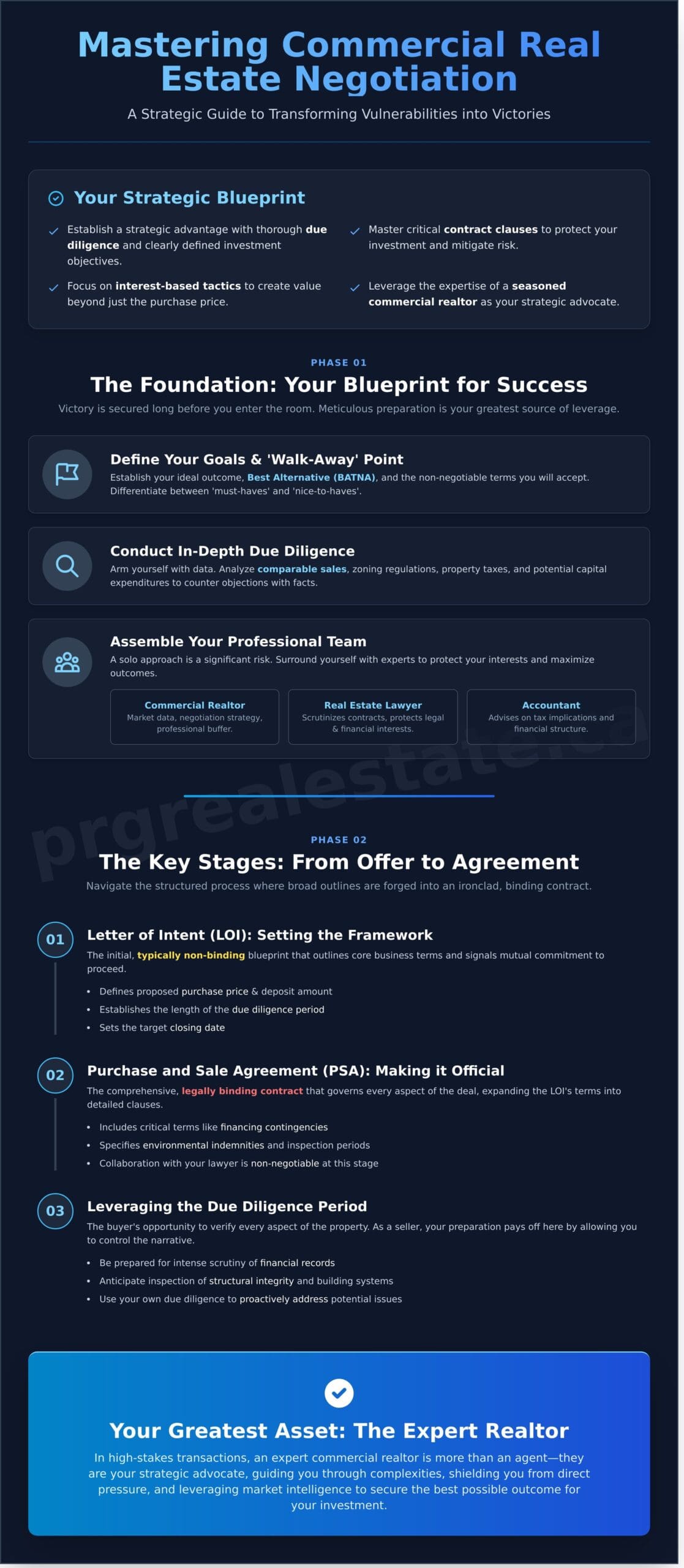
The Foundation: How to Prepare for a Winning Negotiation
In the high-stakes world of commercial real estate, victory is not achieved at the closing table-it’s secured long before you ever enter the room. A successful commercial real estate negotiation hinges on meticulous preparation. This foundational stage is your single greatest source of leverage, allowing you to enter discussions from a position of strategic strength, not hopeful reaction. By establishing clear objectives and conducting deep research, you build an unshakeable case for your property’s value.
Defining Your Goals and ‘Walk-Away’ Point
Clarity of purpose is non-negotiable. Before engaging with any potential buyer, you must define your precise objectives. This involves establishing your ideal outcome (target price, closing timeline, specific conditions) and, just as critically, your Best Alternative to a Negotiated Agreement (BATNA). Your BATNA informs your ‘walk-away’ point-the absolute minimum price and set of terms you will accept. Differentiating between your ‘must-haves’ and ‘nice-to-haves’ provides the flexibility needed to concede on minor points while holding firm on what truly matters.
Conducting In-Depth Due Diligence
True market intelligence goes far beyond a simple asking price. A comprehensive due diligence process involves a deep analysis of comparable sales (comps) to validate your valuation. It’s essential to investigate municipal zoning regulations, current property taxes, and any potential future assessments that could impact value. A thorough property condition assessment will identify capital expenditures a buyer may use as a bargaining chip. Understanding these commercial real estate fundamentals and the specific market trends in Brampton and the Greater Toronto Area (GTA) equips you with the data needed to counter any objection with confidence.
Assembling Your Professional Team
Navigating a complex commercial real estate negotiation alone is a significant risk. Assembling a dedicated team of professionals is a strategic investment that protects your interests and maximizes your outcome. Your core team should include:
- An Expert Commercial Realtor: Provides critical market data, develops negotiation strategy, and acts as a professional buffer between you and the buyer.
- A Real Estate Lawyer: Scrutinizes every detail of the Agreement of Purchase and Sale, ensuring your legal and financial interests are protected.
- An Accountant: Advises on the tax implications and verifies the financial structure of the deal to ensure its long-term viability for your portfolio.
The Key Stages: From Initial Offer to Final Agreement
A successful commercial real estate negotiation is not a single event but a structured process. Each stage, from the initial handshake to the final signature, presents a strategic opportunity to strengthen your position and maximize your return. Understanding these distinct phases is essential for any seller looking to prevent costly errors and secure the best possible outcome for their asset. Each step builds upon the last, moving from a broad outline to a binding, ironclad contract.
The Letter of Intent (LOI): Setting the Framework
The Letter of Intent (LOI) serves as the initial blueprint for the transaction. While typically non-binding in Canada, it outlines the core business terms and demonstrates a mutual commitment to proceed. An effective LOI clearly defines key parameters, including:
- The proposed purchase price
- The initial deposit amount
- The length of the due diligence period
- The target closing date
This document is your first real test of the buyer’s seriousness and flexibility. Crucially, always ensure your legal counsel includes language explicitly stating the LOI is non-binding until a formal Purchase and Sale Agreement is executed.
The Purchase and Sale Agreement (PSA): Making it Official
Once the LOI is agreed upon, the transaction moves to the Purchase and Sale Agreement (PSA). This is the comprehensive, legally binding contract that will govern every aspect of the deal. Here, the broad strokes of the LOI are expanded into detailed clauses, including critical terms like financing contingencies, environmental indemnities, and specific inspection periods. Collaborating closely with your lawyer is non-negotiable at this stage. A detailed strategic negotiation analysis reveals that the fine print in the PSA dictates the balance of power and risk. This document is the definitive roadmap to closing.
Leveraging the Due Diligence Period
The due diligence period is the buyer’s opportunity to verify every aspect of the property, from its structural integrity to its financial records. As a seller, you must be prepared for this scrutiny. If unforeseen issues arise-such as a necessary roof repair or an environmental concern-they become powerful renegotiation tools for the buyer. However, this is also your final opportunity to control the narrative. By proactively addressing potential findings, you can offer strategic concessions, such as a price reduction or a credit at closing, to keep the deal on track and prevent it from collapsing before it becomes firm.
Proven Negotiation Strategies to Secure the Best Terms
Mastering the art of commercial real estate negotiation means moving beyond a simple back-and-forth on price. True success lies in a strategic, interest-based approach that uncovers creative solutions, builds leverage, and secures the most advantageous terms for your asset. It’s about understanding the psychology of the deal and controlling the flow of the conversation to achieve your primary objectives.
Think Beyond Price: Uncovering Mutual Interests
A truly strategic deal addresses more than just the final number. By asking insightful questions, you can uncover the buyer’s core motivations. Do they need a rapid closing to meet an operational deadline? Are there specific tax implications in the Canadian market driving their timeline? Offering a concession that is low-cost to you-like a flexible possession date-can often secure a higher price or fewer conditions, transforming a potential deadlock into a win-win agreement and building valuable goodwill.
Controlling the Narrative and Creating Leverage
In any high-stakes negotiation, the party with superior information holds a distinct advantage. Your position is strengthened by what you don’t reveal. Never disclose your ‘walk-away’ price or any sense of urgency to sell. The most powerful tool in your arsenal is your Best Alternative to a Negotiated Agreement (BATNA)-whether it’s another interested buyer or the financial stability to hold the property. Projecting the confidence that you are prepared to walk away from an unfavourable deal is paramount.
Common Tactics and How to Respond
Sophisticated buyers often employ proven tactics. Recognizing them is the first step to effectively countering them and protecting your interests:
- The Low-Ball Offer: Do not be offended or dismiss it outright. Respond professionally with a reasonable counter-offer, reinforcing your position with market data, recent comparable sales, and the unique value proposition of your property.
- The Nibble: After agreeing on major terms, a buyer may ask for small, last-minute concessions just before closing. Address these strategically. Either stand firm or concede on a minor point in exchange for one of your own to prevent an erosion of your deal’s value.
- Good Cop/Bad Cop: One person on the buyer’s team may seem aggressive while another appears reasonable. Recognize this as a tactic to pressure you. Ignore the dynamic and focus exclusively on the objective merits and figures of the deal.
- Time Pressure: A buyer may create artificial deadlines to force a hasty decision. Maintain control of the timeline. A rushed decision is rarely the best one, so insist on the time required for proper due diligence.
Decoding the Fine Print: Critical Contract Clauses
While the purchase price often dominates headlines, the true success of a transaction is forged in the details of the Agreement of Purchase and Sale (APS). This legally binding document outlines the precise terms, rights, and obligations of each party. A masterful commercial real estate negotiation hinges on strategically shaping these clauses to protect your interests and ensure a smooth path to closing. Overlooking this fine print is a risk no serious seller can afford. Your legal and real estate advisors are indispensable partners in navigating this complexity.
Representations and Warranties (‘Reps & Warranties’)
These are statements of fact that you, the seller, guarantee to be true at the time of closing. As a seller, your objective is to limit these representations to matters within your direct knowledge and to negotiate the shortest possible “survival period”-the timeframe after closing during which you remain liable for a breach. Common examples include:
- Your legal authority to sell the property.
- Compliance with current environmental regulations.
- The absence of any pending or threatened litigation.
Contingencies: Understanding the Buyer’s Safety Nets
Contingencies are conditions that must be met for the deal to become firm, effectively serving as the buyer’s contractual escape hatches. Your goal is to negotiate for tight, well-defined deadlines to minimize uncertainty. Key contingencies to manage include the buyer’s right to secure financing, conduct satisfactory due diligence (inspections), and obtain necessary zoning or land-use approvals. A firm, non-conditional offer is always the strongest position for a seller.
Closing Adjustments, Prorations, and Credits
The final financial accounting of the deal occurs at closing. It is critical to understand how costs are divided. Prorations are standard adjustments for shared, ongoing expenses like property taxes, tenant rent, and utilities, which are split between you and the buyer based on the closing date. You may also negotiate credits to the buyer in lieu of performing repairs discovered during due diligence. A meticulous review of the final Statement of Adjustments with your lawyer is essential to ensure accuracy and protect your bottom line.
Navigating the intricacies of the APS is where expert guidance provides its greatest value. An experienced advisory team ensures every clause is structured to your advantage, securing the successful outcome your asset deserves. For strategic support in your next transaction, partner with the experts at PRG Real Estate Brokerage.
The PRG Advantage: Why an Expert Realtor is Your Greatest Asset
Executing a successful sale requires more than just a willing buyer; it demands strategic expertise and flawless execution. The process of commercial real estate negotiation is a high-stakes discipline where minor oversights can result in significant financial consequences. An elite commercial realtor from PRG Real Estate is not merely an agent; they are your strategist, advocate, and guide, transforming a complex transaction into a streamlined success. Partnering with an expert is a direct investment in maximizing your return.
Unmatched Market Intelligence and Valuation
Our team provides a decisive edge with access to proprietary sales data and off-market opportunities that are invisible to the public. We deliver an objective, data-driven valuation of your asset, establishing a powerful and defensible negotiating position from the outset. This intelligence ensures you command the highest possible price in any market cycle, preventing you from leaving money on the table or misjudging your asset’s true worth in the Canadian market.
Strategic Counsel and an Emotional Buffer
High-value negotiations can become tense and emotionally charged. Our realtors act as a crucial buffer, managing difficult conversations and filtering out unproductive communication to keep the focus strictly on your financial goals. We provide the clear-headed, strategic counsel needed to navigate every stage of the deal. We advise on:
- When to apply pressure and push for better terms.
- When to make a strategic concession to maintain momentum.
- When the terms are no longer favourable and it is time to walk away.
Let our experts lead your next negotiation and secure the optimal outcome for your portfolio.
Mastery of the Process and Paperwork
A successful negotiation culminates in a flawless closing. Our experts masterfully manage the intricate timeline of a transaction, ensuring all deadlines for due diligence, contingencies, and deposits are met without fail. We coordinate seamlessly with lawyers, lenders, and inspectors, managing the complex flow of documents from the initial Letter of Intent (LOI) to the final closing statements. This meticulous oversight prevents costly delays and protects your interests at every step.
Secure Your Advantage: The Final Word on Negotiation
Mastering the art of commercial real estate negotiation is a strategic discipline built on meticulous preparation and a deep understanding of the process. From conducting thorough due diligence to decoding critical contract clauses, every step is an opportunity to strengthen your position. However, the most significant advantage is not just what you know, but who you have in your corner.
The team at PRG Real Estate brings a results-oriented approach to every transaction, backed by unparalleled expertise in the Brampton and GTA commercial markets. Our proven track record of successful, high-value transactions is a testament to our commitment to achieving your financial goals. Don’t leave your investment to chance; align with a partner dedicated to excellence.
Secure your strategic advantage. Partner with Brampton’s top commercial realtors today.
Your next landmark investment awaits.
Frequently Asked Questions About Commercial Real Estate Negotiation
How much can you typically negotiate on a commercial property’s price?
In the Canadian commercial market, there is no fixed percentage for price negotiation. The negotiable range is dictated by strategic factors such as current market dynamics, the property’s condition, its time on market, and the seller’s urgency. While a 5-10% adjustment from the asking price can be a benchmark in a balanced market, a well-priced asset in high demand may see very little movement. A strategic approach backed by a comprehensive market analysis is essential to maximizing your position.
What is the difference between a non-binding Letter of Intent (LOI) and a binding Purchase Agreement?
A Letter of Intent (LOI) is a preliminary, non-binding document outlining the proposed key terms of a transaction, such as price and timelines. It signals serious intent but does not legally obligate either party to complete the sale. Conversely, a formal Agreement of Purchase and Sale (APS) is a comprehensive, legally binding contract. Once executed, the APS commits both seller and buyer to the transaction, subject only to the fulfillment of its specific conditions and terms.
What are the most common mistakes to avoid in commercial real estate negotiation?
A critical error in commercial real estate negotiation is inadequate preparation, such as failing to establish a well-researched property valuation. Other common mistakes include letting emotion drive decisions, revealing your final position prematurely, and neglecting to investigate the buyer’s motivations. Perhaps the most significant misstep is proceeding without expert representation. A seasoned commercial realtor provides the strategic counsel necessary to navigate complexities and secure the most advantageous outcome for your asset.
How long does a typical commercial real estate negotiation and closing process take?
The timeline for a commercial transaction in Canada can vary significantly based on complexity. The initial negotiation phase may last from a few days to several weeks. Following an accepted offer, the due diligence period typically spans 30 to 90 days, allowing for comprehensive inspections and reviews. From waiving conditions to the final closing, you can expect an additional 30 to 60 days. A realistic total timeframe from offer to closing is generally between 60 and 120 days.
Is it a good idea to negotiate directly with the seller to save on commission?
While attempting to negotiate directly may seem like a way to reduce costs, it often proves to be a strategic disadvantage. Professional commercial realtors provide indispensable market knowledge, expert valuation, and skilled negotiation tactics that typically result in a higher sale price and more favourable terms. Forgoing this expertise can expose you to legal risks and financial losses that far exceed any potential commission savings. Partnering with a top-tier firm ensures your interests are protected and your return is maximized.
What happens if a major issue is found during the due diligence inspection?
Discovering a significant issue during due diligence is a critical moment. The buyer typically has several contractual options. They may request that you, the seller, remedy the defect prior to closing or propose a price reduction to compensate for the future cost of repairs. If a mutually acceptable agreement on the issue cannot be reached, the buyer may have the right to terminate the contract and have their deposit returned, as stipulated in the purchase agreement.