Commercial Property ROI in 2026: A Strategic Guide to Calculation & Maximization
In the dynamic Canadian real estate market, a surface-level understanding of an investment’s potential is a significant liability. Many sophisticated investors find themselves wrestling with complex spreadsheets, uncertain which metrics truly define a property’s value and fearful that a single miscalculation could derail their portfolio. This uncertainty often transforms the critical ‘go/no-go’ decision into a high-stakes gamble. The key to mitigating this risk and achieving superior outcomes lies in a strategic, forward-looking approach to calculating commercial property roi.
This 2026 strategic guide is engineered to move you beyond basic formulas. We will equip you with the advanced analytical tools and expert insights necessary to not only accurately project the financial performance of a potential asset but to truly maximize it. You will learn to identify the key levers that drive value, interpret complex data with confidence, and make decisive, data-driven investment decisions that build lasting wealth in the Canadian market. Prepare to transform your approach to commercial real estate investment for the years ahead.
Key Takeaways
- Move beyond purchase price to master the essential metrics, including Cap Rate and Cash-on-Cash Return, that reveal an investment’s true performance.
- Uncover the critical factors beyond the initial calculation that significantly impact your real-world commercial property roi, from market fluctuations to unforeseen capital expenditures.
- Learn four proven, value-add strategies to actively boost your property’s profitability, transforming a good investment into a high-performing asset.
- Understand how leveraging expert local market knowledge is the definitive advantage in identifying and securing high-return commercial properties in Brampton.
Understanding Commercial Property ROI: The Ultimate Metric for Investors
In the strategic world of Canadian commercial real estate, success is not measured by the purchase price or gross rental income alone. The ultimate metric that separates savvy investors from speculators is the commercial property roi. At its core, Return on investment (ROI) is the definitive measure of an investment’s profitability and efficiency, expressing your net profit as a percentage of your initial capital. For example, a C$50,000 annual net profit on a C$1,000,000 property is far more telling than the gross rent figures.
It’s crucial to distinguish between an anticipated ROI, based on proforma projections before purchase, and your actual ROI, calculated from historical performance data. Mastering this calculation is the first and most critical step toward building a high-performing property portfolio.
Why ROI is Critical in Commercial Real Estate
A precise understanding of ROI is fundamental to any successful investment strategy. It moves beyond surface-level figures to provide a clear, standardized benchmark of performance, empowering you to make strategic decisions with confidence.
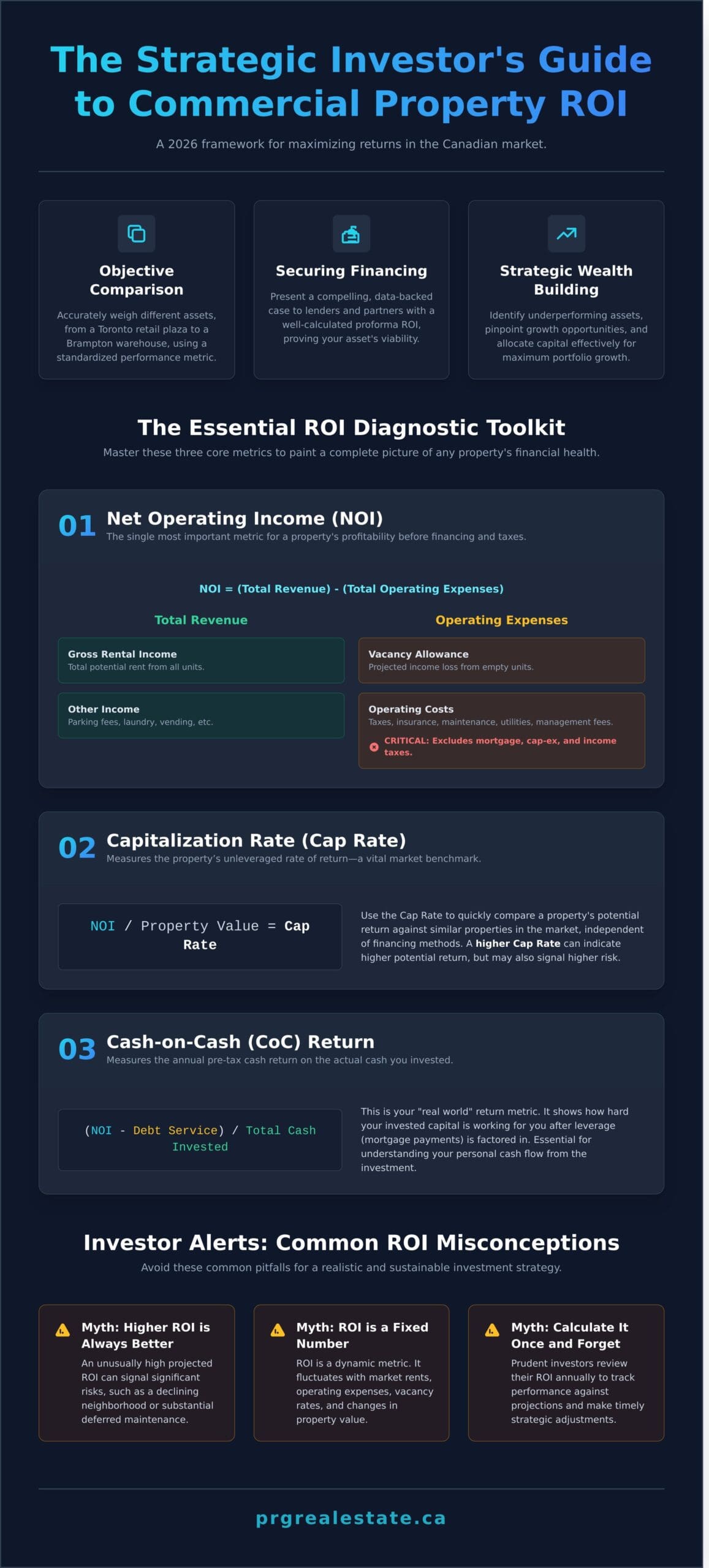
- Objective Comparison: ROI allows for a direct, apples-to-apples comparison between vastly different assets. You can accurately weigh the potential of a 7% ROI on a retail plaza in Toronto against a 6% ROI on an industrial warehouse in Brampton.
- Securing Financing: Lenders and financial partners demand proof of viability. A well-calculated proforma ROI demonstrates the asset’s potential to generate profit, making your financing application significantly more compelling.
- Strategic Wealth Building: Your ROI figures form the foundation of your long-term goals. They help you identify underperforming assets, pinpoint opportunities for improvement, and strategically allocate capital for maximum growth.
Common Misconceptions About ROI
To leverage ROI effectively, investors must also recognize common pitfalls and myths that can lead to poor decision-making. Navigating these misconceptions is key to a realistic and sustainable investment approach.
- Myth: A higher ROI is always better. While attractive, an unusually high ROI can signal higher risk, such as a property in a declining neighbourhood or one requiring substantial, unforeseen capital expenditures.
- Myth: ROI is a fixed number. Your commercial property roi is a dynamic metric. It fluctuates with market rents, operating expenses, vacancy rates, and changes in the property’s market value over time.
- Myth: You only need to calculate it once. Prudent investors review their property’s ROI annually. This regular analysis allows you to track performance against projections and make timely adjustments to your management strategy.
The Essential ROI Formulas: A Practical Calculation Guide
To make strategic investment decisions, you must move beyond speculation and into quantitative analysis. The true measure of a commercial property ROI is revealed through a core set of financial metrics. Think of these formulas not as isolated calculations, but as a diagnostic toolkit. While there are many different ways to calculate the ROI, mastering the following three will provide the foundational clarity needed to evaluate any deal. Each metric tells a different part of the story; together, they paint a complete picture of a property’s financial health and potential.
Calculating Net Operating Income (NOI)
NOI is the single most important metric for determining a property’s profitability before accounting for financing. It represents all the revenue the property generates, minus all reasonably necessary operating expenses.
Formula: Gross Rental Income + Other Income – Vacancy – Operating Expenses = NOI
Operating expenses include property taxes, insurance, maintenance, utilities, and property management fees. Crucially, they do not include mortgage payments (principal and interest), capital expenditures, or income taxes.
- Annual Gross Rent: C$42,000
- Vacancy Allowance (5%): -C$2,100
- Annual Operating Expenses (Taxes, Insurance, Maint.): -C$9,900
- Annual NOI: C$30,000
Determining Cap Rate (Capitalization Rate)
The Cap Rate measures the property’s unleveraged rate of return. It is a vital market benchmark used to compare the performance of similar properties, independent of any specific financing structure. It answers the question: “What return would I get if I bought this property with all cash?”
Formula: NOI / Current Market Value = Cap Rate
Using our Brampton example, if the property’s market value is C$550,000, the Cap Rate is C$30,000 / C$550,000 = 5.45%. In the current Greater Toronto Area market, commercial cap rates typically range from 4% to 6%, varying significantly by asset class and location. A higher cap rate often implies higher risk or a lower-quality asset, while a lower cap rate suggests lower risk and higher investor demand.
Calculating Cash-on-Cash Return
For investors using financing, the Cash-on-Cash Return is paramount. This metric calculates the return on the actual cash you’ve invested-your down payment, closing costs, and renovation expenses. It provides the clearest picture of the performance of your invested capital.
Formula: Annual Pre-Tax Cash Flow / Total Cash Invested = Cash-on-Cash Return
Continuing our example, assume a C$550,000 purchase with a C$200,000 total cash investment. If the annual mortgage payment (debt service) is C$26,400, your pre-tax cash flow is C$30,000 (NOI) – C$26,400 = C$3,600. Your Cash-on-Cash Return would be C$3,600 / C$200,000 = 1.8%. This demonstrates how leverage and financing terms directly impact your personal return and is a critical factor in assessing any deal’s viability.
Beyond the Numbers: Key Factors That Drive Real-World ROI
A spreadsheet can show a promising return, but seasoned investors know that financial formulas are only as reliable as the data fed into them. The most common pitfall for new investors is underestimating the qualitative factors that can drastically alter a property’s performance. Achieving a strategic and successful commercial property roi requires rigorous due diligence that goes far beyond the initial calculations. This is where professional expertise ensures your on-paper projections align with real-world outcomes.
Location and Market Dynamics
A property’s value is intrinsically tied to its location. A comprehensive analysis must include local economic indicators, such as job growth and major infrastructure projects, like those transforming areas of Brampton. Visibility and accessibility for customers, clients, and suppliers are critical. It’s also vital to assess the submarket’s health; high vacancy rates in the surrounding area can exert downward pressure on your rental income projections. Understanding the nuances of the broader post-pandemic commercial real estate market provides essential context for these local trends.
Tenant Quality and Lease Structure
Your tenants are the engine of your investment’s cash flow. A building occupied by creditworthy tenants on long-term leases represents a stable, low-risk asset. The structure of these leases is equally important. A Triple Net (NNN) lease, where the tenant covers property taxes, insurance, and maintenance, creates a predictable income stream for the landlord. Conversely, a Gross lease places these expense burdens on you, introducing more variability. A thorough review of existing lease agreements for details like rental escalations and renewal options is non-negotiable.
Property Condition and Capital Expenditures
Hidden costs can quickly erode your returns. Deferred maintenance is a liability that will eventually come due, often at a premium. Before any acquisition, you must account for the lifespan and potential replacement cost of major systems. These capital expenditures (CapEx) include:
- Roofing systems
- HVAC units
- Parking lot and paving
- Structural components
Commissioning a professional property condition assessment is a critical step to quantify these future costs, protecting your cash flow and the long-term viability of your investment. For a detailed guide on this process, review our comprehensive article: Evaluating Commercial Buildings for Sale: A Checklist.
From Good to Great: 4 Proven Strategies to Increase Your Commercial ROI
Calculating your initial return on investment is merely the baseline. Elite investors understand that the true potential of an asset is unlocked through strategic management and proactive optimization. A disciplined approach to asset management is what separates average returns from exceptional ones. The following proven strategies are designed to actively enhance your commercial property roi, transforming your investment into a high-performing asset that delivers sustained value.
Strategy 1: Optimize and Increase Revenue Streams
Maximizing gross potential income is the most direct path to a higher ROI. This involves more than just collecting rent; it requires a strategic analysis of all potential revenue sources to ensure no opportunity is overlooked.
- Align Rents with Market Value: Upon lease renewal, strategically adjust below-market rents to reflect current rates in your local Canadian market, instantly boosting your net operating income.
- Introduce Ancillary Income: Monetize underutilized assets. Consider charging for reserved parking spots, leasing rooftop space for signage or telecom equipment, or offering secure storage units for a monthly fee.
- Implement RUBS: Where permitted by provincial regulations, a Ratio Utility Billing System (RUBS) can be used to pass on a portion of utility costs to tenants, significantly reducing your operating expenditures.
Strategy 2: Systematically Reduce Operating Expenses
Every dollar saved in expenses flows directly to your bottom line and increases the property’s valuation. A disciplined approach to cost management is a critical component of maximizing investment performance and is essential for a healthy commercial property roi.
- Conduct Regular Expense Audits: Routinely review all service contracts and operating costs to identify inefficiencies, eliminate waste, and renegotiate for more favourable terms.
- Invest in Efficiency: Capital upgrades like LED lighting, smart thermostats, and low-flow water fixtures can generate substantial long-term savings on utilities, often with the support of government rebate programs.
- Appeal Property Taxes: In Canada, property assessments are not always accurate. A successful tax appeal, managed by an expert, can result in significant and recurring annual savings.
Strategy 3: Execute Strategic Value-Add Improvements
Targeted capital expenditures can dramatically increase your property’s value and rental appeal, allowing you to command higher rents and attract more stable, long-term tenants. The key is to focus on improvements that offer the highest return.
- Enhance Curb Appeal: Modernizing the facade, upgrading landscaping, and improving common areas can justify higher lease rates and reduce vacancy periods.
- Repurpose Underutilized Space: Convert an oversized storage room into a small co-working space, a vacant basement into rentable storage lockers, or an unused office into a tenant lounge.
- Add In-Demand Amenities: Depending on the asset class and location, adding features like EV charging stations, upgraded security systems, or modern end-of-trip facilities can be a powerful differentiator.
Executing these strategies with precision requires deep market expertise. To ensure your investment is positioned for maximum growth, partner with a top commercial real estate team that understands how to unlock true asset value.
Maximizing Your ROI in Brampton: The PRG Advantage
Understanding the formulas to calculate your return on investment is the first step. Translating those calculations into a profitable reality requires market-specific expertise and strategic execution. In Brampton’s dynamic and competitive landscape, the difference between an average return and a market-leading one is your choice of representation. This is where PRG Real Estate Brokerage provides a decisive advantage, ensuring your investment journey is built on a foundation of data, access, and expert guidance.
Expert Property Sourcing and Analysis
A superior commercial property roi begins with sourcing the right asset. Our team leverages unparalleled, on-the-ground knowledge of Brampton’s commercial corridors to identify undervalued properties with significant growth potential. We provide the accurate, verified data you need for your calculations-from current market rents in specific industrial parks to realistic operating expenses. Furthermore, our extensive network grants you VVIP access to off-market opportunities, positioning you to acquire high-return assets before they ever reach the public market.
Strategic Negotiation and Due Diligence
Securing a property on the right terms is critical to protecting your initial capital and maximizing future returns. The PRG Real Estate Brokerage team are master negotiators, adept at structuring deals that favour your financial objectives. We then guide you meticulously through the due diligence process, transforming assumptions into certainties. Our role extends to connecting you with our trusted network of professionals, including:
- Top-tier commercial property inspectors
- Experienced real estate lawyers in the Peel Region
- Reliable contractors and property managers
A Partnership for Long-Term Growth
Our commitment to your success extends far beyond a single transaction. At PRG Real Estate Brokerage, we build relationships to become ‘clients for life,’ acting as your long-term strategic advisors. We provide ongoing insights into Brampton’s market trends, helping you identify the optimal moments to refinance, reposition, or sell your asset to secure maximum profit. Your success is our ultimate metric. Let our expertise in the local market elevate your investment strategy and deliver the exceptional commercial property roi you deserve.
Partner with Brampton’s top commercial realtors to secure your next high-return investment.
Transforming ROI from a Metric to a Milestone
As we look towards 2026, it is evident that achieving exceptional returns in commercial real estate demands more than a surface-level understanding. Success is built on a foundation of accurate calculation, a strategic awareness of the factors that influence value, and the proactive implementation of strategies to enhance asset performance. Ultimately, mastering your commercial property roi is the definitive measure of a successful and resilient investment portfolio.
Navigating this complex landscape requires a partner with proven expertise and a track record of excellence. As the Top Commercial Realtors in Brampton and Royal LePage® Red Diamond™ Award Winners, PRG Real Estate offers the strategic insight necessary to turn potential into profit. Our commitment is to ensure your investments are not just sound, but positioned for optimal growth in the Canadian market.
The opportunity for superior returns is within reach. Secure your strategic commercial investment. Contact PRG Real Estate today.
Frequently Asked Questions About Commercial Property ROI
What is a good ROI for commercial property in Canada?
In Canada, a good return on investment for commercial property typically ranges from 6% to 12% annually. However, this benchmark varies significantly based on asset class, location, and market conditions. Prime industrial properties in major hubs like the GTA may yield different returns than retail spaces in smaller cities. A strategic investment, backed by expert analysis, focuses on securing assets that align with your specific financial goals and risk tolerance for a superior commercial property roi.
Is commercial real estate more profitable than residential?
Commercial real estate can offer higher profitability than residential properties, primarily through stronger cash flow from long-term leases and built-in rent escalations. While residential assets may offer more stable appreciation, commercial investments provide opportunities for greater economies of scale. The choice depends on an investor’s capital, risk appetite, and management capabilities. A comprehensive analysis is essential to determine which strategy best aligns with your portfolio objectives.
How long does it take to see a return on a commercial property investment?
Investors can see returns from cash flow almost immediately after a property is tenanted, typically collected on a monthly basis. However, a return from capital appreciation-the increase in the property’s value-is a long-term prospect, often realized over a 5 to 10-year holding period. The timeline is heavily influenced by the investment strategy, whether it’s a stable, income-producing asset or a value-add project requiring significant repositioning and capital.
What is the difference between ROI and Cap Rate?
Capitalization Rate (Cap Rate) and Return on Investment (ROI) are both key performance metrics, but they measure different things. Cap Rate measures a property’s unleveraged annual return relative to its market value, providing a snapshot of potential profitability. In contrast, ROI provides a more comprehensive picture by calculating the total return, including financing, relative to the actual cash invested. A thorough analysis of commercial property roi requires understanding both metrics for a complete financial assessment.
Can you calculate ROI on a vacant commercial property?
You cannot calculate the actual ROI on a vacant property because there is no income to measure. However, you can and should calculate a *projected* ROI. This involves creating a pro-forma analysis using market-rate rental income, estimated operating expenses, leasing costs, and tenant improvement allowances. This forecast is a critical step in due diligence, allowing you to assess the investment’s potential and viability before acquisition, ensuring a strategic and informed decision.
What are the biggest risks that can negatively impact my ROI?
Several key risks can negatively impact your ROI. The most significant include tenant vacancies, which eliminate rental income, and unexpected capital expenditures, such as major structural or HVAC repairs. Economic downturns can also reduce tenant demand and rental rates. Furthermore, rising interest rates can increase financing costs and erode cash flow. Proactive property management and diligent financial planning are essential to mitigate these risks and protect your investment returns.
How do property taxes in Brampton affect my overall ROI?
Property taxes in Brampton, as in any municipality, are a significant operating expense that directly reduces a property’s Net Operating Income (NOI). Because ROI calculations are based on net profit, higher property taxes will lower your overall return. It is critical to factor in current and projected tax rates during your initial due diligence. A successful investment strategy requires accounting for these non-negotiable costs to ensure your financial projections are accurate and achievable.