Retail Space for Sale GTA: The Ultimate 2026 Buyer's Guide
CategoriesBlog

Retail Space for Sale GTA: The Ultimate 2026 Buyer’s Guide

The Greater Toronto Area’s retail market presents a landscape of immense opportunity-and significant challenges. For entrepreneurs and investors alike, navigating the search for retail space for sale GTA can be an overwhelming ordeal, marked by high stakes, complex zoning laws, and the persistent fear of hidden costs. It’s a dynamic market where strategic decisions define success, and a single misstep can prove exceptionally costly to your business or portfolio.

This is where clarity and expert guidance become your most valuable assets. Our Ultimate 2026 Buyer’s Guide is engineered to cut through the noise, providing the strategic insights you need to confidently evaluate a property’s financial viability, identify locations primed for high visibility, and understand the nuances of the GTA’s key retail hubs. Prepare to move beyond uncertainty and secure the perfect commercial space with unwavering confidence and a clear path to success.

Key Takeaways

  • Strategically match your business model to the right type of retail property-from high-street storefronts to plaza units-to maximize your investment’s potential.
  • Master a due diligence checklist to evaluate properties beyond the asking price, assessing crucial factors like zoning, demographic trends, and long-term asset value.
  • Confidently navigate the complex purchase process for any retail space for sale GTA, from securing commercial financing to successfully closing the deal.
  • Learn how partnering with a commercial real estate specialist provides a critical advantage through expert negotiation and access to off-market opportunities.

Decoding the GTA Retail Landscape: Types of Spaces & Key Markets

Securing the right commercial property is a strategic imperative for any successful business or investor. The Greater Toronto Area presents a dynamic and complex market, where understanding the nuances of property types and regional economic drivers is paramount. Before diving into specific listings, it’s essential to grasp the fundamentals of what is commercial property and how its different forms serve distinct strategic goals. A well-informed approach ensures your investment aligns perfectly with your operational needs and long-term financial objectives.

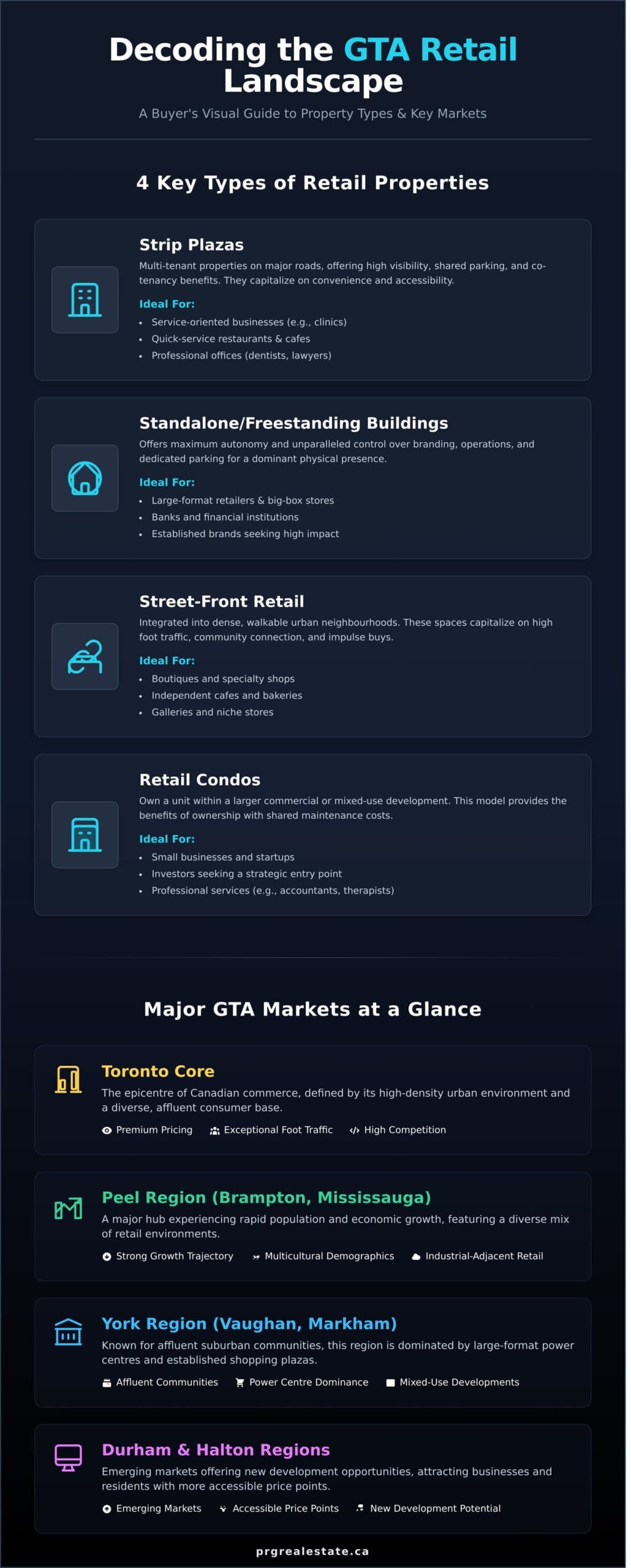
Types of Retail Properties Explained

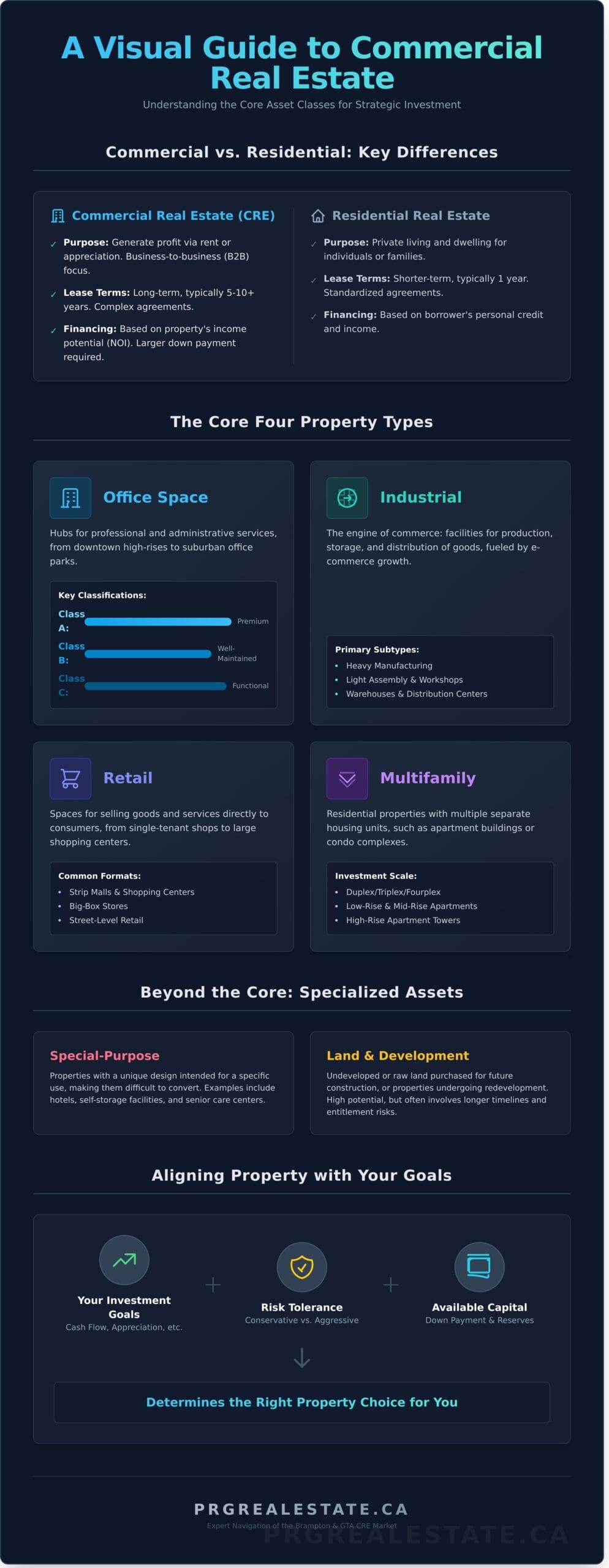
Choosing the correct asset class is the first step in refining your search for retail space for sale GTA. Each property type offers unique advantages:

  • Strip Plazas: These multi-tenant properties offer high visibility on major arterial roads and benefit from shared parking and co-tenancy. They are ideal for service-oriented businesses like clinics, quick-service restaurants, and professional offices that thrive on convenience and accessibility.
  • Standalone/Freestanding Buildings: Offering maximum autonomy, these properties provide unparalleled control over branding, operations, and parking. They are a prime choice for large-format retailers, banks, and established brands seeking a dominant physical presence.
  • Street-Front Retail: Integrated into dense, walkable urban neighbourhoods, these spaces capitalize on high foot traffic. They are perfectly suited for boutiques, cafes, and specialty shops that benefit from a strong community connection and impulse buys.
  • Retail Condos: This model allows you to own a unit within a larger commercial plaza or mixed-use development. It provides the benefits of property ownership with shared maintenance costs, making it a strategic entry point for small businesses and investors.

Major GTA Markets at a Glance

The GTA is not a monolith; each region presents a distinct investment landscape with its own consumer demographics and growth trajectory.

  • Toronto Core: The epicentre of Canadian commerce, characterized by high-density, a diverse consumer base, and premium pricing. Foot traffic is exceptional, but so is the competition.
  • Peel Region (Brampton, Mississauga): A hub of rapid population and economic growth. This area features a strong mix of industrial-adjacent retail and bustling suburban shopping centres catering to a multicultural demographic.
  • York Region (Vaughan, Markham): Known for its affluent suburban communities, York is dominated by large power centres, established plazas, and a growing number of mixed-use developments.
  • Durham & Halton Regions: These are emerging markets offering significant new development opportunities and more accessible price points. They are attracting both new businesses and residents, signaling strong future growth potential.

The Investor’s Checklist: How to Evaluate a Retail Property

Securing a high-value commercial property requires a strategic evaluation that extends far beyond the initial asking price. Seasoned investors understand that true value is uncovered through meticulous due diligence, focusing on the tangible metrics that drive long-term profitability. This checklist provides the expert framework to assess any retail space for sale in the GTA, ensuring your capital is deployed with precision and foresight.

Location & Accessibility Analysis

The adage “location, location, location” is paramount in retail. A comprehensive analysis involves more than a simple map search. Your due diligence should include:

  • Traffic and Demographics: Verify vehicle and pedestrian traffic counts using municipal data or third-party studies. Analyze neighbourhood demographics to ensure the local consumer base aligns with your target market’s spending habits.
  • Visibility and Access: Evaluate the property’s street-front visibility, potential for prominent signage, and ease of access for customers, including parking availability and entry/exit points.
  • Retail Synergy: Assess proximity to anchor tenants (like major grocery stores or banks) and complementary businesses that draw a consistent flow of potential customers to the area.

Zoning, Condition, and Permitted Use

Operational viability depends on the property’s physical and legal standing. Before proceeding, you must confirm the site’s suitability. Investigate municipal zoning bylaws and future land use plans to ensure your intended use is permitted. A professional Property Condition Assessment (PCA) is non-negotiable; it uncovers the true state of the building’s structure, roof, and essential systems, identifying potentially costly future repairs. If the property has existing tenants, a thorough review of all lease agreements is critical to understand current income, terms, and obligations.

Financial Due Diligence: Beyond the Price Tag

A successful investment is built on sound financial analysis. Go beyond the surface-level numbers to calculate the property’s true potential. Key metrics include the Capitalization (Cap) Rate, which indicates the rate of return based on expected income. You must also project the Cash-on-Cash Return to understand your ROI on the actual capital invested. Scrutinize all operating expenses, from property taxes and insurance to common area maintenance (CAM) costs. Finally, comparing the property to recent, similar sales (comparables) is fundamental. For a definitive standard on this process, investors should align their analysis with Canada’s official property valuation guidelines, which set the benchmark for accurate market assessment.
Retail Space for Sale GTA: The Ultimate 2026 Buyer's Guide

The Purchase Process: From Securing Financing to Closing the Deal

Navigating the acquisition of commercial real estate is a disciplined, multi-stage process that demands precision and strategic insight. Unlike residential transactions, purchasing retail space for sale in the GTA involves greater complexity and higher stakes. Understanding this path is the first step toward a successful investment. At PRG Real Estate Brokerage, we demystify this journey, guiding you from initial financial preparations to the final transfer of ownership with unwavering expertise.

Step 1: Financing and Pre-Approval

Securing financing for a commercial property is fundamentally different from a residential mortgage. Lenders assess the property’s potential income and your business’s financial health, not just personal credit. A comprehensive business plan and detailed financial statements are non-negotiable. We strongly advise obtaining financing pre-approval before beginning your search. This step not Monly defines your budget but also positions you as a credible, serious buyer in a competitive market. Options range from traditional bank loans to CMHC-insured financing and private lending solutions.

Step 2: Making an Offer and Negotiation

Once you identify a target property, the next step is structuring a compelling offer. This typically begins with a Letter of Intent (LOI) to outline key terms, followed by a formal, legally binding Agreement of Purchase and Sale (APS). Strategic negotiation is critical, focusing on more than just price. Key terms include:

  • Purchase Price: The initial offer and subsequent counter-offers.
  • Closing Date: The timeline for finalizing the transaction.
  • Conditions (Clauses): Safeguards that must be met, such as securing financing, satisfactory building inspections, and environmental assessments.

An expert commercial realtor is your greatest asset here, leveraging market knowledge to negotiate terms that protect your interests and optimize your investment.

Step 3: Due Diligence and Closing

After an offer is accepted, the conditional or “due diligence” period begins. This is a critical window to verify every aspect of the property with a team of professionals, including lawyers, accountants, and inspectors. Key activities include conducting a title search, performing environmental site assessments (ESAs), and confirming the property’s physical condition and zoning compliance. Analyzing the investment against current Canadian commercial real estate market trends ensures its long-term viability. Once all conditions are waived and financing is finalized, your lawyer will prepare the statement of adjustments and facilitate the transfer of ownership, officially closing the deal on your new retail space.

Why Partner with a Commercial Real Estate Specialist?

Identifying potential properties is a crucial first step, but securing the right asset on optimal terms requires a level of expertise that goes far beyond public listings. In the highly competitive Greater Toronto Area, the difference between a profitable investment and a costly mistake often comes down to the partner you choose. Attempting to navigate this complex market alone or with a generalist realtor can expose you to unseen risks, missed opportunities, and unfavourable negotiations.

A dedicated commercial real estate specialist acts as your strategic advisor, providing the market intelligence and industry access necessary to achieve your investment objectives. Their value is measured not in commissions, but in the long-term success of your acquisition.

The Strategic Advantage of Market Expertise

Partnering with a top-tier commercial realtor provides an immediate and decisive competitive advantage. This expertise manifests in several critical areas:

  • Access to Off-Market Properties: Gain exclusive entry to a pipeline of retail properties that are not advertised publicly, giving you the first opportunity to evaluate and acquire premier assets.
  • Deep Regulatory Knowledge: Navigate complex local zoning, municipal bylaws, and future development plans with confidence, ensuring your chosen property aligns with your business goals and avoids costly compliance issues.
  • Expert Valuation and Analysis: Leverage sophisticated, data-driven valuation techniques to ensure you pay the right price. We analyze sales comparables, income potential, and market trends to protect your capital.
  • An Established Professional Network: Instantly connect with our trusted network of commercial lawyers, lenders, contractors, and inspectors, streamlining every stage of the transaction.

How PRG Real Estate Delivers Results

At PRG Real Estate, our entire approach is engineered to deliver superior outcomes for our clients seeking retail space for sale GTA-wide. We don’t just facilitate transactions; we build strategic partnerships. Our focus on data-driven investment analysis means every recommendation is backed by rigorous market intelligence. We employ proven negotiation tactics to secure the most favourable terms, from price to closing conditions, safeguarding your interests at every turn.

Our commitment is to become your trusted advisors for life. This philosophy drives our unwavering dedication to client success, from securing your first property in Brampton’s commercial core to expanding your portfolio into the GTA’s emerging markets.

Your Next Steps to Acquiring Retail Property

The path to acquiring your ideal retail property begins with a clear, strategic plan. We start with a no-obligation consultation to understand your specific business objectives, investment criteria, and long-term vision. From there, we develop a customized property search and acquisition strategy tailored to your unique needs.

Take the decisive step towards securing your next commercial investment. Schedule your strategic consultation with our experts today.

Your Next Step Towards Commercial Excellence in the GTA

Navigating the Greater Toronto Area’s dynamic commercial landscape requires a strategic, informed approach. As this guide has detailed, your success hinges on a deep understanding of the diverse property types across key markets, conducting meticulous due diligence using a comprehensive investor’s checklist, and mastering the legal and financial complexities of the purchase process. Ultimately, the most critical factor in securing a profitable retail space for sale GTA is partnering with a specialist who provides expert guidance.

At PRG Real Estate, our team embodies this specialized expertise. We deliver a proven, results-oriented approach focused on identifying and securing strategic investments that align with your long-term portfolio goals. Led by our award-winning Broker of Record, Harsh Pabla, our firm’s unwavering commitment to excellence ensures you receive unparalleled market insight and formidable negotiation power. Don’t leave your next major acquisition to chance; partner with a team built on trust, loyalty, and a track record of success.

Connect with PRG’s top commercial realtors to find your ideal retail space.

Your 2025 commercial real estate success story starts now.

Frequently Asked Questions About Retail Space for Sale in the GTA

What is a ‘Cap Rate’ and how is it used to evaluate retail properties?

The Capitalization Rate, or ‘Cap Rate,’ is a fundamental metric in commercial real estate. It is calculated by dividing a property’s Net Operating Income (NOI) by its current market value, expressed as a percentage. Investors utilize the Cap Rate to efficiently compare the profitability and risk profile of various properties. A higher Cap Rate generally suggests a higher potential return on investment but may also indicate greater associated risk.

How much capital do I need for a down payment on a commercial retail space in the GTA?

In Canada, commercial mortgages require a more substantial down payment than residential loans. For a retail property in the Greater Toronto Area, prospective buyers should prepare for a minimum down payment ranging from 25% to 35% of the total purchase price. This figure can fluctuate based on the lender’s criteria, the property’s specifics, and your financial strength. Consulting a commercial mortgage specialist is a crucial step to determine your exact capital requirements.

What are the main differences between buying a retail property versus leasing one?

Buying a retail property is a strategic investment that allows you to build equity, gain from potential appreciation, and maintain full control over your premises. In contrast, leasing offers greater flexibility, requires significantly less upfront capital, and typically places the burden of major property maintenance on the landlord. The optimal decision depends on your company’s long-term strategic goals, financial capacity, and operational needs, weighing the benefits of ownership against the flexibility of leasing.

How long does the entire process of buying a retail space typically take?

The timeline for acquiring a commercial retail space varies based on transaction complexity. From the initial property search and analysis to the final closing, the process typically spans from three to nine months. This period includes critical stages such as conducting comprehensive due diligence, securing appropriate financing, and finalizing all legal documentation. Engaging an expert commercial real estate team is essential to navigate this process efficiently and avoid unnecessary delays.

What are the most common mistakes first-time commercial investors make?

First-time investors often make the critical error of performing inadequate due diligence, overlooking crucial details like zoning restrictions, environmental reports, and building condition. Another frequent mistake is underestimating the total acquisition and operational costs. Attempting to navigate the market for retail space for sale GTA without representation from a seasoned commercial realtor can lead to a misaligned investment that fails to meet strategic objectives.

Can I buy a retail property through my corporation?

Yes, purchasing commercial real estate through a corporation is a standard and often advantageous practice. This structure provides a crucial layer of liability protection, separating your personal assets from your business interests. It can also offer distinct tax efficiencies. To ensure you establish the most beneficial ownership structure for your investment goals, it is imperative to seek professional advice from your legal and accounting advisors before proceeding with an acquisition.

Selling Commercial Property: A Complete Step-by-Step Guide
CategoriesBlog

Selling Commercial Property: A Complete Step-by-Step Guide

The decision to sell a commercial asset represents a significant financial milestone. However, the process of selling commercial property in Canada can feel overwhelmingly complex, riddled with concerns over accurate valuation, effective marketing, and the potential for costly legal missteps. Many owners fear leaving significant money on the table or becoming entangled in a transaction that fails to meet its timeline or financial objectives, transforming a potential opportunity into a source of stress and uncertainty.

This definitive guide is engineered to replace that uncertainty with a clear, strategic framework. We provide the expert, step-by-step roadmap necessary to navigate every stage with precision-from preparing your asset for sale to closing the deal with confidence. Our commitment is to equip you with the insights needed to command the maximum possible sale price for your property and ensure a smooth, predictable, and successful transaction from start to finish.

Key Takeaways

  • Master the crucial pre-sale phase by conducting a strategic valuation and preparing your asset meticulously before it ever hits the market.
  • Develop a tailored marketing and sales strategy designed to attract the most qualified investors, moving far beyond a simple listing.
  • Successfully selling commercial property requires navigating the complex due diligence and closing phases to protect your investment and maximize returns.
  • Understand that an initial offer is just the start of a detailed negotiation process where expert guidance is critical to securing favourable terms.

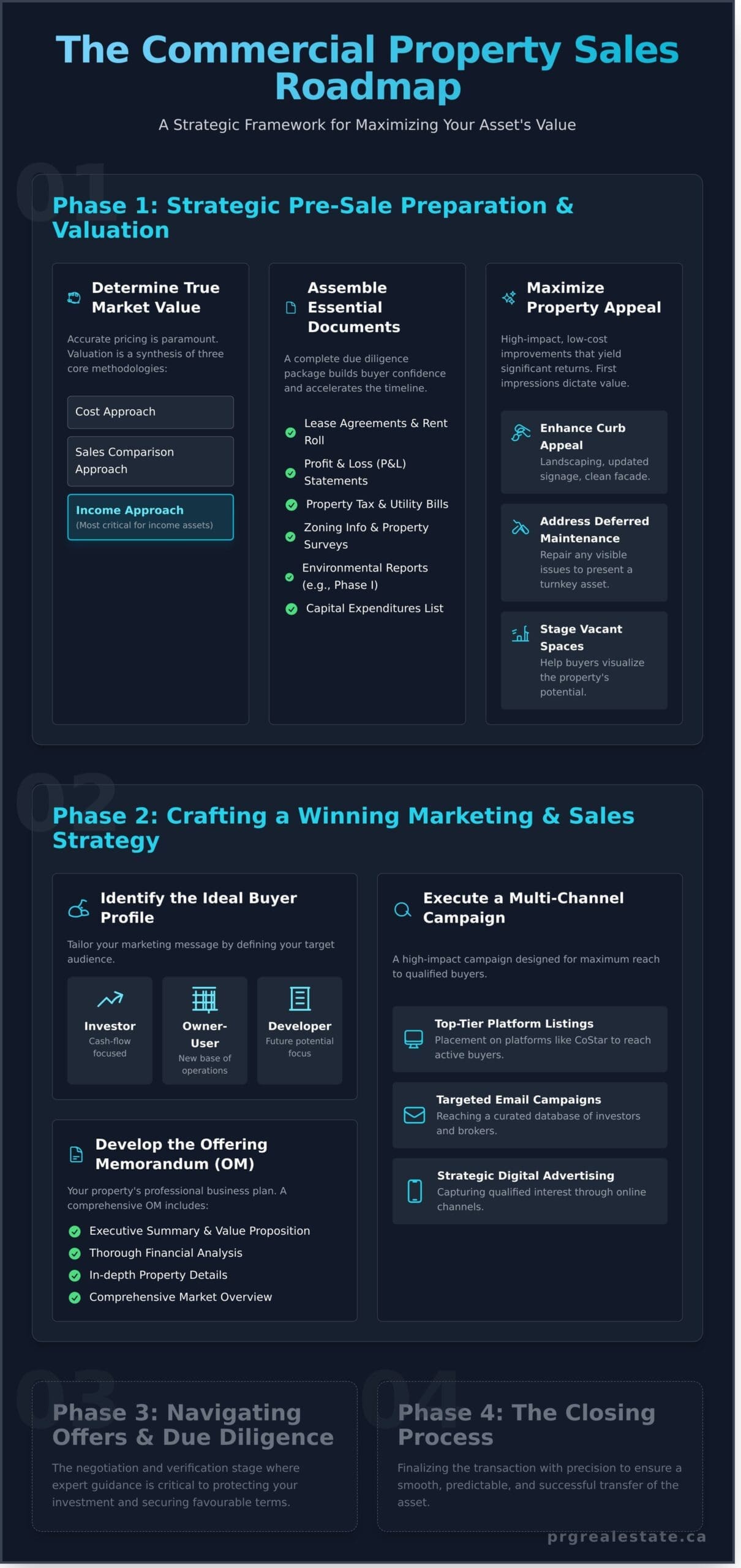
Phase 1: Strategic Pre-Sale Preparation and Valuation

The successful sale of a high-value asset begins long before it hits the market. The initial phase of selling commercial property in the Greater Toronto Area is not about listing, but about meticulous, strategic preparation. This foundational work ensures you enter the market from a position of strength, prepared to maximize your return on investment and facilitate a seamless transaction. Overlooking this stage is the most common and costly mistake an owner can make.

Determining Your Property’s True Market Value

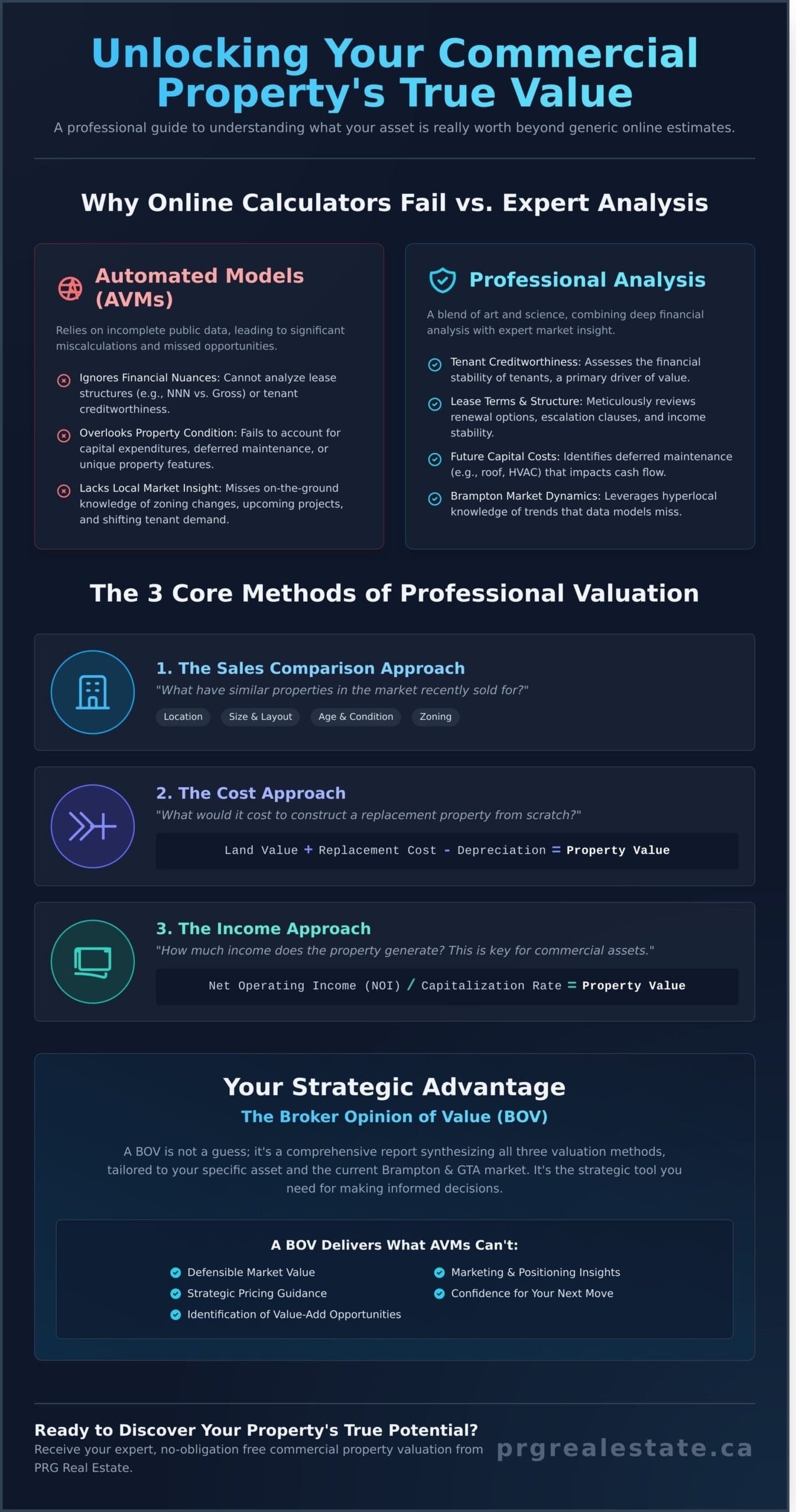
Commercial valuation is a sophisticated, data-driven discipline far removed from residential appraisals. An accurate price is determined by a synthesis of three core methodologies: the Cost Approach (what it would cost to replace), the Sales Comparison Approach (what similar properties have sold for), and most critically for income-generating assets, the Income Approach (its potential to generate revenue). A comprehensive Broker’s Opinion of Value (BOV) from a seasoned commercial real estate expert is essential. This analysis considers not just the numbers, but critical factors like location, zoning regulations, tenant quality, lease terms, and the physical condition of the commercial property itself. Pricing your asset correctly from day one is paramount to attracting qualified buyers and avoiding prolonged, value-eroding time on the market.

Assembling the Essential Documentation Package

A prepared seller is a credible seller. Before listing, our team helps you assemble a comprehensive due diligence package. Having this information organized and ready for review builds immediate buyer confidence and significantly accelerates the transaction timeline. Your package should be complete and accurate, including:

  • Current and historical lease agreements and a detailed rent roll
  • Three years of profit and loss (P&L) statements
  • Recent property tax bills and utility statements
  • Up-to-date zoning information and property surveys
  • Any available environmental reports (e.g., Phase I ESA)
  • A list of recent capital expenditures and planned improvements

Maximizing Appeal: Property Enhancements and Staging

First impressions dictate perceived value. We advise clients on high-impact, low-cost improvements that yield significant returns. This includes enhancing curb appeal with landscaping and updated signage, addressing any deferred maintenance issues, and ensuring the property is immaculately clean and easily accessible for investor tours. For vacant spaces, professional staging can help prospective tenants or buyers visualize the potential. The goal is to present a turnkey, well-maintained asset, clearly highlighting its potential for future development or optimized use to capture maximum investor interest.

Phase 2: Crafting a Winning Marketing and Sales Strategy

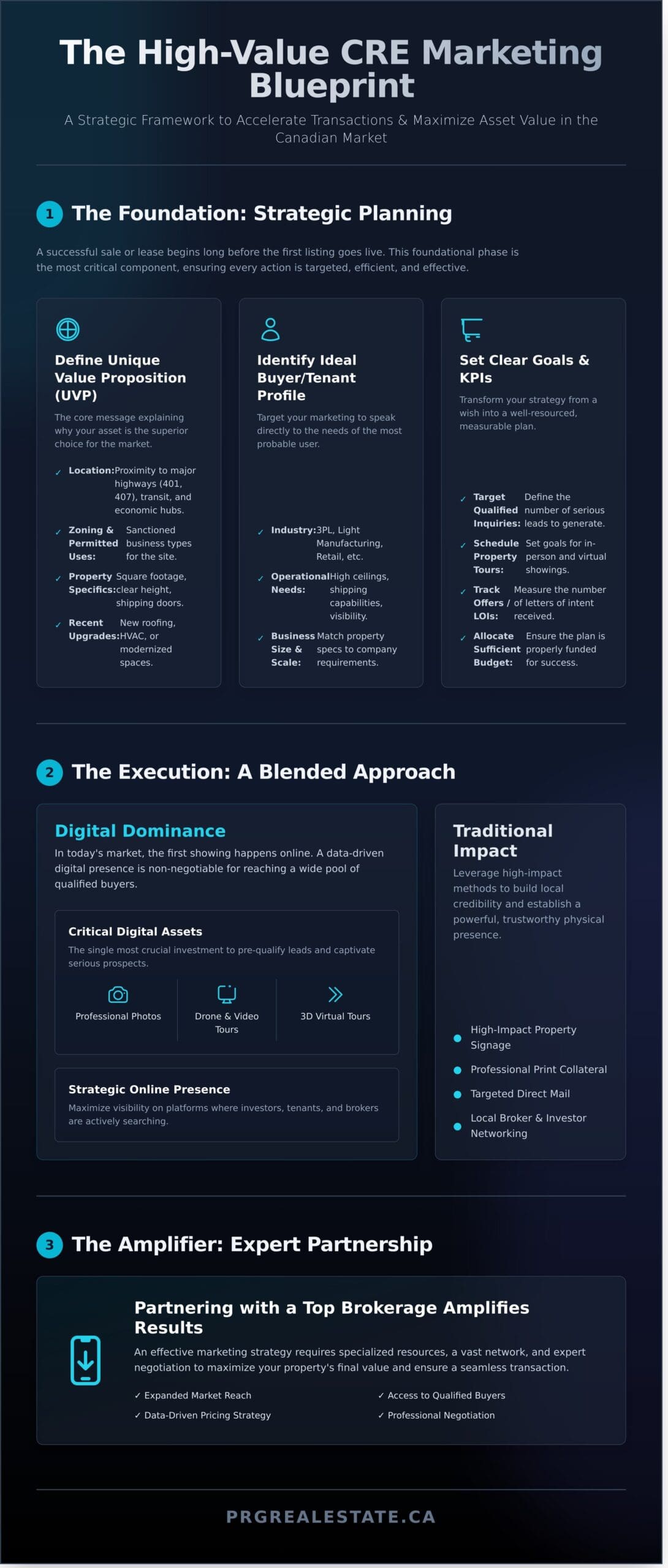
In the competitive Greater Toronto Area market, effective marketing goes far beyond a simple ‘For Sale’ sign. A sophisticated, tailored strategy is essential to attract the most qualified buyers and maximize your property’s value. This involves creating non-negotiable professional marketing materials and leveraging a broker’s extensive network to generate both on-market and off-market interest, ensuring your asset is positioned for optimal results.

Identifying the Ideal Buyer Profile

Success in selling commercial property begins with a clear understanding of your target audience. Is your ideal buyer an investor focused on cash flow, an owner-user seeking a new base of operations, or a developer with an eye for future potential? By defining this profile, we tailor every marketing message to resonate with their specific motivations, preventing wasted time and resources on unqualified leads and focusing exclusively on prospects with genuine intent and capacity.

Developing a Compelling Offering Memorandum (OM)

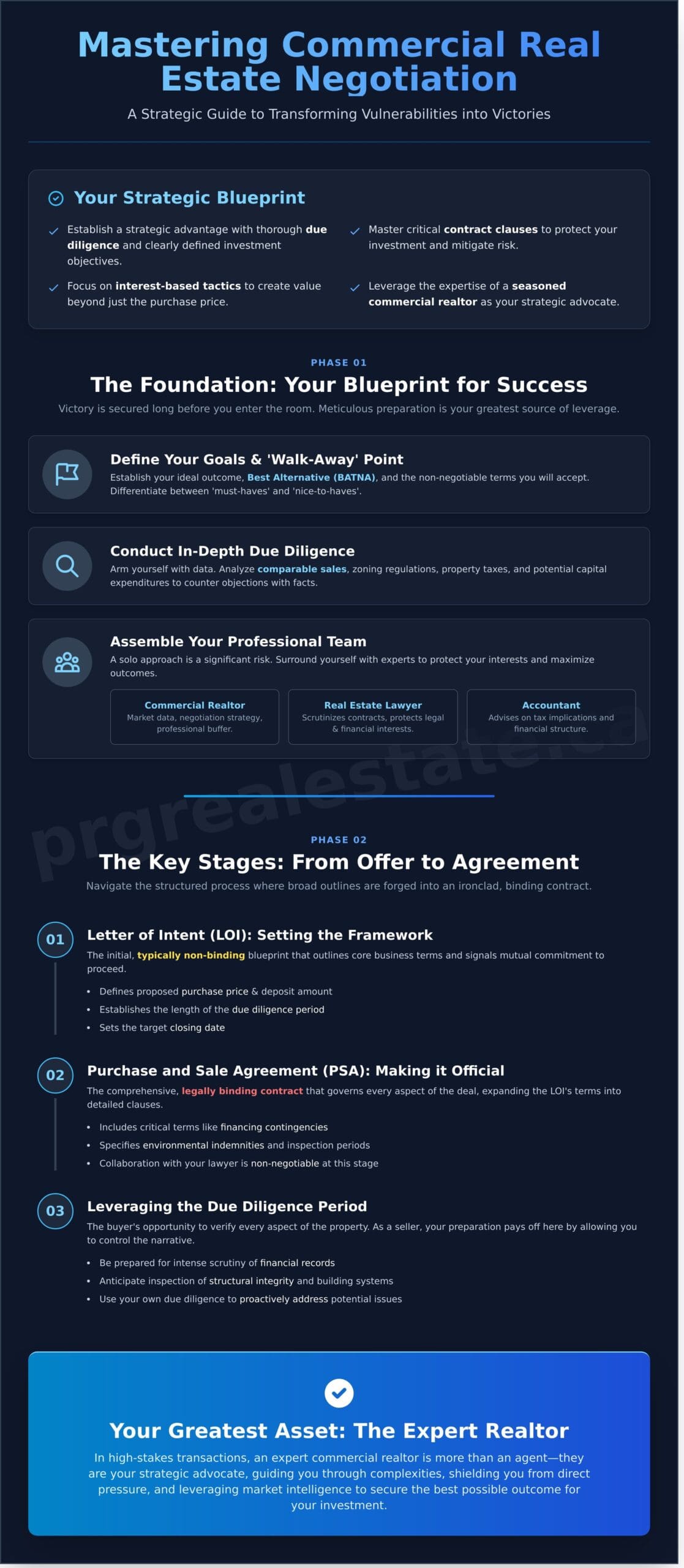
The Offering Memorandum (OM) is the professional business plan for your property. It is your most powerful tool to showcase the investment opportunity and establish credibility. A comprehensive OM must include high-quality photography, detailed floor plans, and critical data points. Key sections include:

  • An Executive Summary highlighting the unique value proposition.
  • A thorough Financial Analysis with rent rolls, operating expenses, and pro-forma projections.
  • In-depth Property Details covering zoning, building specifications, and capital improvements.
  • A Market Overview of the immediate area and broader GTA trends.

A well-structured OM is a cornerstone of any successful sale, providing the essential documentation required to attract serious investors and facilitate informed decision-making.

Executing a Multi-Channel Marketing Campaign

Once your strategy and materials are perfected, we execute a high-impact, multi-channel campaign designed for maximum reach. This includes listing your property on top-tier commercial platforms like CoStar, deploying targeted email campaigns to our curated database of active investors and brokers, and utilizing strategic digital advertising to capture qualified interest. This proactive approach ensures your property is presented to the entire market, not just a fraction of it. See how PRG Real Estate Brokerage’s strategic marketing gets results.

Selling Commercial Property: A Complete Step-by-Step Guide

Phase 3: Navigating Offers and the Due Diligence Gauntlet

Receiving an offer is a significant milestone, but it marks the beginning of the most intricate phase of your transaction. This is a critical stage when selling commercial property, where strategic negotiation and meticulous management determine whether a potential deal closes successfully or collapses under pressure. A results-oriented approach, managed by an expert commercial broker, is non-negotiable to protect your interests and maximize your return on investment.

Evaluating and Negotiating Offers

The most attractive offer isn’t always the one with the highest price. A truly superior offer combines a strong price with favourable terms. Our team conducts a comprehensive analysis of all components to position you for success. Key considerations include:

  • Buyer Credibility: Assessing the buyer’s financial strength, financing pre-approval, and track record in the market.
  • Conditions & Contingencies: Scrutinizing financing, inspection, and zoning conditions that could create risk.
  • Closing Timeline: Ensuring the proposed date aligns with your financial and strategic objectives.

We leverage strategic counter-offers to improve terms, moving methodically toward a binding Agreement of Purchase and Sale (APS) that safeguards your position.

Managing the Due Diligence Period

Once an agreement is conditionally accepted, the buyer begins their due diligence-an intensive verification period that can last 30 to 90 days. Our role is to manage this process with absolute efficiency and transparency. This involves facilitating access for physical inspections, Phase I Environmental Site Assessments (ESAs), financial and lease audits, and comprehensive title searches. By maintaining impeccably organized records and responding promptly to all inquiries, we build buyer confidence and prevent unnecessary delays.

Overcoming Common Hurdles and Re-Negotiations

It is common for buyers to uncover perceived issues during due diligence, often leading to re-negotiation requests. Whether it’s a minor repair or a complex zoning query, these hurdles require a skilled negotiator. The expert guidance provided by the PRG Real Estate team helps you determine when to offer a credit versus making a repair, ensuring minor issues don’t derail the sale. With an unwavering commitment to your goals, we keep the transaction on track, navigating every challenge to achieve a successful and profitable closing.

Phase 4: The Closing Process and Finalizing the Transaction

The final phase of selling your commercial property is where meticulous execution transforms a negotiated offer into a completed sale. This stage is defined by critical legal and financial coordination, demanding professional oversight to navigate complexities and protect your interests. Success hinges on the seamless collaboration between your broker, legal counsel, and the buyer’s representatives to ensure all obligations are met precisely and on schedule.

From Accepted Offer to Binding Agreement (PSA)

Once an offer is accepted, the next critical step is drafting the Purchase and Sale Agreement (PSA). This legally binding contract is prepared by real estate lawyers and must accurately reflect every term, condition, and timeline negotiated. Key clauses to scrutinize include representations and warranties about the property’s condition, closing adjustments for items like property taxes and utilities, and default provisions. This document is the definitive blueprint for the remainder of the transaction.

Coordinating with Lawyers, Lenders, and Title Companies

Effective coordination is paramount to prevent costly delays. Your PRG Real Estate broker acts as the central point of communication, ensuring a fluid exchange of information between all parties. Our role involves:

  • Liaising with both seller and buyer lawyers to facilitate the PSA review.
  • Confirming the buyer’s financing is secured and progressing according to the agreed-upon timeline.
  • Working with the title insurance company to resolve any potential issues or encumbrances on the property title.

This proactive management ensures that the path to closing remains clear and efficient.

The Closing Day: What to Expect

On the closing day, all the preceding efforts culminate in the final transfer. You will review and sign the closing documents, including the Statement of Adjustments, which provides a detailed financial breakdown of the sale. This statement outlines all credits and debits, including the final purchase price, legal fees, and brokerage commissions. Once documents are signed and funds are successfully transferred via the lawyers’ trust accounts, the property ownership is officially registered in the buyer’s name, finalizing the process of selling commercial property.

Navigating the closing process requires unwavering expertise and a commitment to excellence. To ensure your transaction is executed with strategic precision, partner with the experts at PRG Real Estate.

Secure Your Investment’s Future: Partner with a Commercial Real Estate Leader

As this guide has demonstrated, successfully selling commercial property is a multi-faceted endeavor that extends far beyond simply listing a building. From meticulous pre-sale preparation and accurate valuation to executing a sophisticated marketing campaign, every step is critical. Expertly navigating the due diligence gauntlet and ensuring a seamless closing process are the final, crucial pieces to securing an optimal outcome.

Achieving a premium result in this competitive landscape requires a partner with a proven track record. As specialists in the dynamic Brampton and Greater Toronto Area commercial market, the team at PRG Real Estate leverages a strategic, data-driven marketing approach. Our commitment is to position your asset perfectly, attract the most qualified buyers, and ensure your property achieves its highest possible value.

Don’t leave your investment’s potential to chance. Maximize your property’s value. Partner with Brampton’s top commercial realtors.

Take the definitive step toward a successful and profitable transaction today.

Frequently Asked Questions About Selling Commercial Property

What are the typical commission rates for selling a commercial property?

In Canada, commercial real estate commission rates are negotiable and not standardized. They often follow a tiered structure based on the property’s final sale price. For example, a common arrangement is 5% on the first C$1 million and 2.5% on the remaining balance. This commission is typically split between the listing brokerage and the buyer’s brokerage. Engaging an expert commercial realtor ensures you negotiate a structure that aligns with your property’s value and market position for optimal results.

How long does it usually take to sell a commercial property in the Brampton area?

The timeline for selling commercial property in the Brampton area is typically more extended than for residential sales, often ranging from 6 to 12 months or longer. Key factors influencing this timeframe include the asset class (e.g., industrial, retail, office), current market demand, strategic pricing, and the complexity of buyer due diligence. A proactive marketing strategy, managed by top commercial realtors in Brampton, is critical to expediting this process and attracting qualified purchasers efficiently.

What are the main differences between selling commercial and residential real estate?

The key distinction lies in the buyer’s motivation and the transaction’s complexity. Commercial buyers are driven by investment metrics like capitalization rates and ROI, not emotion. The due diligence process is far more intensive, involving analysis of leases, zoning, environmental reports, and financial statements. Consequently, marketing is highly targeted toward specific investors and businesses, unlike the broad-market approach in residential sales, creating a more strategic and data-driven process from start to finish.

What are the capital gains tax implications of selling a commercial property in Canada?

In Canada, when you sell a commercial property, 50% of the capital gain is considered taxable income. A capital gain is the selling price minus the property’s adjusted cost base and any expenses related to its sale. This taxable portion is then added to your income for the year and taxed at your personal or corporate marginal tax rate. We strongly advise consulting with a tax professional to understand the precise implications and explore potential deferral strategies.

How can I ensure confidentiality when selling my business’s property?

Maintaining confidentiality is paramount, especially for an operating business. This is achieved through a strategic, controlled marketing process. We utilize non-disclosure agreements (NDAs) that all prospective buyers must sign before receiving sensitive information. Furthermore, we thoroughly vet all inquiries to ensure only financially qualified and serious parties gain access to property details. This discreet approach protects your operations, employees, and client relationships from unnecessary disruption during the sale.

Can I continue to operate my business in the building during the sales process?

Absolutely. It is standard practice to continue full business operations while your property is on the market. This can be structured in two ways: selling to an investor who values an in-place tenant (your business), or selling to an end-user who will occupy the space after you vacate. A popular strategic option is a sale-leaseback, where you sell the property and simultaneously sign a lease with the new owner, unlocking capital while ensuring business continuity.

The Ontario Development Approval Process: A Developer's Complete Guide
CategoriesBlog

The Ontario Development Approval Process: A Developer’s Complete Guide

Transforming a visionary development concept into a shovel-ready project in Ontario is a significant undertaking, often perceived as a labyrinth of bureaucratic hurdles and potential financial pitfalls. The complexity of the ontario development approval process can be daunting, leaving even seasoned developers concerned about costly missteps, unpredictable timelines, and selecting the correct application path. At PRG, we believe that strategic preparation is the cornerstone of success and that expert knowledge is your most valuable asset.

This comprehensive guide is engineered to eliminate that uncertainty. We provide a clear, chronological roadmap that demystifies each critical stage-from pre-consultation and zoning by-law amendments to site plan control and final permits. You will gain the confidence to navigate municipal requirements effectively, forecast realistic project costs and timelines, and recognize precisely when professional intervention is key to achieving your development goals with unwavering excellence.

Key Takeaways

  • Identifying the correct application path for your project-whether a minor adjustment or a major policy change-is critical to avoiding costly delays.
  • Beyond initial zoning, the Site Plan Approval process is where the technical and design specifics that determine your project’s final look and function are finalized.
  • Gain a realistic understanding of project timelines and potential costs to build a pro-forma that withstands the rigours of the ontario development approval process.
  • Assembling a team of specialized experts is not an expense but a strategic investment that significantly increases your project’s probability of success.

Understanding the Foundation: Ontario’s Land Use Planning Framework

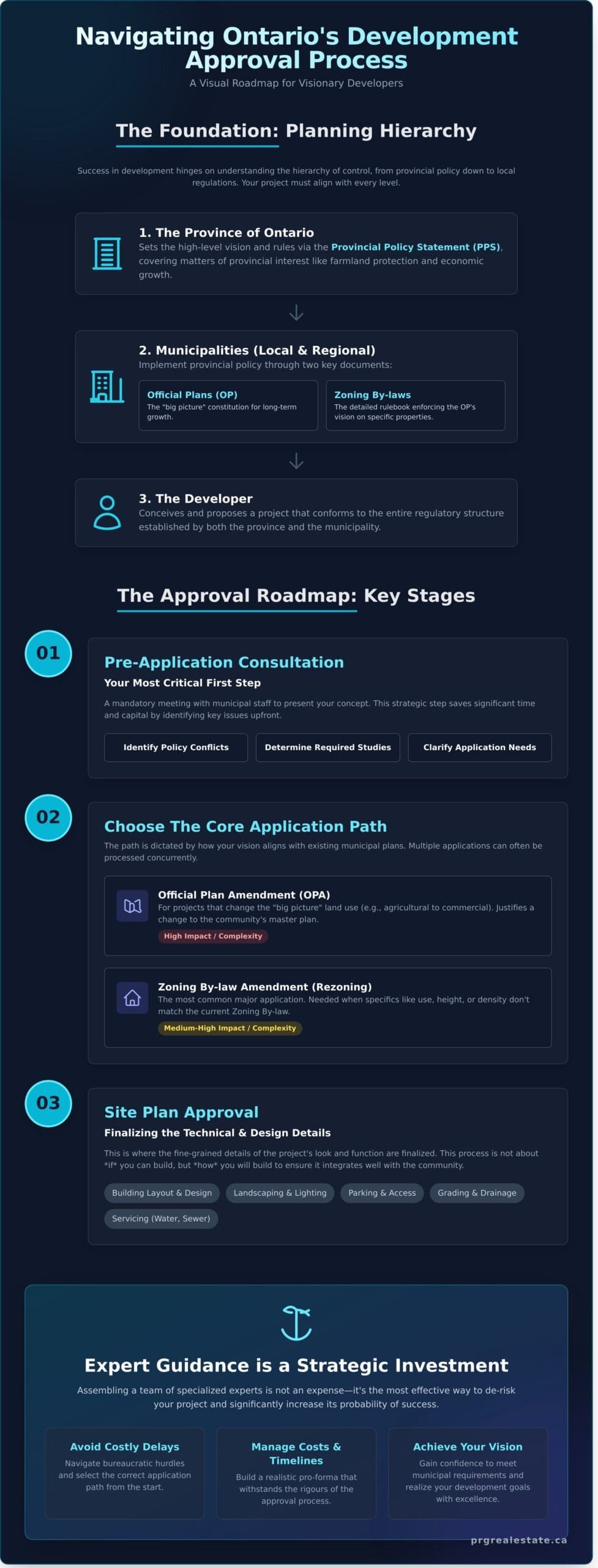
Successful real estate development is not a matter of chance; it is the result of strategic navigation through a complex regulatory landscape. In Ontario, this landscape is defined by a structured framework designed to ensure community growth is orderly, sustainable, and serves the public interest. At the core of the ontario development approval process is the provincial Planning Act, the primary legislation that dictates how land can be used. This creates a clear hierarchy of control, flowing from the province down to the local municipality. Every development proposal, from a minor variance to a major subdivision, must align with this established framework to achieve success.

The Key Players: Province, Municipalities, and the Developer

Navigating this process requires a clear understanding of the distinct roles of each key entity. Success depends on effectively managing the requirements and expectations at each level of this hierarchy:

  • The Province of Ontario: Sets the high-level vision and rules for land use through the Provincial Policy Statement (PPS). The PPS provides overarching direction on matters of provincial interest, such as protecting farmland, managing natural resources, and promoting economic growth.
  • Municipalities: Local and regional governments are responsible for implementing provincial policies on the ground. They create detailed Official Plans to manage long-term growth and enact specific Zoning By-laws to regulate day-to-day land use with precision.
  • The Developer: As the proponent, your role is to conceive of a project that not only meets your investment objectives but also conforms to the entire regulatory structure established by both the province and the municipality.

Official Plans vs. Zoning By-laws: What’s the Difference?

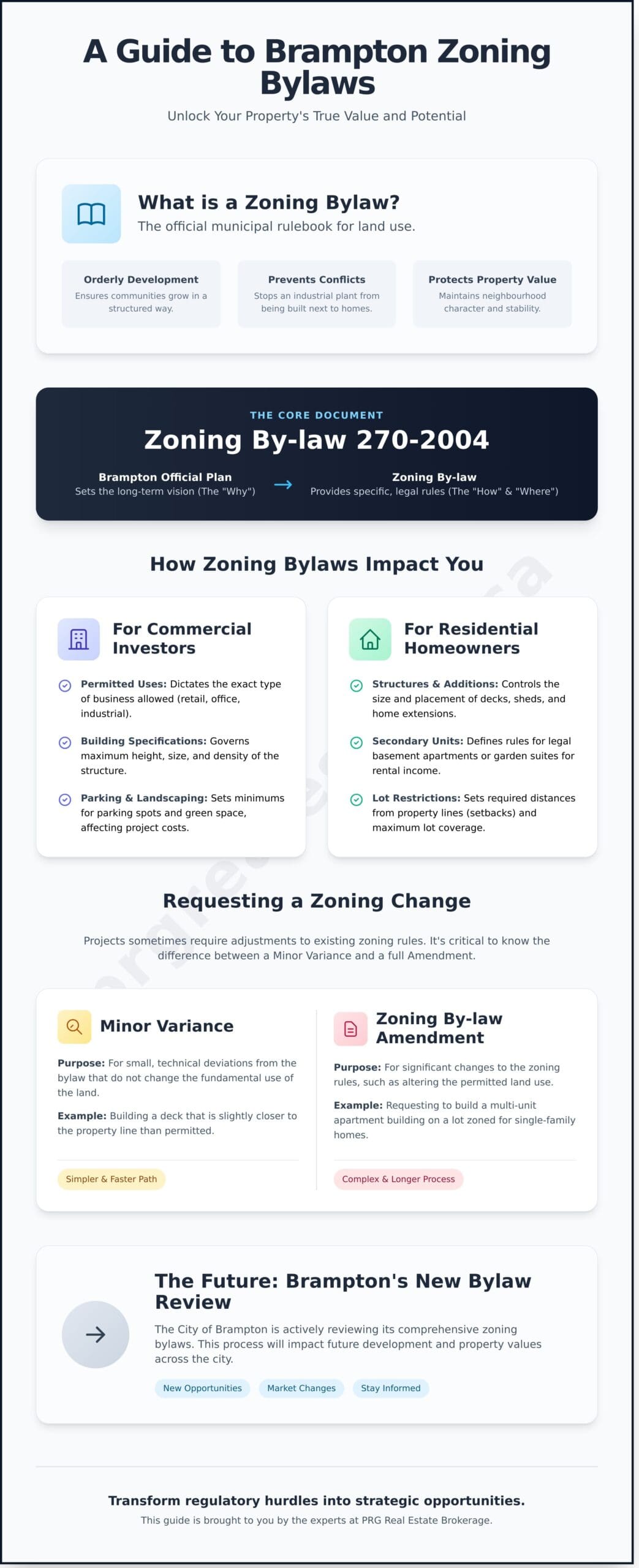
Think of the Official Plan (OP) as a municipality’s “big picture” constitution for land use-a long-term vision outlining where residential, commercial, and industrial growth should occur. The Zoning By-law is the detailed rulebook that enforces this vision, specifying exactly what can be built on a property, including permitted uses, building heights, and setbacks. Your project must comply with both. If it doesn’t, you must apply for an Official Plan Amendment or a Zoning By-law Amendment. Should a municipality deny such an application, the decision can often be appealed to the Ontario Land Tribunal for a final ruling.

Pre-Application Consultation: Your Most Important First Step

Before a single drawing is finalized or an application fee is paid, the most critical step in the ontario development approval process is the Pre-Application Consultation. This is typically a mandatory meeting with municipal planning staff to present your preliminary concept. Its purpose is strategic: to identify key policy conflicts, required technical studies (e.g., traffic, environmental, servicing), and the specific requirements for a complete application. Engaging in this process early is not a formality; it is an essential investment that saves significant time and capital by preventing costly redesigns and unforeseen delays.

The Core Application Types: Which Path Will Your Project Take?

Navigating the ontario development approval process requires a strategic understanding of which application stream your project falls into. The path is dictated by how your vision aligns with the municipality’s existing land use policies. Think of it this way: are you proposing a minor tweak to the established rules, or a significant rewrite for your property’s future? Each scenario demands a different approach, governed by Ontario’s Land Use Planning Framework. Successfully managing these applications is critical, and it’s important to note that multiple submissions are often required and can be processed concurrently to optimize timelines.

Here are the most common application streams developers will encounter:

Official Plan Amendment (OPA): Changing the Big Picture

An OPA is necessary when your project’s proposed land use is fundamentally not permitted by the municipality’s Official Plan-the document that sets out the long-term vision for the community. For instance, seeking to build a commercial plaza on land designated for agricultural use would require an OPA. This is a significant and often lengthy process that demands expert navigation and a compelling planning rationale to justify the change to the community’s master plan.

Zoning By-law Amendment (Rezoning): Aligning Rules with Your Vision

This is the most common major application for new developments. A Zoning By-law Amendment, or rezoning, is required when your project’s specific use, density, height, or setbacks differ from the current zoning by-law. A classic example is proposing a mid-rise apartment building on a lot zoned exclusively for single-family homes. This application is essential for aligning the detailed local rules with your development goals.

Plan of Subdivision/Condominium: Creating New Parcels of Land

When a project involves dividing a large property into smaller, legally distinct parcels for sale, a Plan of Subdivision or Condominium is required. This process is foundational for creating new housing developments, office parks, and industrial lots. It’s crucial to distinguish between the two:

  • A Plan of Subdivision creates new, separate lots of land with frontage on a public road.
  • A Plan of Condominium creates legal title to individual units within a shared property, without subdividing the land itself.

Minor Variance & Consent to Sever: For Smaller Adjustments

For less complex changes, two more streamlined processes exist. A Minor Variance is sought for small deviations from the zoning by-law, such as a minor adjustment to a required building setback that doesn’t alter the general intent of the by-law. A Consent to Sever is used to create one or two new lots from an existing property. These applications are typically faster and less intensive than a full rezoning or OPA, making them ideal for smaller-scale projects.

The Site Plan Approval Process: Bringing Your Vision to Life on Paper

Once you have successfully navigated the initial zoning and policy hurdles, the ontario development approval process moves into a highly detailed, technical phase: Site Plan Approval. This stage transitions from the broad strokes of land use to the fine-grained details of your project’s physical design and function. Governed by Section 41 of the Planning Act, municipalities designate specific areas as ‘Site Plan Control Areas.’ If your property falls within one of these zones, securing Site Plan Approval is a mandatory step toward obtaining a building permit.

What a Site Plan Application Includes

A Site Plan Application is a comprehensive package of documents that provides a complete technical blueprint of your proposed development. It goes far beyond a simple sketch, requiring a suite of professional submissions that demonstrate the project’s viability, safety, and integration with the surrounding community. A typical submission package will include:

  • Detailed Architectural Drawings: Complete building elevations, floor plans, and cross-sections that illustrate the design, materials, and massing of all proposed structures.
  • Site Servicing and Grading Plans: Technical drawings showing connections to municipal water, sanitary, and storm sewers, as well as how the land will be graded for proper drainage.
  • Landscape, Parking, and Lighting Plans: Detailed layouts for all outdoor areas, including plant selections, parking stall configurations, barrier-free access, and specifications for exterior lighting to ensure safety without creating light pollution.
  • Supporting Technical Studies: Depending on the project’s scale, this may include a Stormwater Management Report, a Traffic Impact Study, an Arborist Report, and a Geotechnical Study.

Navigating the Circulation and Revision Cycle

Upon submission, your application is circulated to various municipal departments (e.g., Engineering, Planning, Parks and Recreation) and external agencies like the local Conservation Authority or regional government. Each department provides expert commentary based on their specific mandate. As detailed in Ontario’s official guide to the plan review and approval process, this collaborative review is fundamental. Receiving requests for revisions is a standard and expected part of this cycle. Successfully navigating this phase requires a skilled project manager who can efficiently coordinate responses from your team of consultants, ensuring a timely and strategic resolution to all comments.

The Site Plan Agreement: Your Legal Commitment

The culmination of a successful review is the Site Plan Agreement. This is a legally binding contract between you, the developer, and the municipality. It contractually obligates you to develop the property precisely in accordance with the approved plans and studies. This agreement is typically registered on the title of the property, binding all future owners. To guarantee the completion of required site works, the agreement will also outline financial securities, such as a Letter of Credit, that you must provide to the municipality. This ensures that public-facing elements like landscaping, sidewalks, and services are completed to the municipality’s standards.

The Ontario Development Approval Process: A Developer's Complete Guide

Timelines, Costs, and Key Challenges to Anticipate

For any developer, the most critical variables in a project’s pro-forma are time and money. Understanding the realistic timelines and costs associated with the ontario development approval process is not just beneficial-it is essential for financial viability. Proactive planning, informed by expert insight, is the most effective strategy to mitigate delays and prevent significant budget overruns. This section provides the strategic foresight needed to avoid common and costly mistakes.

Mapping the Timeline: How Long Does Approval Really Take?

While every project is unique, application timelines generally fall within predictable ranges. It is crucial to note that these are estimates and can vary significantly based on municipal staff resources, application complexity, and the potential for appeals.

  • Minor Variance or Consent: Typically the fastest, ranging from 3-6 months.
  • Site Plan Approval: A more detailed process that can take anywhere from 6-18 months, contingent on the project’s scale and technical requirements.
  • Zoning By-law Amendment / Official Plan Amendment (OPA): These are the most intensive applications, often requiring 12-24 months or more to secure a decision.

Budgeting for Success: Hard and Soft Development Costs

A comprehensive budget must account for costs incurred long before any ground is broken. These are broadly categorized as soft and hard costs.

Soft Costs are the upfront investments required to prepare and process your application. This capital is at risk before project approval is certain and includes municipal application fees, legal fees, and consultant fees for your team of planners, engineers, architects, and surveyors.

Hard Costs are typically paid later, after approvals are in place. These include substantial expenses like Development Charges (DCs), parkland dedication fees (or cash-in-lieu), and building permit fees, which are calculated based on the project’s final approved design.

Common Pitfalls and How to Avoid Them

Navigating the approval landscape requires diligence. Three common pitfalls consistently cause delays and escalate costs:

  • Incomplete Submissions: A poorly prepared application is the fastest route to delay. Municipalities will return incomplete packages, forcing you to restart the clock.
  • Underestimating Community Consultation: Neglecting early and meaningful engagement with community members and local councillors can lead to organized opposition and potential appeals.
  • Poor Consultant Coordination: A development team must operate in lockstep. A lack of coordination between planners, engineers, and architects can result in conflicting reports and costly revisions.

Successfully navigating the complexities of the development approval process in Ontario demands a team with a proven track record. At PRG Real Estate Brokerage, our expertise ensures your project is positioned for success from day one, transforming challenges into opportunities for growth.

Why Expert Guidance is Your Most Valuable Asset

Navigating the intricate landscape of land development is not a solo venture. Viewing professional consultation as a cost is a critical misstep; it is, in fact, a strategic investment in efficiency, risk mitigation, and profitability. The complexity of the ontario development approval process demands a multi-disciplinary team of experts working in concert. A well-coordinated team doesn’t just prevent costly errors and delays-it actively accelerates timelines and unlocks the full potential of your project.

Assembling Your Development A-Team

Success requires a roster of specialists, each with a critical role. Your core team is the foundation upon which a successful project is built, ensuring every technical, legal, and regulatory requirement is met with precision.

  • Planner: Your primary strategist and guide through the municipal bureaucracy. They prepare and submit applications, liaise with city staff, and ensure your proposal aligns with the Official Plan and zoning by-laws.
  • Engineer & Architect: The technical experts responsible for the project’s design and viability. They create the site plans, architectural drawings, and technical studies required to prove the project is feasible, safe, and serviceable.
  • Lawyer: Your legal counsel for drafting complex agreements, navigating land title issues, and representing your interests in negotiations or potential appeals to the Ontario Land Tribunal.

The Strategic Role of a Development-Focused Realtor

A specialized development realtor is more than an agent; they are a pivotal strategic partner from day one. Their value extends far beyond the transaction, providing the market intelligence and access needed to ensure your project is viable before you even begin the ontario development approval process. They provide crucial upfront market analysis and site selection advice, identifying parcels of land with the highest potential for rezoning and profitability.

Furthermore, their established relationships with landowners and industry players can unlock exclusive off-market opportunities and land assemblies that are never publicly listed. With a deep understanding of municipal politics and planning department priorities, they help position your project for a smoother, more predictable approvals journey. Their insight is foundational to achieving your development goals. Leverage our development expertise for your next project.

Your Strategic Partner in Navigating Ontario’s Development Landscape

Successfully navigating the intricate ontario development approval process demands more than a blueprint; it requires strategic foresight and deep-seated expertise. From understanding the foundational land use framework to mastering the site plan approval stage, the path to breaking ground is complex. The key to mitigating risks and maximizing your return on investment lies in securing expert guidance from a team that knows the terrain.

At PRG Real Estate, our proven expertise in GTA real estate development sets us apart. As top commercial realtors in Brampton, we are driven by a commitment to developing thriving communities, transforming ambitious visions into tangible assets. We leverage our industry leadership and unwavering dedication to excellence to streamline every stage of your project, ensuring your objectives are met with precision and efficiency.

Don’t let regulatory hurdles slow your progress. Navigate your development project with confidence. Contact PRG’s experts today. Your vision for a landmark development is within reach.

Frequently Asked Questions

What is the difference between an Official Plan and a Zoning By-law?

An Official Plan is a municipality’s strategic vision, outlining broad policies for long-term growth and land use. In contrast, a Zoning By-law is a detailed, legally binding document that implements the Official Plan’s vision. It specifies exactly how land can be used, dictating building heights, setbacks, and permitted uses for every property. Your development proposal must conform to both of these critical planning documents to secure approval.

Can I appeal a municipal decision on my development application?

Yes, in many cases, a municipal council’s decision on a development application can be appealed to the Ontario Land Tribunal (OLT). This applies if your application is refused or if the municipality fails to make a decision within the statutory timeframe. However, appeal rights are governed by strict rules and deadlines under the Planning Act. Securing expert representation is critical to navigate this complex process and build a strong case for a successful appeal.

What are Development Charges (DCs) and when do I have to pay them?

Development Charges (DCs) are fees levied by municipalities on new developments to help pay for the capital costs of growth-related infrastructure, such as roads, water systems, and emergency services. These charges ensure that the financial burden of new infrastructure does not fall solely on existing taxpayers. In Ontario, DCs are typically calculated and payable at the time a building permit is issued for the project, representing a significant financial milestone.

How important is community and public consultation in the approval process?

Community and public consultation is a critical and often mandatory component of the ontario development approval process. Engaging with local residents and stakeholders proactively can identify potential issues early, build support for your project, and mitigate the risk of appeals. A well-executed consultation strategy demonstrates a commitment to community building and can significantly streamline the path to receiving a final decision from council, preventing costly delays and fostering positive relationships.

What is the Ontario Land Tribunal (OLT) and what is its role?

The Ontario Land Tribunal (OLT) is an independent adjudicative body that resolves disputes related to land use planning. Its primary role is to hear appeals on decisions made by municipalities regarding applications under the Planning Act, such as Official Plan amendments and zoning changes. The OLT functions like a court for planning matters, making final, legally binding decisions based on evidence and provincial policies, ensuring consistent application of planning law across Ontario.

Do I need a lawyer for the development approval process?

While not mandatory for an initial application, engaging a planning lawyer is a strategic investment for navigating the complex ontario development approval process. An experienced lawyer ensures your application is robust, interprets intricate municipal and provincial policies, and provides critical representation during negotiations or appeals. For complex projects or any matter proceeding to the Ontario Land Tribunal, legal counsel is not just advisable-it is essential for protecting your interests and achieving a successful outcome.

Real Estate Development Consultation: A Guide to Maximizing Your Project's ROI
CategoriesBlog

Real Estate Development Consultation: A Guide to Maximizing Your Project’s ROI

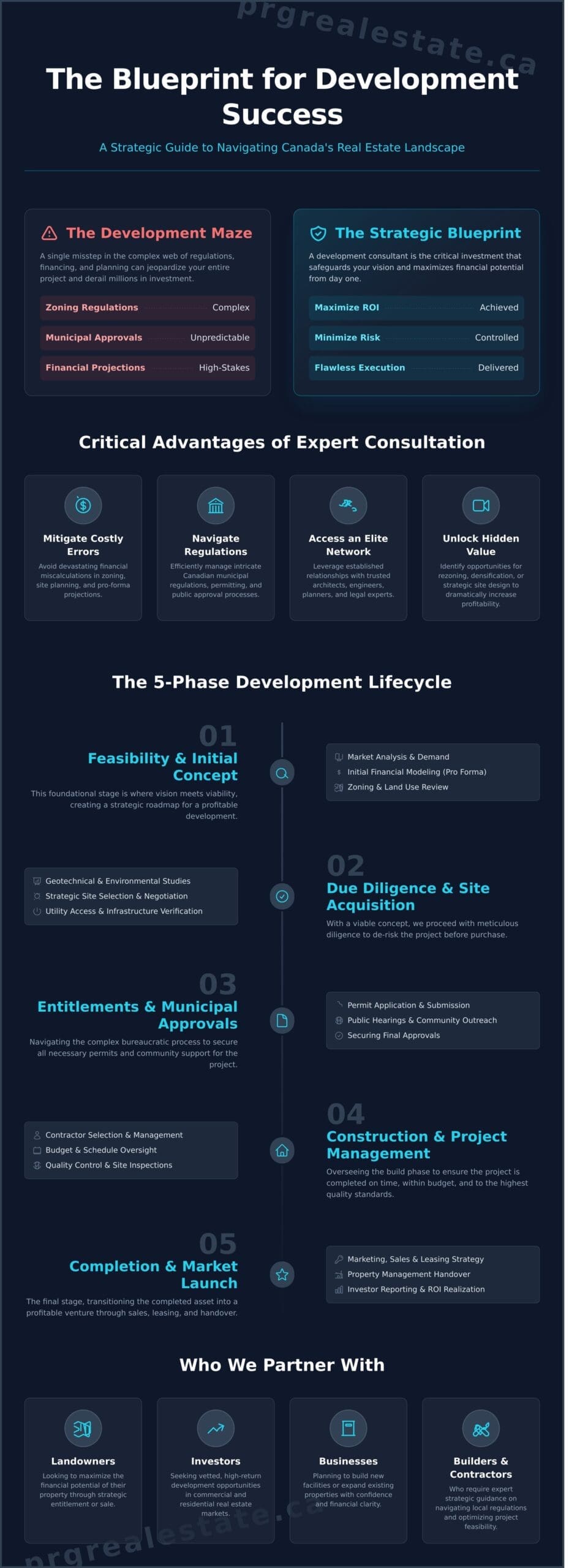
The path from a promising plot of land to a completed, profitable development is fraught with complexity. Zoning regulations, municipal approvals, and financial projections can feel like an insurmountable maze, where a single misstep can jeopardize millions of Canadian dollars and derail your entire project. This is where strategic guidance becomes your most valuable asset. Engaging in professional real estate development consultation is not an expense; it is the critical investment that safeguards your vision and maximizes its financial potential from day one.

This comprehensive guide is designed to demystify the entire process. We will provide a clear, step-by-step roadmap, from initial feasibility studies and securing financing to navigating the intricate web of Canadian municipal approvals. You will gain the confidence and expert knowledge required to build a successful project without critical errors, ensuring your investment delivers the highest possible return. Prepare to transform your ambitious concept into a thriving reality, built on a foundation of expert strategy and flawless execution.

Key Takeaways

  • Shift your perspective from a single transaction to a strategic investment by understanding how a consultant maps out a project for maximum ROI.
  • Learn the five critical phases of the development lifecycle and how an expert guide ensures you navigate each stage with confidence and precision.
  • Discover the essential roles on a development ‘dream team’ and why your consultant is the most critical player for coordinating a successful outcome.
  • Arm yourself with the essential criteria for selecting the right real estate development consultation firm to protect your investment and drive profitability.

What is Real Estate Development Consultation? Your Strategic Blueprint for Success

Real estate development consultation is the strategic process of guiding a project from its initial concept to a successful and profitable completion. It moves beyond simple transactions to encompass the entire lifecycle of a development. While a comprehensive understanding of what is real estate development covers the multifaceted activities involved, a consultant acts as the project’s lead strategist or ‘quarterback’. Their role is to orchestrate every critical phase, ensuring all components align to achieve the highest possible return on investment.

This is fundamentally different from hiring a realtor to acquire land or a builder to handle construction. A development consultant’s primary objective is to ensure your project is feasible, profitable, and meticulously executed. We analyze market viability, navigate complex entitlements, and create a comprehensive blueprint that minimizes risk and maximizes value before a single shovel breaks ground. Our expert real estate development consultation provides the foresight and strategic direction essential for success in Canada’s competitive market.

Why You Can’t Afford to Skip Expert Consultation

Attempting to navigate the development landscape without an expert guide is a high-stakes gamble. A seasoned consultant provides the critical oversight needed to transform vision into reality, safeguarding your investment at every turn. Key advantages include:

  • Mitigating Costly Errors: Avoid devastating financial miscalculations in zoning, site planning, and pro-forma projections that can derail a project.
  • Navigating Complex Regulations: Efficiently manage intricate Canadian municipal regulations, permitting, and the public approval processes that often cause significant delays.
  • Access to an Elite Network: Leverage our established relationships with trusted architects, engineers, planners, and legal experts to assemble a top-tier project team.
  • Unlocking Hidden Value: Identify opportunities for rezoning, densification, or strategic site design that can dramatically increase a property’s profitability.

Who Needs a Development Consultant?

Professional guidance is not reserved for large-scale developers. A wide range of stakeholders partner with us to achieve their development objectives:

  • Landowners looking to maximize the financial potential of their property through strategic entitlement or sale.
  • Investors seeking vetted, high-return development opportunities in the commercial and residential real estate markets.
  • Businesses planning to build new facilities or expand existing properties with confidence and financial clarity.
  • Builders and Contractors who require expert strategic guidance on navigating local regulations and optimizing project feasibility.

The 5 Key Phases of Development: A Consultant’s Step-by-Step Process

Navigating the complexities of property development requires a strategic, structured approach. Our real estate development consultation transforms this intricate process into a manageable, five-phase journey, providing the clarity and control necessary to make informed decisions. This framework ensures each stage builds logically upon the success of the last. A methodical process, as outlined in industry resources like the Prologis’ Guide to Real Estate Development, is not just best practice-it is essential for securing financing from Canadian institutions and gaining crucial municipal support for your project.

Phase 1: Feasibility & Initial Concept

This foundational stage is where vision meets viability. We conduct rigorous market analysis to confirm demand, perform initial financial modeling (pro forma) to project costs and return on investment, and review municipal zoning and land use policies to ensure alignment. The outcome is a clear, high-level concept and a strategic roadmap for a successful and profitable development.

Phase 2: Due Diligence & Site Acquisition

With a viable concept established, we proceed with meticulous due diligence to de-risk the project. This critical phase involves:

  • Coordinating essential technical studies, including geotechnical and environmental assessments.
  • Assisting in strategic site selection and the negotiation of purchase agreements.
  • Verifying utility access, servicing, and existing infrastructure capacity.
  • Developing a detailed project budget to secure initial financing commitments.

Phase 3: Entitlements & Municipal Approvals

Securing official approval is a pivotal milestone. Our experts manage the entire entitlements process, from submitting applications for rezoning and site plan approval to leading community engagement and presentations to planning committees. We navigate complex local bylaws and coordinate directly with city planners to address feedback and ensure all requirements are met efficiently.

Phase 4: Pre-Construction & Design

Here, the vision begins to take physical shape. We oversee the selection of a best-in-class team of architects, engineers, and contractors. Our role includes managing the detailed design and construction drawing process, implementing value engineering to optimize costs without compromising quality, and securing all necessary building permits to prepare for groundbreaking.

Phase 5: Construction & Project Delivery

The final phase focuses on execution and excellence. Our oversight continues through the construction process, managing budgets, timelines, and contractor communications to mitigate risks. We coordinate final inspections, secure occupancy permits, and ensure a seamless project handover, turning your approved design into a tangible, high-value asset.

Assembling Your Development Dream Team: Key Professionals and Their Roles

Executing a successful real estate development project is not a solo endeavour; it is a complex symphony of specialized expertise. Success hinges on assembling a team of top-tier professionals, each a master of their respective field. The value of a comprehensive real estate development consultation is its ability to act as the central point of contact, coordinating every expert and ensuring they are perfectly aligned with the project’s strategic goals, timeline, and budget. This orchestrated approach prevents costly delays, communication gaps, and critical budget overruns.

The Core Team: Architect, Planner, and Civil Engineer

Every project is built on a foundation of three key disciplines that transform a raw piece of land into a viable site. These professionals work in tandem to create the project’s blueprint.

  • Architect: Responsible for the building’s design, translating your vision into functional, aesthetic, and compliant construction plans.
  • Urban Planner: The strategic expert who navigates complex municipal zoning bylaws, official plans, and land-use policies to secure necessary approvals.
  • Civil Engineer: Manages the site’s essential infrastructure, including grading, servicing for water and sewer, and stormwater management systems.

Essential Technical & Legal Experts

Beyond the core design, a team of technical specialists is required to mitigate risk and ensure compliance with Canadian regulations. Their due diligence is critical for a secure investment.

  • Real Estate Lawyer: Handles all legal aspects, from the initial land acquisition and contract negotiation to navigating development agreements and final closing.
  • Geotechnical Engineer: Analyzes soil, rock, and groundwater conditions to provide critical recommendations for a stable and cost-effective foundation design.
  • Environmental Consultant: Conducts Phase I and II Environmental Site Assessments (ESAs) to identify and address any potential site contamination.

Financial and Sales Partners

Bringing the project to life and ensuring its commercial success requires strategic financial and sales expertise. These partners secure the necessary capital and drive revenue upon completion.

  • Mortgage Broker/Lender: Sources and structures the optimal construction financing and long-term mortgages required to fund the project.
  • Real Estate Brokerage: Develops and executes the marketing strategy, managing pre-construction sales, leasing campaigns, and the final sale of the completed assets.

Coordinating this diverse group of experts is the cornerstone of successful project management. Let PRG help you build your expert development team, ensuring seamless execution from concept to completion.

Real Estate Development Consultation: A Guide to Maximizing Your Project's ROI

Real estate development is a hyper-local discipline. A successful strategy in Toronto or Mississauga can fail in Brampton if it doesn’t account for the unique municipal vision, political climate, and community expectations. The Greater Toronto Area is not a monolithic market; it is a complex tapestry of distinct municipalities, each with its own official plans, zoning bylaws, and growth priorities. True success requires more than just capital; it demands an intimate understanding of regional infrastructure projects, like the Hurontario LRT extension, and how they will reshape communities. A strategic real estate development consultation provides this critical on-the-ground intelligence.

At PRG Real Estate Brokerage, our expertise is deeply rooted in this landscape. We don’t just see properties; we see potential shaped by local policy and future growth. Our established relationships with municipal planners, engineering departments, and local councils are a key asset, enabling us to streamline approvals and proactively address potential roadblocks before they become costly delays.

Understanding Brampton’s Official Plan & Zoning

Aligning your project with Brampton’s ‘2040 Vision’ is non-negotiable for securing approvals. This forward-thinking plan prioritizes sustainable, transit-oriented communities. We guide clients in navigating specific zoning bylaws for residential, commercial, and industrial lands, ensuring your proposal contributes to the city’s goals. Our focus is on identifying prime opportunities within key development corridors and intensification areas, such as those along Queen Street and around major transit hubs, to maximize your investment’s potential and secure municipal support.

Key Challenges in the GTA Market

Successfully developing in the GTA means strategically overcoming significant financial and logistical hurdles. Our consulting services are designed to mitigate these risks and protect your bottom line. Key challenges we help you master include:

  • Managing Costs: Navigating volatile land acquisition prices and high construction costs (C$) requires precise financial modeling and strategic procurement.
  • Navigating Municipal Fees: We provide clarity and strategic planning for Development Charges (DCs), parkland dedication fees, and other levies that can significantly impact project viability.
  • Stakeholder Engagement: Effectively addressing community feedback and satisfying stakeholder concerns is crucial for a smooth approvals process. We help craft a narrative that builds consensus and support.

Leveraging local knowledge is the difference between a stalled project and a thriving community. A comprehensive real estate development consultation with our team equips you with the strategic advantage needed to navigate this competitive landscape. Discover how our expertise can drive your project forward by exploring our services at prgrealestate.ca.

How to Choose the Right Real Estate Development Consultant

Selecting the right partner for your project is the single most important decision you will make at the outset. A top-tier consultant is more than a service provider; they are a strategic advisor whose expertise directly impacts your project’s viability and profitability. To make an informed choice, you need a clear framework for evaluation. This checklist empowers you to identify a partner committed to excellence and equipped to navigate the complexities of development.

Look for a Proven Track Record

A consultant’s past performance is the most reliable indicator of future success. Vague promises are insufficient; demand concrete evidence of their capabilities. When vetting potential partners for your real estate development consultation, insist on the following:

  • A comprehensive portfolio: Review their successfully completed projects, paying close attention to those that mirror the scale and scope of your own vision.
  • Relevant experience: Have they managed residential subdivisions, commercial plazas, or high-density infill projects in a market like Brampton? Their experience must be directly applicable.
  • Verified accolades: Look for credible client testimonials, case studies, and industry awards that substantiate their reputation for delivering results.

Verify Local Market Expertise

Real estate development is hyper-local. A consultant who lacks deep-rooted knowledge of your specific municipality is a liability. They must demonstrate an intricate understanding of Brampton’s unique regulatory landscape, including zoning bylaws, the Official Plan, and development charges. Ask them how they maintain relationships with key municipal staff and how they stay ahead of evolving policies that could impact your project timeline and budget.

Assess Their Network and Approach

An elite consultant brings more than just their own knowledge; they bring an established network of top-tier professionals, including architects, engineers, planners, and legal counsel. Their approach should be holistic and strategic, integrating every phase of the development cycle from initial feasibility studies to final approvals. Their communication must be clear, professional, and consistently focused on achieving your objectives. The right firm provides a comprehensive advisory service, ensuring every decision is aligned with your ultimate goals. See why PRG is the trusted choice for development in Brampton.

Transform Your Vision into a Landmark Success

Embarking on a real estate development project is a significant undertaking, where success is measured by both profitability and lasting community impact. As this guide has detailed, maximizing your ROI is not a matter of chance but the result of a meticulously executed strategy. It requires a deep understanding of the key development phases, the assembly of a skilled professional team, and invaluable local market knowledge. This is where professional real estate development consultation proves indispensable, providing the expert framework to navigate challenges and capitalize on opportunities.

At PRG Real Estate, we embody this strategic approach. With unparalleled expertise in the dynamic Brampton and GTA real estate markets, we have a proven track record of developing thriving communities. Our commitment is to provide unwavering strategic guidance, steering your project from its initial concept to a successful final sale. We don’t just manage projects; we build legacies and create clients for life.

Your ambition deserves a partner dedicated to excellence. Partner with PRG to bring your development vision to life. Contact our experts today.

Frequently Asked Questions

What is the first step in starting a real estate development project?

The foundational first step is a comprehensive feasibility study. This strategic assessment involves a detailed site analysis, rigorous market research, and the creation of a financial pro forma to project costs and potential returns. This due diligence is critical as it determines the project’s overall viability and informs every subsequent decision in the development lifecycle. Our experts guide you through this essential process to ensure your project is built on a solid foundation for success.

How much does real estate development consultation typically cost?

Consultation fees are structured to align with the scope and complexity of your project. Costs can be based on an hourly rate, a fixed fee for specific deliverables, or a percentage of the total project value. At PRG, we provide a transparent and detailed proposal outlining all associated costs in Canadian Dollars (C$) after an initial assessment of your objectives. This ensures you have a clear understanding of the investment required to leverage our expert guidance.

How long does the municipal approval process take in the GTA?

Navigating the municipal approval process in the Greater Toronto Area is a complex undertaking with variable timelines. For straightforward projects, approvals may take 12 to 18 months. However, more complex applications involving rezoning or Official Plan amendments can often extend to 24 months or longer. Our team’s expertise in dealing with various GTA municipalities helps streamline this process, manage expectations, and proactively address potential delays to keep your project moving forward efficiently.

Can a consultant help me secure financing for my project?

Absolutely. A key role of a development consultant is to position your project for successful financing. We prepare a comprehensive and professional financing package, including detailed market analysis, robust pro forma financials, and a compelling development plan. Leveraging our extensive network of lenders, from major Canadian banks to private capital firms, we connect you with the most suitable financing partners to ensure your project is capitalized for success from the outset.

What are the biggest risks in real estate development?

The primary risks in development include entitlement risk (failure to secure necessary approvals), construction risk (cost overruns and delays), and market risk (shifts in economic conditions or property values). Our strategic approach is designed to mitigate these challenges. We conduct exhaustive due diligence to minimize approval hurdles, implement rigorous project management to control costs and schedules, and provide expert market analysis to ensure your project remains profitable and resilient.

Is my property a good candidate for development?

Determining a property’s development potential requires a multi-faceted analysis of zoning by-laws, servicing capacity, site access, and current market demand. A professional real estate development consultation is the definitive method to evaluate your property’s highest and best use. Our experts provide a clear, data-driven assessment, uncovering hidden value and outlining a strategic path to maximize your asset’s potential and return on investment.

Free Commercial Property Valuation: Accurately Determine Your Property's Worth
CategoriesBlog

Free Commercial Property Valuation: Accurately Determine Your Property’s Worth

Navigating the complexities of the Canadian commercial real estate market can be a significant challenge. You know your property is a valuable asset, but generic online calculators offer vague estimates, and the jargon of formal appraisals-from cap rates to Net Operating Income-can feel overwhelming. You need a clear, accurate picture of your property’s worth without committing to a costly formal appraisal. This is precisely why we’ve created this definitive guide, offering you a professional and free commercial property valuation to empower your investment strategy.

In the following sections, we will demystify the core valuation methods used by industry leaders and break down the key factors that influence your property’s value in today’s market. Our goal is to equip you with the clarity and confidence needed to make strategic decisions. Discover the true potential of your asset and receive a complimentary, data-backed assessment from PRG Real Estate, Brampton’s top commercial realtors, to help you determine your next move.

Key Takeaways

  • Understand why standard online valuation tools are inaccurate for commercial assets, which are primarily valued on their income-generating potential, not just comparable sales.
  • Discover the three core valuation methodologies-the Income, Sales Comparison, and Cost Approaches-that top brokers and appraisers use to determine a property’s true market worth.
  • Identify the key local market factors in Brampton and the GTA, from zoning regulations to economic trends, that directly impact your commercial property’s current and future value.
  • Learn how to leverage a Broker Opinion of Value (BOV) as a strategic tool for decision-making and receive your expert, no-obligation free commercial property valuation.

Why Online Valuation Tools Can’t Price Your Commercial Property

In today’s digital world, many investors search for a “Zillow for commercial properties”-a simple tool for an instant valuation. However, this concept is fundamentally flawed. Unlike residential homes, commercial assets are valued primarily as income-generating businesses, not just on square footage and recent sales. An automated estimate cannot grasp the complex financial and operational details that determine a commercial property’s true market worth, leading to significant miscalculations and missed opportunities.

The Problem with Automated Valuation Models (AVMs)

Automated Valuation Models (AVMs) are built on publicly available data, which is often incomplete or confidential for commercial transactions in Canada. These algorithms excel at comparing standardized residential properties but fail when faced with the unique nature of commercial real estate. An AVM cannot analyze the intricate details of a lease agreement, differentiate between a Triple Net (NNN) and a Gross lease, or understand how specific features like zoning restrictions, loading dock capacity, or ceiling clear height impact a property’s utility and value.

Key Data Points That Require Human Analysis

A strategic and accurate valuation requires an expert’s ability to interpret critical data points that algorithms overlook. Our approach to providing a free commercial property valuation is rooted in a comprehensive analysis that considers the complete financial picture of your asset. This includes a deep dive into factors that require professional judgment, such as:

  • Tenant Creditworthiness: The financial stability of your tenants is paramount. A long-term lease with a national, credit-rated corporation holds significantly more value than one with a new, unproven business.
  • Lease Terms & Structure: We meticulously review lease lengths, renewal options, and rent escalation clauses. The structure of the lease directly impacts your net operating income and, therefore, the property’s value.
  • Capital Expenditures: An expert assessment identifies deferred maintenance and potential future costs-like a roof replacement or HVAC system upgrade-that will affect the property’s cash flow and marketability.
  • Local Brampton Market Dynamics: As the top commercial realtors in Brampton, our team possesses on-the-ground knowledge of upcoming developments, infrastructure projects, and shifting tenant demand that generic data models will always miss.

Ultimately, a precise valuation is a blend of art and science, combining financial analysis with deep market insight. It requires an understanding of the established methods of professional commercial property valuation and the expertise to apply them to the unique context of your property and the local market. This level of detail is essential for making informed investment decisions.

The 3 Core Methods of Professional Commercial Property Valuation

Determining the true market value of a commercial asset is not guesswork; it is a strategic discipline built on established, industry-standard methodologies. At PRG, our experts don’t rely on a single data point. Instead, we synthesize insights from three core valuation approaches to provide a comprehensive and defensible assessment. Understanding these methods is the first step in appreciating the expert analysis that underpins a truly accurate, free commercial property valuation.

The Sales Comparison Approach (Market Approach)

Think of this as valuing your asset by examining what similar properties in the Canadian market have recently sold for. It’s a direct reflection of what buyers are currently willing to pay. Our experts perform a detailed analysis, comparing your property against others based on critical factors:

  • Location: Proximity to key arteries, transit, and amenities.
  • Size & Layout: Gross leasable area and functional design.
  • Age & Condition: The physical state and need for capital improvements.
  • Zoning: Permitted use and future development potential.

While highly effective, this method’s precision is contingent on the availability of recent, truly comparable sales, which can be scarce for unique assets.

The Cost Approach

This method answers a fundamental question: what would it cost to construct a replacement property from scratch today? The calculation is direct: Land Value + Replacement Construction Cost – Accumulated Depreciation = Property Value. Depreciation accounts for physical wear, functional inefficiencies, and external economic factors. This approach is most valuable for new constructions or special-purpose properties, such as a community centre or a custom-built industrial facility, where sales and income data are limited.

The Income Capitalization Approach

For an investor, a commercial property is an income-generating machine. This approach values the asset based on its capacity to produce cash flow. We first determine the Net Operating Income (NOI)-the property’s annual income after all operating expenses are paid. This NOI is then divided by a Capitalization (Cap) Rate, which reflects the prevailing rate of return for similar properties in the market. As the premier method for office buildings, retail plazas, and multi-family apartments, it directly links a property’s value to its financial performance, providing the insight you need from a free commercial property valuation.

Free Commercial Property Valuation: Accurately Determine Your Property's Worth

Key Factors That Directly Impact Your Property’s Value in Brampton

While valuation methods provide a framework, the true market value of your commercial property is determined by a strategic analysis of tangible, on-the-ground factors. An expert appraisal moves beyond theory to scrutinize the specific variables that buyers and investors prioritize. Understanding these elements allows you to see your asset through the eyes of the market, identifying both its strengths and areas for potential improvement.

Property-Specific Financials

The financial performance of your property is the bedrock of its value, directly feeding into the Income Approach calculation. A strong and stable cash flow is paramount for attracting premium offers.

  • Rent Roll Analysis: We assess the quality and diversity of your tenants. A property with long-term leases to national, credit-worthy tenants is inherently more valuable than one with short-term leases to small, independent businesses.
  • Lease Terms: Favourable terms, such as built-in annual rent escalations and limited landlord responsibilities (as in a triple net lease), create predictable revenue growth and reduce risk for a new owner.
  • Operating Expenses: A history of well-managed expenses, including property taxes, insurance, and maintenance, demonstrates efficiency and maximizes the Net Operating Income (NOI)-a critical driver of value.

Physical and Locational Attributes

A property’s physical characteristics and its strategic position within Brampton are fundamental to its desirability and long-term potential. Location isn’t just a mantra; in the GTA, it’s a primary value multiplier.

  • Location and Accessibility: Proximity to major transportation arteries like Highways 410, 407, and 401 is a significant advantage, particularly for industrial and logistics properties. High visibility and easy access for retail and office spaces also command higher values.
  • Building Condition: The age, construction quality, and recent capital expenditures (e.g., new roof, updated HVAC) are closely examined. A well-maintained building with minimal deferred maintenance is valued more highly.
  • Zoning and Development Potential: Current zoning regulations dictate the property’s use. However, its potential for future development, intensification, or rezoning can unlock substantial hidden value that a standard analysis might miss.

Brampton Market Dynamics

No property exists in a vacuum. Its value is directly influenced by the real-time conditions of the local Brampton and wider GTA market. This is where our deep market intelligence provides a decisive edge.

  • Supply and Demand: We analyze the current inventory for your specific asset class. Brampton’s tight industrial market, for example, has driven significant value appreciation due to high demand and limited supply.
  • Vacancy Rates and Market Rents: Low local vacancy rates indicate a healthy market, allowing landlords to command higher average rental rates per square foot, which in turn boosts potential income.
  • Prevailing Cap Rates: The capitalization rate is a direct reflection of investor sentiment and perceived risk for similar properties in the area. We track these rates meticulously to ensure your valuation is aligned with current market expectations.

These intricate factors and their interplay are precisely what our team at PRG Real Estate evaluates. A comprehensive understanding is essential for an accurate appraisal. To see how these elements apply to your asset, we invite you to request a free commercial property valuation from our experts. Our detailed analysis ensures you have the strategic insights needed to make informed decisions. Learn more about our approach at prgrealestate.ca.

How to Get Your Free, Professional Broker Opinion of Value (BOV)

Making a strategic decision about your commercial asset starts with a precise understanding of its current market value. A Broker Opinion of Value (BOV) from PRG Real Estate is a powerful tool designed to provide you with the clarity and confidence needed to optimize your investment strategy. We have streamlined our process to deliver expert insights efficiently and professionally.

What is a Broker Opinion of Value?

A BOV, often called a Comparative Market Analysis (CMA), is an expert assessment of your property’s market value conducted by an active commercial realtor with on-the-ground experience. It differs significantly from a formal appraisal, which is a legally binding document typically required by lenders for financing. A BOV is a strategic report that leverages real-time sales data and deep market intelligence, making it the ideal instrument for owners considering a sale, exploring refinancing options, or conducting a strategic portfolio review.

The PRG Valuation Process: What to Expect

Our commitment to excellence is reflected in our efficient and thorough valuation process. We respect your time and provide a clear, confidential path to the insights you need for your free commercial property valuation.

  • Step 1: Initial Consultation. We begin with a confidential discussion to understand your specific property, your long-term objectives, and any unique factors influencing your asset.
  • Step 2: Submission of Key Documents. To ensure maximum accuracy, we request essential documents such as the current rent roll and recent profit and loss (P&L) statements.
  • Step 3: In-Depth Market Analysis. Our team of top commercial realtors conducts a rigorous analysis, evaluating your property against comparable sales, active listings, and prevailing economic conditions in the Brampton market.
  • Step 4: Report Delivery and Discussion. We deliver a comprehensive valuation report and schedule a follow-up meeting to discuss the findings, answer your questions, and outline potential strategies to maximize your return.

Your Complimentary Valuation Report Includes:

Your final report is more than just a number; it is a detailed market intelligence document designed to empower your next move. The insights provided by the experts at PRG Real Estate will give you a decisive advantage.

  • A clear, estimated value range for your property in the current market.
  • A detailed analysis of comparable recent sales and active listings in your area.
  • Expert commentary on current Brampton and GTA market trends affecting your property’s value.

Ready to unlock the true potential of your commercial asset? Take the first step toward a more strategic and profitable future.

Request Your Confidential Valuation from Our Experts.

Secure Your Investment with a Professional Property Valuation

Determining the true worth of your commercial property is a critical strategic decision that generic online estimators simply cannot support. As we’ve covered, a credible valuation moves beyond simple algorithms, requiring an expert analysis of the three core valuation methods and the specific market factors impacting property values right here in Brampton.

Your asset deserves a precise and professional assessment. Let our team of top commercial real estate specialists provide you with a complimentary and confidential free commercial property valuation. This in-depth Broker Opinion of Value is grounded in real-time, local market data and is tailored to the unique characteristics of your property, providing the clarity you need to act with confidence.

Unlock the true potential of your investment. Request Your Free, No-Obligation Property Valuation Today.

Frequently Asked Questions About Your Property Valuation

What is the difference between a broker valuation (BOV) and a formal appraisal?

A Broker Opinion of Value (BOV) is a market-based estimate provided by a real estate professional to determine a probable selling price, used for strategic planning and listing decisions. In contrast, a formal appraisal is a legally binding valuation conducted by a licensed appraiser, typically required by lenders for financing or for legal matters. Our BOV provides expert insight into current market dynamics to inform your investment strategy and potential listing price.

How long does it take to receive my free commercial property valuation?

Our team of top commercial realtors is committed to providing a swift and accurate analysis. Once we receive all the necessary property information, you can typically expect to receive your comprehensive free commercial property valuation within 2 to 4 business days. This efficient turnaround ensures you have the timely data needed to make informed, strategic decisions regarding your asset without delay, reflecting our commitment to client success and results-oriented service.

Is the information I provide kept confidential?

Absolutely. PRG Real Estate operates with unwavering integrity and a commitment to client confidentiality. All information and documentation you provide for your property valuation are handled with the utmost discretion and are used exclusively for the purpose of creating your market analysis. Our reputation is built on trust and loyalty, and we guarantee that your sensitive financial and property data will be kept secure and private throughout the entire process.

Am I obligated to list my property with you if I request a valuation?

There is absolutely no obligation to list your property with PRG Real Estate. We offer this valuation as a professional courtesy to help you understand the current market value of your asset. Our goal is to provide strategic insights and build long-term relationships based on trust and expertise. Should you decide to sell in the future, we are confident our results-oriented approach will make us your first choice, but the decision remains entirely yours.

How often should I get my commercial property valued?

For strategic asset management, we recommend valuing your commercial property at least once a year to stay ahead of market fluctuations. However, an updated valuation is crucial following significant events such as major capital improvements, changes in tenancy or lease terms, local zoning amendments, or substantial shifts in the economic landscape. Proactive valuation ensures your investment strategy remains aligned with current market realities and maximizes potential returns.

What documents do I need to provide for an accurate valuation?

To provide the most accurate and strategic valuation, we require key documents that detail your property’s financial performance and physical condition. Please provide the current rent roll, income and expense statements for the last 2-3 years, a recent property tax bill, and a list of any significant capital expenditures made in the past five years. This data allows our experts to conduct a thorough and precise analysis of your asset’s market position.

Commercial Real Estate Marketing: The Definitive Strategy Guide
CategoriesBlog

Commercial Real Estate Marketing: The Definitive Strategy Guide

A high-value commercial property sitting vacant is more than an empty space-it’s a significant liability in your investment portfolio. The critical difference between a rapid, profitable transaction and a lengthy, costly vacancy often hinges on a single element: a sophisticated and strategic approach to commercial real estate marketing. In a competitive Canadian market, simply listing a property and hoping for the best is a formula for unrealized potential and mounting expenses, leaving you wondering if you’re reaching the right decision-makers or leaving money on the table.

This definitive guide is engineered to eliminate that uncertainty. We move beyond theory to deliver a clear, actionable framework of proven digital and traditional strategies tailored for the Canadian commercial real estate landscape. You will discover which channels deliver the highest return on investment, how to attract and qualify serious buyers and tenants, and how to execute a plan that not only accelerates your transaction timeline but maximizes your property’s final value. Prepare to transform your marketing from a cost centre into a powerful driver of profit.

Key Takeaways

  • Build a strategic foundation before executing any tactics. A well-defined plan ensures every marketing effort is targeted for maximum return on investment.
  • Master the digital landscape to capture attention first. High-quality digital assets are non-negotiable for attracting qualified buyers and tenants in today’s market.
  • Leverage high-impact traditional methods to build local credibility. A blended approach using proven tactics establishes a powerful and trustworthy physical presence for your property.
  • Partnering with an expert brokerage amplifies your reach and results. An effective commercial real estate marketing strategy requires specialized resources and expertise to maximize your property’s value.

The Foundation: Building Your Commercial Real Estate Marketing Strategy

In the competitive landscape of Canadian real estate, success is not achieved through random tactics but is built upon a deliberate, strategic plan. A successful sale or lease begins long before the first listing goes live. This foundational phase is the most critical component of your entire commercial real estate marketing campaign, setting the direction and ensuring every subsequent action is targeted, efficient, and effective. A professional approach transforms the process from a simple transaction into a strategic exercise, a core principle of the modern real estate business that drives superior outcomes.

Defining Your Property’s Unique Value Proposition (UVP)

Your property’s UVP is the core of your marketing message-it’s the compelling reason a buyer or tenant should choose your asset over all others. To define it, you must conduct a thorough analysis of its most powerful attributes. This requires a deep dive into its position within the local market, such as Brampton, to understand how it stands out. Key factors to identify include:

  • Location: Proximity to major highways (e.g., 401, 407), transit, and economic hubs.
  • Zoning & Permitted Uses: What business types are officially sanctioned for the site?
  • Property specifics: Total square footage, clear height, shipping doors, and office-to-warehouse ratio.
  • Recent Upgrades: New roofing, HVAC systems, or modernised office spaces that reduce future costs for the user.

Identifying Your Ideal Buyer or Tenant Profile

Effective commercial real estate marketing speaks directly to the needs of a specific audience. Instead of casting a wide, generic net, you must identify the most probable user for your space. Is it a third-party logistics (3PL) company needing high ceilings and extensive shipping capabilities? A light manufacturing firm? Or a retail business seeking high-visibility frontage? Creating a detailed profile of this ideal prospect-including their industry, operational needs, and business size-allows you to tailor every piece of marketing collateral to resonate with their specific pain points and objectives.

Setting Clear Marketing Goals and KPIs

A strategy without measurable goals is merely a wish. To ensure accountability and track progress, you must establish clear Key Performance Indicators (KPIs) from the outset. These goals should be specific, measurable, and tied to a realistic timeline based on current market data. Define what success looks like for your campaign by setting targets for qualified inquiries, scheduled property tours, and the number of letters of intent or offers received. Finally, allocate a clear and sufficient budget to power these activities, ensuring your strategy is not only well-planned but also well-resourced.

Mastering Digital Marketing for Commercial Properties

In today’s market, the first showing of your property doesn’t happen in person-it happens online. The modern commercial real estate landscape is dominated by digital-first impressions, making a strategic and data-driven online presence a non-negotiable for securing a swift and profitable sale. A comprehensive commercial real estate marketing plan leverages multiple channels to reach a wider pool of qualified local and national buyers. Unlike traditional methods, digital campaigns provide trackable data, allowing for real-time adjustments to maximize ROI. For those looking to deepen their understanding, many industry leaders offer excellent commercial real estate marketing tips that reinforce the power of a robust digital strategy.

Professional Photography, Videography, and Virtual Tours

Your digital assets are the single most crucial investment in the marketing process. High-resolution, professional photos are the baseline, but to truly captivate serious prospects, you must go further. Drone footage is invaluable for showcasing a property’s scale, accessibility to major transportation routes like the 401 or QEW, and its position within the community. Furthermore, immersive 3D virtual tours (e.g., Matterport) act as a powerful filter, pre-qualifying leads by allowing them to explore every angle of the space remotely. This saves immense time for all parties and ensures in-person tours are reserved for the most committed decision-makers.

Strategic Online Listings and Syndication

Visibility is paramount. Your property must be professionally presented on the platforms where investors, tenants, and brokers are actively searching. This includes leading commercial real estate listing platforms and industry-specific marketplaces, as well as the commercial sections of local real estate boards (MLS). However, simply listing is not enough. A compelling property description that focuses on benefits-not just features-is essential. Instead of just listing square footage, highlight how the layout optimizes workflow or how its location reduces logistics costs. An expert broker then syndicates this powerful listing across a vast network, ensuring it reaches every potential buyer.

Targeted Digital Advertising (PPC & Social Media)

To accelerate the sales process, a proactive advertising strategy is key. A multi-faceted approach ensures you capture attention across the digital ecosystem:

  • Google Ads (PPC): Target high-intent users actively searching for terms like “industrial space for lease in Vaughan” or “Toronto retail property for sale.” This puts your asset directly in front of motivated buyers.
  • LinkedIn Advertising: Reach corporate decision-makers with precision. Target users by job title (e.g., CEO, Operations Manager), industry, or company size to connect with the individuals who approve these transactions.
  • Remarketing Campaigns: Stay top-of-mind with prospects who have already viewed your listing. Subtle display ads follow them across the web, reinforcing your property’s value and encouraging them to take the next step.

Commercial Real Estate Marketing: The Definitive Strategy Guide

Leveraging Traditional Marketing for High-Impact Results

In an increasingly digital world, it’s easy to overlook the formidable power of tangible marketing assets. However, a strategic and well-executed traditional campaign remains a cornerstone of successful commercial real estate marketing. These proven methods build critical local awareness, establish credibility, and engage serious buyers in ways digital channels cannot replicate. The most effective strategies achieve superior results by integrating these high-impact offline tactics with a robust online presence.

High-Impact Property Signage and Offering Memorandums

Your property sign is more than just a marker; it’s a 24/7 advertisement. A professionally designed sign featuring clear branding, essential property details, and prominent contact information captures the attention of high-potential local prospects. Equally critical is the Offering Memorandum (OM), a comprehensive document that serves as the property’s business plan. A top-tier OM must include:

  • An executive summary highlighting the core investment opportunity.
  • Detailed financial analysis, including pro-forma projections and current rent rolls.
  • High-resolution photography, floor plans, and site surveys.
  • In-depth market and demographic analysis for the surrounding area.

A polished, printed brochure version of the OM acts as a powerful leave-behind, reinforcing your property’s value long after a tour is complete.

The Power of Broker-to-Broker Networking

The most lucrative commercial real estate deals are often secured through established relationships before a property is ever listed publicly. Top brokerages cultivate extensive networks of other agents, each with their own pool of qualified buyers and investors. A brokerage’s reputation for integrity and excellence, like that of PRG Real Estate Brokerage, acts as a powerful endorsement, ensuring your property is presented directly to the most serious and capable players in the market.

Direct Mail and Targeted Email Campaigns

While broad digital campaigns have their place, precision targeting through direct mail and email remains exceptionally effective. By building a curated list of potential buyers-such as owners of similar properties, local business leaders, or known investors in your asset class-you can deliver your message with unparalleled accuracy. An effective email campaign showcases the property’s key value propositions with professional visuals and a clear call-to-action, while a well-designed direct mail piece can cut through digital noise to make a lasting impression on high-value targets.

Why Partnering with a Top Brokerage Amplifies Your Marketing

Executing a successful marketing strategy for a commercial property demands far more than just a listing; it requires significant expertise, time, and resources that most property owners cannot spare. An expert brokerage acts as your strategic partner, managing the entire complex process from start to finish. This allows you to remain focused on your core business, confident that your asset is being positioned for maximum value. The objective is not merely to market a property, but to engineer the optimal deal structure and secure the best possible terms.

Access to an Exclusive Network and Off-Market Opportunities

A primary advantage of partnering with a top-tier firm like PRG is gaining immediate access to our exclusive, private database of qualified investors, developers, and businesses actively seeking properties in the Brampton area. We leverage these deep-rooted connections to generate interest and identify potential buyers before your property ever hits the public market. Our established reputation ensures your asset is presented to serious, pre-vetted prospects, creating a competitive and confidential sales environment from day one.

Expertise in Crafting and Executing a Multi-Channel Strategy

There is no one-size-fits-all solution in commercial real estate marketing. Our team develops a bespoke, multi-channel plan tailored to your asset’s unique value proposition. We manage every critical detail to ensure a professional and compelling presentation, including:

  • High-impact professional photography and virtual tours
  • Targeted digital advertising campaigns and social media promotion
  • Creation of institutional-grade marketing collateral
  • Proactive outreach and skilled negotiations

Throughout the process, we provide transparent, professional reporting to keep you fully informed of all progress and interest.

Maximizing Your Return on Investment

Our strategic marketing is designed to create a competitive environment that drives up the final sale price, directly enhancing your return. By entrusting your sale to our experts, you save invaluable time and avoid the costly mistakes that can arise from inexperienced marketing efforts. We don’t just sell properties; we deliver superior financial outcomes. Let PRG’s experts craft a winning marketing strategy for your property.

Achieve Unmatched Results with a Strategic Marketing Partner

As we’ve explored, a successful approach to commercial real estate marketing demands a robust foundation, a strategic blend of digital and traditional tactics, and flawless execution. While a well-defined plan is essential, the expertise guiding the process is what truly separates a standard listing from a landmark transaction.

Transforming this knowledge into tangible results is where a partnership with an elite brokerage makes the difference. At PRG Real Estate, our award-winning team-recognized as Royal LePage® Red Diamond™ members-leverages unparalleled expertise in the Brampton and Greater Toronto Area market to develop strategic, results-driven marketing plans that maximize your asset’s value.

Are you ready to elevate your marketing and achieve superior outcomes? Partner with Brampton’s Top Commercial Realtors to Market Your Property and let our proven strategies unlock the full potential of your investment.

Frequently Asked Questions About Commercial Real Estate Marketing

How much should I budget for commercial real estate marketing?

A strategic commercial real estate marketing budget in Canada typically ranges from 1% to 3% of the property’s anticipated sale price. For a C$2 million asset, this means allocating between C$20,000 and C$60,000. This investment covers high-impact essentials like professional photography, videography, targeted digital advertising, premium listings, and the creation of a comprehensive offering memorandum. A well-funded campaign ensures maximum exposure to qualified investors and accelerates the transaction timeline.

What is the single most important marketing tool for a commercial property?

While high-quality digital assets are crucial, the single most indispensable tool is a professionally crafted Offering Memorandum (OM). This comprehensive document serves as the property’s business plan, detailing everything from financial projections and market analysis to property specifications and due diligence materials. A compelling OM establishes credibility, answers key investor questions upfront, and provides serious buyers with the concrete data they need to make a confident, informed decision. It is the cornerstone of a successful campaign.

How long does it typically take to sell or lease a commercial property with effective marketing?

The timeline for selling or leasing a commercial asset in Canada varies based on market conditions, property type, and price point. However, with an aggressive and strategic marketing plan, a properly priced property can often secure a qualified buyer or tenant within 6 to 12 months. An ineffective strategy can leave a property languishing on the market indefinitely. Our results-oriented approach is designed to compress this timeline by targeting the right audience from day one. For owners who require a much faster timeline, an alternative to traditional marketing is selling directly to a real estate investment firm. Companies in this space, such as Peregrine REI, specialize in quick, direct purchases, offering a different path for sellers who prioritize speed and certainty.

For owners who require a much faster timeline, an alternative to traditional marketing is selling directly to a real estate investment firm. Companies in this space, such as Peregrine REI, specialize in quick, direct purchases, offering a different path for sellers who prioritize speed and certainty.

What are the biggest marketing mistakes property owners make when trying to sell?

The most detrimental marketing mistakes are poor quality photography, inaccurate pricing, and insufficient market exposure. Amateur photos fail to capture a property’s value and deter serious inquiries. Overpricing an asset based on emotion rather than data alienates qualified buyers from the start. Finally, simply listing a property without a proactive outreach and advertising strategy ensures it will be overlooked. Avoiding these common pitfalls is fundamental to achieving a timely and profitable sale.

Is digital marketing or traditional marketing more important for CRE?

A modern commercial real estate marketing strategy demands an integrated approach, but digital channels now hold a distinct advantage. Digital marketing provides unparalleled reach, precision targeting of investors, and measurable analytics to optimize campaign performance. While traditional methods like signage and broker networks remain valuable, platforms like LinkedIn, targeted email campaigns, and premium online listings are essential for reaching a national or even global pool of qualified prospects efficiently and effectively.

Can I market a commercial property myself without a broker?

While technically possible, marketing a significant commercial asset yourself is not advisable. The process demands extensive market knowledge, a vast network of qualified buyers, and expertise in complex negotiations and due diligence. Partnering with top commercial realtors ensures your property receives maximum exposure through established channels and is presented professionally. This strategic alliance is crucial for navigating complexities, mitigating risks, and ultimately securing the highest possible return on your investment.

Mastering Commercial Real Estate Negotiation: A Strategic Guide
CategoriesBlog

Mastering Commercial Real Estate Negotiation: A Strategic Guide

In the high-stakes world of commercial real estate, the difference between a landmark acquisition and a costly liability is determined at the negotiation table. The anxiety is palpable: the fear of overpaying, the risk of overlooking a hidden clause in a complex contract, or the feeling of being outmaneuvered by a more experienced party. True success in this arena hinges on mastering the art and science of commercial real estate negotiation, transforming potential vulnerabilities into strategic advantages.

This definitive guide is designed to elevate your approach from uncertain to authoritative. We will provide you with the essential strategies and expert-level tactics used by top professionals across Canada to command every stage of the discussion. You will learn how to confidently dissect terms, leverage information, and protect your financial interests with unwavering precision. Prepare to navigate your next transaction with the control and confidence required to secure the best possible outcome for your investment.

Key Takeaways

  • Establish a strategic advantage before talks begin by conducting thorough due diligence and defining your non-negotiable investment objectives.
  • A successful commercial real estate negotiation focuses on strategic, interest-based tactics to create value, not just argue over the price.
  • Protect your investment by mastering the critical contract clauses within the Purchase and Sale Agreement that can make or break your deal.
  • Leverage the expertise of a seasoned commercial realtor to act as your strategic advocate and guide through the complexities of high-stakes transactions.

The Foundation: How to Prepare for a Winning Negotiation

In the high-stakes world of commercial real estate, victory is not achieved at the closing table-it’s secured long before you ever enter the room. A successful commercial real estate negotiation hinges on meticulous preparation. This foundational stage is your single greatest source of leverage, allowing you to enter discussions from a position of strategic strength, not hopeful reaction. By establishing clear objectives and conducting deep research, you build an unshakeable case for your property’s value.

Defining Your Goals and ‘Walk-Away’ Point

Clarity of purpose is non-negotiable. Before engaging with any potential buyer, you must define your precise objectives. This involves establishing your ideal outcome (target price, closing timeline, specific conditions) and, just as critically, your Best Alternative to a Negotiated Agreement (BATNA). Your BATNA informs your ‘walk-away’ point-the absolute minimum price and set of terms you will accept. Differentiating between your ‘must-haves’ and ‘nice-to-haves’ provides the flexibility needed to concede on minor points while holding firm on what truly matters.

Conducting In-Depth Due Diligence

True market intelligence goes far beyond a simple asking price. A comprehensive due diligence process involves a deep analysis of comparable sales (comps) to validate your valuation. It’s essential to investigate municipal zoning regulations, current property taxes, and any potential future assessments that could impact value. A thorough property condition assessment will identify capital expenditures a buyer may use as a bargaining chip. Understanding these commercial real estate fundamentals and the specific market trends in Brampton and the Greater Toronto Area (GTA) equips you with the data needed to counter any objection with confidence.

Assembling Your Professional Team

Navigating a complex commercial real estate negotiation alone is a significant risk. Assembling a dedicated team of professionals is a strategic investment that protects your interests and maximizes your outcome. Your core team should include:

  • An Expert Commercial Realtor: Provides critical market data, develops negotiation strategy, and acts as a professional buffer between you and the buyer.
  • A Real Estate Lawyer: Scrutinizes every detail of the Agreement of Purchase and Sale, ensuring your legal and financial interests are protected.
  • An Accountant: Advises on the tax implications and verifies the financial structure of the deal to ensure its long-term viability for your portfolio.

The Key Stages: From Initial Offer to Final Agreement

A successful commercial real estate negotiation is not a single event but a structured process. Each stage, from the initial handshake to the final signature, presents a strategic opportunity to strengthen your position and maximize your return. Understanding these distinct phases is essential for any seller looking to prevent costly errors and secure the best possible outcome for their asset. Each step builds upon the last, moving from a broad outline to a binding, ironclad contract.

The Letter of Intent (LOI): Setting the Framework

The Letter of Intent (LOI) serves as the initial blueprint for the transaction. While typically non-binding in Canada, it outlines the core business terms and demonstrates a mutual commitment to proceed. An effective LOI clearly defines key parameters, including:

  • The proposed purchase price
  • The initial deposit amount
  • The length of the due diligence period
  • The target closing date

This document is your first real test of the buyer’s seriousness and flexibility. Crucially, always ensure your legal counsel includes language explicitly stating the LOI is non-binding until a formal Purchase and Sale Agreement is executed.

The Purchase and Sale Agreement (PSA): Making it Official

Once the LOI is agreed upon, the transaction moves to the Purchase and Sale Agreement (PSA). This is the comprehensive, legally binding contract that will govern every aspect of the deal. Here, the broad strokes of the LOI are expanded into detailed clauses, including critical terms like financing contingencies, environmental indemnities, and specific inspection periods. Collaborating closely with your lawyer is non-negotiable at this stage. A detailed strategic negotiation analysis reveals that the fine print in the PSA dictates the balance of power and risk. This document is the definitive roadmap to closing.

Leveraging the Due Diligence Period

The due diligence period is the buyer’s opportunity to verify every aspect of the property, from its structural integrity to its financial records. As a seller, you must be prepared for this scrutiny. If unforeseen issues arise-such as a necessary roof repair or an environmental concern-they become powerful renegotiation tools for the buyer. However, this is also your final opportunity to control the narrative. By proactively addressing potential findings, you can offer strategic concessions, such as a price reduction or a credit at closing, to keep the deal on track and prevent it from collapsing before it becomes firm.

Proven Negotiation Strategies to Secure the Best Terms

Mastering the art of commercial real estate negotiation means moving beyond a simple back-and-forth on price. True success lies in a strategic, interest-based approach that uncovers creative solutions, builds leverage, and secures the most advantageous terms for your asset. It’s about understanding the psychology of the deal and controlling the flow of the conversation to achieve your primary objectives.

Think Beyond Price: Uncovering Mutual Interests

A truly strategic deal addresses more than just the final number. By asking insightful questions, you can uncover the buyer’s core motivations. Do they need a rapid closing to meet an operational deadline? Are there specific tax implications in the Canadian market driving their timeline? Offering a concession that is low-cost to you-like a flexible possession date-can often secure a higher price or fewer conditions, transforming a potential deadlock into a win-win agreement and building valuable goodwill.

Controlling the Narrative and Creating Leverage

In any high-stakes negotiation, the party with superior information holds a distinct advantage. Your position is strengthened by what you don’t reveal. Never disclose your ‘walk-away’ price or any sense of urgency to sell. The most powerful tool in your arsenal is your Best Alternative to a Negotiated Agreement (BATNA)-whether it’s another interested buyer or the financial stability to hold the property. Projecting the confidence that you are prepared to walk away from an unfavourable deal is paramount.

Common Tactics and How to Respond

Sophisticated buyers often employ proven tactics. Recognizing them is the first step to effectively countering them and protecting your interests:

  • The Low-Ball Offer: Do not be offended or dismiss it outright. Respond professionally with a reasonable counter-offer, reinforcing your position with market data, recent comparable sales, and the unique value proposition of your property.
  • The Nibble: After agreeing on major terms, a buyer may ask for small, last-minute concessions just before closing. Address these strategically. Either stand firm or concede on a minor point in exchange for one of your own to prevent an erosion of your deal’s value.
  • Good Cop/Bad Cop: One person on the buyer’s team may seem aggressive while another appears reasonable. Recognize this as a tactic to pressure you. Ignore the dynamic and focus exclusively on the objective merits and figures of the deal.
  • Time Pressure: A buyer may create artificial deadlines to force a hasty decision. Maintain control of the timeline. A rushed decision is rarely the best one, so insist on the time required for proper due diligence.

Mastering Commercial Real Estate Negotiation: A Strategic Guide

Decoding the Fine Print: Critical Contract Clauses

While the purchase price often dominates headlines, the true success of a transaction is forged in the details of the Agreement of Purchase and Sale (APS). This legally binding document outlines the precise terms, rights, and obligations of each party. A masterful commercial real estate negotiation hinges on strategically shaping these clauses to protect your interests and ensure a smooth path to closing. Overlooking this fine print is a risk no serious seller can afford. Your legal and real estate advisors are indispensable partners in navigating this complexity.

Representations and Warranties (‘Reps & Warranties’)

These are statements of fact that you, the seller, guarantee to be true at the time of closing. As a seller, your objective is to limit these representations to matters within your direct knowledge and to negotiate the shortest possible “survival period”-the timeframe after closing during which you remain liable for a breach. Common examples include:

  • Your legal authority to sell the property.
  • Compliance with current environmental regulations.
  • The absence of any pending or threatened litigation.

Contingencies: Understanding the Buyer’s Safety Nets

Contingencies are conditions that must be met for the deal to become firm, effectively serving as the buyer’s contractual escape hatches. Your goal is to negotiate for tight, well-defined deadlines to minimize uncertainty. Key contingencies to manage include the buyer’s right to secure financing, conduct satisfactory due diligence (inspections), and obtain necessary zoning or land-use approvals. A firm, non-conditional offer is always the strongest position for a seller.

Closing Adjustments, Prorations, and Credits

The final financial accounting of the deal occurs at closing. It is critical to understand how costs are divided. Prorations are standard adjustments for shared, ongoing expenses like property taxes, tenant rent, and utilities, which are split between you and the buyer based on the closing date. You may also negotiate credits to the buyer in lieu of performing repairs discovered during due diligence. A meticulous review of the final Statement of Adjustments with your lawyer is essential to ensure accuracy and protect your bottom line.

Navigating the intricacies of the APS is where expert guidance provides its greatest value. An experienced advisory team ensures every clause is structured to your advantage, securing the successful outcome your asset deserves. For strategic support in your next transaction, partner with the experts at PRG Real Estate Brokerage.

The PRG Advantage: Why an Expert Realtor is Your Greatest Asset

Executing a successful sale requires more than just a willing buyer; it demands strategic expertise and flawless execution. The process of commercial real estate negotiation is a high-stakes discipline where minor oversights can result in significant financial consequences. An elite commercial realtor from PRG Real Estate is not merely an agent; they are your strategist, advocate, and guide, transforming a complex transaction into a streamlined success. Partnering with an expert is a direct investment in maximizing your return.

Unmatched Market Intelligence and Valuation

Our team provides a decisive edge with access to proprietary sales data and off-market opportunities that are invisible to the public. We deliver an objective, data-driven valuation of your asset, establishing a powerful and defensible negotiating position from the outset. This intelligence ensures you command the highest possible price in any market cycle, preventing you from leaving money on the table or misjudging your asset’s true worth in the Canadian market.

Strategic Counsel and an Emotional Buffer

High-value negotiations can become tense and emotionally charged. Our realtors act as a crucial buffer, managing difficult conversations and filtering out unproductive communication to keep the focus strictly on your financial goals. We provide the clear-headed, strategic counsel needed to navigate every stage of the deal. We advise on:

  • When to apply pressure and push for better terms.
  • When to make a strategic concession to maintain momentum.
  • When the terms are no longer favourable and it is time to walk away.

Let our experts lead your next negotiation and secure the optimal outcome for your portfolio.

Mastery of the Process and Paperwork

A successful negotiation culminates in a flawless closing. Our experts masterfully manage the intricate timeline of a transaction, ensuring all deadlines for due diligence, contingencies, and deposits are met without fail. We coordinate seamlessly with lawyers, lenders, and inspectors, managing the complex flow of documents from the initial Letter of Intent (LOI) to the final closing statements. This meticulous oversight prevents costly delays and protects your interests at every step.

Secure Your Advantage: The Final Word on Negotiation

Mastering the art of commercial real estate negotiation is a strategic discipline built on meticulous preparation and a deep understanding of the process. From conducting thorough due diligence to decoding critical contract clauses, every step is an opportunity to strengthen your position. However, the most significant advantage is not just what you know, but who you have in your corner.

The team at PRG Real Estate brings a results-oriented approach to every transaction, backed by unparalleled expertise in the Brampton and GTA commercial markets. Our proven track record of successful, high-value transactions is a testament to our commitment to achieving your financial goals. Don’t leave your investment to chance; align with a partner dedicated to excellence.

Secure your strategic advantage. Partner with Brampton’s top commercial realtors today.

Your next landmark investment awaits.

Frequently Asked Questions About Commercial Real Estate Negotiation

How much can you typically negotiate on a commercial property’s price?

In the Canadian commercial market, there is no fixed percentage for price negotiation. The negotiable range is dictated by strategic factors such as current market dynamics, the property’s condition, its time on market, and the seller’s urgency. While a 5-10% adjustment from the asking price can be a benchmark in a balanced market, a well-priced asset in high demand may see very little movement. A strategic approach backed by a comprehensive market analysis is essential to maximizing your position.

What is the difference between a non-binding Letter of Intent (LOI) and a binding Purchase Agreement?

A Letter of Intent (LOI) is a preliminary, non-binding document outlining the proposed key terms of a transaction, such as price and timelines. It signals serious intent but does not legally obligate either party to complete the sale. Conversely, a formal Agreement of Purchase and Sale (APS) is a comprehensive, legally binding contract. Once executed, the APS commits both seller and buyer to the transaction, subject only to the fulfillment of its specific conditions and terms.

What are the most common mistakes to avoid in commercial real estate negotiation?

A critical error in commercial real estate negotiation is inadequate preparation, such as failing to establish a well-researched property valuation. Other common mistakes include letting emotion drive decisions, revealing your final position prematurely, and neglecting to investigate the buyer’s motivations. Perhaps the most significant misstep is proceeding without expert representation. A seasoned commercial realtor provides the strategic counsel necessary to navigate complexities and secure the most advantageous outcome for your asset.

How long does a typical commercial real estate negotiation and closing process take?

The timeline for a commercial transaction in Canada can vary significantly based on complexity. The initial negotiation phase may last from a few days to several weeks. Following an accepted offer, the due diligence period typically spans 30 to 90 days, allowing for comprehensive inspections and reviews. From waiving conditions to the final closing, you can expect an additional 30 to 60 days. A realistic total timeframe from offer to closing is generally between 60 and 120 days.

Is it a good idea to negotiate directly with the seller to save on commission?

While attempting to negotiate directly may seem like a way to reduce costs, it often proves to be a strategic disadvantage. Professional commercial realtors provide indispensable market knowledge, expert valuation, and skilled negotiation tactics that typically result in a higher sale price and more favourable terms. Forgoing this expertise can expose you to legal risks and financial losses that far exceed any potential commission savings. Partnering with a top-tier firm ensures your interests are protected and your return is maximized.

What happens if a major issue is found during the due diligence inspection?

Discovering a significant issue during due diligence is a critical moment. The buyer typically has several contractual options. They may request that you, the seller, remedy the defect prior to closing or propose a price reduction to compensate for the future cost of repairs. If a mutually acceptable agreement on the issue cannot be reached, the buyer may have the right to terminate the contract and have their deposit returned, as stipulated in the purchase agreement.

Common Area Maintenance (CAM) Fees: A Complete Guide for 2026
CategoriesBlog

Common Area Maintenance (CAM) Fees: A Complete Guide for 2026

Securing a commercial lease is a significant milestone, yet hidden within the contract are line items that can dramatically impact your bottom line-none more so than the often-misunderstood common area maintenance fees. These variable charges, intended to cover the upkeep of shared spaces, can quickly escalate, leaving tenants with unexpected bills that erode profitability. Are you confident you know exactly what your C$ are paying for? Can you verify the charges from your landlord? More importantly, do you have a strategy to negotiate these terms to protect your investment?

This definitive 2025 guide is engineered to eliminate that uncertainty. We provide expert, strategic insights into CAM charges within the Canadian commercial real estate market. You will learn precisely what these fees should cover, how they are calculated, and the critical questions to ask before signing any lease. Our objective is to empower you with the knowledge to analyze lease offers with confidence, negotiate fair and transparent terms, and ultimately safeguard your business from costly surprises. Consider this your roadmap to mastering one of the most critical financial components of your commercial lease.

Key Takeaways

  • Learn precisely what CAM fees cover-from administrative costs to utilities-to gain a clear picture of your total occupancy expenses in Canada.
  • Understand the pro-rata share calculation to verify that your billed common area maintenance fees accurately reflect your percentage of the total leasable area.
  • Identify which expenses, such as major capital improvements, should be strategically excluded from CAM charges to protect your business from unfair costs.
  • Discover actionable negotiation tactics to cap annual increases, define controllable vs. uncontrollable costs, and secure crucial audit rights in your commercial lease.

What Are Common Area Maintenance (CAM) Fees?

In Canadian commercial real estate, common area maintenance fees are one of the most critical financial components of a lease agreement. These fees represent a tenant’s proportional share of the costs associated with the operation, repair, and upkeep of shared spaces within a property. Unlike base rent, which covers the exclusive use of your leased premises, CAM fees ensure that the entire property-from the parking lot to the lobby-remains functional, safe, and professionally managed. For any business, a strategic understanding of these costs is non-negotiable for accurate budgeting and sustained profitability.

The Role of CAM in Commercial Leases

For landlords, CAM provides a structured mechanism to manage and pass through the operational costs of a multi-tenant property, ensuring its value is preserved. For tenants, these fees translate into tangible benefits: a well-maintained environment that enhances customer experience and employee safety. The allocation of these costs is typically done on a ‘pro-rata’ basis, where a tenant pays a percentage of the total expenses equal to their share of the property’s total leasable area. These Common Area Maintenance (CAM) charges are a standard feature in most net leases across Canada, forming a key part of a tenant’s total occupancy cost alongside base rent, property taxes, and insurance.

Examples of Common Areas Covered

The specific costs included in common area maintenance fees are detailed in the lease agreement, but they generally cover a wide range of shared property elements. A comprehensive list often includes:

  • Exterior and Grounds: Parking lot maintenance (including paving, lighting, and crucial snow removal), landscaping, and sidewalk upkeep.
  • Interior Shared Spaces: Lobbies, hallways, elevators, public restrooms, and shared corridors.
  • Building Systems & Structure: Maintenance and repair of the roof, foundation, HVAC systems serving common areas, and fire safety systems.
  • Management and Administration: Fees for property management, security services, and administrative costs associated with managing the property.

The Anatomy of CAM Fees: What’s Included and What’s Excluded

To effectively manage and budget for commercial tenancy, both landlords and tenants must have a precise understanding of what constitutes a Common Area Maintenance (CAM) fee. While these charges are standard, their composition is not. The single most critical document defining these costs is the commercial lease agreement. It serves as the definitive guide, and a thorough review is non-negotiable before signing.

Dissecting these fees reveals that they fall into distinct categories, each covering a necessary aspect of maintaining a property’s value, safety, and operational integrity.

Standard Inclusions in CAM Charges

While specifics vary, most common area maintenance fees are allocated to cover the day-to-day operational costs of shared spaces. These expenses ensure the property remains functional, clean, and safe for all tenants and their clients. Typical inclusions are:

  • Property Services: This is the most visible category, including costs for janitorial services, landscaping, security personnel, parking lot maintenance, and seasonal needs like snow and ice removal in the Canadian winter.
  • Common Area Utilities: The cost to power, heat, and cool shared spaces such as lobbies, hallways, elevators, and public restrooms. This includes hydro, water, and natural gas.
  • Administrative Fees: A portion of the property management team’s salaries, along with costs for essential professional services like accounting and legal fees directly related to managing the property.

Common Exclusions & Red Flags to Watch For

Just as important as what is included is what should be excluded. The fundamental distinction lies between operating expenses (CAM) and capital expenditures (CapEx). CAM fees cover routine maintenance, while CapEx involves major improvements or replacements that increase the property’s value, such as a new roof or HVAC system. These are typically the landlord’s responsibility.

Tenants should be vigilant for red flags in the lease, such as vague clauses using terms like “etc.” or costs that solely benefit the landlord, including marketing expenses to attract new tenants or brokerage commissions.

Controllable vs. Uncontrollable Costs

A strategic approach to CAM involves differentiating between costs the landlord can influence and those they cannot.

  • Uncontrollable Costs: These include expenses like property taxes, building insurance, and regulated utility rates. They are passed through to tenants with little room for negotiation.
  • Controllable Costs: These are expenses where a landlord can seek competitive bids and manage efficiencies, such as cleaning contracts, landscaping services, or security providers.

For instance, property managers will often get quotes from specialized exterior maintenance firms, such as PBC Pressure Cleaning, to ensure they are getting competitive rates for services like power washing parking lots and building exteriors, which fall under these controllable costs.

Understanding this distinction is a critical component when negotiating CAM charges, as it empowers tenants to focus their due diligence on the variable costs that the landlord can directly influence. This is where strategic oversight can lead to significant savings over the lease term.

Common Area Maintenance (CAM) Fees: A Complete Guide for 2026

How CAM Fees Are Calculated and Billed

In commercial real estate, financial transparency is paramount. Common area maintenance fees are not arbitrary charges; they are calculated using an established methodology designed to distribute costs equitably among all tenants. Landlords typically forecast these expenses for the upcoming year and bill tenants in monthly installments alongside their base rent. This strategic approach ensures the property remains impeccably maintained while providing predictable budgeting for your business.

Calculating Your Pro-Rata Share

A tenant’s portion of the total CAM cost is determined by their “pro-rata share,” which is their percentage of the property’s total leasable area. The standard formula is direct and effective:

(Tenant’s Leased Square Footage / Total Leasable Square Footage of Property) x Total Annual CAM Costs

For example, if a property has C$300,000 in total CAM costs and 100,000 leasable square feet, a tenant leasing a 5,000 sq. ft. unit would be responsible for 5% of the costs. This equates to C$15,000 annually, or C$1,250 per month. Verifying these square footage figures in your lease agreement is a critical due diligence step.

CAM in Different Lease Types

The allocation of common area maintenance fees is fundamentally tied to the type of commercial lease you sign. The primary structures in the Canadian market include:

  • Triple Net (NNN) Lease: The most common model for multi-tenant properties. The tenant pays their pro-rata share of all three “nets”-CAM, property taxes, and building insurance-separately from their base rent.
  • Modified Gross Lease: A hybrid agreement where the landlord and tenant negotiate to share specific operating costs. The exact responsibilities are explicitly defined within the lease document.
  • Full-Service Gross Lease: The landlord covers all property operating expenses. These costs are factored into a higher base rent, offering the tenant simplified and predictable monthly payments.

Understanding CAM Reconciliation

At the end of each fiscal year, the landlord performs a CAM reconciliation. This essential audit compares the total estimated CAM charges paid by tenants against the actual expenses incurred. If tenants overpaid, they will receive a credit or refund. Conversely, if actual costs exceeded the estimates, tenants will receive an invoice for the shortfall. This annual statement ensures financial accuracy and is a standard practice tenants should anticipate and review carefully.

Navigating these details requires expert guidance. For strategic advice on your next commercial lease agreement, connect with the professionals at PRG Real Estate Brokerage.

A Strategic Guide to Negotiating CAM Clauses

Negotiating the CAM clause is not an adversarial process; it is a fundamental step in structuring a successful commercial lease. For both tenants and landlords, the objective is to establish a transparent, predictable, and fair agreement that protects their respective interests. A well-negotiated clause on common area maintenance fees prevents future disputes and fosters a positive, long-term landlord-tenant relationship.

Key Negotiation Points for Tenants

Tenants should approach CAM negotiations with a focus on clarity and cost control. Securing favourable terms requires a strategic review of the following critical areas:

  • Cap on Controllable Expenses: Propose an annual cap (e.g., 3-5%) on controllable costs like landscaping or cleaning. This protects you from unpredictable spikes in operating expenses, while acknowledging that uncontrollable costs like property taxes cannot be capped.
  • Define Exclusions: Insist on a clear, itemized list of what is excluded from CAM. This should explicitly prohibit passing through capital expenditures, such as a full roof replacement or major structural repairs, which are the landlord’s responsibility.
  • Secure Audit Rights: The lease should grant you the right to audit the landlord’s CAM records annually. This essential clause provides the transparency needed to verify that charges are accurate and comply with the lease terms.
  • Clarify Management Fees: Scrutinize how the management fee is calculated. A fee based on a percentage of total CAM costs is often preferable to one based on a percentage of gross rent, as the latter can inflate the fee without adding value.

Strategic Considerations for Landlords

Landlords must balance operational flexibility with tenant fairness to maintain a competitive and well-managed property. The goal is to ensure the lease allows for complete cost recovery while building trust:

  • Maintain Clear Definitions: Define CAM expenses broadly enough to cover all legitimate operational costs but with enough clarity to avoid ambiguity. This ensures you can recover costs for services like security, snow removal, and general administration.
  • Resist Uncontrollable Caps: It is standard practice to refuse caps on uncontrollable expenses like property taxes, insurance premiums, and utilities. Capping these exposes the landlord to significant financial risk.
  • Offer Proactive Transparency: Build tenant confidence by providing detailed annual CAM reconciliations. Transparent reporting reduces disputes and strengthens relationships, making tenants more likely to renew.
  • Allow for New Services: Ensure the lease permits the pass-through of costs for new services or technologies that become necessary or beneficial to the property, such as security system upgrades or sustainability initiatives.

The Role of Your Commercial Realtor

Navigating the complexities of commercial leases requires specialized expertise. An experienced commercial realtor is not just an advisor; they are your strategic advocate. A top-tier realtor leverages deep market knowledge to identify clauses that deviate from Canadian market standards, strengthening your negotiating position. They ensure every verbal agreement is meticulously translated into the final lease document, protecting you from costly oversights. Ultimately, their involvement transforms the leasing process from a potential liability into a strategic advantage. Partner with PRG’s experts to secure the best lease terms.

Secure Your Advantage: Final Thoughts on CAM Fees

Mastering the complexities of commercial leasing begins with a firm grasp of common area maintenance fees. As this guide has detailed, these charges are a significant component of your total occupancy cost. Understanding the specific inclusions and exclusions, scrutinizing calculation methods like pro-rata shares, and strategically negotiating caps and audit rights are not just best practices-they are essential actions for protecting your bottom line and ensuring a transparent, fair lease agreement.

However, turning this knowledge into a tangible financial advantage requires seasoned expertise. As the top commercial realtors in Brampton, PRG Real Estate has a proven track record of securing favourable terms for our clients, built on a reputation of trust and exceptional outcomes. Our team provides the strategic advice needed to transform complex lease negotiations from a potential liability into a significant asset for your investment. Don’t leave your financial success to chance. Let our expert commercial realtors guide you through your next lease. Contact PRG today.

Frequently Asked Questions About Common Area Maintenance (CAM) Fees

What is the difference between CAM and TMI (Taxes, Maintenance, Insurance)?

In Canadian commercial real estate, TMI represents the total additional rent covering Property Taxes, Common Area Maintenance, and Building Insurance. CAM is a specific component within TMI, focused exclusively on the costs to operate and maintain shared spaces like lobbies, parking lots, and elevators. While related, TMI is the comprehensive term for all three operating cost categories, whereas CAM is just one piece of that financial puzzle. Understanding this distinction is critical for accurate lease analysis.

Can a landlord make a profit from CAM fees?

No, a landlord should not profit from common area maintenance fees. These charges are intended to be a direct pass-through of the actual costs incurred to operate and maintain the property. The lease agreement is the governing document and should clearly outline what is included. Tenants typically have the right to audit the landlord’s CAM records to ensure transparency and verify that the charges accurately reflect legitimate expenses without any additional markup for profit.

Are capital improvements, like replacing an entire HVAC system, ever included in CAM?

Typically, major capital improvements that increase a property’s value, such as a full HVAC replacement, are the landlord’s responsibility and are not included in CAM. However, many modern leases contain clauses that allow for the amortization of certain capital expenditures. If an improvement reduces operating costs or is required by law, its cost may be spread over its useful life, and that annual amortized amount can be legitimately included in the CAM charges passed on to tenants.

How are CAM fees handled for a vacant space in the building?

The landlord is generally responsible for paying the pro-rata share of CAM fees for any vacant units within the property. The total building operating costs are allocated among tenants based on their occupied square footage. To protect tenants from sharp increases if a major tenant leaves, some leases include a “gross-up” clause. This provision allows the landlord to calculate CAM expenses as if the building were 95-100% occupied, ensuring a stable and predictable cost structure.

What is a typical CAM fee as a percentage of base rent in the Brampton area?

In the Brampton and Greater Toronto Area, CAM fees are almost always expressed as a cost per square foot, not as a percentage of base rent. For retail or office properties, tenants can typically expect CAM fees to range from C$12 to C$18 per square foot annually. This figure can fluctuate significantly based on the building’s age, amenities, and the specific services included. Industrial properties often have lower CAM costs due to fewer shared amenities.

What should I do if I believe there is an error in my CAM reconciliation bill?

If you suspect an error, your first step is to review the CAM clauses in your lease agreement. Next, submit a formal written request to your landlord or property manager for detailed documentation supporting the charges, including invoices and receipts. Compare these documents against your lease terms. If discrepancies persist after your review, a formal dispute notice should be sent. For complex situations, seeking guidance from an expert commercial real estate advisor or legal counsel is a prudent final step.

Brampton Zoning Bylaws: A Guide for Property Owners & Investors
CategoriesBlog

Brampton Zoning Bylaws: A Guide for Property Owners & Investors

Navigating the dense and often confusing world of municipal regulations can be the single greatest barrier between you and the full potential of your property. For homeowners and investors alike, a clear understanding of the Brampton zoning bylaws is not just an advantage-it’s an essential component of any successful real estate strategy. The official documents can be overwhelming, leaving you uncertain about what you can build, how to verify a property’s designation, or how recent changes might impact your investment.

This expert guide from PRG Real Estate Brokerage is designed to cut through that complexity. We provide the strategic insights you need to confidently check a property’s current zoning, understand precisely what you are permitted to build, and navigate the process for seeking amendments. Consider this your definitive resource for transforming regulatory hurdles into strategic opportunities, empowering you to make informed decisions and unlock your property’s true value in Brampton’s dynamic market.

Key Takeaways

  • Understand how zoning dictates a property’s permitted uses and regulations, which is the first step in unlocking its true investment potential.
  • Discover how to use the City of Brampton’s official online tools to quickly and accurately identify the specific zoning for any residential or commercial property.
  • Learn the critical difference between applying for a Minor Variance and a full Zoning By-law Amendment to ensure you follow the most efficient path for your project.
  • Stay ahead of market changes by understanding how the city’s ongoing review of Brampton zoning bylaws will impact future development and property values.

What Are Zoning Bylaws & Why They Matter in Brampton

For any developer, investor, or property owner in Brampton, a comprehensive understanding of zoning is not just an advantage-it’s a necessity. In essence, what are zoning bylaws? They are the municipal rulebook for land use, dictating precisely what can be built on a property and how that property can be used. The primary purpose is to ensure orderly and compatible development, preventing conflicts like a new industrial plant being built next to a quiet residential neighbourhood. This strategic organization is fundamental to fostering sustainable community growth and directly impacts property values, development potential, and the overall economic landscape of the city.

In the City of Brampton, the cornerstone of these regulations is the Comprehensive Zoning By-law 270-2004. This document translates the high-level vision of the Brampton Official Plan-which outlines long-term growth goals-into specific, legally enforceable rules for every parcel of land. While the Official Plan sets the “what” and “why” of development, the zoning by-law defines the “how” and “where,” making it the critical day-to-day guide for all development projects.

The Impact on Commercial Investors

For commercial investors, navigating the brampton zoning bylaws is the first step in any successful due diligence process. These regulations are the gatekeepers of your investment’s potential, defining critical parameters such as:

  • Permitted Uses: Dictates the exact type of business you can operate, from retail and office space to industrial or institutional uses.
  • Building Specifications: Governs the maximum building height, size (Gross Floor Area), and density permitted on the lot.
  • Parking and Landscaping: Sets minimum requirements for vehicle parking spaces, loading zones, and green space, which can significantly affect site layout and project costs.

Misinterpreting these rules can lead to costly delays or a complete project failure. Expert guidance is essential to ensure your commercial vision aligns with municipal regulations from day one.

The Impact on Residential Property Owners

Zoning bylaws also have a profound impact on residential properties, shaping how homeowners can use and enhance their most valuable asset. These rules are designed to protect neighbourhood character, ensure safety, and maintain property values for the entire community. Key residential regulations include:

  • Structures and Additions: Governs the construction of home additions, decks, sheds, and fences, including placement and size limits.
  • Secondary Dwelling Units: Provides the specific legal framework for adding basement apartments or garden suites, a crucial factor for generating rental income.
  • Lot Restrictions: Defines setbacks (the required distance from property lines), maximum lot coverage, and height restrictions to maintain aesthetic consistency and prevent overcrowding.

Decoding Brampton’s Key Zoning Designations (By-law 270-2004)

For any developer, mastering the local zoning framework is the first step toward a successful project. In Brampton, this framework is primarily defined by Zoning By-law 270-2004, a comprehensive document that dictates land use across the city. This by-law strategically divides the municipality into distinct categories-such as Residential, Commercial, and Industrial-to ensure organized, sustainable growth. Each designation comes with a precise set of rules governing permitted uses, building height, setbacks, and lot coverage. For developers, a comprehensive understanding of these regulations is not just beneficial-it’s fundamental. The provincial framework, detailed in Ontario’s Citizen’s Guide to Land-Use Planning, provides the context for how municipal bylaws like Brampton’s are created and enforced.

Crucially, developers must be aware that while these general categories provide a guide, many properties fall under specific ‘exception zones’ with unique, site-specific permissions or restrictions. Therefore, verifying the exact zoning for a target address is a non-negotiable step in your due diligence process. Navigating the nuances of the brampton zoning bylaws is critical to unlocking a property’s true potential.

Primary Residential Zones (R)

Residential zones are foundational to Brampton’s community structure, designed to accommodate a range of housing types. Key designations include:

  • R1, R2, etc.: These zones typically permit lower-density housing, such as single-detached (R1) and semi-detached (R2) homes, forming the backbone of many suburban neighbourhoods.
  • RM (Residential Multiple): These zones are designated for higher-density development, including townhouses, stacked townhomes, and apartment buildings, often located along transit corridors.

Certain residential zones also permit ancillary uses like home-based businesses, provided they meet specific criteria regarding traffic, signage, and scale.

Primary Commercial Zones (C)

Brampton’s commercial zones are structured hierarchically to create vibrant economic hubs, from local corner stores to major retail destinations. The C1 to C4 designations generally scale in intensity, allowing for a strategic distribution of business activity. For instance, a C1 (Local Commercial) zone supports small-scale retail and services catering to the immediate community, while a C3 (Regional Commercial) zone accommodates large shopping centres and big-box stores. These zones are vital for creating employment and providing essential services to residents.

Industrial & Employment Zones (M, E)

The M (Industrial) and E (Employment) zones are the engines of Brampton’s economy. M zones are designated for a wide range of industrial activities, including manufacturing, warehousing, and logistics. In contrast, E zones are typically reserved for business parks, corporate offices, and research facilities, often with higher architectural and landscaping standards. These zones are strategically located with access to major transportation networks, reinforcing Brampton’s position as a key economic hub in the Greater Toronto Area.

How to Find the Zoning for Any Brampton Property: A Step-by-Step Guide

Before assessing a property’s development potential, a developer’s first strategic move is to confirm its designation under the current brampton zoning bylaws. This critical due diligence ensures your project vision aligns with municipal regulations, preventing costly setbacks and legal challenges. Fortunately, the City of Brampton provides powerful online tools to streamline this process. All you need to begin is the property’s municipal address.

Using the Interactive Zoning Map

The most direct method for determining a property’s zoning designation is through the city’s official online mapping tool. This resource provides immediate access to the essential data required for your initial analysis. The process is straightforward:

  • Step 1: Navigate to the City of Brampton’s Interactive Zoning Map. Use the search bar to enter the full property address.
  • Step 2: Click on the highlighted property parcel on the map. A pop-up window will appear displaying detailed information.
  • Step 3: Locate the “Zoning” field within this window and note the specific zone code, such as ‘R1A-1234’ or ‘C4’. This code is the key to unlocking all applicable regulations for the site.

Interpreting the Zoning Information

With the zone code identified, the next step is to cross-reference it with the comprehensive zoning bylaw document. This document details what is permissible for that specific code, including permitted uses, building setbacks, height restrictions, and parking requirements. It is crucial to pay close attention to any ‘exception numbers’ appended to the code, as these introduce site-specific rules that can significantly alter development potential.

Navigating the nuances of the full bylaw requires precision and expertise. Misinterpreting a single clause or exception can jeopardize an entire project. Contact our team for an expert interpretation of your property’s zoning. We provide the clarity and strategic advice needed to move your development forward with confidence.

Brampton Zoning Bylaws: A Guide for Property Owners & Investors

A property’s existing zoning is not always the final word. Ambitious developers and investors often identify opportunities that require a strategic change to a property’s permitted use or density. Whether you intend to build a multi-unit residential building on a lot zoned for single-family homes or simply need a small adjustment to accommodate a specific design, navigating the required changes is a complex process. The path you take depends entirely on the scale of your proposed deviation from the current Brampton zoning bylaws.

Understanding the distinction between a major Zoning Bylaw Amendment and a Minor Variance is critical to managing timelines, budgets, and expectations. Both processes require a formal application to the City of Brampton, but they serve different purposes and follow vastly different paths to approval.

The Zoning Bylaw Amendment Process

A Zoning Bylaw Amendment is required for significant, fundamental changes to a property’s land use. This is the correct path for proposals such as increasing density, changing a commercial property to residential, or introducing a new use not currently permitted. This is a lengthy, multi-stage process that includes pre-application consultation with City staff, a formal application, public meetings, and a final decision by City Council. Success is never guaranteed, and a professionally prepared, compelling case is essential.

Applying for a Minor Variance

When a project requires only a small deviation from the zoning bylaw, a Minor Variance application is the appropriate tool. This is used for adjustments like a minor reduction in a required setback, a small increase in building height, or a slight change in parking requirements. The application is made to Brampton’s Committee of Adjustment, which will grant approval only if the request successfully meets four key tests mandated by Ontario’s Planning Act, proving it is minor, desirable, and maintains the intent of the Official Plan and zoning bylaw.

The Strategic Advantage of Expert Guidance

Attempting to navigate zoning changes without expert representation is a significant risk. A seasoned real estate development professional can provide a critical initial assessment of your proposal’s viability, preventing wasted time and investment. They are instrumental in preparing robust applications, liaising with city planners, and representing your interests at public meetings or Committee of Adjustment hearings. Partnering with an expert doesn’t just simplify the process-it strategically positions your project for approval and maximizes your return on investment. For expert advice on navigating your development project, contact PRG Real Estate Brokerage.

The Future of Brampton Zoning: What the New Bylaw Review Means for You

The landscape of real estate development in Brampton is on the verge of a significant transformation. The City is currently undertaking a comprehensive Zoning By-law Review, a critical initiative designed to modernize its regulatory framework. The primary goal is to replace the outdated By-law 270-2004 with a new, streamlined set of rules that align with the vision laid out in the Brampton Plan, the city’s new Official Plan.

For savvy developers and investors, this review is not just a procedural update; it represents a fundamental shift in how land can be utilized. Understanding these proposed changes is essential for identifying future opportunities and making strategic investment decisions that will capitalize on Brampton’s growth trajectory. A forward-thinking approach requires looking beyond current land use permissions and evaluating a property’s potential under the new Brampton zoning bylaws.

Key Proposed Changes for Investors

This review is engineered to foster a more modern, dense, and economically vibrant city. For investors, the most impactful proposals center on strategic growth and flexibility. Key changes to monitor include:

  • Intensification Along Transit Corridors: Expect significant increases in permitted density and height around major transit hubs and avenues, such as the Queen Street and Hurontario LRT lines, creating prime opportunities for high-density residential and mixed-use projects.
  • Flexible Mixed-Use Zones: The introduction of new mixed-use zoning categories is intended to encourage the development of complete communities where residents can live, work, and play, reducing reliance on traditional, segregated land use.
  • Support for Economic Growth: The new bylaw aims to simplify regulations for commercial and industrial developments, making it easier to establish businesses and employment hubs that will drive Brampton’s economy forward.

How to Stay Informed

Navigating this period of regulatory change demands diligence and expert insight. The most reliable source for official documents and timelines is the City of Brampton’s official project page. The city will also hold public consultations, offering a vital opportunity for stakeholders to provide feedback.

However, interpreting the complex implications of these draft policies requires specialized expertise. At PRG Real Estate, our team is actively monitoring every stage of the bylaw review process. We provide our clients with strategic analysis, ensuring their investment decisions are based on a comprehensive understanding of both current regulations and future potential. Don’t just adapt to the future-anticipate it. Partner with a team that understands the future of Brampton real estate.

Unlock Your Property’s Potential with Zoning Expertise

As this guide has shown, mastering Brampton’s dynamic property landscape begins with a firm grasp of its foundational zoning regulations. Understanding the intricacies of the brampton zoning bylaws-from decoding specific designations in By-law 270-2004 to strategically preparing for the upcoming city-wide review-is the key to unlocking your property’s true potential and avoiding costly compliance issues. However, navigating this complex framework requires more than just information; it demands expert guidance and strategic insight to capitalize on every opportunity.

At PRG Real Estate, our commitment to excellence is built on a deep understanding of this very landscape. Our team of top commercial realtors brings a proven track record of guiding investors and developers through Brampton’s most complex transactions. We leverage our specialized expertise in the local commercial and development sectors to provide strategic advice that transforms zoning knowledge into maximum investment potential. Don’t leave your success to chance. Let our top commercial realtors help you navigate Brampton’s zoning bylaws. Contact PRG Real Estate today.

Partner with us to turn regulatory challenges into profitable opportunities.

Frequently Asked Questions About Brampton Zoning Bylaws

What is the difference between the Brampton Official Plan and the Zoning Bylaw?

The Official Plan is Brampton’s strategic, long-term vision for community growth, outlining general policies on land use. In contrast, the Zoning Bylaw is the legally enforceable instrument that implements this vision. It dictates the specific, day-to-day rules for every property, detailing permitted uses, building heights, setbacks, and parking requirements. For developers, the Zoning Bylaw is the primary regulatory document governing a project’s viability and compliance.

Can I operate a business from my home in Brampton?

Yes, home-based businesses are permitted in many residential zones, but they are subject to strict regulations within the zoning bylaw. These rules are designed to maintain the residential character of neighbourhoods and typically restrict client traffic, exterior signage, outdoor storage, and the number of non-resident employees. It is critical to verify the specific permissions and limitations for your property’s zoning category before commencing operations.

How do I make a complaint about a potential zoning violation?

To report a suspected zoning infraction, you must file a formal complaint with the City of Brampton’s Enforcement and By-law Services division. This can be done by calling 311 or using the City’s online reporting portal. To ensure an effective investigation, you must provide the specific municipal address of the property in question and a clear, detailed description of the potential violation for review by a By-law Enforcement Officer.

What does it mean if a property has a ‘legal non-conforming’ status?

A ‘legal non-conforming’ status means a property’s use, building, or structure was lawfully established but no longer complies with the current brampton zoning bylaws due to a subsequent amendment. This status allows the existing use to continue indefinitely. However, it cannot be expanded or enlarged, and if the structure is substantially destroyed, it may be required to be rebuilt in full conformity with the current bylaw.

How much does it cost and how long does it take to get a zoning amendment?

Securing a zoning bylaw amendment is a significant undertaking in both time and capital. Application fees payable to the City of Brampton can start from C$15,000 and increase based on the project’s complexity. The process, from pre-application consultation to final council decision, typically requires a minimum of 9 to 12 months, but can easily extend further depending on the required technical studies, public consultation, and potential appeals.

Are there special zoning rules for properties in heritage districts?

Yes, properties within Brampton’s designated Heritage Conservation Districts are subject to an additional layer of stringent regulation. Any proposed development, alteration, or demolition must not only comply with the underlying zoning but also receive approval from the Brampton Heritage Board. These special rules are enforced to preserve the district’s unique historical and architectural character, often impacting everything from building materials to facade design.

The 8 Main Types of Commercial Real Estate: A Guide for Investors
CategoriesBlog

The 8 Main Types of Commercial Real Estate: A Guide for Investors

Navigating the world of commercial real estate can feel complex, with a landscape of terminology and classifications that can seem intimidating to even the most ambitious investor. However, making a strategic and successful investment in the Brampton & GTA market hinges on a clear understanding of the fundamental types of commercial real estate. From the high-rise office towers shaping the skyline to the bustling retail centres and sprawling industrial parks, each property category presents a unique set of opportunities and challenges.

This definitive guide is designed to demystify the market. We will provide an expert breakdown of the eight main property categories, exploring the purpose, potential, and key considerations for each-from office and retail to multifamily and special-purpose properties. By the end, you will have the foundational knowledge required to identify which asset classes align with your investment goals and to discuss your strategy with absolute confidence.

Key Takeaways

  • Commercial real estate is divided into core categories like office and retail, and specialized niches, each with unique risk and return profiles.
  • Mastering the different types of commercial real estate-from industrial to multifamily-is the first step to aligning an asset with your investment goals.
  • Your investment strategy, risk tolerance, and available capital will determine whether a core property, a specialized asset, or undeveloped land is the right choice for you.
  • Market dynamics in Brampton and the GTA vary significantly across property classes, making local expertise essential for strategic investment decisions.

What is Commercial Real Estate (CRE) and How Does It Differ from Residential?

Embarking on a commercial real estate venture requires a strategic mindset, beginning with a clear understanding of the asset class itself. At its core, commercial real estate (CRE) refers to any Commercial property used exclusively for business-related purposes or to provide a workspace. Unlike residential real estate, which is purchased for private living, the primary objective of a CRE investment is to generate profit, either through consistent rental income or long-term capital appreciation. Mastering the various types of commercial real estate is the foundational step toward building a successful and resilient portfolio.

The distinction between commercial and residential extends far beyond purpose. Key operational differences that every investor must recognize include:

  • Lease Terms: CRE leases are typically longer, often spanning 5 to 10 years or more, and are far more complex than standard residential agreements, frequently involving detailed clauses on maintenance, insurance, and property taxes.
  • Financing in Canada: Securing a commercial mortgage in Canada generally requires a larger down payment and is evaluated based on the property’s income-generating potential, not just the borrower’s personal credit.
  • Tenant Relationships: Interactions are business-to-business (B2B), focusing on professional partnerships that support the tenant’s operational success and the landlord’s return on investment.

The Investor vs. The User Perspective

Engagement with CRE typically falls into two categories. The investor acquires property with the sole intention of leasing it to tenants to generate cash flow and build equity. In contrast, the user, or owner-occupier, purchases or leases a property to operate their own business. While both are making a significant investment, their goals-and therefore their evaluation criteria-are fundamentally different, with one focused on returns and the other on operational utility.

Key Metrics in CRE You Should Know

To evaluate and compare different types of commercial real estate, investors rely on specific financial metrics. Two of the most critical are:

  • Net Operating Income (NOI): This is the property’s total income after deducting all operating expenses. NOI is the purest measure of a property’s ability to generate profit.
  • Capitalization Rate (Cap Rate): Calculated by dividing the NOI by the property’s current market value, the cap rate represents the potential rate of return on the investment.

A comprehensive understanding of these metrics provides the data-driven insight necessary for making strategic acquisition decisions and achieving excellence in your investment journey.

The Core Four: Office, Industrial, Retail, and Multifamily Properties

When investors begin exploring the various types of commercial real estate, their focus inevitably lands on four foundational pillars: office, industrial, retail, and multifamily. These categories represent the bulk of the commercial market, and nearly every business or investor will interact with them at some point. Each asset class operates within its own distinct market, driven by unique economic factors and tenant demands. Understanding the nuanced risk and reward profile of each is a critical first step for anyone serious about investing in different types of real estate.

Office Space: The Hub of Business

Office properties are buildings designed for professional and administrative services. Investment value is often determined by a classification system: Class A properties are premium, modern buildings in prime locations; Class B are well-maintained but older; and Class C are functional spaces requiring updates. Subtypes range from downtown high-rises and suburban office parks to specialized medical office buildings. In Canada, the market is adapting to post-pandemic trends, with a growing demand for flexible layouts and high-quality, amenity-rich hybrid workspaces.

Industrial Properties: The Engine of Commerce

Industrial real estate encompasses facilities used for producing, storing, and distributing goods. This broad category includes everything from heavy manufacturing plants and light assembly workshops to the massive warehouses and distribution centres that form the backbone of modern logistics. Driven by the relentless growth of e-commerce, the Canadian industrial sector has seen unprecedented demand. Key features that determine value include clear ceiling height, the number of loading docks, and efficient truck and transportation access.

Retail Properties: The Face of Consumerism

As the public face of commerce, retail real estate includes all properties where businesses sell goods and services directly to consumers. This spans a wide array of formats, such as neighbourhood strip malls, large community shopping centres anchored by a major grocery or department store, and standalone urban storefronts. The success of a retail investment is heavily dictated by three factors: location, foot traffic, and the strength of its anchor tenants. The sector continues to evolve, with a strategic shift towards experiential retail and mixed-use developments.

Multifamily Housing: A Residential-Commercial Hybrid

Multifamily property is defined as a residential building containing five or more individual housing units. While used for residential purposes, it is classified as commercial real estate because it is owned and operated as a business to generate income. This includes everything from low-rise apartment buildings to high-rise complexes, student housing, and senior living communities. Multifamily is one of the most sought-after types of commercial real estate for its reputation of providing stable cash flow and consistent demand, driven by the fundamental need for housing.

Beyond the Core: Specialized Commercial Real Estate Categories

Beyond the foundational asset classes, a diverse world of specialized commercial properties offers strategic opportunities for discerning investors. These niche assets, designed for specific industries or functions, can deliver exceptional returns. While they demand a higher degree of market knowledge, they often operate with less competition, providing a distinct advantage. Exploring these alternative types of commercial real estate is essential for building a truly diversified and high-performance portfolio.

Hospitality: Hotels and Lodging

Hospitality properties are assets dedicated to providing accommodation, dining, and other services to travellers and tourists. The sector’s performance is intrinsically linked to the health of the Canadian economy, tourism trends, and corporate travel budgets. Strategic investors closely monitor general industry data and market reports to assess market viability. This category includes:

  • Full-Service Hotels: Offering extensive amenities like on-site restaurants, conference facilities, and concierge services.
  • Limited-Service Motels: Providing basic, efficient accommodation without extensive on-site amenities.
  • Extended-Stay Hotels: Featuring rooms with kitchenettes designed for guests requiring longer-term stays.

A critical factor for any investor is the high degree of operational management required, which is far more intensive than a typical net-lease property and directly impacts profitability.

Special Purpose Properties: Unique and Custom-Built

This broad category encompasses properties constructed for a single, specific use, making them unique within the market. Examples are incredibly varied and demonstrate the vast scope of investment opportunities among different types of commercial real estate, including car washes, movie theatres, self-storage facilities, private schools, and places of worship. The primary investment challenge lies in their limited adaptability; if the specialized tenant vacates, repurposing the property can be costly and complex. However, these assets often benefit from stable, long-term leases with a single tenant, providing a predictable income stream for investors with the foresight to secure a strong operator.

The 8 Main Types of Commercial Real Estate: A Guide for Investors

Land and Development: The Foundation for Future Growth

While most investors focus on existing structures, land represents a fundamental and distinct category among the various types of commercial real estate. It is the raw material from which all future value is created, offering significant potential for appreciation through strategic development. Investing in land is not about immediate cash flow; it is a forward-thinking strategy focused on capitalizing on future growth, demographic shifts, and infrastructure expansion.

At PRG Real Estate Brokerage, our expertise extends beyond transactions to encompass the entire development lifecycle. We guide our clients in identifying and acquiring high-potential land parcels, from raw, unserviced tracts to fully entitled, shovel-ready sites. Our strategic approach is designed to unlock maximum value and lay the groundwork for thriving communities and successful commercial ventures.

Types of Commercial Land

Understanding the classification of commercial land is critical for any investor. Each type presents unique opportunities and challenges:

  • Greenfield Land: This refers to undeveloped land, typically in suburban or rural areas adjacent to urban expansion. Greenfield sites offer a blank canvas for large-scale master-planned communities or extensive commercial complexes, representing pure growth potential.
  • Infill Land: These are vacant or underutilized parcels within already developed urban or suburban areas. Infill opportunities are highly sought after due to their access to existing infrastructure, services, and established markets, making them ideal for targeted, high-density projects.
  • Brownfield Land: This category includes former industrial or commercial properties where redevelopment is complicated by potential environmental contamination. While they require remediation, Canadian municipal and provincial governments often offer incentives to encourage their revitalization, turning liabilities into valuable assets.

Key Considerations for Land Investment

Unlike other types of commercial real estate, land’s value is entirely prospective. Success hinges on rigorous due diligence and expert analysis. Key factors include:

  • Zoning and Entitlements: A property’s current zoning and its potential for rezoning are the most critical value drivers. Navigating municipal Official Plans and securing development approvals is a complex process that demands specialized expertise.
  • Access to Infrastructure: The feasibility and cost of connecting a site to essential utilities-such as water, sewer, hydro, and roads-must be thoroughly evaluated. Proximity to major transportation corridors is also paramount.
  • Investment Horizon: Land investment is inherently a long-term strategy. Returns are realized upon sale to a developer or through the development process itself, which can take several years.

Navigating the complexities of land acquisition and development requires deep market knowledge and strategic foresight. Our expertise ensures your investments are positioned for success. Explore development opportunities with our expert team.

How to Choose the Right Commercial Property for Your Goals

Understanding the various types of commercial real estate is the foundational step. The next, more critical phase is strategically aligning a specific property class with your unique financial objectives, capital availability, and risk tolerance. The optimal investment is not a one-size-fits-all solution; it is a calculated decision engineered to produce a specific, desired outcome.

To clarify this process, we have outlined three common investor profiles. Identifying which profile best describes your goals will provide a clear direction for your investment journey.

For the Cash Flow Investor: Stability and Income

For investors prioritizing consistent, predictable returns, multifamily and industrial properties are premier choices. These assets, often secured by long-term leases with stable tenants, generate reliable monthly income. Similarly, retail properties with triple-net (NNN) leases in high-traffic locations offer a hands-off investment, as tenants are typically responsible for taxes, insurance, and maintenance, ensuring a pure stream of passive revenue for the owner.

For the Appreciation Investor: Growth and Value-Add

Investors with a primary focus on capital growth should target assets with significant value-add potential. This includes acquiring land in developing corridors poised for future growth or purchasing Class B/C office or retail properties that can be renovated and repositioned to command higher rents and a greater sale price. For those with significant capital and a high-risk tolerance, ground-up development projects represent the pinnacle of appreciation strategy, offering substantial returns upon successful completion.

For the Business Owner: Finding a Home for Your Operations

For business owners, the property choice is a direct function of operational necessity. A logistics company requires an industrial warehouse with high ceilings and excellent transportation access, while a law firm needs a professional Class A or B office space that reflects its brand prestige. The critical decision is whether to lease or buy-a choice that profoundly impacts both cash flow and long-term equity. This decision must be weighed carefully against your company’s growth projections and capital strategy.

Once the physical space is secured, branding extends beyond the building itself. For many service-based businesses, their vehicles become mobile billboards. It’s a powerful marketing strategy to build a local presence, and interested owners can explore Commercial Vehicle Wraps to see how this is done effectively.

Aligning your goals with the right types of commercial real estate is fundamental to building a successful portfolio. To ensure your next investment is both strategic and successful, connect with the experts at PRG Real Estate for unparalleled market insight and execution.

Partner with an Expert to Navigate the Brampton CRE Market

Understanding the various types of commercial real estate is the foundational step in building a successful investment portfolio. However, translating that knowledge into a profitable acquisition requires a deep, localized understanding of market dynamics. The opportunities and risks associated with an industrial property in Brampton are vastly different from those of a retail space in Mississauga or a multi-family unit in the Greater Toronto Area. Success is not just about choosing the right property type; it’s about choosing the right property in the right location, at the right time.

This is where strategic partnership becomes your most valuable asset. Navigating the complexities of the CRE market demands expert guidance to mitigate risk and maximize returns. As a major financial decision, your investment deserves the highest level of professional diligence and market intelligence.

Why Local Expertise Matters

A top commercial realtor provides more than just listings; they offer a decisive competitive advantage. At PRG Real Estate, our team possesses an intricate understanding of the Brampton and GTA landscape. This expertise includes:

  • In-depth Market Intelligence: We have firsthand knowledge of local zoning laws, upcoming municipal development plans, and granular market trends that dictate property value and potential.
  • Exclusive Access: Our extensive network provides access to off-market listings and opportunities that are not available to the public, giving our clients a first-mover advantage.
  • Strategic Connections: We connect our clients with a trusted network of local contacts, from city planners and lawyers to lenders and contractors, ensuring a seamless transaction from start to finish.

Your Next Step in Commercial Real Estate

Your journey begins by clearly defining your financial goals, risk tolerance, and operational capacity. The most successful investors align their strategy with the types of commercial real estate that best suit their objectives. Whether you are seeking stable, long-term cash flow from a multi-family property or higher-risk, higher-reward potential from a development project, clarity is key.

Let our commitment to excellence and unwavering integrity guide your next move. We are not just transactional agents; we are strategic partners dedicated to building “clients for life” by ensuring your commercial investments are both strategic and successful. Take the definitive step toward achieving your investment goals.

Contact PRG Real Estate to begin your strategic property search.

Mastering the landscape of commercial real estate begins with a clear understanding of your options. As we’ve explored, the various types of commercial real estate-from the foundational stability of multifamily and industrial properties to the dynamic potential of retail, office, and specialized assets-each present distinct pathways to portfolio growth. The most critical takeaway is that successful investing isn’t just about choosing a property; it’s about strategically aligning that asset class with your precise financial goals, risk tolerance, and long-term vision.

Making the right choice in the competitive Brampton and Greater Toronto Area market requires more than just knowledge-it demands proven expertise and a track record of success. As an award-winning team, PRG Real Estate delivers the strategic guidance that empowers investors, developers, and business owners to make confident, high-value decisions. We are committed to ensuring your commercial investments are not just profitable, but perfectly aligned with your ambitions. Ready to transform your vision into a tangible asset? Partner with Brampton’s top commercial realtors to find your ideal property. Your next successful investment is within reach.

Frequently Asked Questions About Commercial Real Estate

Is multifamily real estate considered commercial or residential?

In Canada, the classification depends on the number of units. Properties with four or fewer units are typically considered residential, qualifying for residential mortgages. However, buildings with five or more units are classified as commercial real estate. This distinction is critical as it dictates the type of financing, valuation methods, and regulatory standards that apply to the asset. For investors, multifamily properties offer a unique blend of residential stability with the scale of a commercial investment.

What is the difference between Class A, Class B, and Class C office buildings?

This classification system grades office buildings based on their quality and amenities. Class A properties are the most prestigious, typically new or extensively renovated buildings in prime locations with high-end finishes and top-tier tenants. Class B buildings are older but well-maintained, offering functional space at more competitive lease rates. Class C properties are the oldest, often requiring significant capital improvements and are attractive to tenants seeking the most affordable rents in a given area.

What is a triple net (NNN) lease and which property types use it?

A triple net (NNN) lease is a lease structure where the tenant is responsible for paying not only their base rent but also the three “nets”: property taxes, building insurance, and common area maintenance (CAM) costs. This arrangement shifts the financial responsibility for most operating expenses to the tenant, providing the landlord with a highly predictable income stream. NNN leases are most common with single-tenant retail, industrial properties, and some freestanding office buildings.

Can I invest in commercial real estate as an individual, or is it only for companies?

Individuals can absolutely invest in commercial real estate. While large corporations are major players, individual investors can purchase properties directly, form partnerships, or invest through vehicles like Real Estate Investment Trusts (REITs). Many investors choose to create a corporation for liability protection and potential tax advantages. Partnering with an expert brokerage is essential for an individual to navigate the complexities of commercial transactions and secure a strategic acquisition.

Which type of commercial real estate has the highest return on investment?

The highest return on investment (ROI) is not tied to a single asset class but is dependent on market cycles, location, asset management, and entry price. Historically, industrial and multifamily properties have demonstrated strong, consistent performance in the Canadian market due to high demand. However, opportunistic investors can find exceptional returns in all types of commercial real estate, from retail to office, by identifying undervalued assets or value-add opportunities. A successful strategy requires expert market analysis.

How do I get financing to buy a commercial property?

Securing commercial financing in Canada typically requires a more substantial down payment than residential loans, often 25-35% or more. Lenders, including major banks and credit unions, will rigorously evaluate the property’s income-generating potential-specifically its Debt Service Coverage Ratio (DSCR)-as well as your personal financial strength and business plan. A comprehensive proposal, accurate property appraisal, and a strong professional team are critical components for a successful financing application.